Lit List Short Reviews; Cycling The Silk Road: From Shanghai to London in Thirty-Six Weeks by Chaewon Yoo, The Girl With A Golden Heart by Achal Kumar, Not Him or Her Accepting and Loving My Non Binary Child Here's What You Should Know by Michelle Mann, The Numbers Game by Miles Watson, One Night in Paris A City of Light Novella Book 1 by Juliette Sobanet, Wiccan The Truth About Wicca and Witchcraft A Witch's Bible by Julia Steyson
By Julie Sara Porter
Bookworm Reviews
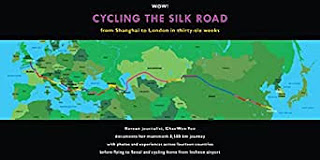
Cycling The Silk Road From Shanghai to London in Thirty-Six Weeks by Chaewon Yoo
Korean journalist, Chaewon (Eva) Yoo knows how to plan and plan big.
From June, 2018-January, 2019, Yoo traveled 8,567 kilometers along the Silk Road between Shanghai and London via bicycle. Her book, Cycling The Silk Road covers that journey. It's a short book but is illustrated with eye catching photogtaphs and described with engaging anecdotes and good advice for any interested traveler.
The Silk Road was a network of trade routes that connected the East and West to the 18th century when industrialization resulted in expansion in local productivity, Enlightenment values, and affordability for the masses. Silk, paper, and gunpowder were among the goods traded on the route. The Bubonic plague and other diseases were also spread creating worldwide pandemics. Yoo had a strong sense of history by traveling this route and an awareness of the modern world as she interacted the people who lived in the different countries.
Yoo's writings are brief, but she captures her experiences with warmth and humor. As she cycled through the asphalt, chalk powder, and dust in Yingshang, she was bemused to find a hotel that "looked like something from a Western movie or a desert in Arizona, U.S.A. when (she) was ten."
While in Italy, she recalls the friendly people that she met such as people performing in a Christmas play in traditional Provincial clothing. She also remembers the wine, most of it on tap. At a tavern, she only wanted half a liter, but the assistant filled her drink up to the brim.
There are various moments where Yoo was pleased to observe the nature around her. While rafting on a banana boat along the Dan River, Yoo lay on the boat and looked up at the sky, observing the clouds moving at different height.
Sometimes, her descriptions of nature uplifted what could have been a trying time. A difficult time of traveling uphill in the rain in Edessa, Greece became an eye catching moment when Yoo observed a 50 meter waterfall with strange rock formations made even more impressive by the rain.
Yoo brilliantly describes the homes and people. Her encounters with the residents are some of the highlights.
While in Yevlax, Azerbaijan, Yoo stayed in an old house with a cow barn. She described "every yard with a plastic cover and a sink to wash fruit, vegetables, and your teeth." She described the food and drink that was offered, such as tea with honey dipped berries served in intricately designed glass holders and sugar and candy inside glass containers.
While in Milan, Italy, Yoo experienced the kindness of strangers. Her bike was stolen so she purchased a secondhand one. The theft coincided with a seminar. Yoo posted her map and asked if anyone would attend. She met 15 people who wanted to hear her story.
In France, Yoo's hosts guided her to various events such as a hypnosis meeting, a January festival, and a potluck dance complete with accordion music. Yoo described France "as the most hospitable country on (her) trip."
The photographs in the book are filled with delectable food, lovely landscapes, and friendly people. They help provide images to Yoo's words. In fact, the short length makes the photos the main focus of the book so the Reader can experience the trip the way Yoo did.
Cycling The Silk Road is a wonderful account of a trip that is memorable in words and pictures.

The Girl With A Golden Heart by Achal Kumar
Achal Kumar's short novel, The Girl With A Golden Heart is a moving and spiritual story about a woman who finds justice through fighting an enemy and self-actualization by helping the people of her village.
In the beginning, we are introduced to Shivani, an Indian woman who is one of the ten women entrepreneurs in the country. She is powerful and dedicated and has a reputation for honor and philanthropy, particularly with her woman care trust which helps poor girls and women pursue education and gain self-employment in their own villages.
One night, she returns to her home village of Madhurpura and remembers the circumstances that led her to depart and pursue this life path.
Most of the book occurs in flashbacks when Shivani was a young woman. After a flood, Bharat, Shivani's impoverished father sought help from Baccha Babu, a criminal who behaves like a mob boss. He appoints thirty associates who engage in robbery, kidnapping, smuggling, and stealing land grants from poor farmers.
Using threats, manipulation, and intimidation, Babu ultimately ends up owning Bharat's farm.
Shivani is raped by one of Babu's loathsome sons. The rape leaves her traumatized especially since she can't report it to the police. (Babu owns the police.) The further escalation of violence and Babu's tighter grip on Madhurpura leads Shivani to lose some family members. She desires revenge against Baccha Babu, the man who stole her family's farm and destroyed her village, reputation, and family.
The book is impactful as Shivani and Babu engage in their one on one war. Babu appears ahead with his thugs, intimidation tactics, and money. However, Shivani's determination to bring him down, her clear-sightedness in researching and analyzing his business properties for weaknesses, and kindness in gaining allies rather than threatening them prove to be assets.
In Karmingar, she falls in love with Altaf, a man who helps her in her war against Babu. Even though she puts him in dangerous situations, she is concerned for his well being enough to sacrifice her life for him. Also, her business acumen helps put his family in a better financial situation than they were before.
She finds a sanctuary in the home of a progressive politician who empathizes with her plight and treats her like his own daughter. Ultimately, he helps mentor Shivani on her part towards a better future.
Babu's plans create division between Muslims and Hindus and results in more violence and economic trouble including for him. It's almost karmic justice that Shivani's kindness brings her forward while Babu's greed brings him down.
The Girl With A Golden Heart is a moving parable about someone who thrived despite great adversity. Then she used that privilege to help others in the same situation.

Not Him or Her Accepting and Loving My Non Binary Child Here's What You Should Know by Michelle Mann
Not Him or Her Accepting and Loving My Non Binary Child Here's What You Should Know by Michelle Mann is a good book that covers an important topic, how to raise a non binary child in a world that isn't always understanding.
Mann brings forward an important topic that has been very controversial lately. She humanizes the conflicts that many non binary children and their cisgendered parents go through within their own families and society. It also shows that the most important keys in such families are understanding and acceptance.
Parents and others can be inclusive by exhibiting proper characteristics like using the right preferred pronouns and defending the child in front of others.
The personal stories add a great touch to the book, especially in revealing the diversity of parents and their children's experiences. Various situations are covered, such as Simone having to take excess time to explain to a dental assistant that her child was nonbinary. They show how many of the simplest procedures could produce stress because of a judgemental society.
The book covers different age groups of non-binary children from early childhood, to teenagers, to adulthood. This counters the whole myth that "It's a phase. They'll outgrow it." Mann openly counters such myths and assumptions and how they contribute to a lack of acceptance within the child.
Not Him or Her shows how devaluing and demeaning those myths are and how gender identity is often influenced by parental and societal views that either encourage or demean the child.
Bottom line: If the child is old enough to recognize gender in society around them through toys, advertising, and adult perspective, then they are old enough to recognize the gender identity within themselves.
Not Him or Her reminds the Readers that the most important thing that they can do for their child is to understand, accept, and unconditionally love them.

The Numbers Game by Miles Watson
Miles Watson's novella, The Numbers Game is a tight, suspenseful, and character driven book about a WWII pilot with a unique gift that helps him survive but could overpower him.
Pilot Officer Maurice Mickelwhite is a mathematical genius. (Fun Fact: Maurice Mickelwhite is also the real name of actor Michael Caine. This appears to be a coincidence.)
His potential life of teaching calculus and algebra while living only for numbers is interrupted by the War. As he participates in the Battle of Britain, Maurice is able to use his talent for numbers to calculate the probabilities of survival, not only for him but the other members of his squadron. He knows the likelihood in which each pilot is going to die and is quite often right. Unfortunately, his own numbers are very close to coming up.
The Numbers Game is a brilliant character study about someone who goes to war but doesn't really want to.
Maurice is not exactly a flag waving jingoist ready to die for King and Country.
In fact, he had dreams of teaching math in school and being left to "his numbers, his tobacco, and his copy of the Journal of the London Mathematical Society.
Instead, he got the war."
Maurice wouldn't have minded using his mathematical genius to work in the London office but instead he is in the RAF as a pilot. (There was even a rumor that the RAF refused "as a matter of principle" to let anyone do anything that they showed an interest or talent in.)
This attitude is counter to the popular culture image that RAF's were brave heroic patriotic fliers with their own colorful language and daring to kick the German fighters out of England.
The Numbers Game shows that it was often made up of men who were there by force and would rather be doing anything else.
In many ways, Maurice is similar to characters like Yossarian from Catch 22 or Hawkeye Pierce in MASH. He gets through the madness of war by holding onto a sardonic sense of humor. He scoffs at those who insist that skill and abilities are factors in determining when someone is going to die. He thinks, "The numbers formed a path which you were doomed to walk-a path ending in a scaffold….The more you flew, the greater your risk of dying. It was just that simple."
Because of his certainty about death, Maurice has a very fatalistic behavior when his fellow pilots die. Even when others disagree with him and die anyway, he is neither grief stricken nor smug about being proven right. He is matter of fact because he saw it coming. He comes across as cold at times, but Maurice is almost like someone with precognitive abilities. They have a tremendous talent that allows them to see what is to come so they are not surprised when it happens. The events just confirm what he already knew.
Since the narrative is short, there isn't a whole lot of time to focus on Maurice's character but that adds to the suspense. The brief length allows tension to build as the pilots approach the end of the short novel and their lives. Every moment is quick as the Reader waits for the inevitable conclusion.
The Numbers Game reveals that war is not always defined by victories or ideologies, sometimes it is just a matter of numbers.

One Night in Paris: A City of Light Novella Book 1 by Juliette Sobanet
One Night in Paris, Juliette Sobanet's novella is an enchanting and lovely time travel fantasy with a brilliant sense of time and place.
Ella, a modern woman has had enough of her controlling and abusive husband, Dave. On her way to fly to Paris to visit her dying grandmother, she announces that she is leaving him and wants a divorce.
In Paris, Ella's grandmother shows her pictures from the 1920's of herself and her best friend, Lucie. She also gives her a request. She can't rest until Ella goes back and stops Lucie from marrying a man named Max and dying at the young age of 23. Grandma invites Ella to wear one of her flapper dresses and a brooch. After she puts them on, Ella finds herself transported to 1927 Paris and standing in a jazz club face to face with Grandma's friend, Lucie.
One of the most delightful traits that this novella possesses is its setting. 1927 Paris is depicted with all of the color and excitement that comes to be expected in a work about the Roaring Twenties. Ella is drawn by the excitement of jazz, free living, drinking, and the flapper lifestyle. It's exciting and gives her a chance to liberate herself from her modern worries and her unhappy marriage.
One Night in Paris is also a magical story about love and friendship. During her time in 1927, Ella encounters Leo, a charming American writer. Their night of passion and bliss could be an inspiration for Leo's writing. It's almost cliche for a brief romance to be set in Paris, but Sobanet makes it work. Ella and Leo's romance is touching without being overdone or maudlin. It's fairy tale like as Jazz Age Paris is almost a fantasy land capturing the romantic and fantastic elements of the people who dwell within it.
However, One Night in Paris is more than a love story. There is a strong theme of female friendship and empowerment. When she observes Lucie and her verbally abusive boyfriend, Ella thinks about her loveless marriage. She tries to rescue Lucie from her potential end and transforming from a happy go lucky independent free spirited woman to a timid frightened abused wife under her future husband's thumb.
In their quick meeting, Ella develops a bond with Lucie. She is at first confused about her assignment but willing to help Lucie to honor her grandmother's wishes. However, as she gets to know Lucie, she wants to protect her on her own. She wants to save Lucie from the same situation which she had just left.
One Night in Paris is a beautiful romantic novella of love and friendship. It's pure magic.

Wiccan: The Truth About Wicca and Witchcraft A Witch's Bible by Julia Steyson
Julia Steyson wrote the perfect beginner's book for those who are interested in Wicca.
The first part introduces the Reader to the history of Paganism. Steyson includes lists of various mythologies and figures that Readers might be interested in communicating with like Odin, Norse God of Wisdom or Venus, Roman Goddess of Love. It is a good introduction to show that Paganism has a long history to be understood and respected.
The second and third parts go into modern times and the various tools, rituals, and some sample spells for practicing Wiccans. The lists of elements, crystals, herbs, and other tools can be confusing but it is helpful to know what can be used for specific purposes. Of course, none of these things are necessary. The tools are meant as guides. Sometimes, all you need is your brain and a quiet time and place to think.
One of the most interesting parts are the seven paths of spiritual practice including coming into presence, awakening intention, sustaining awareness, transcending self interest, deepening remembrance, expressing gratitude and wonder, and radiating blessing. These paths show that Wicca can be a vibrant bright ever changing exchange between the WIccan and Spirit.
Wicca The Truth About Wicca and Witchcraft is a great start to a wonderful open minded, spiritual path.

