Showing posts with label China. Show all posts

Wednesday, December 24, 2025

Bird of Paradox and Other Tales by John Devlin; Short Stories of Love, Learning, and Diversity


Bird of Paradox and Other Tales by John Devlin; Short Stories of Love, Learning, and Diversity 

By Julie Sara Porter 

Bookworm Reviews 

Spoilers: Author John Devlin knows how to capture ordinary events and conversations and create plots and characters who are rich with development and meaning. 

In his anthology, Bird of Paradox and Other Tales, each tale began (in his words) as “scraps of overhead gossip, a scribbled note, or the kind of boast a man makes when all bets are off.” They are based on situations that Devlin experienced in places from rural Ireland to China and Vietnam where he taught English.

Some are moving, others are humorous. All deal with lack of communication and understanding that can be found between people of different cultures, backgrounds, and genders. They can be messy, rude, argumentative, short sighted, suspicious, unpredictable, ignorant, arrogant, lustful, regretful, hopeful, confident, and enthusiastic. Most of all very understandable and recognizable.

The best stories are:

Bird of Paradox”

In this case, bird does not refer to avian creatures in the sky. Instead it uses the British slang for women in the title, specifically one woman.

Barry is visiting his Aunt Lena, a visit that he is not looking forward to with good reason. Aunt Lena is a very contradictory and argumentative character 

This story is a witty character study of an aunt and nephew. Devlin’s gift of overhearing conversation is at play as Barry is in the Tube and train station. He is an observer watching other people and overhearing their stories, making this confined area even more crowded and claustrophobic with their conversations and faces. It's a place where you can't help but hear and see everyone and everything even if you aren't a part of it. 

Once Barry enters Lena's house, she is an antidote to the confinement of the Tubes. She is set apart from everyone around her. A woman who uses her bizarre anecdotes about life in a brothel, peculiarities like a fear of flies, and her opinions about everyone around her. She is an eccentric character who makes a magnetic but suffocating presence. You are fascinated by her but a little of her goes a long way.

It's an interesting dichotomy that the nephew exists to move silently around other people and the aunt is a force that commands others to move around her.

Lady Luck

This story demonstrates the difficulties of dating and how sometimes daters speak a different language. Walter is looking to get lucky and wants to have sex with the right woman. He places a personal ad specifically looking for Asian women. 

The women display various traits and behaviors but none are the right woman for him. One likes line dancing and has a large appetite. Another preferred a younger man. Another goes into a story about a troubled relationship with her late husband's brother. Another goes into long tangents about her ex never giving him a word edge wise. 

These dates are humorous exercises in futility as something is bound to go wrong leaving Walter perpetually alone. It's the kind of dating scene which relies on only a few minutes to decide whether or not they are compatible enough for a night let alone for a lifetime.

The Xmas Party

 This and the next story are part of a series involving Joe McKenna, a teacher at Great Wall English (GWE). The series deals with culture shock and diversity, interpersonal relationships in an academic setting, and finding common ground in a new place.

The first story involves Joe’s introduction to the staff at the GWE Christmas party in early November. Joe becomes involved in the various pairings and peccadillos of the teaching staff who could probably use some education.

Though the story is short, it packs a lot of character. From the awkward pairing of the pompous Ronnie and the mild mannered Sunny to a guy named Fat Freddy who inspires a lot of gossip, 

It's a very busy, noisy, and nosey environment. There's a constant stream of chatter, movement, and color to make the Reader feel like they are among this group having small talk and trying to sound interested in the tenth person that they have been introduced to. It can be fun but draining to put on a performance.

The politeness, talk, and overwhelming tedium is broken during a fight between a couple of the teachers. This fight is a reminder that even when people are together for a common goal whether it's teaching English or having a party, differences are bound to collide and if unchecked, tempers could flare.

Charlie Visits the Ancestral Temple

If “The Xmas Party” celebrated the noise and chatter, this story is a comparatively simpler affair. It involves Joe McKenna and his colleague, Charlie Bell visiting an ancestral temple.

The story is both mesmerizing and humorous. Charlie is captivated by a lion dance and the souvenir pigs. Joe however is concerned about the confusing directions and tourist crowds. 

People can look at one place and see something different: a sacred temple or an abandoned ruin. A colorful performance or a tourist trap. A piece of local culture or a tacky item. It depends on who is doing the looking.

Online Teaching in Lockdown

This story is part of a series involving an unnamed narrator (possibly Devlin himself) teaching in Vietnam, a difficult endeavor made even more so during a pandemic.

This story in particular involves The Narrator arriving in Vietnam just as COVID hits. Besides getting accustomed to a new country and school system, he also has to take a crash course in online education and Zoom.

The Narrator is bemused as the online interactions become increasingly personalized as people do chores and get undressed during them. Social media keeps people apart but also lends them a degree of intimacy that they never had before.

The students also exhibit various behaviors to deal with the stress of being out of a social environment. They get into fights, withdraw into themselves, behave recklessly. It shows that in times of stress, people will respond in a variety of ways. 

In using Zoom, the Narrator learns more about his students seeing sides that he would never have seen in a classroom.

Sidestreets of Saigon

This story does not deal with character interactions so much as it deals with setting. The Narrator describes his new neighborhood.

The Narrator is fascinated and somewhat overwhelmed by this new location with its temples, crowded streets, and ubiquitous sidestreets. It's easy to understand why he feels culture shock and out of place. It takes awhile to get used to the rhythm of a new location and that discombobulation can increase in a foreign country. 

The Narrator is a great observer focusing on the various people like a mother-daughter team of restauranteurs, an efficient female barber, a woman with two dogs, and others. The people give the streets color and life. They are captured going about their daily lives through someone else's words.

Lonely Hearts

Similar to “Lady Luck” this story covers dating but instead of a series of bad dates, this is a dialogue heavy focus on one bad date between an unnamed man and woman.

The two constantly talk to each other in brief question and answer format (“Do you work evenings or days.” “Evenings are sacred. I work days.”) It's practically like an interrogation or a tennis match where the two characters try to size and one up each other.  

The two characters go around in circles trying to search for something in common or at least some form of connection. As their conversations get deeper and more personal, it's clear that this is one relationship that is bound to fail.

The Wrong Gerri

This story might have the healthiest relationship in the entire anthology and it involves mistaken identity.

Tony returns from Japan where he taught English to reconnect with his former girlfriend, Gerri. He calls her number and gets Gerri, but it's another woman who doesn't remember Tony or any of the details that he mentions.

Unlike the other couples, they click well and are genuinely interested in what the other has to say. He compliments her cosy house. She teases him about Japanese women. They share unbelievable stories that leave one another amused, curious, and probably in disbelief, but at least captivated.

 The possibility of meeting again is certainly in the air. Even if she isn't the right Gerri, it's clear that she is the right woman.


Monday, July 24, 2023

Weekly Reader: Chasing Dragons: The True History of the Piasa Including Excerpts from To The Gates of Feng Tu Translated by Laurie Bonner-Nickless and Written by Mark Nickless and Laurie Bonner-Nickless; Fascinating Hidden History About Chinese Exploration of The Missouri-Illinois Area


Weekly Reader: Chasing Dragons: The True History of the Piasa Including Excerpts from To The Gates of Feng Tu Translated by Laurie Bonner-Nickless and Written by Mark Nickless and Laurie Bonner-Nickless; Fascinating Hidden History About Chinese Exploration of The Missouri-Illinois Area

By Julie Sara Porter

Bookworm Reviews


Spoilers: It's amazing how a long awaited discovery could lead to a huge change in the history that we were taught in school. Who would have thought that a journal entry about a strange painting would lead to potential proof that Chinese explorers may have arrived and visited the Midwest decades before Spanish and Italian European explorers found their way to the Americas?


That's exactly what is discussed in Chasing Dragons: The True History of the Piasa Including Excerpts from To The Gates of Feng Tu Translated by Laurie Bonner-Nickless and Written by Mark Nickless and Laurie Bonner-Nickless. This is a fascinating study of a history that has been long hidden but now needs to be brought to light.


The search began when Mark Nickless read an article in his local newspaper, The Jefferson County Leader, that described a painting of two monsters called The Piasa on the bluff overlooking the Mississippi River near St. Louis and discovered by Jesuit explorer Jacques Marquette in 1673. The painting's origin was a mystery to Marquette and to the Native Americans who traveled with him. 


Marquette described it as "large as a calf..horns on their heads like those of a deer…red eyes, a beard like a tiger's, a face somewhat like a man's, a body covered in scales and so long a tail that it winds all around the body, passing above the head and going back between the legs, ending in a fish's tail. Green, red, and black are the three colors composing the picture." Sounds very draconian doesn't it?


This article stirred a memory inside Nickless who saw a Book Talk on C-SPAN by Gavin Menzies about his book, 1421: The Year China Discovered America, detailing explorers from the Ming Chinese Dynasty that used a massive fleet of ships to map the world including North America. 


According to Menzies's book, the Emperor Zhu Di appointed Zheng He as admiral of his fleet. Zheng He was commanded in 1406 to explore the entire world. With a fleet of two hundred 480 foot long ships.and 90 foot auxiliaries, crewed by 27,000 sailors and soldiers, Zheng He traveled around the world seven times in twenty-eight years. During these voyages, Menzies wrote that Zheng He traveled from the southern tip of Greenland to Antarctica, even voyaging to the Americas in 1420-1421. They mapped the various voyages. Unfortunately, the Ming government issued an edict prohibiting all voyages. The ships were destroyed and all maps, charts, and records were gathered and burned.


Putting these two events together, Nickless and his wife, Laurie Bonner-Nickless, researched the description of The Piasa and realized that Marquette's description matched that of two dragons, two Chinese dragons. Did members of Zheng He's fleet find their way to the Missouri-Illinois area? The Nicklesses suggest that it's possible.


The Nicklesses compared Marquette's description to other literary depictions of Chinese dragons and the details matched perfectly. That particular pictograph style was known to Chinese artists but not by any local Native American tribe. (In fact, Marquette's Native American fellow travelers were as stunned and frightened as he was about the picture) nor did the creatures resemble any told in local myth and legends.  It is also worth noting that in Chinese legends, dragons are depicted as wise and benevolent creatures that represent good fortune and luck and are seen as symbols of the Emperor. The colors green, red, and black are also symbolic of the Chinese emperor.


Okay, one picture may not mean anything. It could be a coincidence, but upon further investigation, it was revealed that banker George M. Doherty discovered jade items in Piasa Creek in the 1880's. In 1924, banker E.W. Payne said that even a superficial examination of the Piasa could tell that they were dragons. 


To add to the mystery, an acquaintance of the Nicklesses who spoke Mandarin Chinese and several Native American languages interpreted the word "Piasa" to mean "little men." Considering many of the men of the local tribes, like the Osage, were over six feet tall, the word may not have been a description of the creatures but of the shorter men who painted them.

Not to mention that petroglyphs have been found in Jefferson County, Missouri which strongly resemble Chinese characters. One appears to spell out "Love is here." (Another is of particular interest to me because it is five miles north of Hillsboro which is near my hometown of De Soto, Missouri).

Another interesting link is Bonner-Nickless' discovery in Luo Mao Deng's writings of a walled city of people with peculiar head dresses that could be a description of the city of Cahokia and its tribe, a tribe that later disappeared leaving behind their legendary mounds. All of this is mostly circumstantial, but certainly paints a picture that Chinese explorers not only may have made their way to Missouri and Illinois but encountered the local natives and were determined to leave their mark.


However, not everyone agreed with the assessment that the Piasa was a dragon or of the Chinese influence. In 1836, Professor John Russell offered a different view of the painting, a view that unfortunately stuck in local consciousness way more than Marquette's original description did. His entries contained much exaggeration and moral teachings for a religious audience. Instead of two wingless dragons, he described a large winged bird that devoured humans. 

He made up a legend in which the bird would pounce upon human beings leaving skeletons in its cave until a chief sacrificed himself to end the monster's tyranny. In other words, Russell's description transformed a picture of what appeared to be a benevolent Asian dragon into a fearsome European draconian-like creature courtesy of cultural and religious assumptions about the magical mythical creatures.


It didn't help that the painting had been assaulted by gunfire many times and then the limestone bluff in which the painting was quarried for housing material. So no way of verifying the creature's original appearance. So the location of the original painting was thought lost. 

In 1925, a new version of the Piasa was painted above the Great River Road in Alton copied from a catalog illustration and no doubt inspired by Russell's version of the creature. 

It was this description of the Piasa that carried over into cryptozoological legends and was repeated by various sources (including a YA unexplained phenomena book that I previously read). 


Chasing Dragons is interesting from a historical and academic perspective as it describes the various steps that researchers take to find answers to their questions. It's a mystery or a treasure hunt in which the prize is a greater knowledge and understanding about our world. 

The Nicklesses did extensive research by scouting the area and reading local accounts to learn that the location of the original Piasa painting was in Elsah, Illinois,10.9 miles north of the redone Alton one. Bonner-Nickless located a guidebook from the 19th century of Elsah that clearly had "Piasa Bluffs" marked.

 This actually fits the timing since Elsah was founded in 1847 and structures made from limestone quarried beginning in 1852-1853, the same time that the original Piasa painting was destroyed to become a limestone quarry. This information, combined with a clear copy of "Der Piasa Felsen" or "The Piasa Rock", an 1847 illustration by Henry Lewis, provided the clues that the Nicklesses needed to determine the real subject and location of the Piasa painting.


The Nicklesses' book is an interesting account of how art and culture is changed, altered, interpreted, and sadly sometimes destroyed by those around them. This is particularly telling in the story of what happened to the original Piasa painting and why the history of Chinese explorers and their dragon friend has been largely unexamined.


One reason that Chinese exploration of the Americas in general and the origins of the Piasa specifically are not well known is because of the Ming Dynasty's destruction of information about Zheng He's voyages. Nickless writes, "If not for this unimaginable disaster, Zheng He's costly achievement would have enabled China to dominate the globe. So far no one can be certain why the Ming government did this. It is a mystery. Because of this ill-advised decision, China then vanished as a player from the world stage for half a millennium."


Thankfully, not every item was destroyed. One was a map dated 1428 showing part of North America's East Coast including the Gulf of St. Lawrence. This route would have taken Zheng He's fleet from Lake Michigan to Alton with a portage in the Illinois River which flows to the Mississippi River right where the original Piasa was located. The other possibility is that they made their way to the Caribbean, through the Gulf of Mexico into the Mississippi River. There is a strong Chinese presence in the Caribbean to suggest this. Marquette's description of the Piasa is the final piece of the puzzle that the fleet made it to the Midwest and to the Missouri-Illinois area.


Another reason that the Piasa and its artist/explorers are not more well known can be summarized in two unfortunate words: "Manifest Destiny" and two more words: "James Semple." Semple was an attorney, a Brigadier General in the Blackhawk War, an Illinois Supreme Court judge, confidant of Abraham Lincoln, and eventual U.S. Senator. He was also a true believer in expanding the U.S. territory to the Pacific Coast and the concept of Manifest Destiny.


 Semple took part in American expansion to Oregon and returned to Illinois in 1847 where the Piasa would have been seen by many, particularly on the steamboats which went up and down the Mississippi River every day, and had already appeared in Lewis' painting. With an already inflamed over exaggerated sense of "White Superiority" and fueled by the anti-Chinese immigration rhetoric of the day, the thought of visual evidence that the Chinese arrived in the area before Europeans was something that Semple would not tolerate.


In 1852, Semple purchased a riverfront property which he later named Elsah. He then advertised that if anyone could build a house, they would then get the deed. There was plenty of limestone that was quarried and other materials for the taking. The practically free land and housing was tempting. The people of Elsah got their land and homes. Semple got property, money, and changed history and the original Piasa was no more, painted over, forgotten, repainted, and remade. 


However, the story doesn't end there. Thanks to new historical emphasis on Zheng He's voyages, as well as books and articles like Menzies' and those written by the Nicklesses (including a history conference in Nanjing, China to commemorate the 600th anniversary of the beginning Zheng He's journeys), the history of the Chinese explorers and the remainders of their arrivals are finally being recognized and known to the world.


The Piasa and its creators would have long been buried in history if not for the curiosity, persistence, and research provided by scholars, historians, artists, authors, and particularly a determined couple from Jefferson County, Missouri who asked questions, looked up information, and peered through sources to find answers. Truly, It is a historical journey of draconian proportions.


Friday, May 13, 2022

New Book Alert: The Old Dragon's Head by Justin Newland; Enchanting Magical Historical Fantasy About Ancient China


 New Book Alert: The Old Dragon's Head by Justin Newland; Enchanting Magical Historical Fantasy About Ancient China

By Julie Sara Porter

Bookworm Reviews


Spoilers: In my review of the Enchanted World, one of the books that I reviewed was Dragons. One of the strongest themes in that book was the difference in how dragons were perceived in the West than they were in the East. In Europe, they were seen as malevolent monstrosities, something to be feared, avoided, fought, and ultimately slain. In Asia, they were seen as benevolent beings who brought good luck and fortune to those who encountered them. They were powerful  but were treated with respect by the humans observing them. Dragons were even considered symbols of the Emperor and often put on carvings and designs. That respect for dragons is in play in Justin Newland's enchanting historical fantasy set in Ancient China, The Old Dragon's Head.


The protagonist is Bolin, a young man working on the Eastern End of the Great Wall of China. Supposedly, the wall is protected by the Great Dragon, Lao Lang. In fact, Bolin's crew are standing on the head. 

However, Bolin has other things to concern himself with than a dragon that no one has ever seen. The army just sent a Mongolian Army into retreat. Unfortunately, the victory was short-lived after the death of the emperor. His grandson seized the throne and the young emperor's uncle formed a rebellion against him.

Bolin's life is just about to get more complicated. He begins seeing visions of ghosts and events before they happen. Many call it having ying-yang eyes, the ability to see beyond. Whatever it is, it terrifies Bolin and he isn't sure that he wants to be a part of it.

There are also other concerns. There is Prince Zhau Di, the emperor's uncle, who wants to find a dragon pearl so he can claim leadership and control over Lao Lang. The magistrate has been let go for another one who is a spy for the Mongols. A jailer has a preference for toture and doesn't mind using it on anyone regardless of guilt or innocence. Luli runs the local po office (not post office), where people come to her to communicate with spirits. Her predictions are becoming more dire. There is a palpable tension and everyone is waiting in fear and apprehension for war or revolution or both. Perhaps, it's time for Lao Lang to make his appearance. 


This book is excellent in character and setting. The history and mythology of China are well written and interwoven perfectly. The Imperial conflicts, the war against the Mongols, and the construction of the Great Wall are revealed. The Reader gets a full sense of how hard the laborers worked and the difficulties that they were up against while building this awesome architectural project. Worker's deaths were all too common and it was very easy to obtain another worker. 

There are also some fascinating yet terrifying looks at the judicial system. A person could get arrested and face the worst kinds of punishments including whippings, beatings, and various forms of torture.  The passages are particularly frightening, such as when Luli's mentally disabled son is taken from her and abused. With families fighting  for the Imperial throne, sadistic jailers, avenging armies, and magistrates playing both sides, there's no point in being afraid of dragons. Humans are much scarier.


Newland also brings elements of fantasy usually within the characters. Bolin's Yin-yang eyes make him stand out. The Chinese concept of Yin-yang refers to doubles: dark and light, male and female, solid and liquid, things that are complete opposites but exist side by side, interdependent and reliant on each other. Bolin is able to see both the natural and supernatural world. Those eyes show him many things that he needs to see but not always what he wants. 


One of his first visions is to see his father plummeting to his death. There are many times when he doubts his visions and even his sanity. Luli tells him that his abilities could lead to great things. Bolin responds by running in the opposite direction and not wanting to be a part of it. He doesn't want to stand out. He just wants to be one of the workers. Instead the Yin-yang eyes are calling him for a higher purpose, one that makes him an outsider.


The one who understands Bolin's position is the best character in the book: Luli. Some come to her for advice to remove spirits or have their destinies foretold, but just as many fear or distrust her. She is a single mother with a mentally disabled son. The people treat them like outsiders and when things go bad, it's all too easy to use them as convenient scapegoats.


The final third deals with a lot of fighting, revelations, and a few twists. Some of it is a bit hard to follow. But Newland expertly weaves the opposites of history and fantasy and makes one terrific whole.


Monday, December 27, 2021

New Book Alert The Long Game: An Amy Radigan Thriller by Ian Conner; Complex and Multi Plotted Political Thriller Closes Outstanding Reading Year


New Book Alert: The Long Game: An Amy Radigan Thriller by Ian Conner; Complex and Multi Plotted Political Thriller Closes Outstanding Reading Year

By Julie Sara Porter

Bookworm Reviews


Spoilers: There are some authors that their very name tells you what book that they are going to write. Even in my experience with my blog, I have found that authors have preferences for certain genres and tropes. I see Kathy Ann Trueman or Catherine Dove's name and I know that I will read an Epic Fantasy or Regency Romance. Tom Vater will lead us straight to a Mystery by a European detective in an Asian location. Lee Matthew Goldberg will take you through a trippy Horror or Science Fiction with lots of drug use involved. Melissa Muldoon and Kit Sergeant will take a trip through Historical Fiction with strong confident female leads that are artists and spies respectively. Rob Santana will be counted on for a novel with a modern setting, plenty of biting satire,social commentary, and desperate not always likeable characters doing desperate things. Sawney Hatton is going to take his Readers through a bloody short trip into Supernatural Horror.

Yes, some authors leave their fingerprints all over certain books so Readers can recognize those fingerprints instantly. Then there are authors who are like chameleons. Each book is different from the others and they have next to nothing in common.


Take Ian Conner for example. His novel, Dark Maiden is a Supernatural Horror set in the limited setting of Pequabuck Lake in Nollesemic Village, Maine. It is set throughout four centuries and involves a sinister lake creature that haunts the village, especially two families that it considers its enemies.


Conner's next book, The Long Game: An Amy Radigan Thriller could not be more different from Skadegamutc Ghost Witch if it tried. Instead of supernatural horror, it is a political thriller set in the real world and involves real world issues like environmentalism, censorship, sexuality, hate crimes, xenophobia, and corruption. Instead of being contained in one rural setting,The Long Game goes all over the world from California, to Washington DC, to China, to Vietnam and so on. With such a wide setting, there are many plots that involve many characters unlike Skadegamutc Ghost Witch which features a much more limited cast that take on this demonic entity. Long Game is complex and multiplotted and handles itself well with interesting characters and strong political themes.


The plot or rather plots in The Long Game are rather intricate and varied but I will do my best to summarize (or as Indigo Montoya said, "I will explain. No it's too long, I'd better sum up").

 Along the California coast, Captain James Quinn's ship was sabotaged, nearly killing him. It's followed by another explosion along the San Onofre harbor. It may have had something to do with a sample of water outside the nearby San Onofre Nuclear Generating Station or SONGS that Quinn gathered and had analyzed. This water is revealed to be contaminated and toxic. The mysterious explosions, contamination, and sabotage are being investigated by intrepid journalist, Amy Radigan.

Meanwhile, journalist Amir Husseffgi is reported missing in Saudi Arabia. Even though the Saudi Prince denies any involvement and U.S. President Colin Rockwell swears that he won't investigate it, video footage of Husseffgi's murder and beheading in the name of the prince is leaked. It is revealed Rockwell has been currying favor with the Saudis and doesn't want to break those connections.

On the South China Sea, two U.S. Naval ships are attacked leaving several sailors dead. Vice President Susan Ralston wants to confront the Chinese government but Rockwell refuses. He has been having an affair with the Chinese ambassador, Xin Zhui, and is soon to be caught literally with his pants down. All of this leads to an impeachment investigation towards Rockwell and his affiliations with the Chinese and Saudi Arabian governments.

During their separate investigations into these events, both Ralston and Radigan and their friends and family are viciously attacked. Ralston in a deliberate plane crash and Radigan by an attempted hit. Don't worry, Reader, it all makes sense and everything is revealed to be connected to everything else, eventually.


Connervbrilliantly balances all of these plots rather well. He also has a handle on using them as mirrors for real life occurrences. The most obvious is the murder of Amir Husseffgi based on the real life assassination of journalist Jamal Khashoggi. Colin Rockwell's obstreperous misogynistic racist attitude is all too similar to a certain real life ex President. A smart calm independent female Vice President is certainly based on the real life Kamala Harris. They are groundbreaking female Vice President for different reasons. (First African American and Indian American for Harris and first LGBT for Ralston.) Also, the alternate universe scenario reveals that Harris herself, after getting the top job, was fatally wounded during an assassination attempt by a Trump supporter claiming to "stop the steal." (If that doesn't recall a certain insurrection by a multitude of Trumpers egged on by their cult leader, I don't know what does.)


As with many books that I have reviewed these past couple of years have proven, what we once thought existed only in fiction is no longer out of the realm of reality. It would have been ludicrous to assume that followers of a President would believe his claims that the election process was fraudulent and even after several investigations proved that there was no corruption, they still rioted at the Capitol verbally and prepared to attack the former Vice President and several Congress members. Not to mention that even though they had literally millions of eyewitnesses watching it in real time, said former President and his supporters still had people insisting that it was a spontaneous gathering of harmless tourists (or that it was an insidious plot by Antifa or BLM to make Trump look bad, even though they did a good enough job on their own).

After that, it is definitely not impossible to believe that a future President could openly conspire to assassinate his Vice President or pull a gun on those who are charging him with crimes. The only way the Long Game could be more synced to real time is if a 24 hours news station's correspondents could insist that Rockwell's impeachment investigation was a conspiracy and that Ralston secretly worked for the Deep State.

The Long Game is only a couple of steps off from what really happened and what still could happen.


With such a twisted plot, one would suspect that Conner would have trouble juggling such a large cast of characters but he excels at that as well. Many have outstanding moments. There is Randall, a bodyguard hired to protect Radigan and her girlfriend, Lily Pham. Randall is a real softie as he reveals in his dialogues with Twizzler, a troubled teen turned sidekick and informant.  

Lily also proves her mettle when she gets the better of a hitman. He thinks it will be an easy job and she immediately proves him wrong. Both Lily and Ralston's girlfriend, Carol Lee are the definite "Ride or Die" supportive spouses, ready to stand by the women in their lives, no matter what.

Amanda Rockwell, the First Lady, holds a press conference to put her husband in his place and uses the First Couple version of "Not tonight, Couch Boy." Meanwhile, Xin Zhui could be seen as a femme fatale but also has enough insight to take part in Rockwell's downfall. Then there's the President that Readers will love to hate, or just hate, Colin Rockwell himself. He takes Donald Trump's worst qualities up to eleven (if such a thing were possible) and thankfully gets his commeuppance. 


By far the standout characters are Amy Radigan and Susan Ralston. They are similar in many ways. Both are dedicated in their fields of journalism and politics respectively and both are lesbians in loving committed relationships. They also are born survivors who are able to get through touch situations such as surviving assassination attempts and conspiracies.

Their investigative techniques are very different and are respective of their positions in life. Radigan has to contend with slamming doors, voice mails, and receptionists giving her the run around. These are hurdles that Ralston's title and influence can open. Radigan however has the passion, idealism, and integrity that Ralston lost in her years of compromise and working in business and politics. It's not a surprise that when  the two women meet, they become friends. Radigan is the woman that Ralston once was and Ralston is the woman that Radigan could become. The two women bring out the best in each other and are able to see through the many tangled strands in this intricate spider web.


The Long Game is a brilliant complex novel that proves Conner has a great handle on plots and characters. He proved that she can write Horror and now has proven that he can write Political Thriller. His book is a great final well written word on 2021.


Tuesday, October 12, 2021

New Book Alert: Saratoga (The Illustrated Colonials Book 3) by Tom Durwood; YA Series About Enlightened Young Royals Has A Satisfying Ending


 New Book Alert: Saratoga (The Illustrated Colonials Book 3) by Tom Durwood; YA Series About Enlightened Young Royals Ends On A High Note

By Julie Sara Porter

Bookworm Reviews

Spoilers: So this is it.

We come to the last final volume in Tom Durwood's The Illustrated Colonials series. We reach the final adventures of Jaiyi Mei Ying, Prince Mahmoud, Sheyndil, Leo, Will O., And Gilbert du Motier and it ends on a high note. While the first book, The Pact is my personal favorite, Saratoga brings the characters forward allowing them to adapt and accept their roles in a new world. The teens are now ready to leave their youth, ascend into adulthood, and become the leaders that they were trained to become. 

The plot mostly focuses on Prince Mahmoud who apparently ties with Mei Ying as Durwood's favorite characters in the ensemble (since they receive the lion's share of attention in both this and Home Fronts). 

Mahmoud travels to the future United States to deliver documents of alliance and finance to Gilbert who is busy filling the role history and popular culture (such as a famous Tony Award winning Broadway hip hop musical) have bestowed upon him as "America's favorite fighting Frenchman," the Marquis De Lafayette.

 After enduring a very uncomfortable sea voyage Mahmoud encounters loyalist spy, Gentleman Johnny Burgoyne, a meeting that ends with him being kidnapped. Mahmoud manages to make his escape and is caught in the middle of the Battles of Beckman's Mill and Saratoga.

Meanwhile, Leo's military strategy and Will's business contacts end up becoming quite fruitful for them as people come directly to Will to work for him. Unfortunately, on his way to travel to Boston Harbor to join his buddies, Leo is threatened with a duel and subsequently betrayed. Sheyndil and Mei Ying take their lessons to the home front to battle local opposing forces with the same drive and dedication that their male counterparts possess.

It would be nice to see the Enlightenment Six reunite perhaps on American soil. One of the gifts that the first volume had was the ensemble cast. These were kids from different countries with diverse backgrounds, ethnicities, economic status, goals, and roles in society. Each one grew and adapted, becoming a close group of friends and better individuals. It would have been a nice payoff to see them reunite physically, perhaps in the United States during the American Revolution or back in Alsace-Lorraine after the war ended. Instead, they spend the book apart and only a few see each other again.

However, it also makes sense that Durwood would do this approach. It gives a chance for the characters to make individual contributions, using their various talents and contributions in their own way. Many of those contributions are made within their own countries but lead to the ultimate goal of uniting each other. They also are able to evolve into leaders on their own merits.

The one who benefited the most from this approach was certainly Mahmoud. I was not kidding when I speculated that he is probably Durwood's favorite character. He certainly has shown the most development in the three volumes.

In the first book, The Pact, he was a spoiled arrogant Prince certain of his own place as a royal and put everyone around him into little boxes of nobles, slaves, etc. Through his education, he learned different philosophies and looked at a larger world around him.

The second book , Home Fronts, featured Mahmoud verbally sparring with his family in Ottoman Turkey when he realizes that he has changed but they have not. His philosophies are spoken and theoretical. They are not yet practiced.

Saratoga is the completion of Mahmoud's journey. He is finally able to physically put what he learned into practice and become an accomplished freedom fighter. Throughout this book, he is able to use his strength and intelligence to outfight and outwit his enemies. He proves to be clever at escaping from captivity and active as he fights in battle. He has clearly changed a lot and it is wonderful watching him grow so much into a hero.

The other reason that it makes sense for the characters to have their stories come to an end on their own is to emphasize the international concerns of The Illustrated Colonials series as a whole. While part of the series is set in North America and the covers show an emphasis on the American Revolution, the series expands on that by taking on international concerns in France, China, Russia, The Netherlands, Germany, and Turkey later expanding into The United States and Africa. This is very important as it shows oppression and tyranny wears many faces and that there are many people who suffered under it. There were also people who fought against it and shared the same values of equality and loyalty. This isn't just an American struggle, it's a global struggle.

Of course, as with many final volumes, there is great loss. Some characters don't make it, leaving many tears from friends, family, and a few from the Reader. Some ascend and become well known in their own right. Years later, one character acknowledges the other's roles in the world that they helped to create. It is a very satisfactying ending as the character is addressing a college of young people, thereby recognizing the leadership that their friends took and passing the mantle to the next generation. 

Saratoga is a terrific ending to a wonderful YA series. Hopefully, young people will discover and read it, love the characters and setting, and maybe just learn a thing or two about friendship and equality along the way. 


Friday, October 1, 2021

Lit List Short Reviews; Cycling The Silk Road: From Shanghai to London in Thirty-Six Weeks by Chaewon Yoo, The Girl With A Golden Heart by Achal Kumar, Not Him or Her Accepting and Loving My Non Binary Child Here's What You Should Know by Michelle Mann, The Numbers Game by Miles Watson, One Night in Paris A City of Light Novella Book 1 by Juliette Sobanet, Wiccan The Truth About Wicca and Witchcraft A Witch's Bible by Julia Steyson

 Lit List Short Reviews; Cycling The Silk Road: From Shanghai to London in Thirty-Six Weeks by Chaewon Yoo, The Girl With A Golden Heart by Achal Kumar, Not Him or Her Accepting and Loving My Non Binary Child Here's What You Should Know by Michelle Mann, The Numbers Game by Miles Watson, One Night in Paris A City of Light Novella Book 1 by Juliette Sobanet, Wiccan The Truth About Wicca and Witchcraft A Witch's Bible by Julia Steyson

By Julie Sara Porter

Bookworm Reviews

Cycling The Silk Road From Shanghai to London in Thirty-Six Weeks by Chaewon Yoo


Korean journalist, Chaewon (Eva) Yoo knows how to plan and plan big.

From June, 2018-January, 2019, Yoo traveled 8,567 kilometers along the Silk Road between Shanghai and London via bicycle. Her book, Cycling The Silk Road covers that journey. It's a short book but is illustrated with eye catching photogtaphs and described with engaging anecdotes and good advice for any interested traveler.


The Silk Road was a network of trade routes that connected the East and West to the 18th century when industrialization resulted in expansion in local productivity, Enlightenment values, and affordability for the masses. Silk, paper, and gunpowder were among the goods traded on the route. The Bubonic plague and other diseases were also spread creating worldwide pandemics. Yoo had a strong sense of history by traveling this route and an awareness of the modern world as she interacted the people who lived in the different countries.


Yoo's writings are brief, but she captures her experiences with warmth and humor. As she cycled through the asphalt, chalk powder, and dust in Yingshang, she was bemused to find a hotel that "looked like something from a Western movie or a desert in Arizona, U.S.A. when (she) was ten."

While in Italy, she recalls the friendly people that she met such as people performing in a Christmas play in traditional Provincial clothing. She also remembers the wine, most of it on tap. At a tavern, she only wanted half a liter, but the assistant filled her drink up to the brim.


There are various moments where Yoo was pleased to observe the nature around her. While rafting on a banana boat along the Dan River, Yoo lay on the boat and looked up at the sky, observing the clouds moving at different height.

Sometimes, her descriptions of nature uplifted what could have been a trying time. A difficult time of traveling uphill in the rain in Edessa, Greece became an eye catching moment when Yoo observed a 50 meter waterfall with strange rock formations made even more impressive by the rain.


Yoo brilliantly describes the homes and people. Her encounters with the residents are some of the highlights.

While in Yevlax, Azerbaijan, Yoo stayed in an old house with a cow barn. She described "every yard with a plastic cover and a sink to wash fruit, vegetables, and your teeth." She described the food and drink that was offered, such as tea with honey dipped berries served in intricately designed glass holders and sugar and candy inside glass containers.


While in Milan, Italy, Yoo experienced the kindness of strangers. Her bike was stolen so she purchased a secondhand one. The theft coincided with a seminar. Yoo posted her map and asked if anyone would attend. She met 15 people who wanted to hear her story.

In France, Yoo's hosts guided her to various events such as a hypnosis meeting, a January festival, and a potluck dance complete with accordion music. Yoo described France "as the most hospitable country on (her) trip."


The photographs in the book are filled with delectable food, lovely landscapes, and friendly people. They help provide images to Yoo's words. In fact, the short length makes the photos the main focus of the book so the Reader can experience the trip the way Yoo did.


 Cycling The Silk Road is a wonderful account of a trip that is memorable in words and pictures.


The Girl With A Golden Heart by Achal Kumar


Achal Kumar's short novel, The Girl With A Golden Heart is a moving and spiritual story about a woman who finds justice through fighting an enemy and self-actualization by helping the people of her village.


In the beginning, we are introduced to Shivani, an Indian woman who is one of the ten women entrepreneurs in the country. She is powerful and dedicated and has a reputation for honor and philanthropy, particularly with her woman care trust which helps poor girls and women pursue education and gain self-employment in their own villages.

One night, she returns to her home village of Madhurpura and remembers the circumstances that led her to depart and pursue this life path.


Most of the book occurs in flashbacks when Shivani was a young woman. After a flood, Bharat, Shivani's impoverished father sought help from Baccha Babu, a criminal who behaves like a mob boss. He appoints thirty associates who engage in robbery, kidnapping, smuggling, and stealing land grants from poor farmers. 

Using threats, manipulation, and intimidation, Babu ultimately ends up owning Bharat's farm. 

Shivani is raped by one of Babu's loathsome sons. The rape leaves her traumatized especially since she can't report it to the police. (Babu owns the police.) The further escalation of violence and Babu's tighter grip on Madhurpura leads Shivani to lose some family members. She desires revenge against Baccha Babu, the man who stole her family's farm and destroyed her village, reputation, and family.


The book is impactful as Shivani and Babu engage in their one on one war. Babu appears ahead with his thugs, intimidation tactics, and money. However, Shivani's determination to bring him down, her clear-sightedness in researching and analyzing his business properties for weaknesses, and kindness in gaining allies rather than threatening them prove to be assets.


In Karmingar, she falls in love with Altaf, a man who helps her in her war against Babu. Even though she puts him in dangerous situations, she is concerned for his well being enough to sacrifice her life for him. Also, her business acumen helps put his family in a better financial situation than they were before.

She finds a sanctuary in the home of a progressive politician who empathizes with her plight and treats her like his own daughter. Ultimately, he helps mentor Shivani on her part towards a better future.

Babu's plans create division between Muslims and Hindus and results in more violence and economic trouble including for him. It's almost karmic justice that Shivani's kindness brings her forward while Babu's greed brings him down.


The Girl With A Golden Heart is a moving parable about someone who thrived despite great adversity. Then she used that privilege to help others in the same situation.


Not Him or Her Accepting and Loving My Non Binary Child Here's What You Should Know by Michelle Mann


Not Him or Her Accepting and Loving My Non Binary Child Here's What You Should Know by Michelle Mann is a good book that covers an important topic, how to raise a non binary child in a world that isn't always understanding.


Mann brings forward an important topic that has been very controversial lately. She humanizes the conflicts that many non binary children and their cisgendered parents go through within their own families and society. It also shows that the most important keys in such families are understanding and acceptance.

Parents and others can be inclusive by exhibiting proper characteristics like using the right preferred pronouns and defending the child in front of others.


 The personal stories add a great touch to the book, especially in revealing the diversity of parents and their children's experiences. Various situations are covered, such as Simone having to take excess time to explain to a dental assistant that her child was nonbinary. They show how many of the simplest procedures could produce stress because of a judgemental society.


The book covers different age groups of non-binary children from early childhood, to teenagers, to adulthood. This counters the whole myth that "It's a phase. They'll outgrow it." Mann openly counters such myths and assumptions and how they contribute to a lack of acceptance within the child.


Not Him or Her shows how devaluing and demeaning those myths are and how gender identity is often influenced by parental and societal views that either encourage or demean the child.

Bottom line: If the child is old enough to recognize gender in society around them through toys, advertising, and adult perspective, then they are old enough to recognize the gender identity within themselves.


Not Him or Her reminds the Readers that the most important thing that they can do for their child is to understand, accept, and unconditionally love them.


The Numbers Game by Miles Watson


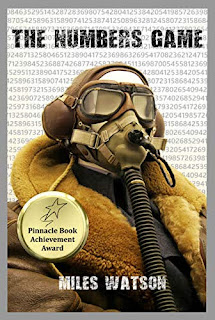
Miles Watson's novella, The Numbers Game is a tight, suspenseful, and character driven book about a WWII pilot with a unique gift that helps him survive but could overpower him.


Pilot Officer Maurice Mickelwhite is a mathematical genius. (Fun Fact: Maurice Mickelwhite is also the real name of actor Michael Caine. This appears to be a coincidence.)

His potential life of teaching calculus and algebra while living only for numbers is interrupted by the War. As he participates in the Battle of Britain, Maurice is able to use his talent for numbers to calculate the probabilities of survival, not only for him but the other members of his squadron. He knows the likelihood in which each pilot is going to die and is quite often right. Unfortunately, his own numbers are very close to coming up.


The Numbers Game is a brilliant character study about someone who goes to war but doesn't really want to.

Maurice is not exactly a flag waving jingoist ready to die for King and Country. 

In fact, he had dreams of teaching math in school and being left to "his numbers, his tobacco, and his copy of the Journal of the London Mathematical Society.

Instead, he got the war."

Maurice wouldn't have minded using his mathematical genius to work in the London office but instead he is in the RAF as a pilot. (There was even a rumor that the RAF refused "as a matter of principle" to let anyone do anything that they showed an interest or talent in.) 

This attitude is counter to the popular culture image that RAF's were brave heroic patriotic fliers with their own colorful language and daring to kick the German fighters out of England. 

The Numbers Game shows that it was often made up of men who were there by force and would rather be doing anything else. 


In many ways, Maurice is similar to characters like Yossarian from Catch 22 or Hawkeye Pierce in MASH. He gets through the madness of war by holding onto a sardonic sense of humor. He scoffs at those who insist that skill and abilities are factors in determining when someone is going to die. He thinks, "The numbers formed a path which you were doomed to walk-a path ending in a scaffold….The more you flew, the greater your risk of dying. It was just that simple."


Because of his certainty about death, Maurice has a very fatalistic behavior when his fellow pilots die. Even when others disagree with him and die anyway, he is neither grief stricken nor smug about being proven right. He is matter of fact because he saw it coming. He comes across as cold at times, but Maurice is almost like someone with precognitive abilities. They have a tremendous talent that allows them to see what is to come so they are not surprised when it happens. The events just confirm what he already knew. 


Since the narrative is short, there isn't a whole lot of time to focus on Maurice's character but that adds to the suspense. The brief length allows tension to build as the pilots approach the end of the short novel and their lives. Every moment is quick as the Reader waits for the inevitable conclusion.


The Numbers Game reveals that war is not always defined by victories or ideologies, sometimes it is just a matter of numbers.


One Night in Paris: A City of Light Novella Book 1 by Juliette Sobanet


One Night in Paris, Juliette Sobanet's novella is an enchanting and lovely time travel fantasy with a brilliant sense of time and place.


Ella, a modern woman has had enough of her controlling and abusive husband, Dave. On her way to fly to Paris to visit her dying grandmother, she announces that she is leaving him and wants a divorce.

In Paris, Ella's grandmother shows her pictures from the 1920's of herself and her best friend, Lucie. She also gives her a request. She can't rest until Ella goes back and stops Lucie from marrying a man named Max and dying at the young age of 23. Grandma invites Ella to wear one of her flapper dresses and a brooch. After she puts them on, Ella finds herself transported to 1927 Paris and standing in a jazz club face to face with Grandma's friend, Lucie.


One of the most delightful traits that this novella possesses is its setting. 1927 Paris is depicted with all of the color and excitement that comes to be expected in a work about the Roaring Twenties. Ella is drawn by the excitement of jazz, free living, drinking, and the flapper lifestyle. It's exciting and gives her a chance to liberate herself from her modern worries and her unhappy marriage. 


One Night in Paris is also a magical story about love and friendship. During her time in 1927, Ella encounters Leo, a charming American writer. Their night of passion and bliss could be an inspiration for Leo's writing. It's almost cliche for a brief romance to be set in Paris, but Sobanet makes it work. Ella and Leo's romance is touching without being overdone or maudlin. It's fairy tale like as Jazz Age Paris is almost a fantasy land capturing the romantic and fantastic elements of the people who dwell within it.


However, One Night in Paris is more than a love story. There is a strong theme of female friendship and empowerment. When she observes Lucie and her verbally abusive boyfriend, Ella thinks about her loveless marriage. She tries to rescue Lucie from her potential end and transforming from a happy go lucky independent free spirited woman to a timid frightened abused wife under her future husband's thumb. 

In their quick meeting, Ella develops a bond with Lucie. She is at first confused about her assignment but willing to help Lucie to honor her grandmother's wishes. However, as she gets to know Lucie, she wants to protect her on her own. She wants to save Lucie from the same situation which she had just left.


One Night in Paris is a beautiful romantic novella of love and friendship. It's pure magic.


Wiccan: The Truth About Wicca and Witchcraft A Witch's Bible by Julia Steyson


Julia Steyson wrote the perfect beginner's book for those who are interested in Wicca.

The first part introduces the Reader to the history of Paganism. Steyson includes lists of various mythologies and figures that Readers might be interested in communicating with like Odin, Norse God of Wisdom or Venus, Roman Goddess of Love. It is a good introduction to show that Paganism has a long history to be understood and respected.


The second and third parts go into modern times and the various tools, rituals, and some sample spells for practicing Wiccans. The lists of elements, crystals, herbs, and other tools can be confusing but it is helpful to know what can be used for specific purposes. Of course, none of these things are necessary. The tools are meant as guides. Sometimes, all you need is your brain and a quiet time and place to think.


One of the most interesting parts are the seven paths of spiritual practice including coming into presence, awakening intention, sustaining awareness, transcending self interest, deepening remembrance, expressing gratitude and wonder, and radiating blessing. These paths show that Wicca can be a vibrant bright ever changing exchange between the WIccan and Spirit. 


Wicca The Truth About Wicca and Witchcraft is a great start to a wonderful open minded, spiritual path.


Saturday, August 28, 2021

Weekly Reader: The Illustrated Colonials: The Pact Book One by Tom Durwood; Beautifully Illustrated Strong Character Driven Start Of Series About 18th Century International Teens Getting Involved in America's Revolution


 Weekly Reader: The Illustrated Colonials: The Pact Book One by Tom Durwood; Beautifully Illustrated Strong Character Driven Start Of Series About 18th Century International Teens Getting Involved in America's Revolution

By Julie Sara Porter

Bookworm Reviews


Spoilers: Tom Durwood's book, Kid Lit: An Introduction to Children's Literature,  dissects children's literature and explores the deeper meaning in many of our pop culture touchstones such as Harry Potter, His Dark Materials, Superhero comics, Pixar and Disney animated films, Afrofuturistic novels, early adventure novels and comics like Tarzan and Tintin, and the Star Wars franchise. 

My personal theory is in putting the book together and researching various works and essays, Durwood thought "I could do that. I could write my own children's book series with a plucky group of young adventurers. Stronger themes that could be hidden inside the plot and the readers will appreciate the characters and adventures and afterwards may understand something." 

Well I for one am glad that Durwood accepted the challenge. 


Durwood's wrote The Illustrated Colonials, an alternate history in which six young people from different countries in 1775 are selected to attend The School for Young Monarchs in Alsace Lorraine. Inspired by the Enlightenment theories of liberty, freedom, and equality, the students learn to fight against tyranny and see each other as equals. They are to take those lessons and fight for them when they return to their home countries.

The first book, The Pact, is a beautifully illustrated strong character driven novel that introduces us to the six protagonists, the school, and the conflicts that result between the students and others. The themes of liberty, equality, community, and cooperative partnership are also revealed in The Pact.


The group of six are a diverse bunch, from different countries and backgrounds, all with different reasons for registering at the school. They are: 

Jiayi Mei Ying, from China-The daughter of a prominent family that manages the waters, lands, and operations on the Yunhe Canal territories. She arrogantly lords over the family's subordinates. Her high handedness causes her grandfather to disinherit her. The local teacher in Zhengzhou begins teaching phrases like "common sense" and "no taxation without representation." Mei Ying is uncertain but figures that she couldn't do worse than attend the School For Young Monarchs and maybe become a better leader.

Gilbert Marie John Paul Joseph Roche Yves Gilbert du Motier, Chevalier of the Noailles Dragoons  from France-Gilbert's name will be recognizable to Revolutionary War buffs. He is from a noble aristocratic family and is  a dragoon fighting in battle. Despite his wealth and privilege, he is not blind to the troubles faced by the poor. He is also inspired by the revolutionary ideals and his own sense of adventure to attend the School For Young Monarchs.

Sheyndil Czerzinsky AKA Shay from Russia-A former peasant, Shay is interested in new technologies and planting seeds for agricultural production. Her interests in technology and agriculture are shared in higher places particularly by Catherine the Great, Empress of Russia. Catherine decides to patronage the young woman so she can represent Russia at the school.

Leo Krummensee-Grabmaler from Brandenburg-Leo is the son of the Heir of Hohenzollem, Lesser Magistrate of the Margraviate of Brandenburg. The arrogant noble and soldier is informed that a petition is being circulated where he and his sister could lose their titles and estates. Leo's sister plans on marrying while Leo decides to lay low in Alsace Lorraine and attend the School.

Prince Mahmoud Mustafahn Hasan Husameddin Cezayrili, third son of the sixth wife of Sultan Abdulhamid Caliph of all Muslims, Secular Ruler from the Ottoman Empire, Turkey- Mahmoud is the spoiled overweight son of the Sultan. His mother is tired of the boy having everything handed to him. She wants him to study at the School to prepare for his eventual role as Sultan.

Will Oldenbarnevelt from the Netherlands-Will is the youngest son of a prosperous merchant. Since his father declared that Will's older brother, Casper, will inherit the family business, Will gets nothing. Will is well read, shy, and a strategic chess master, his mother points out. She suggests that Will at least get a smaller trade route in the Bosporus. Before that though he has to attend a certain school.


By their powers combined, the six set out to become heroes in their day, sort of an 18th century version of the Planeteers Minus Captain Planet. (Maybe more like Captain Liberty?)  At the school, the students learn about the Enlightenment philosophies and start practicing them in their daily lives. They begin to work together and use their talents in fighting, engineering, agriculture, scholarly research, finance, and leadership to aid each other. 

There are a few times when they are challenged by opposing forces such as former enemies from their countries and soldiers who represent forces who  are opposed to this idea of togetherness. The Super Six learn to fight alongside each other as a team putting those values that they have been taught to practical use.


Of course fighting as a team doesn't mean that they will always get along. Personality conflicts abound almost as soon as they meet. It begins right away when Mei Ying defends Will from a bit of physical joshing by Gilbert. She gives the Frenchman a serious kick earning respect from Will, Leo, Sheyndil, and oddly enough Gilbert.

The students get into plenty of arguments such as when Sheyndil, Leo, and Gilbert fight about what it actually means to be a royal and who in their group deserves that moniker. 

Mahmoud and Gilbert get into a particularly fierce disagreement about whether servants do or should respect their employers and what rights that they have. These conflicts show how the characters were raised and how their upbringing shaped them so far. However, the fact that they are at that school and able to listen to each other shows that they can reject some of those limiting beliefs from their childhoods and evolve and grow as people.

It is genuinely heartwarming when this group accepts each other's friendship to the point that they make a pact to always aid when one is in trouble. They would send for the others and they would come running.


I would be remiss if I did not mention the beautiful illustrations. Various art forms including portraits, photographs, and prints went into this work. The names of the illustrators themselves including Timothee Mathon, Sahab Sewarty, Jessica Taylor, and Mai Nguyen et al fit two pages. Many authors stick with one illustrator, but Durwood uses several. This fits into the overall narrative of the book. 

While the story is set in an alternate historical continuity, it is also treated like a real event. One of the students actually was a real person. So like any famous people from another time, there may be several pictorial depictions of them. After all, how many times has George Washington or Benjamin Franklin been captured in art?

The various pictures show the six characters and their world as one that could have happened.


Through the students' relationship in The Pact, we learn how history could have been different. Maybe from that, the alternate present could be one of equality, cooperation, and understanding. This book perhaps could be a guide on turning that alternate possibility into a reality in this timeline.