Showing posts with label Drug addiction. Show all posts

Wednesday, June 19, 2024

How We Were Before by Jonathan Kravetz; Anatomy of a Murder, Origins, and Aftereffects


 How We Were Before by Jonathan Kravetz; Anatomy of a Murder, Origins, and Aftereffects 


By Julie Sara Porter 

Bookworm Reviews 


Spoilers: In my review of Dennis Lehane’s Mystic River, I referred to it as a “whatdunnit,” as compared to a “whodunnit.” Instead of figuring out who committed a murder, the emphasis is on the murder and its aftereffects. We may already know who did the murder. Instead the real question is “something violent happened so what are you going to do about it?” 

Jonathan Kravetz’s anthologized novel, How We Were Before is another great example of a “whatdunnit.” It is a Crime Novel with a murder at the beginning and deals with how it impacted multiple characters. 


Elderly couple, Pete and Tara  Blythe, are murdered by Billy Lawson who is arrested, tried, and found guilty. The aftereffects are felt by multiple characters in different chapters. 

The present situations involving the characters alternate with flashbacks that focus on the pair’s lives from their meeting to their deaths at Billy’s hands. 


The narrative challenges the Reader with its complex and intricate storytelling and characterization. It is a testament to Kravetz’s writing skills that he gathers such a large cast and makes each character rich and complete. In each chapter, he recalls the murder and its effect in ways that are fresh and unique every time instead of becoming tedious and repetitive. To accomplish this, he pulls some interesting narrative techniques to engage the Reader in the character’s conflicts stemming from the murder and within their own lives. 


A perfect example of the complexities in this book can be found within the chapters that involve Police Chief Tim Pearson. His dereliction of duty and inactivity towards Billy Lawson’s escalating behavior ended up becoming key factors in the eventual murder. He is later revealed to have had a more personal involvement in the Blythe’s lives and later did and said the wrong thing to the wrong person.The fallout is seen through the eyes of his young son, Louis as Pearson engages in alcoholism and abuse to cope with his own failings and remorse. Louis’ home life becomes more tempestuous to the point that he steals a gun for protection. It takes several chapters and other characters’ points of view before Pearson’s story ends in a violent but inevitable conclusion. 


The aftermath of the murder and public trial are effectively felt by those most prominently affected by it: The Blythe’s daughters, Shelby and Samantha and Billy’s mother, Peggy. Shelby tries to overcome her aching loneliness and grief by finding romantic partners and trying to escape into romantic fantasies. She also begins writing to Billy to understand her own feelings towards him and maybe potentially find a path to forgiveness. Samantha’s journey is much more aggressive and upfront. She tries to maintain a public facade while her marriage is crumbling. She and her husband Carlton are filled with buried rage and simmering resentment that threatens to explode into more violence. 


Peggy Lawson’s story is no less tragic. As the mother of the perpetrator, she has to not only contend with knowing about and fearing her son’s behavior but also being painted as the villain in the story. She withdraws into alcoholism and seclusion only to find that seclusion broken in the worst way by someone who takes advantage of her fragile state. 


The book alternates the present with the past by showing important moments in Pete and Tara’s lives. We see their idyllic meeting and early courtship. We see their troubled marriage and complicated relationship with their daughters and of course we see their inevitable demise. Kravetz writes them as complicated multilayered people filled with many flaws and virtues whose loss becomes even more felt the more that the Reader gets to know them. 


Similarly we also peer into Billy’s character. The book does not absolve him of the murders and he certainly deserves punishment but he is also written as multilayered and thought provoking as the rest of the cast. He is seen as a very troubled young man with very few advantages and an addiction that he can’t control. The moments where he shows his vulnerabilities and self-awareness reveal him as someone who knows what he did and accepts that he will spend the rest of his life paying for it. 


This book doesn’t just feature the people who are immediately involved in either the Blythe’s or Billy’s lives. There are many characters who have a peripheral involvement in the murder but still have their lives greatly affected and altered by it. Vice Principal Zachary Rivers desperately tries to save the life of Barry, one of Billy’s high school friends. Ballet instructor Wendy Watson’s relationships with her students, particularly Shelby Blythe, propel her into a troubled romance. Janey, a homeless woman, develops an unhealthy obsession with Samantha Blythe. Adam Liu, Louis Pearson’s best friend has a front row seat to the implosion of his friend’s family. Matt Foster and Emilia Stone, two reporters covering the murder and trial, get up close and personal to some of the participants and so on.


How We Were Before shows that two lives weren’t the only ones destroyed that night. The murder carried a ripple effect that impacted the lives of many others and will continue to do so for a long time to come.


Wednesday, December 14, 2022

New Book Alert: The White Pavilion by Ruth Fox; World Building and Protagonist Elevate This Science Fiction Novel to Brilliance


New Book Alert: The White Pavilion by Ruth Fox; World Building and Protagonist Elevate This Science Fiction Novel to Brilliance 

By Julie Sara Porter

Bookworm Reviews 


Spoilers: When I read a Science Fiction novel, especially one set on another planet, I look for how it approaches world building. How different this new world is from Earth. Whether the characters are unique in appearance, personalities, society, culture or whether they are just Earthlings on another planet. Science Fiction is large in technology and science, as compared to Fantasy. But there must also be a strong sense of creativity and imagination from the authors as much as (and I would argue more) than from Fantasy.

Some recent examples of Science Fiction that I read with brilliant world building include: What Branches Grow by T.S. Beier, Merchants of Knowledge and Magic by Erika McCorkle, Moon Deeds by Palmer Pickering, The Descendants by Destiny Hawkins, The Angela Hardwicke Science Fiction Mysteries by Russ Colchamiro, Cooper's Ridge by Ian Conner, Dusk Upon Elysium by Tamel Wino, Fancy Fanciful Fantasticality by Francessca Bella, Fearghus Academy by I.O. Scheffer, The Love of the Tayanmi by T.A. McLaughlin, Hades Forest by Simon Elson, Salvage Trouble Black Ocean Galaxy Outlaws Mission by J.D. Morin, The Sun Casts No Shadow by Mark Richardson, Pride of Ashna by Emmanuel W. Arriaga, One If: A Virago Fantasy by Carol R. Allan, Suzy Spitfire and the Snake Eyes of Venus by Joe Canzano, Demons of Time by Varun Sayal, Canvas of Time by Amelie Pimont, Bound by P.L. Sullivan, Centricity by Nathaniel Henderson, Orange City by Lee Matthew Goldberg, VanWest by Kenneth Thomas, Behind Blue Eyes by Anna Mocikat, Life is Big by Kiki Denis, Star Wolf by L.A. Frederick, Star Wars: Tales From the Mos Eisley Cantina Edited by Kevin J. Anderson, The Girl Who Found The Sun by Matthew S. Cox, Multiverse Investigations Unit by R.E. McLean, Joshua N'Gon: Last Prince of Alkebulahn by Anthony Hewitt, Dragon's Destiny by Carl Cota-Robles, Zodiac States by William Stalker, Sapphire and Planet Zero by Christina Blake, The Thursday Next Series by Jasper Fforde, Slaughterhouse Five by Kurt Vonnegut, Agents of the Nevermind by Tantra Besko, World Shaken: Guardians of the Zodiac by J.J. Excelsior, Cloud Atlas by David Mitchell, Imajica by Clive Barker, A Wrinkle in Time by Madeleine L'Engle, and The Martian Chronicles and other works by Ray Bradbury.


To that illustrious list, I include The White Pavilion by Ruth Fox. This is a top notch Science Fiction novel which captures a planet whose people pay homage to Earth cultures but make their own. This book also has well thought characters, particularly the protagonist to dwell in it.


Imre is a dancer from the highly regarded White Pavilion in Tierra Major. Tierra Mejor is a planet that is populated by people whose ancestors fled what is now called Old Earth. That was many centuries ago so the Tierrans are far removed from their former lives on Earth and have their own way of thinking and doing things.


One of the most intriguing aspects of Tierra Mejor is how its residents capture the Earthling culture but up to a point. Imre lives in a society that seems to be based on Medieval and Renaissance Italy and Spain. There is a monarchy that has the main power like La Reina, the ill queen whose son, Thaniel, is the Principe Regente in all but name. They speak Spanish and English in tribute to their Earthling ancestry. There is a strong appreciation and acceptance for art and music to the point that dancers like Imre are highly revered and invited to perform certain dances representing different stages in life and the planet's history. There are some people who live a monastic lifestyle in which they transcribe history, pray to their religion, and have tremendous hold over the royal family.


Besides Medieval and Renaissance eras, we find that Tierra Mejor also captures the Victorian Era, specifically Steampunk. There are automatons but aren't very sophisticated like many robots and AIs found in most Science Fiction works. Instead they are more like clunky clockwork mechanicals that serve as drivers, clerks, and servants.

Speaking of clockwork, the whole planet runs on clockwork, literally. Instead of being a naturally made planet, it is operated by a giant wheel built inside the core. So Tierra Mejor is a human made mechanical planet from creation. People help run the wheel and work in an assembly run manner reminiscent of steelworkers, sweatshop workers, and coal miners during the Industrial Era.


Fascinatingly enough, Tierra history doesn't go further than Victorian in appearance. Perhaps, they realized the toll Progress took on Old Earth that they don't want to go any farther involved in science and technology. They want to choose a stopping point and try not to destroy this world as the old one was.


If the White Pavilion ever becomes a movie, it would be fascinating to see how the Production Design team would capture this society that is sort of like Earth but not quite. The architecture, costumes, and lighting would be a challenge to mesh these time periods together at once. Imre for example, at first could dress in flowing elegant feminine Renaissance era gowns at first then slowly as her situation changes, she wears more strident industrial androgynous Steampunk style trousers and shirtwaists. It would be a fascinating thought about how this world could be visualized.


The Tierrans have a unique sense of religion. Because the planet is run by a clockwork wheel, everyone tries to keep their world going in a strict formation called the Pattern. They worship the Pattern. Everyone works in a timely manner and knows their place in society. Everything has to run smoothly and the Pattern cannot be disrupted in any way.

If it is, then disaster could erupt.

Imre learns this during what should be the most important moment of her life. She and her fellow dancers perform the Dance of a Thousand Steps, a heavily mythologized and idealized version of how people traveled from Old Earth to Tierra Mejor. Imre has the coveted role of the Crane which took the people from the old world to the new (more than likely a starship). Unfortunately, during her performance Imre stumbles, falls, and hurts her ankle.


The fall is not her fault (in fact we later find out it was deliberate on someone else's part), but that doesn't matter. As far as everyone around her is concerned, she broke the Pattern. Subsequent earthquakes and a pandemic is enough evidence for them. Imre then finds herself a pariah and then just as quickly taken to the palace to be a dancer/courtesan for the Principe Regente.


The world of Tierra Mejor is a fascinating creation and what makes it even stronger is the characterization. Imre in particular is a standout. When she is first introduced, she is happily situated in her role as a lead dancer. She was sent to the Pavilion at a young age leaving behind a drug addicted prostitute mother. During her time at the Pavilion, she finds her talent. She works hard at her dancing and understands that the dances that she and her colleagues perform symbolize important life events like birth, life, love, and death. It's a form of entertainment for the audience and also an artistic way of revealing their society's culture. 


Imre also finds a surrogate family. She refers to her instructor in maternal terms and her fellow dancers as sisters. 

That makes her rejection after her fall all that more upsetting. Instead of supporting her, assuring her that we all make mistakes, or encouraging her to try again, they turn their backs on her. They don't visit her as she is recovering. Her instructor is satisfied to get rid of her.

Imre goes through so much suffering and maturity that later when she is later given the opportunity to return to the Pavilion, she sees her former sisters as silly, uninformed, and thoughtless and knows that she would never fit in with them.


Imre's time away from the White Pavilion, particularly at the Palace and even more so at the Wheel enlightens her and opens her eyes to how this world is really run. She finds love and lust with a few characters that arouse her sexually or reaches her emotionally. She goes to the library and studies the history of Old Earth and the creation of Tierra Mejor. 

She comes in close contact with the interior workings of Tierra Mejor and what really goes on inside the world that thought she knew. 


Most importantly, Imre gets to know Thaniel, the Regent. She sees him as a young man trapped by his role of being a figurehead but not being able to do anything proactive to help anyone. He is sheltered and protected by relatives and advisors which act like they have his best interest in mind, but really are looking out for themselves. 

Imre sees Thaniel not as a symbol or a figurehead but a human being, a friend, and later a love interest. 

Imre's relationship with Thaniel and the knowledge that she obtains outside of the White Pavilion causes her to see Tierra Mejor as it really is and realize that there are people who will manipulate the Pattern for their own desires.


The White Pavilion is elevated into sheer brilliance because of its memorable protagonist and world building.


Thursday, May 20, 2021

Weekly Reader: Little Blue Eyes by Rob Santana; Little Baby Brings Big Trouble and Tough Decisions


Weekly Reader: Little Blue Eyes by Rob Santana; Little Baby Brings Big Trouble and Tough Decisions

By Julie Sara Porter

Bookworm Reviews


Spoilers: Rob Santana has made a career of writing about people making rash and reckless decisions, usually in moments of desperation. His previous work, The Oscar Goes To and his latest work, Little Blue Eyes feature people that do things like appear in adult films, steal and withhold information, deal and buy drugs, and practically kidnap children. These decisions are often abhorrent and create problems for the characters. But Santana writes these characters with a lot of understanding so that the Reader sees that they were made not from intended malice but by other forces like poverty, addiction, revenge, envy, and simple desperation to improve one's life no matter the circumstances. They act and don't stop to consider the consequences. It's later that the consequences come back to haunt them.


That is the situation faced by Elena Mitchell, protagonist of Little Blue Eyes. Elena has been recently let go from her position at a bank even though a lesser qualified woman was promoted in her place. (The Latina/African-American Elena suspects racism since the blond woman not only cannot do the job but can't speak Spanish very well which is a requirement and in which Elena is fluent.) Worse, her sister Terry is moving in with her soon-to-be-fiance and they are having a baby. Terry rubs further salt on the wound of Elena's life that she is unable to bear children, a painful reminder for her.

 While on a fruitless job search, she hears a cry from behind a dumpster. A small Caucasian baby boy with blue eyes stares at her. Elena picks up the little one and falls into confusion and love. 

After some indecision and contacting the wrong people, Elena decides to raise the baby herself and name him Todd. That is slightly complicated when she arouses suspicion as a biracial woman carrying a white baby in an economically disadvantaged neighborhood of mostly black and Latino residents. (She tells them that she is babysitting.) Of course it isn't too long before the police, a dangerous baby broker and his team, and Todd's less-than-stellar birth parents are on the case and Elena finds herself in a world of trouble.


There are conflicts within the book and unfortunately many of them are caused by Elena's actions. The first thing that Elena does is take Todd to a hospital which is good and makes sense. But the second thing that she does is unexplainable. Instead of contacting any authority figures, adoption agency, or family services, she calls a baby broker, Carlos Ruiz. Not only that but she tells him that the baby is white, a prime catch for baby brokers, since they can sell Caucasian infants to wealthy white families and make a profit. True, Elena changes her mind and grows attached to Baby Todd. The book also makes it clear that she is not a cruel heartless person. She is driven by poverty and possibly mistrust of the police or other official services. She sees no reasonable way out. The worst that she can be thought of is reckless and thoughtless. However, her calling Carlos leads to worse complications that could have been easily resolved if she hadn't called him.


To be fair, Elena may make rash and hasty decisions but once she starts actually caring for Todd, she holds his best interests at heart. She protects him as a lioness would protect her cub, often bringing him along on job interviews, or introducing him to friends and family. She properly feeds, cleans up after, and nurtures the little one and protects him from danger. (Granted, danger she put him in herself.) When things get too dangerous, she makes a very tough decision out of love. It becomes clear that contacting Carlos was a mistake, but it doesn't diminish her love for Todd or her role in his life.


By contrast, Todd's birth parents, Sharon and Nick, make plenty of mistakes and are proven to be inferior parents. They are a pair of addicts who are more interested in their next fix than caring for a baby.

The whole reason that Todd is behind a dumpster in the first place is because Nick coerced Sharon into abandoning him at the hospital waiting room and he was left outside by accident. When they finally regret their decision to give Todd up, they harass and stalk people to get answers. (This is not only foolish but unnecessary since it's later revealed that Sharon's uncle is a cop and they could have just asked him. Though they probably didn't want him to know about their addiction or their shameful neglect of Todd.) There is a lot of covert racism as they harass Elena's neighbors and mistrust them on sight.


While they are more self centered than Elena, Nick and Sharon are also seen as driven and desperate people. They are certainly more unlikeable than Elena but they are seen as people who are so bound to their addictions that they put their own lives and that of their child at risk. Even when they search for Todd, it seems to be less out of love and more out of desperation. There is a moment though that the Reader encounters the hurting and suffering would inside and how they regret the path that their addictions led them on as they realize that they could have been a happy family, but were unable to be.


 Little Blue Eyes becomes a clear choice between a baby's addicted seriously messed up birth parents or an unemployed troubled potential adopted mother. While all three have their flaws, only one actually has the baby's best interest in mind and proves to be the real loving parent.


Friday, May 22, 2020

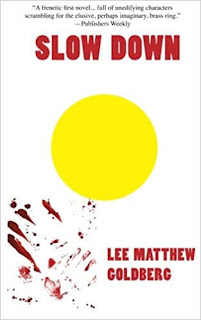
Weekly Reader: Slow Down by Lee Matthew Goldberg; A Dark Drug Fueled Thriller About Fame, Ambition, Addiction, and Selling One's Soul


Weekly Reader: Slow Down by Lee Matthew Goldberg; A Dark Drug Fueled Thriller About Fame, Ambition, Addiction, and Selling One's Soul

By Julie Sara Porter

Bookworm Reviews


Spoilers: Lee Matthew Goldberg's novel, Slow Down, could be considered The Millennial Version of What Makes Sammy Run? In Budd Schulberg's 1941 novel/expose of the Golden Age of Hollywood, Sammy Glick, a shifty opportunistic copyboy steals screenplays, connives against rivals, beds and discards mistresses, and makes life a living Hell for those around him in his climb to the top of the Hollywood scene, only to find his success hollow and empty when there are others waiting to replace and destroy him.

Slow Down has characters that could be considered Sammy Glick's protegees. Only they have benefits from such modern tools as technology and drug use to their advantage.

Slow Down is a dark comedy of a book that seems like one long drug fueled trip into the excesses of fame, ambition, and selling one's soul to those who are better players in the ruthless game of instant celebrity.

Noah Spaeth, is a young ambitious writer with a big mouth who comes from a rich dysfunctional Central Park West family. In his early 20's, Noah has a troubled relationship with just about everyone in his life: from his constantly traveling parents, to his screwed up brother, to his spoiled sister, to his bitchy boss, to his long train of weird friends and clingy ex-girlfriends. Just recently he got fired from his job because he accidentally sent an insulting email to his boss. No problem, Noah says, he has time to focus on his writing and to finally get that one success story which will propel him to gaining that reputation as a bright young genius. Okay, he only has a margin of a idea for his novel with only a few scenes written and one character named Nina. But he is certain his time will come.

Noah's former girlfriend, aspiring actress, Nevie invites him to a swank party and introduces him to experimental filmmaker, Dominick Bambach. Dominick's previous success was an erotic thriller, Detached. His latest project is even more off the beaten path. It is Slow Down and will feature him only giving his actors a small semblance of a scene and have them react as he films. He wants to film their reactions and natural behaviors injecting realism to his production. Noah is fascinated with the project and would like to be mentored by Dominick, at least long enough to give his own career a boost.

Unfortunately, that fascination turns to revulsion when Noah is introduced to a drug called Fast, which produces psychotic after effects. He also encounters a few young actresses, working on Dominick's film, who have similar tattoos of a yellow circle and become insanely violent whenever that tattoo is touched. Could Dominick be so obsessed with filming a natural performance that he is willing to drug his actresses to get it?

Noah also has further questions when he encounters Dominick's wife, Isadora who seduces the young writer and questions her husband's writing and directing ability. Noah's ambitious drive increases and he plots to steal Dominick's movie and his wife.


Slow Down is one ironic title. Things move along at a regular pace, then something happens that speeds up the action to a dizzying pace. There are moments where you can't be sure if what you are reading is really happening, if Noah (or the Reader) is hallucinating, or if the action is completely fictional and instead just the product of a writer finally creating his magnum opus.

The drug scenes are terrifying because of the uncertainty. Many of the women go from bright, ambitious, attractive, budding starlets to animalistic homicidal maniacs, almost as a symbol of the control that Dominick and Noah have over them. Noah also goes through various drug trips with Fast that further confuses things and puts him at Dominick's mercy while he believes that he is in control.

When the yellow circle reappears in Noah's life, it is almost like a warning of terrifying lines that shouldn't be crossed.


The biggest drug in the book is not Fast, but ambition and it hits Noah hard. The more Noah becomes entangled with Dominick and his movie, the more he wants Dominick's life. He entertains notions of the lengths that he will go to pursue his goals from stealing the film to murdering Dominick and marrying Isadora. He beds Nevie and various other actresses to act on his frustrations of his wasted life. He conspires with Isadora so that he can replace Dominick by her side and obtain the filmmaker's reputation via osmosis.

Noah's ambitions are cold, but Noah is more like the little kid who robs cash registers in convenience stores then says, "I'm really bad, honest!" in front of a violent street gang who are ready to commit mass murder. Noah never realizes that he is playing in the big leagues until he reads the final draft of Slow Down and realizes that he is a figurative character just moving along in other people's schemes. He followed someone else's script and was controlled by other's machinations and his own ambitions.

Slow Down is a dark book that gets to the center of various kinds of addiction, not just drugs but fame and success as well. Noah started out brilliant, but angry that he was not put in a position for others to recognize that talent and drive. In the end, he may want fame but the fame is only temporary and once the excitement is done, he wants more. More success on his own terms, more money, a penthouse apartment, more dates, more beautiful mistresses, more drugs, more everything. The price when it comes down is that Noah is no longer in control, still the neurotic insecure mess that he always was, not directing and instead playing out other people's scripts.

Wednesday, December 4, 2019

New Book Alert: The Bipolar Addict: Drinks, Drugs, Delirium, and Why Sober is the New Cool by Connor Bezane; Memoir Explores The Difficulties Of Drug Addiction and Mental Illness


New Book Alert: The Bipolar Addict: Drinks, Drugs, Delirium, and Why Sober is the New Cool by Connor Bezane; Memoir Explores The Difficulties Of Drug Addiction and Mental Illness


By Julie Sara Porter

Bookworm Reviews

Spoilers: One thing that I learned in reviewing various drug addiction and mental illness memoirs for this blog and other sources is that every experience is different or at least their books are different. Some focus on the causes and why they turned to drugs or realized that they thought differently than others. Others are more interested in the wider scope of not only their addiction and illness, but the crisis in general giving statistics on when the crisis started and what can be done to curtail it. Other authors take a middle road by telling their stories and those of others to reveal that addiction and mental illness isn't just their problem. It could be anybody's.

Connor Bezane takes that approach in his book, The Bipolar Addict: Drinks, Drugs, Delirium and Why Sober is the New Cool. He tells the story of his addiction and experience with Bipolar Disorder. Then he turns his book outward and explores the journeys of five other people who had experiences with addiction and mental illness. In this approach, he reveals that this wasn't just a struggle that affected him. Others were also in similar situations making their struggles more personal and at the same time widening the scope to affect the society at large.

Bezane writes that his first experimentation with alcohol and drugs in 2009 was different from other “normies” (the term that he and his fellow mentally ill colleagues refer to the “chemically stable members of society.”). Amphetamines and Barbiturates produced the exact opposite effects from each other: “Uppers brought (him) down and downers brought (him) up.” While crack cocaine usually produces euphoria, Bezane likened it to a soft core lullaby. Heroin also had a soothing effect on him. Bezane admitted that he took them to shut off his problems or so he thought.

The difference didn't just lay within how the drugs affected Bezane, but what caused his addiction.
Unlike other mental illness/addiction memoirs like Erin Khar's Strung Out: One Last Hit and Other Lies I Told Myself, there weren't any specific triggers such as parental divorce, early sexual abuse, or low self-esteem which led to Bezane’s descent. Mental illness and addiction can appear to anyone and don't always need the trauma of a troubled childhood to affect somebody and Bezane's book shows that.

Bezane's childhood was a relatively peaceful supportive one in a middle class neighborhood near Lincoln Park, North Chicago with a PR Executive mother and a stay-at-home father. Most of his memories centered around music like dancing to Michael Jackson's Thriller or watching Flashdance and Footloose with his sister. He liked to dance and even though he was teased at school for being a nerd, the kids admired his skills on the dance floor.

His idyllic childhood was marred when an encounter with a bullying teacher led Bezane to his first anxiety attack. He also began to panic when it came to taking tests resulting in him being unable to complete the track for the advanced class even though he would have aced it.

Depression afflicted Bezane when he received a D on an essay on Great Expectations. Many other incidents throughout his school career increased his depression when in his younger years, he felt more resilient towards disappointment.
Bezane's early experience with anxiety shows how those emotions can erupt instantly and even a word of criticism from a teacher, bullying from students or authority figures, or nervousness on a test can lead to years of crippling tension and self-doubt.

Bezane describes the symptoms of mental illness perfectly. For example, he describes the physical symptoms of anxiety such as the tight constricted chest, sweating palms, and labored breathing clearly. The psychological symptoms such as replaying a negative comment over and over in one's head, having pessimistic thoughts about oneself, and withdrawing from situations that produce the anxious feelings, are also well-written.

The book doesn't just deal with Bezane's battles with alcoholism, drug addiction, and mental illness. He also describes his interest in music and gift for writing which helped give him solace and allowed him to become a part of a wider and rapidly changing world.

In high school, Bezane found solace from the mental illness that he had but didn't understand in the punk scene. He wrote about going to clubs to see bands like Screeching Weasel and Oblivion with “freaky” friends rich with names like Roxie Stardust and eccentric behaviors like putting Elmer's Glue in their hair so it would stay up. With punk music, Bezane felt the friendship and emotional connections that his mental illness deprived him from and he felt acceptance with a group of eccentric friends with similar interests.

Unfortunately the punk scene also became an early factor for Bezane's alcoholism. He experimented with alcohol and marijuana to combat his reserve and shyness. Unfortunately, the alcohol proved to be a bigger crutch as it became a habit and later, an addiction. It also aggravated and increased his mental illness symptoms.

Bezane attended Iowa State in the late ‘90’s. He went to various concerts, became the Arts and Entertainment Editor at the student newspaper, and had many friends who introduced him to various musical acts. One memorable passage describes Bezane attending a rave at a cornfield in Iowa, watching the lights illuminated the area, and listening to the music that djs spun.

However, Bezane's binge drinking increased to the point that when he studied abroad in Spain, the landlady with whom he stayed told him not to drink too much. (“I'm a heavy drinker even by Spanish standards,” he admitted.) It was also in Spain that he began to take hashish.

Bezane had concerns about his sexuality which played into the insecurities that came with his mental illnesses. While he dated a girl, he felt guilty that he led her on while coming to terms with his homosexuality. He later developed a crush on a male roommate but was uncertain how to pursue him. His sexual concerns added to his dependence on alcohol as well as his anxiety, depression, and bipolar.

Bezane graduated and moved to New York City where he edited city pages for AOL, at the same time as 9/11. While he drank to cope with the tragedy, his depression was in check since he shared those feelings with others. He walked through a silent city that was empty in its grief.

However in New York, Bezane also felt a sense of acceptance and place among the Bohemian hipster scene that inhabited the artsy areas in Brooklyn and felt more comfortable with his sexuality as he received his first boyfriend.
However, he had his first bout of hypomania while on the dance floor. He felt an intense sense of elation and lost all sense of time and place.

Bezane eventually received his dream job working at MTV as a researcher, fact checker, and eventually producer. He interviewed groups like the Beastie Boys, attended musical events like Lollapalooza, and researched topical issues such as a profile on former students of Columbine High School on the fifth anniversary of the shootings.
This dream job didn't last.

Bezane's alcoholism and undiagnosed mental illnesses escalated to the point that in 2007 during a live Q&A session with then-Presidential hopeful, John McCain, Bezane had a full-blown panic attack. He was prescribed Prozac, but instead Bezane's mania was triggered.

His mania manifested itself in various ways such as an overly gregarious nature, overstimulated senses, compulsive shopping, insomnia, and constant elation. The elation gave way to paranoia as Bezane hallucinated terrifying voices and his thoughts raced at an accelerated speed. The symptoms of mania are frightening as Bezane described going from feeling a sense of friendliness towards the people in Times Square to become paranoid and afraid of them within a few days. The setting was the same. What changed was Bezane's mental state.

Bezane's behavior at work became increasingly erratic as he created elaborate ideas such as a blog dedicated to his own postings and promoting a band, The Teenagers believing that the group spoke directly to him. He constantly bothered his friends on social media and frightened his boyfriend, Chris, with his increased exuberant behavior. Chris forced him to see a psychiatrist.

As with bipolar, elation is followed by a crashing depression and Bezane crashed hard. He cried uncontrollably and stayed in bed in despair. After suffering a meltdown at work, Bezane admitted that he was bipolar and a colleague suggested that he get help. He was put on medical leave for an indeterminate amount of time.

During his leave, Bezane confessed his troubles to a friend. The description is moving as he describes the serenity he felt when that friend talked to him with understanding and support. This passage reveals how much an understanding ear can mean to someone with a mental illness. That person may not give advice, but just being there and lending support without judgement is enough.

Bezane returned to work at MTV but the mania and depression continued. He was prescribed various anti psychotics and depressants and began stockpiling them. During the Great Recession, he was laid off from MTV and he and Chris broke up shortly afterwards.

Depressed, Bezane drank heavily once more going from one to two or three packs a day and isolated himself from friends. His anxious state interfered with his temporary job interviewing Robert DeNiro and other red carpet celebrities for the Tribeca Film Festival. He knew that he was a mess.

In 2009, Bezane met Jeffrey, a rugby player who invited him to various events that involved, you guessed it, drinking. Because of their different political views: Bezane is a Democrat, Jeffrey a Republican, the two erupted into loud explosive drunken political fights. Rather than have sex with Jeffrey, Bezane enjoyed the drinking with him. He also took prescription pills and began taking harder drugs like crack cocaine and heroin. During one violent argument with Jeffrey, Bezane contemplated suicide. He called the National Suicide Prevention Hotline. Even though, he still doesn't remember the content of the call, he thanked the Hotline for saving his life “on more than one occasion.”

In 2012, Bezane attempted suicide right before a scheduled family meeting which he realized was an intervention. The intervention is tear jerking as Bezane's parents and sister revealed how much Bezane's addictions affected his relationship with them and his therapist stuck to the lies that he told her during their sessions when he minimized his drinking. After the intervention, Bezane had a beer and lit up a crack pipe.

This passage reveals a sad truth that people don't always seek help during an intervention. Sometimes, the opposite happens and that they feel like others are ganging up on them so they refuse to seek the help they sorely need. Ultimately, the decision to seek help lies with the addict and no one else.
For Bezane, that decision came about when his sister told him that either he goes to rehab or he never sees her son, his nephew, again. Bezane who had bonded with the boy and vowed to teach him about rock’n’roll, agreed to go to Hazelden.


While in Hazelden, Bezane bonded with fellow addicts, read various self-help books, engaged in therapy, and began to get a better cleaner outlook. Many of his new friends came from different walks of life and would have had very little in common with Bezane except they all were there to break the cycles of their addictions. They shared various war stories such as missing their drink of choice and recapturing interests such as in Bezane's case, his love for music.

Bezane also became aware of division within the rehab community. AA for a long time had a “no mood stabilizers” policy. Some members looked down upon those who rely on such medication for their mental illnesses. They think those who take them, like Bezane, are not truly clean and are still in the grips of their addictions. In Bezane's case, he had to be cut off of Xanax which finally worked to stabilize his moods.

Bezane also recalled many other patients who relapsed or disobeyed rehab regulations. This book shows that while rehab is helpful, it can be very restrictive and some rules can be harmful to some trying to recover and sometimes those trying to recover fall short of the promises.

In his final session, Bezane gave a speech set to instrumental music in which he revealed all his secrets to the group. He prayed to Apollo, the God of Music, thanking him for being a huge part of his life and recognizing the best in him.

In 2015, after three years of sobriety and being supported by his parents, Bezane re-entered the workforce. He had a few humorous experiences at Faziano's, a high end grocery store where he worked as a bagger and lot captain. Bezane's's chapter describing his eternal war with the Musack piped into the grocery store will arouse the sympathy of even the slightest music aficionado. His time working at Faziano's's bakery is sweet as he recalled the connections that he made with the customers most of whom were in good moods because they were there to treat themselves.

Bezane eventually returned to writing and developed TheBipolarAddict.com, a blog that allows him to communicate with other people about their struggles with mental illness and addiction. He offers advice and support, with others who struggle with these issues. He is closer to his family and is dating. He still struggles with bipolar, but he is trying to work around it.

The Bipolar Addict tells not only Bezane's story, but those of five other people whom Bezane calls “The Eccentrics” who shared their own struggles with mental illness and addiction. Like Bezane's account, their stories are different but all carry the same emotional feelings when a person can't trust their own mind and the work that it takes to get through these hardships.

These stories are from real interviews Bezane conducted with people like him who were dually diagnosed with mental illness and drug/alcohol addictions. They are unforgettable and include:

Jason a con artist who printed cards boasting of his phony title as President of Chase Bank so he could receive money to support his cocaine and heroin addiction. Besides enjoying the thrill of conning people, Jason attributed his devious nature to hypomania. He had trouble concentrating and his excitable fast talking behavior was often a detriment in work and relationships. His coke benders made him unemployable.
Jason became involved in various fraud schemes such as getting money for his nonexistent wife. After he stole crack and heroin from a drug dealer, he was arrested and sent to County Jail. He went into forced detox. He has since found religion, works in sales, and got engaged.

Kelly is an actress who had a nervous breakdown, Anorexia and was addicted to crystal meth and hallucinogens. She was a creative student, perfectionist, and overachiever. An accident in 8th grade caused her to have PTSD and she hid her depression behind a sunny nature.
In high school, Kelly had a nervous breakdown. In college, she took cocaine, hallucinogens, and crystal meth and developed anorexia and self-injury. After she graduated, she got a part in a James Barrie play and was sober throughout the run. When the play ended, Kelly fell back into her old habits and had symptoms of Obsessive Compulsive Disorder.
She attempted suicide twice and had paranoid delusions that required hospitalization. She eventually enrolled in a dual recovery program that helped her recover. She is studying to be an addictions counselor but still feels sad and unfulfilled and wants to reconnect to art and acting.

Ethan was high on ketamine and in a manic state when police found him trying to use a college press pass to board a flight to Buenos Aires. He had a wealthy but highly competitive background. During his sophomore year, Ethan was diagnosed with bipolar and given lithium and Prozac. He began drinking vodka tonics while in high school. His drinking escalated when he attended Harvard. He also started taking cocaine. While working at Let's Go Italy, Ethan partied at gay clubs, frequented one night stands,drank, and took drugs nearly every night.
By the end of his second year of college, Ethan's drug use included ketamine, ecstasy, crack, heroin, and various hallucinogens including acid, mescaline, mushrooms, and salvia.
He eventually tried to take a year off from work, school, and his drug use and drinking and moved...to New York's East Village where drugs were easy to get.
After graduating from Harvard, Ethan moved to Europe and took speedballs. Since Ethan traveled, he didn't have a steady dealer and managed to temporarily get off drugs but still drank and his mania continued. Eventually, he moved to San Francisco where the police arrested him when he tried to leave for Buenos Aires. The forced rehab didn't take and he eventually checked into Hazelden in Chicago. There he also tested positive for HIV.
The diagnosis shook him to permanent sobriety. He now majors in English Literature at Yale and hopes to become a teacher.

Jennifer is a clarinetist who, like Bezane, found solace from her anxiety and depression in music. She began playing band in fourth grade and four years later fell in love with classical music. Later her musical interests included punk music.However, she had a rough childhood including being raped by her father. This incident resulted in PTSD.
During her freshman year of high school, Jennifer developed depression that developed into paranoia and a mixed state including mania and depression. She had increasing suicidal thoughts and during her senior year tried marijuana to cope with her mental illness.
After she turned 21, Jennifer binge drank. She also took acid and mushrooms with a boyfriend. She moved onto harder drugs in 2004 and drank with her coworkers at an insurance company. Ultimately, she moved on to cocaine and OxyContin.The mania gave her delusions that she was on a TV show and led her to compulsive shopping.
Jennifer had a stormy marriage to a drug dealer who verbally and physically abused her as well as got her addicted to crack. After throwing him out for good, Jennifer went into rehab and got her bipolar diagnosis. After she recovered, she returned to her old friend: the clarinet.

Natalya is a dancer fascinated with Electronic Dance Music. She was born in Soviet-era Belarus. She was physically and verbally abused by her brother, her parents constantly fought, and she was molested by her cousins.
Her family became victimized by anti-Semitism and they eventually emigrated to the United States. Natalya felt like an outsider attending American schools in Chicago and developed symptoms of hypersensitivity. She was taunted and bullied and she eventually developed a poor body image. She sneaked out to clubs with friends and began drinking. At 16, she developed anorexia and bulimia. She also feared her brother who had Schizoaffective Disorder and threatened to kill her and their parents. Her brother was eventually hospitalized.
In 2002, a breakup with a boyfriend caused Natalya to binge drink. She had her first manic episode shortly thereafter. After, a long episode of insomnia, suicidal threats, and aimless wandering, Natalya checked herself into a psychiatric hospital.
While attending Columbia University Chicago as a marketing major, Natalya began using drugs and intensified her drinking. She also relapsed on her bulimia and began cutting.
She got a marketing job upon graduation that ended when colleagues smelled alcohol on her breath and saw the scars on her arms from the cutting. She attempted suicide by popping 400 pills. She was sent to the psychiatric ward where she attended AA. Afterwards, she had a series of rehabs followed by relapses. Finally, she entered rehab for the final time and she has been sober for three years. Natalya now works for a major credit card company and dances to hip hop and EDM at the trendiest clubs. She is also married and has a daughter.

The stories of Connor Bezane, Jason, Kelly, Ethan, Jennifer, and Natalya reveal the wide scope that mental illness and addiction can cover. They can affect anyone at any age or background. The journey through mental illness and addiction can be a dark and frightening one.


But these stories also reveal that recovery is possible and there can be light found at the end of this dark journey.

Thursday, September 12, 2019

New Book Alert: Strung Out: One Last Hit and Other Lies That Nearly Killed Me by Erin Khar; Deeply Emotional Account of Heroin Addiction, Recovery, and the Psychology Behind the Addiction


New Book Alert: Strung Out: One Last Hit and Other Lies That Nearly Killed Me by Erin Khar; Deeply Emotional Account of Heroin Addiction, Recovery, and the Psychology Behind the Addiction


By Julie Sara Porter

Bookworm Reviews


Spoilers: It is interesting that I am reviewing Erin Khar’s Strung Out: One Last Hit and Other Lies That Nearly Killed Me for this blog at the same time that I am reviewing The United States of Opioids by Harry Nelson for another site. Both books illustrate how large the Opioid Crisis has become and how it affects both society and the individual. The latter book is a dry fact based account of the Crisis and how it began as well as the various institutions and people that put the Crisis in motion. What it lacks is the personal and the individual case story of people with addictions. It sacrifices the details for the picture of the crisis at large.

Erin Khar's memoirs fills that need. It fills in the details and makes the Opioid Crisis personal. It tells the story of Khar's struggles with drug addiction as well as the mindset that led her down this path as well as her recovery from her addiction.

Khar, a radio advice columnist, was inspired to write this memoir after watching a news report on opioid addiction with her then-twelve-year-old son, Atticus. Atticus asked if his Mom ever had taken drugs. Khar was stunned at the question and hoped that she would never have this conversation with her son, so she could maintain his innocence. She explained why people became addicted and realized that she had to open up about her own past.

Khar writes the mindset of a person with an addiction really well. One way that she accomplishes that is by showing the reasons behind the addiction. Many people think that the addiction is the problem, full stop. When a person breaks their addiction, then they will be fine. Khar's writing shows that is not always the case.

Even before she first sneaked Darvocet from her grandmother's medicine cabinet, Khar was beset with problems that made her young life impossible. Her parents’ divorce along with her father's behavior in trying to buy her love with material possessions and her mother's involvement with an abusive boyfriend traumatized her. Khar had low self-esteem and even as young as four years old, she cut herself and held notions of suicide.

Throughout her young life, Khar derided herself as “ugly” and a “monster,” feeling insults from other children and rejection from boys deeply.
In a later chapter, Khar encountered an old family friend and had a panic attack. She remembered that he molested her when she was four years old and blamed herself ever since. These incidents reveal the lost soul that Khar was before she stole the Darvocet and injected heroin with her boyfriend at 13 and began an addiction that claimed her teen and young adult years.

Khar's book is graphic in its detail about her addiction and how it affected her friendships and romances. Through high school, Khar lived the exterior of the perfect A+ student who was a cheerleader, volleyball player, and horseback rider. In her spare time, she swallowed pills from friend's medicine cabinets, cut herself, took heroin, and slept with her boyfriend, Ted. Much of Khar's retreat into her addiction stemmed from her trying to act like the perfect student in front of everyone so she could hide the pain underneath. Readers with addictions and psychiatric disorders will completely understand this exhausting masquerade that they use to hide the lost soul underneath.

After her grandmother's death when she was fifteen, Khar withdrew from her egocentric father and depressed mother and explored the night life in ‘90’s downtown L.A. that involved her going to clubs, dating several unappealing men, and of course frequent drug use. She lost many of her friends and boyfriends. Ted and Khar broke up after Sam, Ted's cousin and another drug user that she was seeing on the side, died of an aneurysm. Her best friend Ellen, with whom Khar saw many rock bands, broke up with her after she spent too much time with another boyfriend, Ian. Ian, an older man, ended things with her because they were far apart in age (though Khar suspected that he was seeing someone else.). The breakups sent Khar in an even further downward spiral as she experimented with crystal meth and pills.

She dated a drug dealer named Mike-Jim (“He said his name was Mike, but really it was Jim or the other way around,” Khar said) so he could supply her with her new drug of choice,crystal meth. Another unstable boyfriend, Will admitted that he put thirty phenobarbital in her spaghetti after she broke up with him.
These chapters grimly show how each break up, each disappointment, and each instance of abuse and mistreatment can bruise an already fragile personality. To cope, sometimes a person with an addiction can use that as a reason to continue their addiction.

Even when she tried to find a fresh start, Khar was surrounded by her old demons. She spent some time in Paris attending Sorbonne University, going to cafés and museums, making new friends, and trying her best to break her addiction. She became involved with Vincent, a Frenchman, who eventually moved to Los Angeles with her. When she discovered that he hadn't broken up with his old girlfriend, he moved out and she relapsed back into heroin.

In 1997, during the height of the so-called “heroin chic” trend, Vincent and Khar’s mother forced her into rehab. While she tried to follow the twelve-step program to the letter and bonded with many of her fellow patients, her addiction was never truly far behind. A friend at the rehab overdosed during his release and she was too terrified of a relapse to go help him, sending her mother instead.
When she was caught between two men, she missed heroin and returned to the drug.

During a psychiatric session with her mother, Khar's PTSD from her earlier molestation was mentioned. Her mother's denial of the events sent Khar into depression and a return to cutting as well as the drugs.
It is truly heart-breaking to read about this woman travelling from place to place, friend to friend, lover to lover hoping to break her addiction. But the seemingly endless cycle continues and she once again finds herself alone and reaching for the needle or the bottle.

There are some truly chilling moments that reveal how a drug addiction can be unpredictable and frightening, to the point that a person with an addiction can't trust their own mind, body, or the people around them. During rehab, Khar hallucinated spiders crawling up and down her room.

After she and her friend, Diana, had shot up, Khar accidentally o.d.’ed, to the point that she almost died.
A pregnancy with Jack, a troubled boyfriend, ended in an abortion, but Khar continued the relationship because of the drug access they provided for each other. Khar knew the relationship was unhealthy (“The difference between us was that Jack was a drug addict and I was a mentally ill person who had an addiction,” Khar said), but stayed with him.

Many of Khar's transactions put her at the forefront of the socioeconomic gap and she realized that as a biracial woman from a wealthy family, she had advantages such as access to good rehab centers and treatment programs, that many of her fellow addicts and dealers did not.
She bought drugs from many people who were on the lower economic scale and were primarily black and Latino. She witnessed many of the unfair treatment they got such as harsher prison sentences or deportation while she and others of her background were given court appointed rehab.

In one haunting moment, Khar bought drugs from a 12-year-old African-American boy. She reasoned that a 12-year-old doesn't just wake up one day and decide to sell drugs. He sells them because he has no other options in the neighborhood in which he lives and is denied many of the employment, education, and health access that Khar had.

Khar finally kicked her addiction for good, when she was pregnant with her son, Atticus. However, many of the reasons behind her addiction such as low self-esteem and unhealthy relationships continued. Atticus’ father, Michael continued to hold her addiction over her head and refused to admit his infidelities causing Khar to solely blame herself for the end of their marriage. She also started a clothing line with a friend that fell apart so she avoided situations and her friendship ended for a time.

These last chapters reveal the end of the addiction is not the whole story, especially when the reasons behind the addiction remain. When she held Atticus for the first time, Khar repeated a mantra: I love him more than I hate myself realizing that she still had the capacity for love.

She began to make healthier choices like hanging out with better friends who encouraged her sobriety or had recovered themselves and acted as guides to aid her. She got involved with Yoga to help change her mindset and outlook. She found her gift for writing and took to blogging essays and an advice column, Ask Erin.(“She's made all the mistakes so you don't have to.”) She also fell in love with and married Seth and had a second child, Franklin finding stability and happiness in her family.

Erin Khar's book is brilliant at capturing not only a drug addiction, but the reasons and mindset that created the addiction and the resources, healing, and emotional support that one needs to make a full and complete recovery.

Friday, March 22, 2019

New Book Alert: Addictarium: The War Stories Chronicles by Nicole D'Settemi; A Disturbing, Confusing but Unforgettable Novel of Addiction and Recovery


New Book Alert: Addictarium: The War Stories Chronicles by Nicole D'Settemi; A Disturbing, Confusing but Unforgettable Novel of Addiction and Recovery

By Julie Sara Porter

Bookworm Reviews


Spoilers: Nicole D'Settemi's Addictarium is different from your typical novel about drug addiction. Most of the novels focus on the addict, how they got started, and why they turned to drugs. The Reader will learn about their addiction and how it destroyed the addict and their friends and family. Then there will be the obligatory near-death rock bottom moment when the addict realizes that they need help and enter recovery where they then emerge a better stronger person who now vows to live a clean drug free life.

Well Addictarium is not that kind of book. Nicole D'Settemi's disturbing and at times confusing book begins where most books about addiction ends. It's not so much about the addiction as it is about the recovery from it and what happens when the people who are assigned to help the addict recover are worse than they are.

Danielle Martino is a heroin addict. The prologue and first chapter speed through her addiction where she moves from overachiever upper middle class student to troubled, sick, and paranoid addict in the space of a few paragraphs.

There are some pretty graphic moments such as when she turns to prostitution to feed her addiction and when the effects turn her partially blind before she decides to seek recovery.

Mostly, D'Settemi focuses on Danielle's discovery of The Village, an upscale rehabilitation center which promises compassionate care to its patients. Finding nothing to lose except her addiction, Danielle checks in.


Most of the book deals with the power struggles Danielle has with the counselors and other patients as well as her longing to return to heroin. Many of the patients have hang ups of their own. After Danielle breaks up with her boyfriend on the outside and her best friend leaves, she becomes involved with Sasha, a female patient in a romance that is emotional, moving, but at the same time tense and borderline obsessive. Things get even more heated when Sasha leaves and the feelings of abandonment consume Danielle to the point where she wants to start using again.

As bad as the patients are, the staff of the Village are just as disturbing. There are many restrictions and rules which the patients question but are ordered to follow. Many of the counselors treat the patients with contempt and disdain rather than real concern for their well-being and recovery. Compassionate care apparently doesn’t really exist in this nightmare rehab dojo.

Of particular notice are the behaviors of two counselors. One, Nehemiah takes advantage of female patients before he gets fired for having a sex and drugs ring on the side. There are also other staff members who break boundaries with the patients.

While Nehemiah and some of the others are clear jerks, even the most helpful can be the most harmful. Danielle becomes obsessively infatuated with her primary counselor Angel. She thinks about him when he isn't around. She constantly worries about what he would think. He is trying to help her recover from her addiction but she confuses his concern for love.

Rather than let her down gently, Angel encourages her behavior to the point that after he leaves his position, the two embark on an affair. There are some genuinely sweet moments where Danielle wants to give up and Angel encourages her to keep going.

However, they are tempered with the realization that their romance began when Angel was Danielle's counselor and that while Danielle pursued him, she was mentally ill. Angel should have resisted. It was on him to end it. Every time they are together, this Reader wants to scream “Dude! Boundaries!”

Also while he is more tender than Nehemiah, Angel is still using her in his own way and comes off no better than he is. He does not respect the counselor-patient link and believes that he is doing right by becoming involved with her. She needs someone to take care of her and he needs someone to take care of. It makes you wonder if they would still be together, if she recovers and he isn't her caregiver.


With patients,staff, and counselors looking out for themselves it's no wonder that Danielle has a hard time with her recovery. It is also no surprise when she is given a bag of heroin and succumbs once more to her addiction finding no acceptance in sobriety.

There are parts in the narrative that are confusing possibly purposely so. Characters overlap. The setting moves from the Village to the streets without any meaningful transition. It's hard to follow the actions of the plot when the setting and characters are lost.

This makes Danielle comes across as an Unreliable Narrator which could possibly be the point. Do the other patients have emotional problems or does Danielle see them that way? Are the staff really that cold or is Danielle resisting their attempts to help them justifying it in her head that they never wanted to help? Nehemiah was fired but was he a pervert or did Danielle believe patient's gossip and innuendo that he was? What about Angel? Did he really overstep his boundaries as a counselor or did Danielle believe he did?

Because of the confusion within Danielle's narration, the ending where she returns to therapy is ambiguous. Will she finally recover or will she fall into the same pattern and regress? The only one who can answer those questions is Danielle herself.


Monday, January 29, 2018

Classics Corner: Infinite Jest by David Foster Wallace: A Hard to Follow But Thought Provoking Look At The Future

Classis Corner: Infinite Jest by David Fostet Wallace; A Hard To Follow, But Thought Provoking Look At The Future
By Julie Sara Porter, Bookworm Reviews

And I thought Ulysses was a difficult read. Infinite Jest makes the James Joyce novel look like Green Eggs and Ham.
Infinite Jest is one of those books that is made to be reread so the Reader can catch all of the nuances, plot angles, and literary devices that they missed the first time around. But if you are reading and reviewing it for the first time, it's the  literary equivalent to climbing Mt. Everest a difficult climb but you have to read it because it's there.

Infinite Jest is an unwieldy book with several characters and plot angles that it's hard to summarize. Characters get a several page introduction and you think they will be important later, only to take a minor role in later pages. Certain conversations get repeated to the point where the Reader is filled with deja vu thinking "Didn't I read this already?" The narration goes from third person to first to script format without a care. Not to mention, there are over 100 pages of footnotes to the almost 1,000 pages of the main text that recounts important conversations and plot points that the Reader might miss if they don't read the footnotes. Clearly, Wallace did not want to make his book an easy read.

However when Infinite Jest isn't lost in its unwieldiness, it is a thought-provoking and intriguing look at the near future which looks ever so much like today. It is fascinating to read a book set in the future like Infinite Jest and recount how many topics that the writer got right.

Okay, the yearly calendar has yet to be arranged to fit Subsidized Time from advertisers who buy the rights to name the years after their products such as the Year of the Whopper, the Year of the Dove Trial-Size Bar, and the Year of the Depend Adult-Size Undergarment. (How do you determine Astrological signs and personality traits with years like that? Is a baby born in the Year of the Whopper full of themselves? One born in the Year of the Dove Trial-Size Bar obsessed with cleanliness? I'd hate to think what the personality of a Depend Adult-Size Undergarment baby would be.)
However with pop up ads and product placement, advertising surrounds us more than ever that we might as well have years named for them.

People watch entertainment on teleputers and through a site called the Interlace. We know them as Netflix, Hulu, and others.(However Wallace still had a toe in 1996 by saying that the characters watched the works on cartridges and home computers. Wallace did not envision hand-held devices or that the Entertainments could be downloaded on to them.) The majority of the Entertainments are plotless mindless action movies to keep the audience watching and enthralled with the occasional experimentation, not to far off from what is seen in modern-day movie theaters. Pop culture invades every mode of society, even academia, shown when a character gets accepted to a prestigious academy by writing a thesis comparing the lead characters in Hawaii Five-0 and Hill Street Blues. Many real-life college campuses and high schools contain courses on Harry Potter, Game of Thrones and other pop culture touchstone items.

The political social environment also is similar to life in the late-2010's. The United States, Canada, and Mexico have formed a super country but many Quebecois want to break from this union similar to the divisions between the United States and many of its former allies as well as the Brexit when Britain left the European Union. The President, Johnny Gentle, a crooner with little political experience wins the election based on backing from various fringe groups like oh say a certain real estate mogul/reality show star becoming President based on backing from various fringe groups. (Though Gentle's demeanor is more based on Ronald Reagan rather than the bombastic Trump.) Many characters are addicted to various drugs, many of them are a composite of marijuana and various painkillers and prescription drugs similar to the modern day Opioid Crisis. There are areas between the former United States and Canada that are environmentally uninhabitable. While that has yet to happen, the relaxing of many EPA regulations suggest that one day this may be a possibility.

The world of Infinite Jest seems like a composite of Brave New World and Idiocracy, where there is no depth, where shallowness is the order of the day, and most characters behave like thoughtless children living for their personal pleasures and nothing else. The most disturbing thing  about this futuristic society is that except for a few fringe groups here and there, there is hardly any Resistance to fight against this society. Where is Guy Montag to remind them of the importance of reading? Why doesn't a John the Savage claim the right to be unhappy? Why aren't there even people who rebel in little ways like a journaling Winston Smith or an Offred vowing not to let the bastards grind her down?

The answer is nowhere. There is no Resistance. The people have become desensitized to their society that they are numb to it. No one shows much outrage unless it concerns them personally. So they withdraw into themselves and their addictions.

Addiction is an ongoing theme in this book particularly in its main two settings, the Enfield Tennis Academy and the Ennet House Alcohol and Drug Recovery House. The Tennis Academy is filled with students who are pushed to succeed, particularly Hal Incandenza, son of the Tennis Academy's late founder, James O. Incandenza and it's current co-President, Avril Mondragon Tavis Incandenza. While being pushed in his courses and to succeed on the court against students who are sometimes better and younger than his 13 years, Hal also has to deal with his eccentric family. His family includes his obssessive-compulsive mother, Avril, his womanizing brother, Orin, his deformed brother, Mario, his uncle, Charles Tavis who may have had an affair with the nymphomaniacal, Avril, and his father, James who besides creating the Academy made Experimental films before he committed suicide. With a family like that, it's no wonder Hal and his friends retreat into drugs to numb themselves from the stress of a world that no longer listens.

The Ennet House is also filled with lost characters starting with Don Gately, a former addict turned counselor. He has been through the steps so often, that he knows the cliches by heart. He also is not as far from his addictive past as he thinks he is. Another resident at the Ennet House is Joelle Van Dyne, AKA Madame Psychosis, a disfigured former actress who was Orin's former girlfriend and James's frequent co-star in his films. Like her nickname suggests, she has a dark personality that rejects the beauty that she once was. Her addictions are her only means of existence.

The ultimate addiction in this book is not a drug, it's a film. The Entertainment also called the samizdat or Infinite Jest, directed by James Incandenza and.starrimg Joelle Van Dyne is a movie that puts new meaning to the term binge watching. The Entertainment is so addictive that people can't stop watching it, forgetting to eat, forgetting to sleep. They just watch it until they die. Many want this film, including the government to use it as a weapon or an antidote and many others want to use it as another drug, something that helps them forget their worries.

Infinite Jest is a book that is tough going and could be several hundred pages shorter, but when the Reader is able to find the story underneath the length, they find a book that makes them think.