Showing posts with label Film Making. Show all posts

Tuesday, October 13, 2026

Fairy Tale by AK Nevermore, The Perfect Bitch (The Perfect Fate Book 3) by Tom Kane, Our Own Authors by Brian Baleno

Fairy Tale by AK Nevermore 


 AK Nevermore’s Fairy Tale is a suspenseful enchanting tale that gives us a fairy tale in a bleak postmodern urban setting.

Charlie Peel is having a rough time since she has been dumped and lost her job. She is not interested in the claims from the mysterious Nikodem “Nikos” Wisniewski who believes that she fits his grandmother's psychic visions of a wila, or a fairy. Nikos abducts Charlie and entices her to be his fiancee despite their growing attachment towards each other and her curiosity wondering whether his claims of her being a fairy are true.

This short novel favors dark energy and atmosphere over fantastic moments. It creates a strange but effective amalgam of crime thriller and dark fantasy.

The book starts out gritty and harsh like a typical dark urban contemporary thriller featuring two characters at their most frustrated and vulnerable. Charlie is feeling disenchanted by her lost job and break up. She is a woman ready to explode. Nikos tries to do his assignment and cover his tracks. He is aware of his family’s powerful legacy breathing down on him and that he has to live up to their expectations.

Nikos’ family’s control over his actions and Charlie’s fierce despair foreshadow the eventual violence. In fact when Nikos takes Charlie, it reads like a psychological thriller about a stalker or serial killer taking his victim to a remote location. His plan of her posing as his fiancee while Charlie cowers because he has the decapitated head of his previous hunting assignment has a dark comic edge to it. 

The fantasy aspects begin when Nikos recognizes Charlie’s fairy lineage through psychic impressions. They are somewhat subdued since we don’t actually see Charlie use magic or even fully believe that she is a fairy. She just knows that she’s in a Gothic situation surrounded by a potentially dangerous family with unspoken powers, both natural and supernatural. She knows that she has to play their game for now to survive.

But within Charlie lies the unspoken possibility that if she is a wila, then the Wisniewskis are permitting someone made of potent and dangerous magic, a dour outlook on life, and anger at the world including at the man and family holding her against her will into their lives. They could be turning her into the very demon that they are afraid of.

The first story creates suspense by atmosphere. The second could potentially destroy that atmosphere when Charlie discovers the powers that have been lurking inside her and takes it out on her treacherous captors and the desolate world surrounding her. 

The Perfect Bitch (The Perfect Fate Book 3) by Tom Kane

Tom Kane’s book, The Perfect Bitch is a Gothic Historical Paranormal Horror about a movie star whose obsession with fame, youth, and beauty becomes a horror.

Lovella Benjamin is a movie star from the 1930’s-40’s known for her glamor and difficult reputation, both of which earn her the moniker “The Perfect Bitch.” As she ages, she is anxious about her fading career and rivals. Her ambition reached the attention of a stranger, David Garland who has an enticing offer for her.

This book combines early Gothic works like Faust and The Picture of Dorian Gray with the remote allure of Old Hollywood. While the horror elements are eerie, the majority of the book is a character study of Lovella. Her personality including arrogance, fears, and insecurities is fully displayed.

When we first meet Lovella, she is 17 and already aware of how attractive she is and how she can control besotted men with just a look and a hair flip. However, what they don’t realize is that Bella is no ingenue. She is cunning, brilliant, and ruthless. It is quickly shown in the first pages when she turns the casting couch on its head in front of an associate producer. She reveals that she can not only play the Hollywood Shuffle but succeed at it too.

Lovella is a perfect actress because she is willing to play the part on and off the screen. She subjects herself to painful treatments, excessive beauty care regiments, diets, diction lessons, and especially a fake biographical profile to hide who she really is. It’s routine for all actresses but for an actress who is already receptive to deceit and manipulation, it confirms that she’s in the right place. Like other notorious bad girls in the past like Vanity Fair’s Becky Sharp, she doesn’t defy the society around her, she embodies the society around her. She is the worst qualities of Hollywood wrapped up in human form.

Lovella’s complicated journey is probably why the book focuses more on her than the creepy paranormal stuff that happens to her. She is an eerie forceful presence of her own that can challenge any demon, sorcerer, or otherworldly being. She blackmails a former associate when he wants to destroy evidence implicating her. She steals close ups and spotlights from a rival. She starts a whispering campaign against an actor that she is attracted to when told that his presence is interfering with her popularity. She schemes to end the career of a young upstart. She uses a romance for publicity then strings her lover along for years afterwards. 

Lovella’s dominance has an almost supernatural aura on its own that goes beyond earthly means. She has an almost clairvoyant sense and potent energy that knows when and how to wound an adversary while keeping her career, beauty, and fame intact. She herself is sometimes the demonic presence in her book. 

When supernatural events start to happen. It’s not surprising. Instead it’s inevitable. Lovella is not so much being drawn in by circumstances that she can’t explain and is frightened of but welcomed by a presence that understands her and thinks of her as one of their own. The dark twisted otherworldly happenings are reflections of her own dark, twisted, and human soul. 

Our Own Authors by Brian Baleno 

Brian Baleno specializes in writing about people's internal and emotional struggles either in a confined or open setting. The first book that I read by him, Barside Manner is set in a neighborhood bar in Pittsburgh and deals with the internal conflicts of the bartender and customers.His recent work, Our Own Authors might have a wider and more glamorous setting but it isn't free of emotionally conflicted characters. 

In it, Josh is a location scout for movies. On the set of his latest project, a spy romance, he deals with various filming difficulties and his own feelings about being away from his wife and children. 

This is a fun slice of life short novel that strips away the glamor of filmmaking to focus on the tedium and minutiae of working on a movie set. It’s a lot of standing around, coping with script or location changes, adapting to the weather or local needs, arguing with volatile cast and crew, moving around, and being away from home for long stretches of weeks or even months to create something that you hope will resonate with audiences.

 Baleno treats movie making as a job like any other with positive and negative aspects. The only difference is that the results have to be seen and evaluated by a paying and hopefully appreciative public.

On this particular set, Josh has to arrange the exterior shots in Istanbul and Paris by capturing the beautiful locations but maintaining control of the filming area for the cast and crew. He also has to manage the average public that are walking by and going about their daily lives while art is being made right in front of them. 

This job sometimes takes a keen eye for detail, understanding of the local culture and values, finding the best places for atmosphere and lighting, and having the patience to manage so many people, personalities, and schedules. 

Josh also has to deal with the complications involving various personal lives of the people that he works with. Cyrus and Chloe, the lead actor and actress respectively, are having a romance that they want to keep private from the public so Josh is elected as their official secret keeper. 

Josh also takes the time to have interesting conversations with some long time colleagues, particularly the director Oliver over various discussions such as AI’s presence, marriage, children, and how long they can keep up this frantic pace that the entertainment industry craves. These moments make these characters real as they talk about their lives of living in the spotlight and surrounded by enormous pressure.

Their lives are contrasted with the story that the film crew are selling. Throughout the book, the reader is treated to various scenes from the script. It is an espionage romance between Julia and Anar, two operatives from different countries and worlds that can’t deny their attraction to one another. 

The script’s somewhat hokey dialogue, frequent betrayals, and elaborate conflicts are meant to satirize the finished products that Hollywood creates that are as far away and remote from the people working on them as they are from the people watching them.

Along with satire, Our Own Authors has a lot of heart. Many of the most touching moments are when Josh’s thoughts turn to his wife, Lexi and his kids, James and Chris. Thankfully, this is not a story packed with scandal and infidelity but instead with longing and separation. 

Josh misses the milestones with his family and thinks often of them. He is also feeling his age and considers whether he should change careers before he misses everything at home.

 It is nice to read a story about a happily married man who misses his family so much that he wouldn’t dream of stepping out on them and working in entertainment no less. Granted such conflicts keep such books interesting, but there can also be something meaningful found in quiet struggles like deciding between work and family. Of deciding between the fast paced life that one is used to and the slower one that is longed for but not always able to be achieved. 

Even when one is in the profession of creating dreams and illusions for other people, the cast and crew often furnish their own dreams and aspirations away from the set.


Monday, July 1, 2024

Freeze Frame by Rob Santana; Santana Captures Quirky Romance Turned Crime Thriller


Freeze Frame by Rob Santana; Santana Captures Quirky Romance Turned Crime Thriller 

By Julie Sara Porter 

Bookworm Reviews 


Spoilers: Rob Santana is an expert at writing the unexpected.

The Oscar Goes To features the titular awards ceremony interrupted by the Best Actress Winner’s on air suicide. Little Blue Eyes turns a potentially heartwarming story about a woman taking in an abandoned baby into a thriller about addiction, racism, and human trafficking. Even real people like Adolf Hitler and Jane Austen are taken to strange unexpected dimensions. When you read one of Santana's books you don't know what will happen. All you do know is that it won't be anything like the book that you thought it was going to be at the beginning.

His latest novel, Freeze Frame, starts out as a quirky romantic comedy drama that builds into a psychological crime thriller and gives you enough time to appreciate the transition.

Future filmmaker, Kim Poynter loves taking videos of the people around him particularly of Nova Muller, the pretty girl from across the street. He's in love with her but since she already has a boyfriend, Zane, he settles into the friend zone, for now. He is preparing to record Nova’s brother's wedding during the time that both he and Nova discover some horrible secrets about their families. The suspicion and tension from these secrets build until the wedding when Kim happens to capture a crime that will change his and Nova's lives forever. 

Freeze Frame is the type of book that has a slow build up before it reaches the climax. If done right, it can be a benefit by letting one get to know the characters and the conflicts. If done wrong, it can be a sluggish detriment as the Reader waits for something exciting to happen. Santana does it right. He allows us to understand his characters, particularly Kim and Nova, and see them as rich vibrant people before their worlds fall apart around them. 

Kim struggles with his own ambitions and expectations from his family. He has an eye for film and is interested in capturing the world around him. It is how he expresses himself by measuring every camera angle, preparing every shot, and making his work into works of cinematic art even if they are weddings, parties, and every day events. They aren't ordinary to him. They allow him to understand the people that he is recording and allow them to recognize his dedication. 

Kim's materialistic parents however are not supportive of his drive. They want to know why he isn't more interested in earning money and making investments. Look at them. They put their money into Lehman Brothers and that is certainly “too big to fail.” Right? (This book is set in the late 2000’s before the financial crisis.) 

Besides his parent's lack of financial foresight, they are also having marital troubles. Kim captures a compromising situation involving his parents and it changes their relationship forever. 

Kim captures videos because for him they symbolize perfection. If he doesn't like something he can edit it or change it. The negative parts can be removed. Unfortunately, that cannot happen after he puts the camera down. He has to deal with real life with all of its complications, messiness, and hypocrisy.

Nova is the opposite of Kim in many ways. Kim uses his camera to create a fanciful perfect world, but Nova uses herself. She acts like the smart attractive girl next door. The Miss Everything who is going places. What everyone thinks that they see is a brilliant beautiful good girl. What they don't see is a troubled young woman with a suspicious nature, a surly attitude, and complicated relationships with those around her.

She doesn't get along with her father who is overprotective of her in ways that could veer towards inappropriate. There is a bond that at times might be loving but can also be suffocating even threatening.

Their relationship gets progressively worse throughout the book until it completely deteriorates in a way that is sad but inevitable.

Nova also doesn't like her future sister in law at all. Her only supporter is her brother and even that will soon change. Her relationship with Zane is crumbling. He can be incredibly possessive and verbally abusive. Nova has some serious emotional issues that need working through and her friendship with Kim gives her the chance to be honest.

The build-up of Kim and Nova's “will they won't they” potential relationship is a quirky romantic comedy drama, the story of two misfits, that are two-thirds of a love triangle and are from dysfunctional families, that find their way to each other. Then it takes a 180 degree turn and this sweet and cute potential romance is not so sweet or cute.

Things occur that cause them to question their relationships with friends, family, and each other. One or more secrets are brought forward and a violent act is committed. This violent act spirals the book into a thriller. Kim records it and has to weigh whether to reveal it to the authorities and how to hide it from nefarious people who want it to stay private. 

The characterization that was present at the beginning gives way more to plot. But since the Reader has gotten to know Kim and Nova, that makes their situation more dire and the conflicts surrounding them more pronounced. They are left with some difficult choices to make and either way could result in more difficulties. They are hard choices but once made are clearly understood because of what we had experienced with the characters beforehand.

Freeze Frame captures a memorable quirky romance turned crime thriller. It is the picture of an excellent read and is among Santana's best.


Friday, May 22, 2020

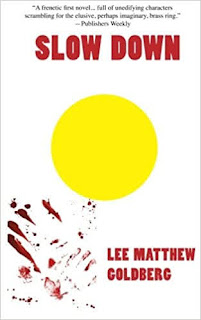
Weekly Reader: Slow Down by Lee Matthew Goldberg; A Dark Drug Fueled Thriller About Fame, Ambition, Addiction, and Selling One's Soul


Weekly Reader: Slow Down by Lee Matthew Goldberg; A Dark Drug Fueled Thriller About Fame, Ambition, Addiction, and Selling One's Soul

By Julie Sara Porter

Bookworm Reviews


Spoilers: Lee Matthew Goldberg's novel, Slow Down, could be considered The Millennial Version of What Makes Sammy Run? In Budd Schulberg's 1941 novel/expose of the Golden Age of Hollywood, Sammy Glick, a shifty opportunistic copyboy steals screenplays, connives against rivals, beds and discards mistresses, and makes life a living Hell for those around him in his climb to the top of the Hollywood scene, only to find his success hollow and empty when there are others waiting to replace and destroy him.

Slow Down has characters that could be considered Sammy Glick's protegees. Only they have benefits from such modern tools as technology and drug use to their advantage.

Slow Down is a dark comedy of a book that seems like one long drug fueled trip into the excesses of fame, ambition, and selling one's soul to those who are better players in the ruthless game of instant celebrity.

Noah Spaeth, is a young ambitious writer with a big mouth who comes from a rich dysfunctional Central Park West family. In his early 20's, Noah has a troubled relationship with just about everyone in his life: from his constantly traveling parents, to his screwed up brother, to his spoiled sister, to his bitchy boss, to his long train of weird friends and clingy ex-girlfriends. Just recently he got fired from his job because he accidentally sent an insulting email to his boss. No problem, Noah says, he has time to focus on his writing and to finally get that one success story which will propel him to gaining that reputation as a bright young genius. Okay, he only has a margin of a idea for his novel with only a few scenes written and one character named Nina. But he is certain his time will come.

Noah's former girlfriend, aspiring actress, Nevie invites him to a swank party and introduces him to experimental filmmaker, Dominick Bambach. Dominick's previous success was an erotic thriller, Detached. His latest project is even more off the beaten path. It is Slow Down and will feature him only giving his actors a small semblance of a scene and have them react as he films. He wants to film their reactions and natural behaviors injecting realism to his production. Noah is fascinated with the project and would like to be mentored by Dominick, at least long enough to give his own career a boost.

Unfortunately, that fascination turns to revulsion when Noah is introduced to a drug called Fast, which produces psychotic after effects. He also encounters a few young actresses, working on Dominick's film, who have similar tattoos of a yellow circle and become insanely violent whenever that tattoo is touched. Could Dominick be so obsessed with filming a natural performance that he is willing to drug his actresses to get it?

Noah also has further questions when he encounters Dominick's wife, Isadora who seduces the young writer and questions her husband's writing and directing ability. Noah's ambitious drive increases and he plots to steal Dominick's movie and his wife.


Slow Down is one ironic title. Things move along at a regular pace, then something happens that speeds up the action to a dizzying pace. There are moments where you can't be sure if what you are reading is really happening, if Noah (or the Reader) is hallucinating, or if the action is completely fictional and instead just the product of a writer finally creating his magnum opus.

The drug scenes are terrifying because of the uncertainty. Many of the women go from bright, ambitious, attractive, budding starlets to animalistic homicidal maniacs, almost as a symbol of the control that Dominick and Noah have over them. Noah also goes through various drug trips with Fast that further confuses things and puts him at Dominick's mercy while he believes that he is in control.

When the yellow circle reappears in Noah's life, it is almost like a warning of terrifying lines that shouldn't be crossed.


The biggest drug in the book is not Fast, but ambition and it hits Noah hard. The more Noah becomes entangled with Dominick and his movie, the more he wants Dominick's life. He entertains notions of the lengths that he will go to pursue his goals from stealing the film to murdering Dominick and marrying Isadora. He beds Nevie and various other actresses to act on his frustrations of his wasted life. He conspires with Isadora so that he can replace Dominick by her side and obtain the filmmaker's reputation via osmosis.

Noah's ambitions are cold, but Noah is more like the little kid who robs cash registers in convenience stores then says, "I'm really bad, honest!" in front of a violent street gang who are ready to commit mass murder. Noah never realizes that he is playing in the big leagues until he reads the final draft of Slow Down and realizes that he is a figurative character just moving along in other people's schemes. He followed someone else's script and was controlled by other's machinations and his own ambitions.

Slow Down is a dark book that gets to the center of various kinds of addiction, not just drugs but fame and success as well. Noah started out brilliant, but angry that he was not put in a position for others to recognize that talent and drive. In the end, he may want fame but the fame is only temporary and once the excitement is done, he wants more. More success on his own terms, more money, a penthouse apartment, more dates, more beautiful mistresses, more drugs, more everything. The price when it comes down is that Noah is no longer in control, still the neurotic insecure mess that he always was, not directing and instead playing out other people's scripts.

Saturday, March 31, 2018

April Fool's Day Weekly Reader Special: The Disaster Artist My Life Inside The Room, The Greatest Bad Movie Ever Made By Greg Sestero; A Hilarious and Heartwarming Book About Bad Film Making But Good Friends


April Fool’s Day Weekly Reader Special: The Disaster Artist: My Life Inside The Room, The Greatest Bad Film Ever Made by Greg Sestero and Tom Bissell; A Hilarious and Surprisingly Heart-Warming Story About Bad Film Making But Good Friends
By Julie Sara Porter,
Bookworm Reviews

Spoilers: There are bad films and then there’s The Room. Not since the full nightgown ladies wrestling in Manos: The Hand of Fate. Not since Ed Wood and Coleman Francis showed their directing skills or lack thereof in Plan 9 from Outer Space and Beast of Yucca Flats respectively. Not since John Wayne stunned audiences with his portrayal of Genghis Khan in The Conqueror. Not since Jennifer Lopez attempted to seduce Ben Affleck with “It’s turkey time, gobble gobble” in Gigli. Not since Elizabeth Berkeley bared her breasts in Showgirls. Not since Madonna attempted to act in…well anything except Evita have so many people looked at a film screen wondering “What the heck did I just watch up there?”
 Allegedly a film about a love triangle between a man, Johnny his “future wife,” Lisa and best friend, Mark it is instead a two hour experiment in bad filming with terrible camera angles, scenes that make no sense,  wooden or hammy performances, and lines that are bad beyond belief. (“Leave your stupid comments in your pocket!” “YOU ARE TEARING ME APART, LISA!!!”)

However as many fans of The Room and its writer/director/producer/star, Tommy Wiseau know, it’s not just a bad movie, it’s an experience more akin to the Rocky Horror Picture Show. People attend midnight showings and call back lines, throw spoons at the screen, and generally have a good time at a movie that instead of quietly fading away and having its performers suffer career nothingness, Wiseau and Co. are  held up as cult heroes and The Room has obtained a second life as “the Citizen Kane of bad movies.”
 Wiseau’s best friend and The Room co-star Greg Sestero (who played Johnny's best friend, "Oh hi Mark.") captured the making of this disaster-piece in his book The Disaster Artist, which is a hilarious account of how not to make a movie but is also at heart a moving testament to a loving friendship between Wiseau and Sestero.

Wiseau and Sestero met in the late ‘90’s in a San Francisco acting class. Sestero had dreams of being an actor ever since he was young and penned a sequel to Home Alone and mailed it to director, John Hughes. (He marveled that instead of giving him a standard rejection letter Hughes wrote “Believe in yourself, have patience and always follow your heart.”) He had the looks and interest, accepting roles as extras (including in the movies, Patch Adams and Gattaca) and taking acting classes but he lacked the confidence and nerve to truly pursue his interest to the fullest.
Then one day at the acting class of Jean Shelton, in walked a student that had plenty of confidence and nerve. After watching Wiseau mangle a Shakespearean sonnet, Sestero found him “terrible, reckless, and mesmerizing.” Sestero became determined to do a scene with Wiseau after he saw him ham up the famous “Stella” scene in A Streetcar Named Desire. Sestero got his scene partner and cinematic history was made for better or worse.

The book develops the duo’s friendship, both the bad and the good aspects of it. Sestero was constantly perplexed by Wiseau’s oddities such as never revealing any details about his personal life like his country of origin (his last name Wiseau is French for bird but his accent suggested possibly Eastern European origins) or revealing where he got his fortune (which included owning apartments in both San Francisco and Los Angeles and a fashion business called Street Fashions U.S.A.).
He had peculiar irritating habits that made him an impossible roommate such as staying up all night listening to tapes to learn English and lose his distinct accent. (“You think its good do you is not something that the average native English speaker would say,” Sestero dryly wrote. “(Wiseau) should have been learning to say, ‘I’d like a refund for these tapes please.’”)

Nevertheless Wiseau retained an optimistic nature that encouraged Sestero through discouragement and a devil-may-care personality that lived moment by moment. (He encouraged Sestero to go several hours out of their way to accompany him on a pilgrimage to visit the road where James Dean died and eat at a diner owned by a former friend of Dean’s.)
Humor is developed as Wiseau sometimes comes across as the proverbial “Best Friend/Roommate From Hell,” an odd but essentially good-natured lovable weirdo. Wiseau is the type of person that would invite such odd theories about his origins such as whether he is an alien or a vampire and those theories are almost believable. (Any future Men in Black production has to feature him in a cameo as “a celebrity/extraterrestrial” ala Michael Jackson in Men in Black II. It is law!)

However there are darker aspects to Wiseau’s character that border on mental instability or at least severe psychological or neurological disorders and Sestero does not shy away from revealing them.
He became possessive and jealous when Sestero made new friends or received acting roles like the lead in Retro Puppet Master.  He sent Sestero a Christmas greeting in Romania while Sestero was filming Puppet Master (which he did not tell Wiseau where the filming was going to be nor where he was staying.)
 He invaded his friend’s privacy by opening his mail and interfering with professional phone calls. Wiseau also had vivid dreams of Sestero killing him though Sestero’s writing suggested he feared the same from him. Sestero sometimes described Wiseau as “a life draining vampire” who sapped his friend of energy because of his emotional potentially unstable nature.

Sestero’s friends and family members warned him of Wiseau’s behavior. One friend in particular took Sestero to see the movie, The Talented Mr. Ripley in which Matt Damon played a con artist who seduces, murders, and impersonates his best friend (Jude Law) to help Sestero make obvious connections between the movie and his friendship with Wiseau.
Most people probably would have taken the hint, booked themselves into the nearest shelter, and told Wiseau via a restraining order to hit the highway, but Sestero was not most people.  He reasoned, “My mother tried to convince me not to go back to L.A. She failed. My hippie friend tried to convince me not to go back to L.A. He failed. Patricia Highsmith, Matt Damon, Jude Law, and Anthony Minghella tried to convince me not to go back to L.A. They failed.” (Which I don’t believe was their objective for writing, directing, and starring in The Talented Mr. Ripley, but what do I know?) Back he went to L.A., Hollywood, and “Tommy’s Planet.”

Wiseau’s behavior in his friendships is nothing to his behavior in filming The Room. His excitable, unpredictable, unbalanced behavior increased during the making of the film.
Oddly enough The Talented Mr. Ripley played inadvertently into the creation of The Room. (Matt Damon and Jude Law can rest easy knowing that.) At the 1999 Golden Globes in which Ripley won various awards including Best Actor for Damon and Best Supporting Actor for Law, Wiseau and Sestero were stuck in traffic watching the limousines go up and down the streets. Wiseau was dejected, “I know they don’t want me. I know they don’t want guy with accent and long hair. So I show them. I show them what I can do…..I write my own play. I’ll do my own project and it will be better than everybody else….People will see my project and you know what? They will not sleep for two weeks. They will be completely shocked you watch.” Which proved once and for all not only that Wiseau possessed misguided precognitive abilities but Fate had a sick twisted sense of humor.

The chapters that dealt with the making of The Room show one comedic blunder after another so much so that it was a miracle that the movie got made let alone released. (No doubt due to Wiseau’s admirable but very bullheaded persistence).
Technical filming mistakes abound such as Wiseau filming in both film and digital causing the visual quality to be haphazard at best. Wiseau insisted that an alley set be built inside their rented studio even though a perfectly fine alley was standing right outside waiting for its film debut. (Wiseau’s reasoning: “Because we do first-class production. No Mickey Mouse stuff.”) As an actor, Wiseau was unable to remember his lines: you know the lines that he actually wrote such as “I did not hit her. I did not. Oh hi, Mark.”

Besides his lack of ability at filming, Wiseau was volatile and abusive with his cast and crew. Crew members got fired right and left, some after arguing justifiably over the unstable production. Wiseau tormented his cast such as his original pick for the character of Mark, an actor he called Don (but was really named Dan) whom Wiseau cast but did not film in an attempt to convince Sestero to play the part which he accepted.
 He was also verbally abusive towards Juliette Danielle, who played his future wife, Lisa. He reduced her to tears by mocking her appearance such as her acne ridden back.
An acquaintance of Wiseau’s, Markus shot behind-the-scenes footage allegedly for a documentary but was in reality so Wiseau could spy on his cast and crew talking about him behind his back.

Not to mention the fact that no one quite knew in filming what The Room was about. Carolyn Minnott who played Lisa’s mother, was confused about a line in which she announces that she has breast cancer but no other reference is made about this revelation. (“It’s a plot twist,” Wiseau not-so-helpfully said.)
A subplot involving Johnny and Lisa’s young neighbor, Denny and a drug dealer named Chris-R was shot with an action scene which Mark and Johnny subdue the drug dealer and somehow are able to arrest him, even though neither of them are law enforcement officers. (Days and hours were wasted filming the “Chris-R” scene according to Wiseau’s changeable moods over various details such as whether Chris-R has a gun and drops it or holds onto the gun causing lots of retakes and hours of unused celluloid.)

Despite being a catalog of ineptitude, The Disaster Artist is not an attack against Wiseau. In fact, Sestero clearly admired his friend’s drive to create his own movie and distribute it to the world.
This is prevalent where Sestero reveals some aspects that he had gleaned from various contradictory conversations with Wiseau and documentation about his past. (Revelations that Wiseau had discredited but Immigration documentation and subsequent research by others had later verified.)

Sestero described Wiseau as a lonely boy from an Eastern European country (documentation since the book’s publication suggested that it was Poland) who longed to move to America and be a part of the Hollywood world that he saw on screen.
According to Sestero’s account, Wiseau moved to France where he took menial jobs, was arrested in a drug raid where he was abused and threatened by the police, and possibly became a male prostitute.
He eventually moved in with his aunt and uncle in New Orleans where he still encountered loneliness and got his heart broken by a woman who the book implied may have been the inspiration for Lisa, Johnny’s manipulative “future wife".
He eventually settled in San Francisco where he sold jeans, yo-yos, and toy birds, and acquired the name Thomas Pierre “Tommy” Wiseau. (How he got his fortune to finance The Room still is not revealed and to this day no one knows. The book suggests various possibilities such as money laundering, inheritance from a wealthy mentor, or mob money-but nothing is outright stated keeping that aspect of Wiseau’s life as a mystery even still.)
 When Wiseau announced at the premiere of The Room “This my movie. This my life” Sestero and The Reader have no doubt about it. The Room was a difficult awful filming experience but it was  a labor of love from someone who loved movies and would have given anything to be a part of them.

There is also warmth between Wiseau and Sestero’s friendship. It is clear from the beginning that Sestero and WIseau filled a need for each other. Sestero’s writing implies that he would have never had the nerve to move to Los Angeles to pursue his acting dream if he hadn’t met Wiseau and the strange eccentric man had not encouraged him to follow his dream.
 Even more so Wiseau would never have had someone that understood his eccentricities and drew him out of his self-imposed isolation if he never met Sestero.
Like many well-known friendships like Sherlock Holmes and Dr. Watson (and their current actors Benedict Cumberbatch and Martin Freeman) or Of Mice and Men’s George and Lennie, Wiseau and Sestero are better together than they are apart.
This is very paramount when in one chapter in their pre-Room days, Wiseau was depressed about Hollywood rejections and he disappeared leaving behind a voice mail message that he was “on a highway to Hell,” and wondering what it would be like to die young like James Dean. Sestero worried about a possibly suicidal Wiseau and wanted to call anyone to find out where he was. He realized he knew no one, no other friends or family members who knew or cared where Wiseau was. Sestero was aware that he was not only Wiseau’s best friend: he was his only friend. (He eventually reunited with Wiseau who wrote his screenplay for The Room possibly a cathartic experience for both of them.)

The Disaster Artist is the type of book that makes The Reader laugh but also warms their heart. It also warms their heart even more as Wiseau and Sestero lately have disproven F. Scott Fitzgerald’s claim that “there are no second acts in life.” They received a second act because of the cult success of The Room and its fans hailing it as an unintentional comedy cult phenomenon, which they willingly embraced. Recently things have turned around for Wiseau and Sestero giving them a third, possibly a fourth act.

The book for the Disaster Artist was not only a best seller but the film version directed by James Franco and starring him and his brother, Dave was a box office success but also an Academy Award nominee for Best Adapted Screenplay. (However the film’s star has eclipsed lately because of sexual abuse allegations towards Franco dismissing its status for any other Oscar consideration.).

 In an even more ironic twist, before the Oscars, Franco won the Golden Globe for Best Actor and called Wiseau to the stage to accept the award with him. (Possibly, this ceremony caused a traffic jam and some irritated young budding filmmaker despaired about how Hollywood doesn’t want him or her and planned their own screenplay in defiance). Wiseau has obtained the Hollywood success status that he longed for and things have definitely come full circle for him and Sestero.
The Dynamic Duo are still friends and continue to make movies including an upcoming one called Best F(r)iends that has some early positive feedback. There might be good performances and a good movie out of them yet.