Showing posts with label Jamaica. Show all posts

Saturday, August 24, 2024

When Banana Stains Fade: A Jamaican Family Saga of Adversity and Redemption by Frances-Marie Coke


When Banana Stains Fade: A Jamaican Family Saga of Adversity and Redemption by Frances-Marie Coke 

Spoilers: When Banana Stains Fade: A Jamaican Family Saga of Adversity and Redemption by Frances-Marie Coke is the second book in a row dealing with intergenerational conflicts concerning mother and daughters after Red Gifts in The Garden of Stones by P.A. Swanborough. While the latter trod a thin line between the reality of the family in question’s situation and the fantasy of their pagan past, the former has no such detours into the fantastic. It is firmly set in the reality of racism, poverty, classicism, gender inequality, domestic violence, and generational conflicts. All of this is in a setting that is quite familiar with this blog. In fact, it was a setting that was quite common in the books that I read and reviewed last year: Jamaica.

In 2002, Zarah left New York for her childhood home of Jamaica. Her parents, Esther and Bradley and grandmother, Naomi are worried and anxious about their daughter's sorrowful return and her memories of an unhappy abusive marriage left behind in New York. Esther’s concern is also joined by loving but strident remainders that she told Zarah that her marriage wouldn't end well. Her kind anxious demeanor often features acidic attacks on Zarah’s choices and personality. This behavior causes their already volatile relationship to become even more strained and leads to threats of estrangement between mother and daughter. Naomi views the conflict with empathy and understanding. After all she had been through something similar with Esther, just as her mother, Pearlie and Aunt Eudora had been through with her, and their mother, Agatha had been through with them. So the Reader is treated to over 100 years of Jamaican history seen through the eyes of five generations of six fascinating women.

What is particularly fascinating and compelling about this book is that it ignores the touristy side of Jamaica. Oh, some of it’s there: the beautiful landscape, the friendly hospitable locals, the Rastafarian religion and its beliefs. There is even a shout out to author Sir Ian Fleming, who made Jamaica his home as he wrote his James Bond novels. But they are largely left in the background. Instead, we are shown what life was and is like for the locals and all is definitely not paradise for the people who live there. 

The forefront of the book features many of the truths that lie within Jamaica’s sandy beaches and reggae music. It is a history of colonization and racism. It is a present of poverty, economic disparity, and domestic violence. These issues are not treated with bold overlines and dramatic emphasis. Instead they are seen and experienced by the people, specifically the family that encounter them.

We are first told of Zarah’s return and her fractured relationship with her parents. We are then treated to a flashback of an affair that Esther had which ended in her divorce and Zarah’s anger at her mother. The majority of the book consists of flashbacks that begin in 1900 with Agatha, Zarah’s great great grandmother and Esther’s great grandmother. Through this family, we see the conflicts that mark one generation and cause friction with the next. 

Agatha works in a sleepy town and is dominated by her religious family, particularly her father. She is told by women around her to just accept whatever treatment that she gets from men. With only that advice in hand, she enters into a relationship with Mas’ Watson, a well-off farmer. Watson gives Agatha two daughters: Eudora and Pearlie. Agatha works to gather and tag bananas to help support her family but can’t avoid the stares and innuendo that people have about her daughters. 

People gossip about Pearlie’s darker skin compared to Eudora who is much lighter. They marvel at the latter’s perceived beauty and predict that she will go far in life. They shake their heads in dread at Pearlie and believe that she will have a future of hardship. Even Agatha’s attempts to straighten Pearlie’s hair or give her lemon juice to lighten her complexion do not hide her real appearance. 

Many degrade the young girl and Mas’ Watson shows preferential treatment towards Eudora. This shows that even when many people are from the same race, there is unfortunately still division within that race. Sometimes there are stereotypical racist beliefs about the difference between people who are from the same basic skin color but whose shades are darker or lighter and hair is straight or curly.

The scrutiny of Agatha’s daughter’s different skin tones and accusations of whether they had different fathers fill the sisters’ lives up to when they attend school. The outrage becomes so bad that after she is raped, Pearlie runs away. She resides in another village where she gives birth to her daughter, Naomi and enters into a relationship with Bertie, a man whose family helps the single mother get back on her feet. Unfortunately, Pearlie’s happiness is cut short and Naomi finds herself alone and friendless like her mother. 

Naomi ends up living with her cold religious Aunt Eudora. Eudora at first doesn’t even want to take in the girl but she is convinced to do so because of her commitment to Christian duty and how it would look within her community to reject her own flesh and blood. Out of rebellion, Naomi attends the local Catholic church and rejects many of the spiritual teachings from her aunt. 

Naomi falls in love with Miles, a musician who spins fantasies within her about moving to America and starting a new life. That isn’t all that he spins within her. No sooner is she pregnant with her daughter, Esther, than she too is left behind like her mother and grandmother before her.

In the most harrowing section, Naomi enters an unhappy second marriage to Pastor Bloomfield. Bloomfield’s abusive and controlling nature is present as he micromanages her schedule down to prayer times and how long she can meet her friends. He won’t allow her to find a career outside of caring for his home and church. In a very classicist gesture, he forces her to stop using the Jamaican patois and speak the standard British English.

 Because of her limited relationship with her biological family and limited resources, Naomi is trapped in an abusive marriage with someone who she thought was a man of God but turned out to be someone who thought that he was God and had a private church of two worshippers: his wife and stepdaughter. 

A very terrifying encounter breaks Bloomfield’s hold on Naomi and Esther and the two rebuild their lives elsewhere. Naomi reverts to the spiritual beliefs that had always provided her comfort and in an act of defiance against her ex, reverts back to the Jamaican patois that he ridiculed. 

With the generations of Agatha, Pearlie, Eudora, and Naomi we see mothers struggling with problems of racism, poverty, religious dogma, and domestic violence. Each one works and hopes that the younger generation will succeed where they failed. With Esther and Zarah, we see the results of those dashed dreams, the desire to escape, and how that unhappiness and disappointment played into their relationships as mother and daughter and the men in their lives. 

Even though Esther had a comparatively happy marriage to Bradley as compared to her mother’s with Brookfield and great-grandmother’s with Mas’ Watson, even she had troubles. In 1988, Esther reunited with her former boyfriend, Patrick who lived an affluent life in Ft. Lauderdale, Florida. She had been living a meager existence with Bradley scraping for every dollar and was growing tired of the struggle. She dreamed not only of a different wealthy life in Florida but of the dashing man who could have given it to her.

 Thoughts become actions during a hurricane and Esther ends up with a miscarriage, a divorce, and a resentful daughter. What was truly heartbreaking in hindsight was that Bradley is an easygoing, steady, kind hearted man. His laid back nature could have provided a contrast to Esther’s more rigid strident domineering control over Zarah’s life. Zarah could have had an ally when arguing with her mother. Instead she reacted to strictness with rebellion and ran away. Esther only realizes when Zarah returns that Bradley has a peculiar strength in his blundering kindness that she overlooked. 

Zarah is considered the great hope of the family. Her mother puts enormous pressure on her to succeed well in school and have the right friends. She becomes something of an overachiever with dreams of escaping Jamaica. However, she also falls in love with Damien, considering him a reprieve from her mother’s tight control and secrets which caused her family to implode. 

Unlike her antecedents, who only dreamt of a life away from the island, Zarah managed to get away and form a life for herself. But her independence came with a price tag: that of being married to the abusive Damien. 

The freedom that Zarah thought that she would experience being away from Jamaica becomes even more of a trap in New York. She is beaten, insulted, and criticized. Worse, she is isolated in a new country where she is an immigrant and has very few friends. 

However, Zarah continues to work and study, raising money in secret. She befriends a woman who takes a maternal interest into her life and helps steer her into a good direction. Zarah’s drive to get out of the abusive situation shows her to be someone who learned enough from the earlier generation to plan an escape and make a new life for herself even if it means retreating to the homes of Mom and Dad for a while.

Agatha, Pearlie, Eudora, Naomi, Esther, and Zarah all lived very difficult traumatic troubled lives but they found strength in other places. Sometimes it was through close friendships, surrogate family members, their religious faith, future goals, or aspirations. Most importantly they learned from each other. Even when they didn’t always get along and fought endlessly, their inner strength and love for each other is always shown as are their hopes that the daughters will have better lives than the mother’s. 

Sometimes those dreams didn’t always come true and depended on the next generation to make it happen. Most importantly they had each other to find comfort, sanctuary, and guides to see them through the tough times and learn from them.

Sunday, June 25, 2023

New Book Alert: Ginger Star: A Prequel (Stuck in the Onesies Series Book Three) by Diane McDonough; Gender and Racial Conflicts Surround 18th Jamaica Historical Fiction


 New Book Alert: Ginger Star: A Prequel (Stuck in the Onesies Series Book Three) by Diane McDonough; Gender and Racial Conflicts Surround 18th Jamaica Historical Fiction 

By Julie Sara Porter

Bookworm Reviews


Spoilers: It's becoming common for me to review two or more books on the same subject. This year alone I have read books about ballet, books set in 2040 California, books in which characters have the ability of lucid dreaming, and fantasies involving magical creatures and beings from countries other than the United States and  those in Europe. It's still rare however when I read two or more historical fiction by different authors that are set at the exact same time frame and feature the exact same historical figures. In recent years, I remember Mistress Suffragette by Diana Forbes and Gilded Summer (Newport's Gilded Age Series Book One) by Donna Russo Morin being one set and Rhapsody by Mitchell James Kaplan and Lady Be Good: The Life and Times of Dorothy Hale by Pamela Hamilton being another. Well now I have another: the early years of the 18th century Caribbean seen through the words of Katie Crabb's Constellation Trilogy and Diane McDonough's Ginger Star: A Prequel Stuck in the Onesies Book Three.


 Both feature sailors, pirates, the slave trade, and both involve characters questioning and rebelling against the standards of the day. They are so similar, that it really isn't fair to compare them. I am not accusing anyone of plagiarizing, just sometimes ideas strike more than one person at a time. 

There are some interesting aspects that each author focuses on. Both focus on the dehumanization of slavery but they also take different approaches on how others are treated. Crabb also writes about the struggles affecting gay men and lesbians in the 18th century and how they often had to conform to societal standards, exile themselves (in this series' case to the seas), or face imprisonment or death.

She takes some looks at gender roles and the status of women in this time period but it definitely is sidelined for the LGBT perspective.


McDonough however puts her emphasis on race and gender roles. Many slaves and free blacks made communities of their own despite threats from the approaching white slavers and colonials. The book also looks at the roles of women in this Caribbean society and how they also fight for their rights and independence.


The book begins with Amari, a young Ghanaian man in a friendly hunting competition. Unfortunately, he and his friend, Kwasi are kidnapped, taken to a slave ship, and then separated. Amari  is injured and cared for by Ronnie Shepherd, the cabin boy and an indentured servant. The two become friends and Amari learns that Ronnie has been keeping a secret. Ronnie is actually a woman disguised as a boy to escape a troubled abusive home life. When the two reach Jamaican shores, Amari rescues Ronnie from being raped and the two make their escape. They reach an estate where a wealthy woman, Adria, helps them hide and covers for them. Adria invites them to stay on her family's estate, Ginger Star. Unfortunately, she has a secret of her own. She's unmarried and pregnant. 


Since The Constellation Trilogy spends a lot of time at sea, the Reader doesn't really get to explore the beauty of the Jamaican island. McDonough more than makes up for that. Adria’s first description of Jamaica is beyond lovely. McDonough wrote, “Small white caps broke over the reef that was outside the cove. The sea went from royal blue to crystal-clear aqua as it closed in on the shoreline. (Adria’s) gaze landed across the cove on a waterfall that spilled into the sea with fresh water from one of the eight rivers in and near Ocho Rios.” The book also explores the local flora and fauna and the local names for them such as ginger star for heliconia and doctor bird for hummingbird. 

McDounough captures the contradictions of an island of immense beauty and the ugly times which occur there: the buying and selling of human beings, the theft of land and resources by outsiders unwilling to share them with the people who were there first, and the fact that those in authority are so willfully corrupt and ignorant to what’s happening around them that the only way to uphold true justice and liberty is to break the law and become a pirate.


McDonough creates some memorable characters who live on the different sides of the socioeconomic and racial scale that inhabit her settings and makes them real. They are more than just microcosms of their society but individuals that live within it. 

The four strongest and best characters in this book are Amari, Ronnie, Adria, and another character whom I will mention later. After he escapes. Amari joins the Maroon community of escaped slaves and indigenous Tainos. They fight against colonists and rebel against the white government that had been forced upon the island. Amari later marries, adopts a son, and becomes a leader of his community. Because he befriended Ronnie and Adria, he is able to be a bridge between the white and indigenous and black communities of the island and to achieve diplomacy in the Maroons’ desire for recognition and independence. Amari still fights against the slavers and colonists when he has to, but he is also willing to work with and talk to his white friends to encourage cooperation. Also, during this time, the Maroon community grows with more slaves leaving plantations to live lives of freedom in which they can declare their own agencies. 


Adria is on the side of those white colonists and she shows kindness and charity towards those around her, white, black, and indigenous. She is mostly sheltered and kept in a very restricted upper class home where she is expected to marry, have children, and lead the servants and household. Adria  is in a more vulnerable position than Ronnie or Amari and is unable to physically fight, but her strength is in her gentleness and generous spirit. One of her greatest moments occurs long after she gives birth and she is separated from her child. When she learns the whereabouts of her child, the Reader expects her to strike out angrily and accuse those around her of kidnapping them, even kidnapping the child herself. Instead she sees the little one is happy and well cared for. Even though she admits that she gave birth, the little one’s real parents are the ones who raised them. 


Ronnie is another one in a peculiar position that puts her between worlds. Even though she is a woman, she spent time working on ships so can see the pirate’s perspective. She reverts back to her female identity, works in a store and sees other women taking charge of their own destiny. As a former indentured servant, she saw first hand the abhorrent treatment that black slaves suffered and speaks against it even after she enters a romance with a white plantation owner. She retains her friendship with Amari and Adria and helps stand against the institution of slavery. She has survived on her own for a long time, so is very strong willed and knows her own mind.


As I mentioned this book is set during almost the exact same time span as The Constellation Trilogy and many of the historical real life figures appear in both, one in particular. While she is glimpsed very briefly in Sailing by Carina’s Star, she is an important figure in Ginger Star and takes part in the plot in a huge way. She is Anne Bonney, one of the few female pirates during the Golden Age of Piracy. In Ginger Star, she is a former friend of Ronnie’s who  encouraged the younger woman to follow her own path of donning men’s clothing and taking to the seas. 

One of the most interesting things about Bonney’s appearance in Ginger Star is that this book offers a few theories as to why she disappeared from history. In reality, her husband Calico Jack Rackham was executed and she was scheduled to be executed as well, but she claimed pregnancy so she was released. That was the last known record of her, no one knows where she went upon her escape, if she escaped, or when and where she died. Ginger Star cleverly fills those gaps by giving Bonney a more decisive end to her story while still being true to her crafty, adventurous, fighting spirit.


Ginger Star is a very different book from The Constellation Trilogy even though it covers the same time period. It captures great beauty in setting, ugliness in inhumanity, and courage and spirit in the various individuals that dwelled in that time and place. 

Thursday, July 1, 2021

Lit List: Short Reviews: The Girl from Colombia by Julian Rodriguez, Neoliberalism, Globalism, Income Inequality, Poverty, and Resistance by Renaldo C. McKenzie, The Bedwetter Journal of a Budding Psychopath by Lee Alan Howard

 Lit List: Short Reviews

By Julie Sara Porter

Bookworm Reviews


Spoilers: I want to apologize for being so scattered with my reviews lately. First, I house sat for my sister while she and her family were in Florida. I was able to get plenty of work done because of their great WiFi but not all projects were completed.

Second, when I returned I had a series of neck and shoulder problems which prevented me from being on the computer for so long. They are gone but now I have a slight ear infection.

Third, the power went off in our house at the same time that my charger was destroyed. The power is back but I still need a new charger so right now I am working on limited time doing as much as I can before the battery goes and I have to borrow someone else's. Let's just say it's been a busy stressful month.

Because of that I have had to condense three reviews into shorter ones similar to what you would find in Amazon or Goodreads. I prefer my longer, more analytic reviews but when pressed for time, it's better than nothing. I may do this from on for shorter works like novellas, poetry books, and short stories. Anyway, here are my three reviews. Hopefully, I should get a new charger by tomorrow and be up to my regular form.


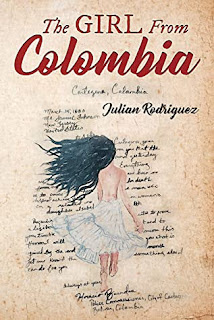
The Girl From Colombia by Julian Rodriguez

Julian Rodriguez's historical fiction novel, The Girl from Colombia is that rare book that writes a love triangle right by giving the Reader three compelling characters so that the emotional investment is on all parties.

In the late 19th century, Joseph Johnson's wealthy cruel father, Samuel is ill. Joseph is set to inherit and marry Elizabeth, an heiress. However, a young mysterious woman from Colombia named Isabel lives in a cottage by the beach. Joseph's curiosity gets the better of him when he finally meets this bewitching beauty. The two fall in love leading to potential scandal and estrangement should they be discovered.


The three characters are very well written. Joseph is someone who has had to suffer under the thumb of a dictatorial father and is torn between his  duty to his family legacy which is largely built on exploitation and deceit and his responsibilities to himself and the people around him. With Isabel he becomes very protective and recognizes a better nature in seeing someone who suffered under the decisions that his father made. His struggles raise the questions in whether a legacy should be preserved when it's built by someone else's cruelty and living off of the backs of others.

Isabel is a very passionate emotional vibrant woman, the most interesting character in the book. She is kept hidden from the Johnsons for a long time as if to deny what Samuel did to her and her mother. However, as Isabel grows she makes her presence known. Her first chapter shows her attempting to enter the Johnson house, knife in hand. When she indulges in her affair with Joseph, she sees someone who is also wounded by Samuel's behavior and is kept hidden in his own way.

Elizabeth is a nice surprise. Usually, love triangles are skewered in one person's favor by making the other as horrible or as boring as possible. Rodriguez is smarter than that. Elizabeth not only is a nice person but she actually befriends Isabel on her own. In fact, she comes up with an idea that could benefit all three parties. If not for plot circumstances, it may have even worked.


The Girl from Colombia not only provides a well written love triangle but shows how sins from past generations can ruin the lives of subsequent generations.


Neoliberalism, Globalism, Income Inequality, Poverty, and Resistance by Renaldo C. McKenzie

Renaldo C. Mackenzie's book Neoliberalism, Globalization, Income Inequality, Poverty and Resistance is a sobering account of how the economic and sociopolitical controversies affect the United States and the Caribbean countries, particularly Jamaica.


People who are interested in global and financial transactions between nations will find a lot to read and think about in this book. McKenzie explains how income inequality has shaped the outlook of these countries and how Jamaica's flattened economic growth has been a factor in the poverty of its citizens. McKenzie also states Neoliberalism restructuring has caused a decline in Jamaica's economics. Sometimes the theory has produced chaotic and uneven results. A decrease in a country's economy also leads to increases in illegal activity such as drug manufacturing, selling, and usage, breakdowns in family structure, and increased violence and hate crimes. 

McKenzie also discusses how racial controversies in the United States have bled into struggles in other countries. Such controversies as The Black Lives Matter protest, racial profiling, and critical race theory taught in education has altered the views that many have had over other countries that had been colonized by white Europeans but inhabited by indigenous people and people of color. Slave revolutions occurred in Jamaica before the Civil War and in the late 19th century many descendants of slaves moved in an African diaspora to Jamaica. Similar to current struggles in the United States and South Africa, the current status of the Caribbean countries can be learned by owning up and acknowledging the racism in the past and how systemic racism remains.


Neoliberalism, Globalization, Income Inequality, Poverty, and Resistance gives Readers a chance to understand how the problems in one country carry over and parallel the problems in another.


The Bedwetter: Journal of a Budding Psychopath by Lee Alan Howard

Lee Alan Howard's psychological thriller The Bedwetter: Journal of a Budding Psychopath lives up to its name. It is a dark absorbing look into the transformation of a troubled young man into a potential murderer.

Russell Pisarek has a long list of problems. He has nocturnal urinations and is embarrassed by it. He has flashbacks of a manipulative and abusive mother. He works in an animal testing lab but has has a history of dealing and using drugs. Right now he lives with his nagging sister who is concerned about the influence Russell has over her son.

Most of the time he spends playing video games like Call of Duty and muttering under his breath how much he hates everyone else. His only friend is Connors, a man who runs an army surplus store in which Russell buys knives and other weapons. The general impression that Russell gives off is someone who is antisocial and angry but keeps all his worst thoughts to himself but is waiting for the day to explode.


Throughout the novel it becomes clear that Russell is a ticking time bomb. The smallest things like a nasty Craigslist response or having to clean the rabbits cages at work send him off. Most of the time he responds by calling the people around him demeaning nicknames (He calls his mother, Melanie, Melanoma) and using his first person narration to mentally cuss them out. (When his mother mocks him in public, Russell tells the Reader "You're my witness-SHE STARTED IT!")

 So far his behavior seems innocuous but it becomes more worrisome the longer the book goes on. He has violent fantasies about a woman in which he is infatuated.  He steals ketamine from work to feed an addiction. After his father dies, he remembers his indifference and participation when his mother abused him and can't muster up any sadness or empathy. It takes a long time for Russell to commit violence but when he does, it's not a surprise that it happened just that it took so long.

Howard writes a character teetering on the edge of sanity rather well. We already sense something is going to happen before it does, we are just waiting for the moment that it does. It's like looking outside on a cloudy day, watching the sky turn green, hearing the thunder and seeing the lightning get closer, and watching the rain turn to hail. You just know that a tornado is coming so that by the time it shows, you are relieved because you have been waiting and expecting it for so long.

When Russell finally commits violence, it's not exactly a moment of triumph but it is seen as an inevitable conclusion. The Reader has been reading his dark obsessive thoughts, has seen his fantasies become more unhinged, and his enemy list become longer. We have been expecting this outcome for sometime and are almost relieved that it finally does.

The Bedwetter is a fascinating look at a troubled individual who gets worse. It is among the closest many of us can ever get into the mind of a psychopath and probably the closest many of us want to.