Showing posts with label Colombia. Show all posts

Thursday, July 1, 2021

Lit List: Short Reviews: The Girl from Colombia by Julian Rodriguez, Neoliberalism, Globalism, Income Inequality, Poverty, and Resistance by Renaldo C. McKenzie, The Bedwetter Journal of a Budding Psychopath by Lee Alan Howard

 Lit List: Short Reviews

By Julie Sara Porter

Bookworm Reviews


Spoilers: I want to apologize for being so scattered with my reviews lately. First, I house sat for my sister while she and her family were in Florida. I was able to get plenty of work done because of their great WiFi but not all projects were completed.

Second, when I returned I had a series of neck and shoulder problems which prevented me from being on the computer for so long. They are gone but now I have a slight ear infection.

Third, the power went off in our house at the same time that my charger was destroyed. The power is back but I still need a new charger so right now I am working on limited time doing as much as I can before the battery goes and I have to borrow someone else's. Let's just say it's been a busy stressful month.

Because of that I have had to condense three reviews into shorter ones similar to what you would find in Amazon or Goodreads. I prefer my longer, more analytic reviews but when pressed for time, it's better than nothing. I may do this from on for shorter works like novellas, poetry books, and short stories. Anyway, here are my three reviews. Hopefully, I should get a new charger by tomorrow and be up to my regular form.


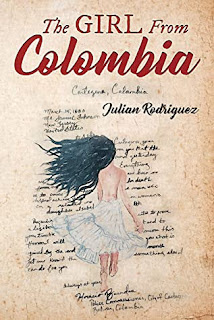
The Girl From Colombia by Julian Rodriguez

Julian Rodriguez's historical fiction novel, The Girl from Colombia is that rare book that writes a love triangle right by giving the Reader three compelling characters so that the emotional investment is on all parties.

In the late 19th century, Joseph Johnson's wealthy cruel father, Samuel is ill. Joseph is set to inherit and marry Elizabeth, an heiress. However, a young mysterious woman from Colombia named Isabel lives in a cottage by the beach. Joseph's curiosity gets the better of him when he finally meets this bewitching beauty. The two fall in love leading to potential scandal and estrangement should they be discovered.


The three characters are very well written. Joseph is someone who has had to suffer under the thumb of a dictatorial father and is torn between his  duty to his family legacy which is largely built on exploitation and deceit and his responsibilities to himself and the people around him. With Isabel he becomes very protective and recognizes a better nature in seeing someone who suffered under the decisions that his father made. His struggles raise the questions in whether a legacy should be preserved when it's built by someone else's cruelty and living off of the backs of others.

Isabel is a very passionate emotional vibrant woman, the most interesting character in the book. She is kept hidden from the Johnsons for a long time as if to deny what Samuel did to her and her mother. However, as Isabel grows she makes her presence known. Her first chapter shows her attempting to enter the Johnson house, knife in hand. When she indulges in her affair with Joseph, she sees someone who is also wounded by Samuel's behavior and is kept hidden in his own way.

Elizabeth is a nice surprise. Usually, love triangles are skewered in one person's favor by making the other as horrible or as boring as possible. Rodriguez is smarter than that. Elizabeth not only is a nice person but she actually befriends Isabel on her own. In fact, she comes up with an idea that could benefit all three parties. If not for plot circumstances, it may have even worked.


The Girl from Colombia not only provides a well written love triangle but shows how sins from past generations can ruin the lives of subsequent generations.


Neoliberalism, Globalism, Income Inequality, Poverty, and Resistance by Renaldo C. McKenzie

Renaldo C. Mackenzie's book Neoliberalism, Globalization, Income Inequality, Poverty and Resistance is a sobering account of how the economic and sociopolitical controversies affect the United States and the Caribbean countries, particularly Jamaica.


People who are interested in global and financial transactions between nations will find a lot to read and think about in this book. McKenzie explains how income inequality has shaped the outlook of these countries and how Jamaica's flattened economic growth has been a factor in the poverty of its citizens. McKenzie also states Neoliberalism restructuring has caused a decline in Jamaica's economics. Sometimes the theory has produced chaotic and uneven results. A decrease in a country's economy also leads to increases in illegal activity such as drug manufacturing, selling, and usage, breakdowns in family structure, and increased violence and hate crimes. 

McKenzie also discusses how racial controversies in the United States have bled into struggles in other countries. Such controversies as The Black Lives Matter protest, racial profiling, and critical race theory taught in education has altered the views that many have had over other countries that had been colonized by white Europeans but inhabited by indigenous people and people of color. Slave revolutions occurred in Jamaica before the Civil War and in the late 19th century many descendants of slaves moved in an African diaspora to Jamaica. Similar to current struggles in the United States and South Africa, the current status of the Caribbean countries can be learned by owning up and acknowledging the racism in the past and how systemic racism remains.


Neoliberalism, Globalization, Income Inequality, Poverty, and Resistance gives Readers a chance to understand how the problems in one country carry over and parallel the problems in another.


The Bedwetter: Journal of a Budding Psychopath by Lee Alan Howard

Lee Alan Howard's psychological thriller The Bedwetter: Journal of a Budding Psychopath lives up to its name. It is a dark absorbing look into the transformation of a troubled young man into a potential murderer.

Russell Pisarek has a long list of problems. He has nocturnal urinations and is embarrassed by it. He has flashbacks of a manipulative and abusive mother. He works in an animal testing lab but has has a history of dealing and using drugs. Right now he lives with his nagging sister who is concerned about the influence Russell has over her son.

Most of the time he spends playing video games like Call of Duty and muttering under his breath how much he hates everyone else. His only friend is Connors, a man who runs an army surplus store in which Russell buys knives and other weapons. The general impression that Russell gives off is someone who is antisocial and angry but keeps all his worst thoughts to himself but is waiting for the day to explode.


Throughout the novel it becomes clear that Russell is a ticking time bomb. The smallest things like a nasty Craigslist response or having to clean the rabbits cages at work send him off. Most of the time he responds by calling the people around him demeaning nicknames (He calls his mother, Melanie, Melanoma) and using his first person narration to mentally cuss them out. (When his mother mocks him in public, Russell tells the Reader "You're my witness-SHE STARTED IT!")

 So far his behavior seems innocuous but it becomes more worrisome the longer the book goes on. He has violent fantasies about a woman in which he is infatuated.  He steals ketamine from work to feed an addiction. After his father dies, he remembers his indifference and participation when his mother abused him and can't muster up any sadness or empathy. It takes a long time for Russell to commit violence but when he does, it's not a surprise that it happened just that it took so long.

Howard writes a character teetering on the edge of sanity rather well. We already sense something is going to happen before it does, we are just waiting for the moment that it does. It's like looking outside on a cloudy day, watching the sky turn green, hearing the thunder and seeing the lightning get closer, and watching the rain turn to hail. You just know that a tornado is coming so that by the time it shows, you are relieved because you have been waiting and expecting it for so long.

When Russell finally commits violence, it's not exactly a moment of triumph but it is seen as an inevitable conclusion. The Reader has been reading his dark obsessive thoughts, has seen his fantasies become more unhinged, and his enemy list become longer. We have been expecting this outcome for sometime and are almost relieved that it finally does.

The Bedwetter is a fascinating look at a troubled individual who gets worse. It is among the closest many of us can ever get into the mind of a psychopath and probably the closest many of us want to.




Sunday, March 29, 2020

Classics Corner: One Hundred Years of Solitude by Gabriel Garcia Marquez; One Hundred Years of Confusion, Beauty, Magic, Emotion, and Fate


Classics Corner: One Hundred Years of Solitude by Gabriel Garcia Marquez; One Hundred Years of Confusion, Beauty, Magic, Emotion, and Fate

By Julie Sara Porter

Bookworm Reviews


PopSugar Reading Challenge: A book published in the 20th Century


Spoilers: Make no mistake about it, One Hundred Years of Solitude is not an easy book to read. But it is a book that is better experienced, thought about, and felt. It's the kind of book where images will stick with the Reader long after the book is closed. They will picture and remember those images and how they made them feel.

First come the difficulties in reading this masterpiece, then the praise.

Characters's names get repeated so often that the Reader should thank any deity imagined that there is a family tree that they can consult when mass confusion arrives over who is who.

The plot focuses on five generations of the Buenida family, a Colombian family that settles in Macondo, an isolated village. They begin with Jose Arcadio and his wife, Ursula. They have three biological children, Aureliano, Jose Arcadio, and Amaranta and one adopted, Rebeca. We then go into subsequent generations which boast of a total of 22 Aurelianos, 4 Jose Arcadios, 3 Remedios, 2 Amarantas, and 2 Ursulas. (It's not even a tradition. Other characters talk about the confusion and oddity of the name repetition.) Not only that, but many of the same generations have similar personality traits and physical characteristics, so many characters are interchangeable. They are less of individuals and more like one long continuous chain of the same people making the same mistakes, having the same beliefs, and living the same lives.

It's not uncommon to read about one character with one name and have them interact with another character with the same name, leaving the poor Reader to try to remember which generation that they are reading about. For example, Jose Arcadio the Father and Jose Arcadio the Son have a conversation in which Jose Arcadio (Son) runs off with a nomadic tribe. Then, Jose Arcadio (Father) regresses into a childlike state right before Jose Arcadio (Son) returns after a long estrangement.

The repetition of names gets comical when Aureliano, by then Col. Aureliano Buenida, impregnates 17 women, fathering sons by all of them. Of course all are named for their father, making that 17 Baby Aurelianos. It gets better. About four of the young Aurelianos move to the Buenida family manse and are called "Aureliano X," first name: Aureliano last name: their mother's family name (like Aureliano Triste). Then as if to make things even more confusing, the 17 Aurelianos all get murdered before they turn 35.

The narrative runs less like a smooth course down a stream and more like a rippling rapids down a rocky coast. Marquez writes like a person telling an oral story going on about something without making a point or telling part of a story and leave out vital information, only to remember it later. He begins the book telling us that Col. Aureliano Buenida was in front of a firing squad and had a childhood memory of seeing ice for the first time. Marquez only thinks to tell us later why he is in front of the firing squad and still later to tell us that he didn't die by the firing squad, but died much later of natural causes.


The effect of Marquez's writing is reminiscent of a ring of small children gathered around a wise village storyteller. They get droplets of information. So they lean in and pay attention to the details so they can get more. Real historical events are present like the military takeovers, civil wars, industrialization, and the rise of the fruit corporations. However, the events aren't a concrete focus so much as how they affect this little village and the people inside it. When Col. Aureliano leaves to start a military revolt against the oppressive Conservative government, he puts his nephew, Arcadio in charge. Unfortunately, Arcadio becomes a dictator turning Macando into a microcosm of the situation in the rest of Colombia, a country of great beauty trampled upon by corrupt political and military leaders. Ultimately, the other residents turn against Arcadio leaving him to face an execution as many leaders who begin their reigns with blood on their hands end the same way.

This book and The House of the Spirits by Isabel Allende could be considered twin spirits. Both are multigenerational books about Central and South American families and both books are considered the embodiments of the magical realism genres. However, both books are excellent in their own ways. The House of The Spirits is technically better written. The plots in the Allende book are straight forward and have clear beginnings, middles, and ends. While the characters are different generations from the same family, they also stand out as individuals. Their personalities, traits, goals, interactions, and ambitions are recognized. It is a book that is excellent on a mental level.

One Hundred Years of Solitude is better on an emotional level. Some paragraphs might be confusing, but the beautiful images are not to be missed. No Reader will forget Jose Arcadio (Father)'s dream of a house of mirror walls that leads him to discover Macondo or the continuous rain that pours down throughout the village.

The long illness in which the villagers all have a simultaneous case of insomnia is another image that stays. As are the means they use to keep their sanity and memories intact like writing notes and placing them on common objects, so they don't forget what they are.

This is a full sensory experience that draws the Reader in and doesn't let them go. It almost has a dream-like fairy tale quality. In fact, fairy tale tropes run abound in this story. There is the jealous rivalry between two sisters: Amaranta and Rebeca that intensifies to death threats and complete isolation for one of them. The divergent paths between Jose Arcadio (Son) and Col. Aureliano is reminiscent of those stories where one brother travels the world to seek his fortune and the other remains inside the kingdom to rule. There is even an eccentric woman, Pilar Ternera, a card reader, who alternates between Fairy Godmother and The Witch in the Woods. The beauty surrounds the book so much that the Reader can forgive the lapses in coherence. It is the deep emotional connection that stays with the Reader.

If there is a book that best represents the magical realism genre, it is this one. There are so many magical touches that add to the emotional experience. Many characters have unusual talents such as Aureliano's ability to survive several near death experiences. As she grows older and blind, Ursula is able to find anything that is lost simply by paying attention to the pauses and breaks from other's routines.

One of the more interesting, almost otherworldly characters is Remedios the Beautiful. Her physical appearance draws men to commit violence or suicide. Even when she wears plain clothes or has her head shaved, her natural beauty shines through. However, she is unaware of her physical appearance because she lives in a state of permanent childlike state, almost like a holy innocent ever virginal or untouched. So of course it makes sense that Remedios' end would not be conventional. She ascends into the heavens, like a saint.

Fatalism is a common theme to One Hundred Years of Solitude. Many characters like Pilar Ternera predict things that later come true. There is a consistent curse hanging over the family's head that occurs during a dream of Ursula's. She dreams that their family line will end when a baby is born with a pig's tail. Five generations later, a baby, Aureliano, is born with the pig tail but to parents who are unaware of the implications and are helpless to stop their inevitable end.

Perhaps that is why the characters all share the same names and are not individually defined as they are in The House of the Spirits. They are fated to become the same people in that continuous chain and the links will continue until the family line ends. This isn't the story of one person in a family, but one family that moves as one person that begins the world with much beauty and magic, but is destined as we all are to come to an inevitable end.