Sunday, December 5, 2021

New Book Alert: Mazarine Dreamer by Francessca Bella; Novel Length Poem Is Long on Fantasy and Reincarnated Romance


New Book Alert: Mazarine Dreamer by Francessca Bella; Novel Length Poem Is Long on Fantasy and Reincarnated Romance 

By Julie Sara Porter

Bookworm Reviews


Spoilers: Did I mention that reincarnated lovers and time travel romances were one of the top themes this year? After Canvas of Time by Amelie Pimont, Rosemary for Remembrance by Nikki Broadwell, Trapped in Time by Denise Daye, Eternally Artemisia by Melissa Muldoon, The Reincanationist Papers by D. Eric Maikrantz, Demons of Time: Race to the 7th Sunset by Varun Sayal, One Night in Paris by Juliette Sobanet, The Amber Crane by Malve Van Hassel, and The Love of the Tayamni Series by T.A. McLaughlin. Why not end the year right with another one?

So how does one make a frequently done theme work? One way is to do what Francessca Bella did, turn your reincarnated fantasy romance into pure poetry, literally.

What makes Bella's The Mazarine Dreamer stand out is its execution. Bella wrote the book in poetic format creating a novel length poem. It's a difficult endeavor. (Indeed, I tried to write this review in poetry form as a reaction but it didn't work very well so I used prose.) But Bella not only deserves props for trying, she deserves it for succeeding.


The plot involves Flavia Mavaret, a psychologist. Flavia interviews a monk who is either suffering from hallucinations or is possessed. She does some studying and learns that Pastello Abbey, the current monastery, has a curse on it.  There have been at least three accounts of mysterious deaths and disappearances affecting Pastello since the Renaissance (at least three that are reported.)

While investigating the abbey and its surroundings, Flavia follows a carrier pigeon to the wooden caravan home of Madame Idona, a mediatress and past life expert. Idona reveals that Flavia is the reincarnation of a woman who was caught in a love triangle in the Renaissance that ended very badly.

Idona gives Flavia the chance to go back in time to set things right. She is to wear a bracelet on her wrist and when a pigeon appears before her, she must recite the Latin words on the scroll that it carries.


Once Flavia travels back in time, she encounters Nevian Evegane, a Renaissance scientist who is trying to breed a clowder of battle cats called the calor. The Renaissance version of Flavia is engaged to Nevian but things aren't going well, mostly because of Nevian's obsession with calor breeding and his  arrogant bordering on abusive behavior. During a tense argument, Flavia goes to the nearby Briarfield estate and encounters Seron Briarfield, a charming artist and magician and the other third of the triangle.

If things weren't complicated enough in the Renaissance, Flavia can travel between past and present. In modern day, Flavia is investigating the curse on Pastello and a sinister creature called Mortis Nuntius. She also catches the attention of her colleague, Netius Eveseen, an intelligent and driven physicist with an interest in zoology and Netius' friend, Lero Monteith, an illustrator with an interest in magic. What a coincidence, Netius and Lero bear strong resemblances to Nevian and Soren respectively and before too long, it appears that the triangle echoes once again and history is cursed to repeat itself.


Bella shows tremendous aptitude for the mechanics of poetry such as rhyme and meter. She begins her work with "So now, my heart a lacked complexity/I work to decode for salvation  its perplexity." 

Since the book is written in rhyming couplet, there are times when Bella really stretches for a near rhyme like "pounders and blunders."(She also solves the riddle that if you find an unrhymable word like orange just have the characters make up a word like "apporange." It worked when Lewis Carroll did it.) Of course if you are writing a novel in poetic form, not every line is going to be great and it doesn't take away the tremendous achievement and talent in writing the book this way in the first place.


Bella was clearly inspired by the Romantic poetry narratives of the past. There is a strong sense of respect for the natural and supernatural world that is spread throughout the work. Flavia is fascinated with pure white albino animals. She herself has albinism and is often recognized for her uncommon appearance. So she relates to these physically unique creatures. Many times pale animals like foxes, birds, cats, and rabbits appear before sharing a psychic connection or to guide her.


Besides the natural world, there are strong ties to the supernatural world.

The book has plenty of magic and an awareness of motifs and themes found in fairy tales and Romantic poetry.

Idona is similar to the wise guide/Mentor figure who gives the protagonist the task and advises them on what path they need to take. 

There are curses and demons. Flavia is haunted by a demonic figure that delights in mentally torturing her and those it encounters.

 The animals are not just a natural connection to Flavia but also a magical one as they lead her to various steps on her quest. There are various motifs that can be found in such works like the Rule of Three (three magic words that Flavia has to recite to travel through time; three encounters at Pastello before Flavia investigated it). 


Color and imagery are also used to capture Romantic Fantasy. Bella's writing helps the Reader visualize the book in front of them.

One of my favorite stanzas shows the transition between past and present as her bracelet transports her.

Flavia says:

"A moving Mazarine fog and I synchronized

the sole two things in existence organized

We shared definition and became premium

to make the presiding magic medium

a true traveling point between my mod life

as Flavia Mavaret and one with past ride

set five hundred years back in the Renaissance

It promised to return me to ancient haunts


Encapsulated into that blue abyss, I experienced

feelings again. They dramatically influenced me as I infused with the color mazarine and became a softer dreamer in its scene

Life I gained inside it, so my understanding 

of it changed thickly into one for demanding

a mazarine transcendence. A blue beyond 

warded off death. In its abyss, I did abscond

Fading slowly away was that blue and mist-swirled 

Surrealism to give way to an alt-world."


Mazarine ends up functioning as a color that represents spirituality and time. It is a conduit between the worlds of past and present and allows Flavia to travel between them. The Mazarine Dreamer is like a study of Romantic fantasy and the tropes that are found inside them.


Flavia herself goes through the various steps of the Hero's Journey such as the Call to Adventure, Refusing the Call, Challenges, Transformation, Atonement, and Return.

Like many heroes before her, Flavia is not the same person that she was before. She begins as a modern woman certain about her career and her place in the world as a psychologist. Though she is curious and open minded enough to accept ideas as magic, she isn't experienced in them personally. This experience of traveling through time opens her mind to become a more understanding and accepting character, especially towards other people who remember their former lives or are  maybe carrying issues and fears that resonated into their current live. She becomes a guide to them the way Idona was for her.


There is a theme of physical vs. metaphysical throughout the Mazarine Dreamer and much of it is carried over by the two (technically four) men in Flavia's life.

In the past, Nevian and Soren firmly stand on opposite sides of the Renaissance ideal. Nevian is all about Reason and science. He is cold and methodical. When he receives the commission to create calors, that becomes his central obsession. He is arrogant in his pursuits and he is condescending and verbally abusive towards Flavia.

On the other hand, Soren stands on the opposite spectrum. He believes in magic not science and has a spiritual connection to the world around him. He is more emotional and Romantic and soothes the loneliness that Flavia feels.


Unfortunately, Soren and Nevian being pitched at opposite extremes works thematically but not plot wise. Thematically, they represent two ideals that are often at odds with which Flavia balances both extremes out, being scientific but open minded,rational in analyzing patient's concerns but emotional enough to be concerned for their welfare. 

Unfortunately, for the plot of an important love triangle which ends in tragedy, it doesn't quite work when one third of the triangle is portrayed as so much better or worse than the other. Nevian is written for the most part as irredeemable and reprehensible. His interest in science is fascinating but the shameful way that he treats Flavia makes any option of him ending up with her troublesome at best. Seron is clearly the better prospect but that takes out the conflicted possibilities that could have resulted in better characters.


Actually Bella does present a more nuanced triangle in the present between Flavia, Netius, and Lero. Like their predecessors, Netius and Lero also stand on opposite sides of the Romance vs. Reason debate but their positions are more fluid. They often overlap with their views.

While Netius is a physicist and can at times be arrogant, he has an almost poetic affection for zoology and biology, almost recognizing deeper connections in the world around him. He also has enough of an open mind that he understands Flavia's experience and doesn't condescend to her when she tells him what is going on.

Lero is an illustrator with a much more emotional and spiritual side. However, he has a medical awareness as he sketches the human heart. Interestingly enough while Soren is the better prospect for Flavia in the past, Lero somewhat falters in the present. There are times when he behaves very immaturely and crosses boundaries especially after Flavia and Netius become involved.

While Nevian and Soren have the more Renaissance view of characters reflecting one thing or another, Netius and Lero are from a more postmodern view. People in literature are more complex than they were. They are not one thing or another. Sometimes their views and personalities adapt or overlap and that's what Bella displays in the modern era and how she portrays the separate triangles both past and present.


The Mazarine Dreamer is a beautiful poetic experiment that works very well. It takes the themes of reincarnation and love existing through time and finds a new interesting way to tell it. It's not an easy read, but it is well worth it.


Friday, December 3, 2021

New Book Alert: Midlife Alchemy Book 1: Paravel by Kate Swansea; Fun Enchanting Modern Fantasy With A Protagonist For The Rest of Us


New Book Alert: Midlife Alchemy Book 1: Paravel by Kate Swansea; Fun Enchanting Modern Fantasy With A Protagonist For The Rest of Us

By Julie Sara Porter

Bookworm Reviews


Spoilers: A couple of years ago, a meme circulated around various writing groups on Facebook in which its author pondered why Fantasies often had Chosen One leads that were in their teens and twenties. Why couldn't the lead be an older woman in middle or late age, the author asked? At least one fantasy book, Dash Hoffman's Mrs. Parivale and the Blue Fire Crystal was a direct response to that meme, in which a 73 year old woman becomes the one that is destined to save a fantasy world. (I started reading it. It was delightful but after I had to end my Kindle Unlimited account, I lost that book as well and have been unable to finish reading or reviewing it.) 

While Kate Swansea's Midlife Alchemy series may not also be inspired by that meme, it definitely seems to suggest that there is a strong need to fantasy series starring characters that are older than the typical leads. I for one am looking forward to what will hopefully become an official trend.


For among the many positive qualities that Midlife Alchemy's first book, Paravel, possesses (and there are many), is its lead protagonist. Dr. Elise Clair is not some ingenue on her school break. She is a 45 year old dental hygienist with two adult children and is soon to be divorced. She caught her husband, Darryl, in the act with not one, but two, of his assistants. After kicking him to yon curb, as an amateur witch she puts a few hexes on him. They seem to work because the last that we see of Darryl, the overly religious ex is practically getting a bonfire ready for an old fashioned witch burning.

 Unfortunately, since many of the locals in her Minnesota town know Darryl better or are surprised that Elise (who took some time off to raise their children and work in Darryl's office) even is a dental hygienist, her career is faltering. Not to mention that she isn't over eager to remain in a town with so many bad memories.

 However, she gets an offer to work as a full time dentist at Black Lake Falls, WA. The offer is intriguing and so are the pictures of the beautiful Alpine town with Germanic style buildings. Elise accepts the position but is surprised to find that it's not a typical small town by any means.


The first red flag is when she asks outsiders about the town and no one has ever heard of it. It is actually cut off from everywhere else, not on a map or even a GPS locator, because it is described as a "border town." Black Lake Falls is actually a town inhabited by witches and vampires so they are able to use their magic to keep the town invisible unless one is invited. It doesn't just keep tourists away, it also keeps out the umbra.

 The umbra are demonic creatures that come in and out of the shadows and murder anyone that they encounter. The only thing that is keeping the umbra at bay is a gate that is guarded by an amulet held by the Warden. 

The Warden is revealed to be a powerful alchemist and has a connection to Elise. Oh and he's also dying and wants the Warden position to be passed along to another and guess who he selects? I'll give you a hint, she's not just in town to fix teeth.


Midlife Alchemy is a great fantasy for both younger and older Readers that brings a lot of delightful charm and magic. One of the highlights is Elise herself. She is a bit of fish out of water, asking questions about the landscape and the residents as any newcomer.

She is surprised by the role that she has been given and her familial connection to it, but she understands and accepts the gravity of the responsibility of protecting the town and possibly the world from umbra. Perhaps because of her age, she doesn't go through the obligatory "I don't want this responsibility" that many fantasy Chosen Ones have.


Elise is discombobulated because it's an inherited position that until now she didn't know about. But she realizes this is a job that she has to do not just because she is the best choice, she is the only choice. (Two other potentials suffered illness or breakdowns.)  She realizes that protecting the world from the umbra is much larger than herself. She knows that in protecting the people in town, she is also protecting her children and other people's children.


This moment is emotionally realized during a decisive battle between the umbra and the people of Black Lake Falls, Elise, unsure if she is going to make it out alive, sends a text message of love to both of her children. 

This moment shows the awareness of a larger picture that an older protagonist has that younger ones may not. Many times, younger teen protagonists either have terrible childhoods or are orphans. They show also very little acknowledgement to the people that they do like on the outside, that their actions in the fantasy world could affect them and they may never know why. This little act in which Elise remembers her children shows that she is full aware of what she could leave behind if she shirks on her duties.


Elise also shows a middle aged person's patience and adaptability in any situation. Even before she arrives in Black Lake Falls, there is a weird moment where one of her dental instruments turns into a weapon. She later learns that is part of alchemy, changing matter from one form to another. She studies the former Warden's journals which are full of odd symbols and arbitrary phrasing and works to interpret them. 

Even the very act of pushing the pins on the amulet to keep the gates closed and the umbra take awhile to learn but she manages. She also comes up with some clever plans to outsmart the umbra and unmask a traitor that is working with them.


Elise is also uncanny in using her talents as both a dental hygienist and an alchemist to make friends. One of the vampires, Nina, is openly hostile towards her (witches and vampires don't get along in Black Lake Falls) but Elise manages to make the vamp her BFF by fixing her damaged fangs. (Hey, vampires need dental care too.)

Elise also makes some mistakes such as assuming one character is a traitor which causes some lost time in chasing this red herring and fighting with the people with whom she is closest. (Also presumed traitor leaves town with the possibility of playing a bigger more dangerous part because of Elise's suspicions.)


Elise makes friends with many of the locals and in a town as lovely as Black Lake Falls it's easy to see why. It's a beautiful town with plenty of magic. It is the very town for these fantasies and Elise fits right in. 

 She also develops a romance with Theo, the General in charge of protecting Black Lake Falls from the umbra. Their romance seems similar to those Hallmark holiday rom coms where the newcomer becomes involved with a local (usually local law enforcement). 

However their romance is augmented by their fights against the umbra and the dangerous situations in which they find themselves. Bigger stakes like saving the world also can result in stronger emotions, more stress levels, holding onto one of the few people that can help them, and seeing them in a more romantic light. Plus it helps that Theo is a great character to help Elise forget about her unhappy marriage.


Midlife Alchemy is a brilliant start of

not only a potentially great series but a potentially wonderful trend of fantasies starring older female characters.


Thursday, November 25, 2021

Weekly Reader: Underground by Kit Sergeant; Sergeant's Female Spies Take on The American Civil War


Weekly Reader: Underground by Kit Sergeant; Sergeant's Female Spies Take on The American Civil War

By Julie Sara Porter

Bookworm Reviews


Spoilers: The previous book by Kit Sergeant, 355, told the story of Meg Coughlin, Sally Townsend, and Elizabeth Burgin, three women who spied during the American Revolution, one of which may have been the mysterious enigmatic "355," a woman who wrote missives directly to George Washington himself.

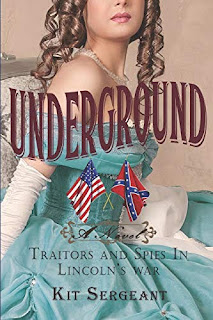
Her next book, Underground: Traitors and Spies in the Civil War, transports us to the War Between the States. She tells of four women who spy for both the Union and the Confederacy in a compelling narrative that gives both sides to a war that still resonates throughout American history and current events.


As with her previous works, Sergeant captures different women from various walks of life that contributed to the Civil War in their own unique ways. Hattie Lewis is the second woman employed by Pinkerton's Detective Agency (the first being Hattie's mentor,Kate Warne). After successfully and secretly hiding and protecting President Elect Abraham Lincoln from an assassination attempt, the boys at Pinkerton's take notice and offer Hattie tougher and more dangerous assignments including spying.

Mary Jane Richards Bower is an African American woman who had been  freed by her employer, Miss Lizzie. Grateful, Mary Jane offers her services by working in various wealthy Confederate homes and passing information to the Union. Her contacts eventually take her to the home of one Jefferson Davis, the President of the Confederacy.

Belle Boyd is a young opinionated Southern Belle who uses her femininity and penchant for firearms to obtain information on behalf of the Confederacy in tempestuous Baltimore, which has mixed residents on both sides of the conflict.

Loretta Janeta Velazquez Williams, a New Orleans widow, takes a more direct approach to the action than the other three lead characters. She dons men's clothes and fights for the Confederacy under the name Lt. Harry T. Buford. 


I have mixed feelings about this installment, as compared to 355 and L'Agent Double which I felt were terrific with no argument. Right or wrong, a lot of my emotions towards Underground have to do with current controversies towards the Confederacy and how it is presented in historical textbooks and popular culture. There are some interesting chapters where Belle uses most men's perception of femininity against them by playing the flirtatious Southern Belle while obtaining and passing information. It's also interesting that Loretta goes the opposite extreme and dons male garb to become a soldier. However, their unapologetic Southern pro slavery views make it hard to be empathetic and root for them.

Many times their racism is made completely clear as they think of black people as subhuman. Loretta is particularly upfront using derogatory terms in her first chapter. The fact that these are women challenging roles that society expects from them and they do not see the correlation towards African Americans doing the same is jarring at best and hypocritical at worst. I know we shouldn't put modern views on the past but there are times when the difference between past and present cannot be ignored and this is one of those times.


Because of that the stories of Hattie and Mary Jane are much more interesting. Hattie tries to break through the all men society of Pinkerton's and eventually earns the respect of her colleagues through her tenacity, courage, and persistence. She spends much of the book on an extended cover assignment where she and a colleague pose as husband and wife. It's a difficult assignment as Hattie must reconcile her personal feelings with her responsibility and duty as an investigator and spy.

Also interesting is Mary Jane's story. Similar to Belle using the masculine views of femininity against her opponents, Mary Jane uses white assumptions about black people against them. She poses as an illiterate kitchen maid but can read very well and is able transcribe missives and documents. She makes her employers believe that she is unintelligent when she is quite brilliant and observant. Also of the four stories, hers is the most suspenseful as Mary Jane ends up working for Jefferson Davis' household right in the belly of the beast of racism and separatism if you will. Her time there is filled with tense moments as she is well aware that any false move, any mistake, and she could be killed by a family who wouldn't bat an eyelid over killing one of their slaves.


Unlike 355 where the stories overlap as the three leads meet and become friends, there isn't much overlap between the four stories. They cover a wide ground of several states so it is not likely that these women would have been able to physically encounter each other very much. There is one awkward early chapter where Belle attempts to seduce "Harry" but Loretta leaves before too much happens, but that's it.


Instead their connections are more thematic then physical. This is particularly prominent when Belle and Hattie are imprisoned at the same time for different charges. The women handle their imprisonment in their own unique styles as Belle flirts with guards and makes powerful allies on the outside that vouch for her. Hattie faces her imprisonment with stoic patience but also quiet terror especially when one of her fellow investigators is executed. 


Underground is yet another achievement in Sergeant's series by giving faces and names to women who otherwise would have gone unknown. It's about time they spoke and acted for themselves.

Tuesday, November 23, 2021

New Book Alert: Dark Maiden By Ian Conner; Native American Folklore Mixes With Modern Horror


New Book Alert: Dark Maiden By Ian Conner; Native American Folklore Mixes With Modern Horror

By Julie Sara Porter

Bookworm Reviews


Spoilers: Dark Maiden by Ian Conner is like one of those ghost stories that you read in Haunted Places collections or hear about in an urban legend. It tells of an old evil spirit with a fascinating backstory that intrudes upon the present day to enact some sort of vengeance or malicious intent on subsequent generations. A story like this might be familiar, but Conner gives it enough atmosphere to send chills down your spine.


A mysterious creature called The Skadegamutc or Ghost Witch has been haunting the Pequabuck Lake in Nollesemic Village, Maine. Many people since the 16th century have been missing and some have drowned despite varying degrees of swimming ability. In 2005, disappearances are quite high particularly because Carlyle Allen, a wealthy developer, wants to build new property in the area leading to more people and more victims to fall prey to the Ghost Witch's clutches.

What is known about the Ghost Witch is that it sometimes takes the form of a beautiful maiden that lures its prey. It appears to have a fondness for twins since many of its victims either are twins or are parts of families that have them. It also seems to have a vendetta against the Two Spears and Four Claws Families, two local clans who have been sworn enemies of the creature for 500 years.


The Ghost Witch is an actual figure from Wabanaki folklore. In Conner's book, it is given a chilling backstory and modus operandi that gives this old narrative a modern scare.

One of the best chapters in the entire book is the first where the Reader is first introduced to this enigmatic spectre in the 16th century. It takes the form of a Maiden that captivates four young women who consider themselves homely as compared to this otherworldly beauty swimming in the lake. As they swim, the girls not only find that they have become beautiful, but are drawn to this mysterious maiden. The Ghost Witch gives an alluring almost erotic presence as it draws the young mortal woman only to take their lives. A story with variations that are repeated so often that it has become hoary and even cliche is transformed into a moment of seduction and terror thanks to Conner's engaging writing. 

That seduction and terror continues for centuries as people are  drawn to and appalled by the Ghost Witch and its actions. It seems to get off on people's most negative emotions like insecurity and greed. Perhaps the Ghost Witch is a metaphor for unbridled and extreme desires and what happens when those desires overpower and take control. They draw someone towards them to a dark and disturbing end.


What is compelling about the Ghost Witch is that it harbors no distinction between who it attacks (except that it has a fondness for twins). Male or female, white or Native American. It's all the same to it. While there is a subplot about redevelopment and the potential destruction of the land and environment, it's clear that the Ghost Witch is not there as a symbol of Mother Nature's rage. In fact, since it uses the most negative emotions to draw prey inside, maybe it's hoping for more greed from the developers and rage and hopelessness from the residents. More negative emotions means more humans to play with and snack on. However, The Ghost Witch doesn't care who it hurts. It will destroy anyone that is unfortunate enough to cross its path.

In fact, its worst enemies are from the Two Spears and Four Claws families. While the Ghost Witch attacks in the present, we are also given the back story of how this creature came to be and why the families are united in their drive to destroy it. For spoiler's sake, I won't go into it in this review but it is compelling and makes the characters more understandable.

 The history gives more dimensions to this inhuman character and its enemies to remind us that it once was actually human, came from somewhere, and fell in the worst way possible. The backstory also reveals why the Two Spears and Four Claws families are so determined to destroy the Ghost Witch and why the current generation feel that it's their responsibility to end this evil once and for all.


Dark Maiden is a construction and restructuring of an ancient folk tale. By giving us its origins, motives, and means, Conner shows that this is not simply some unstoppable demon. Instead it was once human and like all humans is prey to weakness. If understood, it can be defeated.


Weekly Reader: Nightfall Gardens (Nightfall Gardens Series Book One) by Allen Houston; Memorably Eerie Mysterious Novel Tribute To The Dark Gothic YA Novels of Our Youth


Weekly Reader: Nightfall Gardens (Nightfall Gardens Series Book One) by Allen Houston; Memorably Eerie Mysterious Novel Tribute To The Dark Gothic YA Novels of Our Youth

By Julie Sara Porter

Bookworm Reviews


Spoilers: While I read Nightfall Gardens by Allen Houston, I kept picturing in my head the illustrations of Ed Gorey. Nightfall Gardens is that kind of deliciously wicked Gothic YA novel. It evokes the writing style of books like The House With A Clock On Its Walls by John Bellair, Bedknobs and Broomsticks by Mary Norton, or A Series of Unfortunate Events by Lemony Snicket. It's that type of book where eerie things happen in a dark and imaginative setting to some young children. The best YA books are the ones that remind us that dark magical spooky things can happen even to young people and aren't afraid to give their young Readers a bit of a scare. Allen Houston excels at that.


Lily and Silas Blackwood are part of a family of traveling actors. They haven't exactly achieved success, because of dwindling audiences, leaky theaters, and a lead actor who is a full course ham sandwich. After their latest lackluster performance, Lily encounters a very sinister looking man who frightens her on sight and reveals that he is her uncle Jonquil.

Jonquil has reunited with his brother's family to inform them that his mother, the guardian of the mysterious Nightfall Gardens is dying. Nightfall Gardens needs a new female heir or all hell will break loose, literally, and to keep the family tradition going, Lily is selected for the position. After Lily's parents turn the offer down flat,  Jonquil and his men kidnap Lily to take her to Nightfall Gardens with Silas in tow. The children have to be prepared for Lily's new role as Guardian and Silas' as a Rider (or security guard for the Gardens and the people inside the manor). The Blackwood children are introduced to their eccentric grandmother, Deiva, and the Gardens' creepy denizens including ghosts, fauns, werewolves, gargoyles, and Cassandra, a sardonic girl with green skin and a huge grudge against the Blackwoods. Oh and should they want to leave, well they can't. The Nightfall Gardens are cut off from the rest of the world including Lily and Silas' parents.


Nightfall Gardens is one of those memorable settings that are found so often in children's literature: brilliantly imaginative, at times sinister, but knows how to capture that wonder and zeal. Think Wonderland, OZ, Never Land, Hogwarts, Fantastica, The Labyrinth, or The Woods in most fairy tales. We may be stretched by our wonder and imagination. We might love to visit these places but we never forget that there are often dark mysterious forces at bay.

Nightfall Gardens is like every haunted mansion that has ever existed and considering its backstory, it could be seen as the original haunted mansion. (I won't spoil the surprise but let's just say that it involves a certain Greek woman and a certain box which should not be opened.)

Nightfall Gardens gives an unmistakable eerie yet seductive aura from the moment that Jonquil and the Blackwood children enter and face a group of violent Pans. (Not cookware, Pan the satyr from Hellenic mythology. They were the wild feral creatures, half men and half goats, who loved to play their pipes, frolic in the woods, and do unspeakable things to ladies).

 It's the kind of place where that shadow that you swear is a rack of clothes really is a monster in the closet. "Dark is never far and is always looking for a way in," Jonquil says and he is not kidding. It is always dusk or dark around the Gardens. The Gardens themselves draw magical creatures towards it, making living there an unpleasant but enchanting home for the Blackwoods and all who inhabit it.


It turns out that the Pans are just the opening act because Nightfall Gardens is full of surprises. The very ground has weeds and vines that appear to trap and scratch the unwary traveler until they bleed to death. Rooms appear and disappear and mirrors show ghastly reflections instead of the person looking into them. That's not counting the animals and humans, or those that appear as such, that surround the place.

Shades, or Ghosts, take the form of Lily to trap Silas and almost succeed. The White Garden, where the Shades live, is also home to Demons, Banshees, Succubi, Lords of the Underworld, and Wicked Crones. Grandma Deiva is forever waiting for the ghost of her late husband, the children's grandfather, to escort her to her death. Before that, the children have close encounters with him. 

There are some enigmatic figures called The Smiling Ladies that Lily and Silas are advised to just stay away from ("Someone you don't want to meet unless you want eternal sleep," a character somberly says). These creepy creatures are all there, lurking in the shadows, waiting for something, and are ready for the moment when they can strike and shed some blood.


Nightfall Gardens is the first book in the Nightfall Gardens Series, so it does what most first books do: sets up the world. Houston makes the Gardens an unforgettable place that the Reader wants to explore at least through writing. (This Reader is too much of a coward to go to a place like that for real.) Like many, the first book isn't so strong in plot as it is in tone. Plot points are introduced, but due to the book being part of a series, are not resolved by the end. This suggests that these will be ongoing struggles, motifs, and themes that will occur throughout the series rather than being resolved by Book 1.

Besides setting, Houston does a good job in characterizing the Blackwoods. This is a family that has a tremendous burden. They don't want to do it. They have often fought against it, but they know that they have to. Many of them are willing to sacrifice their own personal happiness and welfare to remain in this haunted and disturbing estate for the larger picture of protecting the world.

Since Lily and Silas are new to this responsibility, they try to fight it. Lily in particular is somewhat narcissistic and longs to return to the legitimate stage so she can become a star. When she hears about a possible loophole, she spends some time looking for it so she and her brother can be freed and not have to suffer the burden that their ancestors did.

Silas is more pragmatic and realizes that his own protective nature towards his sister was the reason for his arrival. He wasn't supposed to come and just forced his way in. However, now that he is here, he is determined to do what he can to protect the Gardens and especially Lily.


Nightfall Gardens is one of those literary locations that you will never forget. You might be too scared to visit and you certainly wouldn't want to live there. But you don't mind reading about it, so you can get a good old fashioned Gothic scare.


New Book Alert: The Keeper of Happy Endings by Barbara Davis; Predictable, But Sweet and Romantic Novel About The Desire To Give Happy Endings


New Book Alert: The Keeper of Happy Endings by Barbara Davis; Predictable, But Sweet and Romantic Novel About  The Desire To Give Happy Endings

By Julie Sara Porter

Bookworm Reviews


Spoilers: The Keeper of Happy Endings by Barbara Davis is one of those types of novels with twists that you can see a mile away. The surprise revelations can be spotted in the next country with how predictable they are, especially if you have read a lot of these types of books that tell two stories: one historical and one modern. It won't be a big surprise that the two characters from different eras have a lot in common, or that the modern character learns a valuable lesson from the older character, or even (shocker), that the two stories of two complete strangers are actually connected. Despite or even because of its predictability, The Keeper of Happy Endings makes the Reader love the characters and want to see them get their happy endings after experiencing such hardship as war, abandonment, loss, abuse, and death.


The plot focuses on two women. The first protagonist is Aurora "Rory" Grant, a

young woman from the 1980's who is anxious about her fiance, Hux, a doctor who had been reported missing in South Sudan. The worry is intensified by the verbal abuse that she experiences from her mother, Camilla, a wealthy snobbish woman with extremely high standards that Rory feels that she can never achieve. Feeling lost and disenchanted, Rory decides to open a gallery and maybe display her own textile art. She has even spotted a lovely old building that would be perfect.

The building is owned by the second protagonist, Soline Roussel. In the present, Soline is an elderly recluse. As we learn about Rory's present, we also learn about Soline's past. She was one of a family of dressmakers, whose specialty lay in wedding gowns. The Roussels acquired quite a reputation as being almost magical with their talent. It was said that a bride who wore a Roussel wedding gown was destined to have a happy ending. 

However, the happy endings did not cover the Roussels themselves. Soline's mother had a  mysterious lover who disappeared before she realized that she was pregnant. Her grandmother was deserted by her husband after the birth of her second daughter. That daughter, Soline's aunt, became widowed when her husband died in a car accident during their honeymoon. The Roussel women put their pain and grief into their beautiful intricate designs earning the nicknames of "The Dress Witches." 

Soline also succumbs to the Roussel Family Curse of being unlucky in love. In 1943, shattered by her mother's death, her discovery of Edher father's identity, and the French Occupation by the Nazis, Soline falls in love with Anson Purcell, an American Red Cross medic. The romance begins sweetly enough but let's just say that things don't end well between them. 


The Keeper of Happy Endings is a lovely story which intertwines past and present like the threads that make a Roussel wedding gown. LIke with many of these stories, Rory and Soline's stories are paralleled. Both are talented artists with textiles and fabric. Both have missing lovers due to war. Both have to live up to their family's immense expectations. The difference between the two women is how they handle those similarities. 

Rory is a lot more passive than Soline. Though highly talented, Rory lacks self esteem to display her art. Hux gives her the suggestion to open the gallery and her friendship with Soline gives her the confidence to display her art. Until these influences, Rory never believed in her talent. 

However with Rory's mother, it is easy to see where Rory gets her insecurities from. Camilla micromanages Rory's entire schedule and commands that they meet for regular luncheons. The lunches usually consist of Camilla telling Rory everything that she feels that she is doing wrong, which from what I can tell, is everything that Rory is doing. She is constantly picking at Rory finding different ways to undermine her daughter's self esteem and unfortunately because Rory is still in close proximity to her mother, she is forced to listen. 

Anyone who has lived with a narcissistic verbally abusive parent will understand exactly what Rory is going through. That pain lasts into adulthood and many, like Rory, often accept it. Sometimes it takes an outside agent to break that cycle of abuse and dependency and lucky for Rory, Soline is that outside agent.


In contrast to Rory's passivity, Soline is much more active. While her family already established their reputation as makers of dressing gowns, Soline's addition of bows to the gowns makes the company her own. She becomes just as well known in her own right in New England as her family is in France.

During the war, she volunteers at a hospital and becomes an ally to the French Resistance showing that she can be resourceful in times of great stress. She also has the strength to leave France when her business dries up and the Nazis are on the lookout for Resistors.

Some of the best passages that show Soline's more active character is when she arrives in the United States and like Rory finds herself in a potentially abusive situation. She stands her ground against her abuser and befriends a family member, even making some lovely designs to get back into the business. When Soline finds herself in a troubling situation, rather than accept it like Rory, Soline stands up for herself and leaves. Slowly, she retains her reputation in the states as a prominent designer. Hearing this story gives Rory the confidence to act upon her own life and take charge of it. Like the gowns that her family designs in the hopes that the bride will have a happy ending, Soline almost acts like a fairy godmother by becoming the catalyst for Rory to get hers.


As I said, the plot twists and revelations are somewhat predictable but their placement in the book is well executed. Usually, the revelations are at the end where the characters are gob smacked and strengthened by this deeper bond. Sometimes there is an epilogue that serves as a "Where Are They Now?" Moment to show how the characters reflected and evolved because of the deeper connections.

In Keeper of Happy Endings, the revelations occur towards the middle so there is more to be done. There are still hurt feelings. Characters say that they aren't ready for such a confrontation and still spend several chapters estranged. These characters' worlds are rocked by such news and Davis realizes that one chapter is not going to change that.

What actually stands out is how this news affects Rory. Far from the passive wallflower that she was before, she is compelled to act and fix what went wrong in the past. This news, along with Soline's friendship, propel Rory to bring about not only her happy ending but everyone else's as well.


Yes  The Keeper of Happy Endings is predictable. But it is also sweet, romantic, and filled with lovable characters that you root for. Yes you do want to see, and are glad when they finally get, their happy ending.


Sunday, November 14, 2021

Weekly Reader: Home Front Girls by Suzanne Hayes and Loretta Nyhan; Moving and Sweet Novel About Long Distance Friendship Between WWII Wives


Weekly Reader: Home Front Girls by Suzanne Hayes and Loretta Nyhan; Moving and Sweet Novel About Long Distance Friendship Between WWII Wives

By Julie Sara Porter

Bookworm Reviews 


Spoilers: 

Wartime can make the strangest alliances and friendships. People who would never befriend or even associate with each other from different backgrounds, places, and statuses become allies, simply because they are fighting an enemy army or are at home while friends or family members are doing the fighting.


That is the situation found in Suzanne Hayes and Loretta Nyhan's Home Front Girls, a moving and sweet novel about two American women of different ages, classes, backgrounds, and parts of the country who become pen pals while their husbands fight in WWII.


Glory Whitehall, a young mother from Rockport, Massachusetts whose husband, Robert, is fighting overseas receives one of several addresses, presented by her church, to write to other military wives. Glory selects one with the lovely name of "Garden Witch." 

The "Garden Witch" is in reality Rita Vicenzo, a professor's wife from Iowa City, Iowa whose husband, Sal, is also fighting.

On the surface, the women would have nothing in common. Glory is in her 20's, has one young child and is expecting another, and is from a wealthy family. Rita is in her 40's with an adult son and is from an immigrant family.  Over two years of love, humor, tears, marriage, enlistment, anxiety, rekindling of romance, tested fidelities, and tremendous agonizing loss, the two unlikely women become best friends united by their grief and worry.


As the Readers peer into Glory and Rita's correspondence, they learn how similar and yet how different their lives really are. Both of them are worried about their husbands fighting and both feel isolated within their communities because of that anxiety even though they are surrounded by intrusive but well meaning gossipy neighbors, trying to be helpful but not always helpful female friends, and family members, especially children, with problems of their own.

As with many of the women whose husbands were fighting in WWII, the deuteragonists try to maintain brave supportive faces as they work, create victory gardens, use their ration coupons, attend military support rallies and fundraisers, and raise their children. However, by writing to each other, another woman who has been in the same situation as them, they can convey their worst fears and anxieties. They can let their guards down and reveal their vulnerabilities that they keep hidden from the people around them.


The book also explores their different issues and how they deal with them and help each other. Glory is younger and more impetuous. With Robert gone and two small children, she clings to her childhood friend, Levi. Levi has been a close friend to Glory and Robert and since he has a bad heart, he can't serve in the war. He helps Glory and becomes a surrogate father to her children. It isn't too long before Levi starts expressing feelings that he wouldn't normally express if Robert weren't around. Glory gives into her loneliness and deepest emotions and reciprocates her feelings towards Levi, despite Rita's objections. Glory finds in Levi someone to share her heart aching loneliness, the need to be with someone, that she has felt since Robert's been away. 


Rita also has problems of her own, particularly concerning her adult son, Tobias. Tobias has been romantically involved with a bar owner's daughter, Roylene. Things become more complicated when Roylene becomes pregnant and Tobias enlists before they are married. Despite her own reservations about the situation, Rita provides emotional and physical support to Roylene, becoming a mother figure to her and defending her status as an unwed young mother. Rita relates to Roylene's status as an outsider. She knows what it's like to be judged by a small town so she provides Roylene, the support that she needs.

Rita and Glory's lives change as they encounter death and injury from war. That's when their strengths are truly tested and they depend on not only their own resourcefulness and independence, but the love of the people around them and each other to get through the ultimate hardship of the war.


What makes this book's writing style is the way in which it was constructed. According to the Reader's Guide, Home Front Girls was written via emails between Hayes and Nyhan with each woman taking each character. Hayes, being younger, took the more free spirited and flirtatious Glory while Nyhan, being older took the view of the sardonic and opinionated Rita. In fact, like their characters, Hayes and Nyhan never physically encountered each other during the work of the book. They met after the book's publication and have since met other times (as their leads eventually do as well solidifying their friendship).  Knowing that the book was written similar to how the characters lived, physically separate but emotionally close adds a sense of unmistakable duality between creators and their creations.


Home Front Girls is a novel that explores the deep friendship that women share as they support each other through stress and happiness, whether getting through war or writing a book.