Showing posts with label Confederacy. Show all posts

Thursday, November 25, 2021

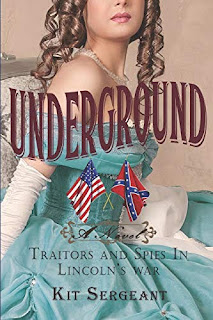
Weekly Reader: Underground by Kit Sergeant; Sergeant's Female Spies Take on The American Civil War


Weekly Reader: Underground by Kit Sergeant; Sergeant's Female Spies Take on The American Civil War

By Julie Sara Porter

Bookworm Reviews


Spoilers: The previous book by Kit Sergeant, 355, told the story of Meg Coughlin, Sally Townsend, and Elizabeth Burgin, three women who spied during the American Revolution, one of which may have been the mysterious enigmatic "355," a woman who wrote missives directly to George Washington himself.

Her next book, Underground: Traitors and Spies in the Civil War, transports us to the War Between the States. She tells of four women who spy for both the Union and the Confederacy in a compelling narrative that gives both sides to a war that still resonates throughout American history and current events.


As with her previous works, Sergeant captures different women from various walks of life that contributed to the Civil War in their own unique ways. Hattie Lewis is the second woman employed by Pinkerton's Detective Agency (the first being Hattie's mentor,Kate Warne). After successfully and secretly hiding and protecting President Elect Abraham Lincoln from an assassination attempt, the boys at Pinkerton's take notice and offer Hattie tougher and more dangerous assignments including spying.

Mary Jane Richards Bower is an African American woman who had been  freed by her employer, Miss Lizzie. Grateful, Mary Jane offers her services by working in various wealthy Confederate homes and passing information to the Union. Her contacts eventually take her to the home of one Jefferson Davis, the President of the Confederacy.

Belle Boyd is a young opinionated Southern Belle who uses her femininity and penchant for firearms to obtain information on behalf of the Confederacy in tempestuous Baltimore, which has mixed residents on both sides of the conflict.

Loretta Janeta Velazquez Williams, a New Orleans widow, takes a more direct approach to the action than the other three lead characters. She dons men's clothes and fights for the Confederacy under the name Lt. Harry T. Buford. 


I have mixed feelings about this installment, as compared to 355 and L'Agent Double which I felt were terrific with no argument. Right or wrong, a lot of my emotions towards Underground have to do with current controversies towards the Confederacy and how it is presented in historical textbooks and popular culture. There are some interesting chapters where Belle uses most men's perception of femininity against them by playing the flirtatious Southern Belle while obtaining and passing information. It's also interesting that Loretta goes the opposite extreme and dons male garb to become a soldier. However, their unapologetic Southern pro slavery views make it hard to be empathetic and root for them.

Many times their racism is made completely clear as they think of black people as subhuman. Loretta is particularly upfront using derogatory terms in her first chapter. The fact that these are women challenging roles that society expects from them and they do not see the correlation towards African Americans doing the same is jarring at best and hypocritical at worst. I know we shouldn't put modern views on the past but there are times when the difference between past and present cannot be ignored and this is one of those times.


Because of that the stories of Hattie and Mary Jane are much more interesting. Hattie tries to break through the all men society of Pinkerton's and eventually earns the respect of her colleagues through her tenacity, courage, and persistence. She spends much of the book on an extended cover assignment where she and a colleague pose as husband and wife. It's a difficult assignment as Hattie must reconcile her personal feelings with her responsibility and duty as an investigator and spy.

Also interesting is Mary Jane's story. Similar to Belle using the masculine views of femininity against her opponents, Mary Jane uses white assumptions about black people against them. She poses as an illiterate kitchen maid but can read very well and is able transcribe missives and documents. She makes her employers believe that she is unintelligent when she is quite brilliant and observant. Also of the four stories, hers is the most suspenseful as Mary Jane ends up working for Jefferson Davis' household right in the belly of the beast of racism and separatism if you will. Her time there is filled with tense moments as she is well aware that any false move, any mistake, and she could be killed by a family who wouldn't bat an eyelid over killing one of their slaves.


Unlike 355 where the stories overlap as the three leads meet and become friends, there isn't much overlap between the four stories. They cover a wide ground of several states so it is not likely that these women would have been able to physically encounter each other very much. There is one awkward early chapter where Belle attempts to seduce "Harry" but Loretta leaves before too much happens, but that's it.


Instead their connections are more thematic then physical. This is particularly prominent when Belle and Hattie are imprisoned at the same time for different charges. The women handle their imprisonment in their own unique styles as Belle flirts with guards and makes powerful allies on the outside that vouch for her. Hattie faces her imprisonment with stoic patience but also quiet terror especially when one of her fellow investigators is executed. 


Underground is yet another achievement in Sergeant's series by giving faces and names to women who otherwise would have gone unknown. It's about time they spoke and acted for themselves.

Friday, April 9, 2021

New Book Alert: Enigma (Road to the Breaking Book 2) by Christopher Bennett; Brilliant Pre-Civil War Era Novel Explores the Real Cost of Slavery


New Book Alert: Enigma (Road to the Breaking Book 2) by Christopher Bennett; Brilliant Pre-Civil War Era Novel Explores the Real Cost of Slavery

By Julie Sara Porter

Bookworm Reviews


Spoilers: Among the myths that the Southern states held in keeping slavery is "The Good Slave Owner Myth", that as long as the slave owner is good to their slaves, never has them whipped, separated, or sold, and had them educated and converted to Christianity, then they weren't doing anything wrong. Unfortunately, that myth was so strong that many Southern apologists, Confederate fan boys and girls, and devotees of the Southern "Lost Cause" (in other words racists with a Civil War grudge) still cling to that myth.

What they fail to acknowledge is that the institution of slavery itself was wrong. If one participated in the transfer, ownership, and purchase of human beings, then their so-called goodness had already been compromised. Their treatment of their slaves was nothing more than mere hypocrisy. That the phrase "good slave owner" is as much a contradiction in terms as the phrase "good Nazi." 


Enigma, the second book in Christopher Bennett's Road to the Breaking historical fiction series about the days before the American Civil War, tackles the "Good Slave Owner" Myth head on. It shows us a protagonist who has seen first hand the horrors of slavery and has returned to his family antebellum plantation home with no intention of repeating them.


In 1860,Mexican-American War veteran Captain Nathan Chambers returns to his childhood Greenbriar County, Virginia home, to take over the run of the plantation after the death of his father. Nathan isn't alone either. He brought six of his best and most loyal soldiers and obtained a completely different outlook on life.

Because of events in the previous book, Road to the Breaking, Nathan has formed a deep fire forged friendship with his fellow soldiers, a band of brothers if you will. Nathan has also experienced firsthand the horrors of slavery and he is no longer the ambivalent boy who left Virginia. Instead, he sees fellow human beings that are dehumanized by that deplorable institution. When he returns home, he has no intention of repeating the institution on a farm that is now his. He is not content to be a good slaver owner. Instead he wants to be a good man and to that, he wants to end the institution of slavery.


Nathan instead wants to free all of the slaves. However, Virginia laws states that that can't happen. However, if laws can't be broken, then they can always be bent. The slave laws say nothing about indentured servitude. So Nathan cleverly decides to change the status of his slaves to indentured servants. They will work on the plantation for a period of seven years for pay. Then at the end of that period will have the option to either leave or become regular paid workers.

During that time, the ex slaves will be given a small tract of land in which they will cultivate for themselves, become literate, be permitted to speak and question their treatment, and have legal marriages. Even Christian sermons will reflect this new outlook, no longer emphasizing white's domination over other races. Instead, the sermons reflect equality and humanity.

The reactions from the people on the plantation vary. Some are excited and supportive. Many former slaves are skeptical and a few are contemplating escape or a violent revolution. The white employees are incensed that they can't kick around the black employees any longer. An overseer is fired when he is caught venting his rage and assaulting a female slave. The neighbors are horrified and offended. It is going to be an uphill battle to implement these changes, that's for sure.


Enigma is filled with memorable characters. Nathan is a terrific lead character who has not only realized the error of his ways. He not only talks the talk in realizing how evil slavery is but he walks the walk in doing everything that he can to get rid of it. He is a leader who leads by example and that makes him someone who is worth following.


Another character who stands out is Evelyn Hanson, a young woman who Nathan's mother has set up with her mother, for them to go courting. Evelyn has been raised, almost brainwashed, to act like a typical Southern lady to the point that she doesn't know her own mind. When she first encounters Nathan, she parrots all of the talking points about slavery that her mother told her to say without thinking about them. Then when she is finally challenged and put on the spot, she reveals herself to be an intelligent and opinionated young woman who unfortunately has had to keep her thoughts to herself. Unfortunately, that conditioning has resulted in Evelyn carrying a lot of anxiety and insecurity. Her mental questions of "Who am I?" are repeated so often that she seems to hover towards an identity crisis or mental breakdown.


Supporting characters stand out in this book particularly Nathan's men and the slaves turned indentured servants. Nathan's fellow soldiers are an extremely loyal team to the point that when Nathan asks if they want to stay working with him, they all agree, citing having no family to return to, large families that wouldn't miss them, and living too far from their former homes. They are also well writtn individuals who stand out on their own right from Stan, the friendly giant Russian who is good with children, to Billy, the quiet tracker who spends this days out in the woods to familiarize himself with his surroundings, to Tom, Nathan's second in command who has a fine organizational and technological mind that enables the plantation workers to come up with innovative ways in which slavery will no longer be necessary.


The indentured servants are well written as well, particularly how they view Nathan and his new ideas. Not surprisingly not all of them are excited. Some like the fiery Tony remain unconvinced and practice shooting just in case they need it. Others like Phinn, think that Nathan's words are all talk and will believe the change when they see it. Megs raised Nathan since he was a baby and isn't afraid to call him out in public on his behavior as a child and when he oversteps his boundaries as an adult. A particularly memorable character is Rosa who becomes involved romantically with Tony and harbors a painful secret connection to the Chambers family.Through these characters, Bennett explores the painful cost of slavery on one's humanity and self identity.


Of course since Enigma predates the Civil War, there is plenty of foreshadowing about the conflict, some very blunt and obvious. Abraham Lincoln's candidacy is referred to with admiration and contempt. Rumors of succession get louder.

 Some foreshadowing bears many similarities to modern day. One character contemplates how the election of one President could cause so much contention that it would inspire people to commit an insurrection definitely calls to mind a certain modern insurrection on January 6. Good historical fiction allows us to draw those parallels between the old days illustrated in the work and modern day, but most let us do that on our own. They don't come right out and say it. In this instance, subtlety is lost to obviousness.


However, Enigma reveals a world that is on the verge of changing. When that happens, many take long looks at themselves and realize how wrong they were.