Showing posts with label Civil War. Show all posts

Saturday, November 21, 2026

Gone With the North Wind A Civil War Novel of New York City by Ann Prehn; The Wardens of Old London Bridge Book 1 Cromwell's Prophecy by John Vale


Gone With the North Wind: A Civil War Novel of New York City by Ann Prehn 

 The title might cause readers to wonder certain things but no. Ann Prehn’s Civil War novel of New York City, Gone With the North Wind is not simply a retelling of Margaret Mitchell's Gone With the Wind from a northern point of view. It covers the Civil War from a largely northern perspective, yes, but that's where the similarities end.

Instead of focusing on one specific family through the eyes of the oldest daughter and experiencing her romances and business acumen during the time period, it focuses on a group of friends who are heavily involved in artistic and political circles and find their values severely tested in such violent times.

In the 1860’s New York artist Wendell was part of a group of Bohemians, artists, authors, poets, activists, and revolutionaries. He becomes romantically involved with Lillian, a married woman who runs in Bohemian circles. Her mysterious behavior confuses Wendell until he learns that she is a committed abolitionist and member of the Underground Railroad.

This book has a phenomenal grasp of setting and history. Prehn did her homework and it shows. The mid 19th century pre-Civil War era comes to life with such attention to detail of time and place. One of the most fascinating aspects is the appearance of the Bohemians. People who use their talents to expose society’s ills. 

There are real and fictional characters interacting with one another. Walt Whitman and Louisa May Alcott are friends of Wendell's and participate in the war effort while writing their free verse poetry and sensationalist novels respectively. Frederick Douglass and Harriet Tubman work with Lillian in the Abolitionist movements. Combining fiction and history creates a rich tapestry of the setting.

Prehn also has a decent grasp of most of the characters. The best character is Lillian. She is a woman who had to conform to society's standards for an upper middle class woman of the 19th century. However, her marriage wasn't the end of her life or voice. In fact she expressed her more iconoclastic nature after her marriage.

She counts the Bohemians as part of her friend group and uses her wealth to promote their works. She hosts art work, leads readings, and recommends editorials and essays written by her friends.

She doesn't just have an eye for the arts but a strong social conscience that doesn't just talk the talk but walks the walk. She spends a lot of time away from Wendell to participate in the Underground Railroad and the Abolition Movement. She is committed to the Bohemian ideals of truth and actively practices it.

However parts of the narration is severely lacking and at times Wendell is not the most likable of protagonists. Wendell considers himself a free spirited Bohemian and there are moments especially where he rejects his immediate family’s traditional values to become an artist. He engaged in plenty of lively discussions with his colleagues about beauty, freedom, war, and love.

Even though he temporarily cools off from Lillian when he learns that she is married, he continues their affair.

However, as much as Wendell claims to be different from most men, he still retains many of the typical views of a man of his day especially towards women. Multiple times he is convinced that Lillian is cheating on him and considers her guilty until proven innocent. He has very traditional ideas of the type of wife he wants and perhaps Lillian would not have fit the role. There are times when he acts like a hypocrite when it comes to rebelling.

This book has a flaw which is very detestable. It chooses one particular narrator and tells the story from their perspectives when more exciting storylines are going on around them. The book is almost exclusively told by Wendell. Many of Lilian’s actions in the Underground Railroad and her volatile marriage are told to Wendell. 

It would be a lot better if the book was told through multiple perspectives. Lilian in particular falters because of this. She is written to be a strong person who lives according to her principles but it is not as effective getting that information second hand. It would have been far more interesting in getting some of her perspectives about the people and events around her.

Gone With the North Wind could be a book that will blow you away but sometimes it's nothing more than a gentle breeze reminding you to stay put.


The Wardens of Old London Bridge (Book 1 Cromwell's Prophecy) by John Vale 

If a book is over 1,000 pages you can guarantee that it's going to make the most of that length and produce great details and slow moving action so it will either be really exciting or really boring. 

Luckily for anyone who reads John Vale’s Historical Dark Fantasy Cromwell's Prophecy, the first book in The Wardens of Old London Bridge series, it is the former. It makes the most of its tremendous length by capturing a detailed time and place, rich characters, and some dark unforgettable moments of magic and demons.

Matt, a baker's apprentice from Yorkshire makes his deliveries along the London Bridge when a strange encounter leaves with a mysterious bag with a very gruesome secret. 

This encounter puts Matt right in the middle of a battle between two separate groups of magic users and an ancient evil under the Bridge that is awake and hungry.

The book is brilliant at capturing real history and speculative fantastic history. This is set in 1537 during the reign of Henry VIII when England was going through a huge religious schism that switched from Catholicism, to Protestantism, back to Catholicism.

 It reversed several more times in the near future before the Anglican Church of England was declared the country's official religion. So the country is in a period of uncertainty and anxiety because of the extramarital whims of its king.

Speaking of Henry VIII, the one and only flaw that the book has is no reference to Henry's private life or his revolving door of his wives and how that played into the divisive nature of the times. This is set during his marriage and possibly after the death of his third wife, Jane Seymour. 

We could have seen them as representatives of their various religions or having some magical connections of their own to contribute. It wouldn't be that hard to insert. Wife #2 Anne Boleyn actually was accused of witchcraft and other fictional accounts such as Philippa Gregory’s Plantagenet and Tudor Court Series flirted with more fantastic elements at the time. So the possibility that at least one of the wives having secret magical or psychic abilities is not entirely out of the realm of possibility.

In fact there is a huge missed opportunity in the appearance of a real-life character, Henry's advisor Thomas Cromwell (of Wolf Hall fame) plays a huge role. He straddles between reality and fantasy by associating with the Hungry Demon under London Bridge. He also seems to know more about the magic users and demons running around London than he should.

The missed opportunity is Cromwell's recommendation and championing of Anne of Cleves as Henry's wife #4. This was a move that would end in Henry and Anne's six months marriage and divorce, Cromwell's arrest and eventual execution. It would be interesting if Cromwell had some sort of vision of her and she is also magically connected to things.

 Since Anne's presence resulted in Cromwell's downfall, a possible otherworldly link could appear between them. I suppose that I am getting ahead of myself and all will be revealed in subsequent volumes. But it would be an interesting future plot point.

What is in the book is top notch. As I said, the religious change and paranoia of the time serves as an undercurrent in the book’s text. If people move from respecting some authority symbols and figures, to disrespecting them and so on, it can cause irreparable damage within their societies. Ultimately they could find friends, families, colleagues as part of some conspiracy in which they are not involved in. 

Naturally when the political, social, and religious realms are ruptured, it wouldn't take long for the physical realm to be completely toppled as well. Everyone is out for themselves and will use any means, even supernatural ones, to gain advantage and seek revenge.

The demonic figures make memorable horrifying presences like something out of Silent Hill. In one of the early chapters, Matt is an eyewitness to a man graphically being eaten alive by what he later learns are invisible demons called NotMeants. 

The man is in pain as his body is covered in sudden bruises, cuts, and blood. His organs fail and are cut open. It's definitely a memorable moment that attracts the reader's attention from the beginning.

The Hungry Demon is largely hinted at but barely shown and the NotMeants are only visible at certain times. Human interactions are what guide us through them. They are similar to many supernatural creatures in literature.

What you don't see is just as powerful and scarier than what you do. These creatures have that Lovecraftian style where they reflect a Cosmic Nihilistic Horror that causes madness and emptiness in their subtle moments.

Magic isn't found only in supernatural creatures but in human, or possibly superhuman characters. The primary antagonist Silas is a sorcerer who has the ability to manipulate and control six women whom he calls his Knots to do his bidding. 

The most fascinating character in the book is Greer, one of the Knots, who is beginning to question her programming and rebel against Silas’ authority especially when his orders involve murder, chaos, and destruction.

Matt also befriends various characters who consider London Bridge to be their personal magical protectorate. All of them are powerful but are aware of the sacrifices that have to be made to obtain those abilities.

Vivian, an innkeeper, has been eternally youthful for centuries. She suffers from the difficulties of living a long life, outliving friends and lovers. They age and she helplessly watches unchanging. She also reveals the blase jaded attitude that one would have seen when kings come and go, war and peace break out, and times of abundance and famine.

There are other characters too like Sweets, a healer who lives up to her name, and Ron, a dashing clever thief who also made otherworldly alliances to obtain their talents. Many times the book goes from third person omniscient to first person in some chapters that reveal the characters' backstories. 

Through these chapters, Sweets and Ron's origins of magical bargains and sacrifices made in pursuit of their particular fields of expertise. Sacrifices like home countries, trust in others, real personal relationships, and betraying or leaving friends and family members made them who they are.

There has yet to be any magical discovery about Matt. He seems to be a weirdness magnet where the strange events start with his arrival. Any subsequent abilities like seeing the demons come from his friendship and involvement with Vivian, Sweets, and Ron. He seems normal for such a protagonist.

His normalcy might be a red herring. There are hints that this baker boy is more than he seems. In fact his arrival might have been a huge factor in the strange events. It's left open ended whether he is himself magical or not but it could be explored in the future.

The Wardens of Old London Bridge has the potential to become a modern Dark Fantasy/Horror classic. It definitely makes the most of its setting, plot, characters, and length.




Tuesday, September 5, 2023

Weekly Reader: Everlasting Spring Beyond Olympus Volume 2 Colton and Blue Star by Francis Audrain; Sequel Mostly Better Than The Original Everlasting Spring Book


 Weekly Reader: Everlasting Spring Beyond Olympus Volume 2 Colton and Blue Star by Francis Audrain; Sequel Mostly Better Than The Original Everlasting Spring Book

By Julie Sara Porter

Bookworm Reviews


Spoilers: Francis Audrain's previous volume in The Everlasting Spring Beyond Olympus series, Benjamin and Boudicca was an incredibly uneven work. It recreated the leadership and independence in Boudicca, Queen of the Iceni, but it came to a screeching halt when Benjamin, a newly converted Christian found himself in Britain and spent most of his time trying to convert the queen to his religion rather than actually helping her fight the Romans. It was clear that Audrain cared more about pushing an agenda rather than telling an engaging historical fiction or even an accurate one (especially since Christianity didn't enter Britain until centuries after Boudicca's death). I suggested that it might have been better if Benjamin encountered a historical character that actually did convert to Christianity or at least a fictional character.

However, Audrain's second volume, Colton and Blue Star, improves on that. While Christianity is a huge part of this book, it is relegated to the background with characters letting their actions and values represent their religious beliefs rather than constantly talking about them. It also presents a fascinating novel with characters living through times of great change and turmoil and how they survived through times of emigration, violence, harsh conditions, war, and racism. Except for a few respects which I will get to later, it is mostly a better volume than Benjamin and Boudicca by far.

The book begins in 1820-40's with Fiona Daley, an Irishwoman who loves to study the history, literature, and legends of her country, particularly the story of Boudicca (who is implied to be her ancestor, tying the two books together). With Protestants taking land and harassing Catholics, Fiona and her parents decide to emigrate to the United States. On the boat, both of Fiona's parents die and she falls in love with Aaron Patrick Cohan, a sailor. They marry and Fiona gives birth to their son, Colton Patrick Cohan.

Fiona and Aaron are pretty interesting characters who unfortunately don't get as much time as they should. It would have been nice for the book to focus on them a bit more or better yet, Audrain made a second book about Fiona and Aaron and made Colton and Blue Star the third book.

Well Colton is a good character as well and this book deals mostly with his adulthood where he moves to the west, gets involved with the Civil War, and falls in love with Blue Star, a beautiful Native American woman.

Colt goes on his own after he kills a man who raped his mother. As many do, in the mid 1800’s, the young man goes west. From a historical perspective, one of the best moments in the book is when Colton is in St. Louis. He sees several steamers and covered wagons all with the same destination as him. It is awe inspiring and at the same time sad at the thought of a country on the verge of expanding and eventually causing the decline of the environment and the people who lived there first. It is possible to feel both hopeful and in despair about the future that we know is coming. 

There are plenty of moments of historical or religious diatribe where the action stops and someone explains something, usually some form of exposition that slows the plot and even some of the characterization, but thankfully it’s not as present or as distracting as it is in Benjamin and Boudicca. Mostly the exposition serves more of a purpose than to give a sermon to the characters and by extension the Reader. Instead, it is used for educational purposes like when Fiona is teaching Colton about his country’s history and why she and her husband immigrated there or as a backstory like when Colton’s friend, Jim Hunter explains about his travels and why he is going west. The exposition can be a bit tedious but does show that Audrain certainly did his homework in writing his novel and inserting his fictional characters in this historical setting. Perhaps, he loved the research so much that he couldn’t bear to part with it so he inserted it into the dialogue as history lessons.

The plot doesn’t get moving again until Colt goes on the Oregon Trail (1980’s kids will surely recall the many bouts of dysentery and cholera, snake bites, and drowning in rivers along the way). There are some interesting details about the costs of horses and wagons, how doctors treated the patients on the trail, and the appearance of a Pony Express rider. There is also a real sense of place and setting as the wagoners travel from Missouri, to Kansas, to Nebraska, and so on. Plains, plateaus, flora, fauna, and weather are present in many paragraphs. The intent of the setting is to recognize the vastness of the lands that surrounds and overwhelms the characters. 

Thankfully, the book does not vilify Native Americans. In fact, it emphasizes how friendly and peaceable most encounters between Natives and European Americans actually are by showing trading exchanges and Natives guiding the white people along their path. In fact the few “Indian attacks” in the book are shown to be isolated incidents, rivalries between tribes, or specifically in self-defense because the European-Americans attacked first. 

Colt is, like I said, an interesting character. In the beginning he is intelligent through his history lessons but also awestruck on the trail. Everything is a new and exciting experience for him, so he learns by example. He also shows tremendous courage when he goes to help Yomba, a Shoshone chief, save his daughter, Blue Star, who was kidnapped by a rival tribe of Paiutes. 

Though cleverly, we are saved from a typical fight because Colt is taken out easily, is resuscitated by a nun, and learns that Blue Star, who is helping to nurse him, escaped on her own accord. Our hero, folks, rides a horse and gets knocked out! Clearly, there are moments to show that Colt, while eager and brave, is still out of his element and is capable of messing up and making plenty of mistakes. He also has a temporary attraction to the gold other riders have found but thankfully it doesn’t drive him to the extreme avarice and addiction of gold fever that many of the miners in California and Alaska would succumb to. Instead he settles in Virginia City, Nevada and agrees to be the partner and bodyguard to Bill Stewart to help keep the peace in Virginia City (an extremely tall order as there are plenty of violent shootouts, Southern sympathizers taking the Civil War to the west, and con men taking advantage of newcomers). 

Unlike Benjamin and Boudica, Colton and Blue Star don't just talk incessantly about Christianity. Colt acts according to his beliefs. Coming from a family that was treated horribly in their home country, Colt has a natural aversion to slavery so sides with the Union and the belief in making the United States free and equal for everyone. He also has to show a lot of honor and integrity by upholding the law against various people who want to take the Civil War to Virginia City. 

While Colt may not be tempted by gold, he is tempted by other interests, showing that though he bestows Christian behavior he is far from saintly, perfect, or self-righteous. He briefly returns to the east, discovers the fate of his parents, and enlists in the Union Army. After being wounded, he enters into an affair with Virginia, a nurse. Colt’s dalliance with Virginia squeaks by because he is under the impression that Blue Star returned to her tribe and married, but he has very little resistance in engaging in an affair with the other woman. In later chapters, it does not go unnoticed and leads to subsequent results.

While Colt is well written, Blue Star does not fare as well. She is written as beautiful, kind, quick-witted in learning to speak English and effectively communicating with Colt and other white people, strong-willed in escaping from the Paiutes on her own, and loyal to Colton who becomes her lover. However, she is treated more as the object rather than the subject. She does not get a point of view chapter and even disappears from the narrative for a time. Most of her thoughts and actions are interpreted by Colton so she is often deprived of her agency. She shows some spunk in later chapters when Colton is assigned to keep an eye on Confederate sympathizers and saboteurs. She learns information by talking to Confederates and provides it to the Union, but she is still often seen as helpless and needing rescue by Colton. It is a sharp contrast to the woman who escaped from the Paiutes and walked her own way from captivity to freedom. 

It could be since Boudicca was such a strong protagonist in the previous book, that anyone after her would falter. But Fiona is an effective lead in the beginning of this book and even gets the POV in the first two chapters. In Virginia City, there are plenty of well written women that are capable of representing themselves such as Julia Bulette, a Madam who helped build the Virginia City community. Fun Fact: Prostitutes often helped build many of the western towns and communities, using their money to build buildings like stores, schools, and churches. They eventually became influential businesswomen and community leaders in their own right. Their contribution was so important that these prostitutes were part of the reason that Wyoming was the first state to grant women’s suffrage. It’s great that Audrain includes this bit of true history in his writing. 

So Blue Star’s uneven characterization and exclusion in telling her own story is even more evident with better women written about in her own book. Audrain should have developed equal time to his heroine as he did in his hero, alternating their perspectives as he did with Benjamin and Boudicca.

Colton and Blue Star deals with much of the hardship and sacrifice of the time period, of living and surviving in an unknown land and fighting to hold the country together. There are plenty of deaths and great sadness, but there is also a strong sense of community, love, family, and friendship that can be found during those times. 


Thursday, November 25, 2021

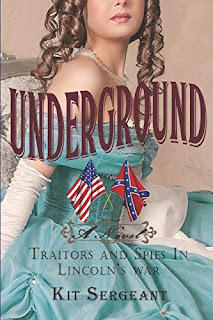
Weekly Reader: Underground by Kit Sergeant; Sergeant's Female Spies Take on The American Civil War


Weekly Reader: Underground by Kit Sergeant; Sergeant's Female Spies Take on The American Civil War

By Julie Sara Porter

Bookworm Reviews


Spoilers: The previous book by Kit Sergeant, 355, told the story of Meg Coughlin, Sally Townsend, and Elizabeth Burgin, three women who spied during the American Revolution, one of which may have been the mysterious enigmatic "355," a woman who wrote missives directly to George Washington himself.

Her next book, Underground: Traitors and Spies in the Civil War, transports us to the War Between the States. She tells of four women who spy for both the Union and the Confederacy in a compelling narrative that gives both sides to a war that still resonates throughout American history and current events.


As with her previous works, Sergeant captures different women from various walks of life that contributed to the Civil War in their own unique ways. Hattie Lewis is the second woman employed by Pinkerton's Detective Agency (the first being Hattie's mentor,Kate Warne). After successfully and secretly hiding and protecting President Elect Abraham Lincoln from an assassination attempt, the boys at Pinkerton's take notice and offer Hattie tougher and more dangerous assignments including spying.

Mary Jane Richards Bower is an African American woman who had been  freed by her employer, Miss Lizzie. Grateful, Mary Jane offers her services by working in various wealthy Confederate homes and passing information to the Union. Her contacts eventually take her to the home of one Jefferson Davis, the President of the Confederacy.

Belle Boyd is a young opinionated Southern Belle who uses her femininity and penchant for firearms to obtain information on behalf of the Confederacy in tempestuous Baltimore, which has mixed residents on both sides of the conflict.

Loretta Janeta Velazquez Williams, a New Orleans widow, takes a more direct approach to the action than the other three lead characters. She dons men's clothes and fights for the Confederacy under the name Lt. Harry T. Buford. 


I have mixed feelings about this installment, as compared to 355 and L'Agent Double which I felt were terrific with no argument. Right or wrong, a lot of my emotions towards Underground have to do with current controversies towards the Confederacy and how it is presented in historical textbooks and popular culture. There are some interesting chapters where Belle uses most men's perception of femininity against them by playing the flirtatious Southern Belle while obtaining and passing information. It's also interesting that Loretta goes the opposite extreme and dons male garb to become a soldier. However, their unapologetic Southern pro slavery views make it hard to be empathetic and root for them.

Many times their racism is made completely clear as they think of black people as subhuman. Loretta is particularly upfront using derogatory terms in her first chapter. The fact that these are women challenging roles that society expects from them and they do not see the correlation towards African Americans doing the same is jarring at best and hypocritical at worst. I know we shouldn't put modern views on the past but there are times when the difference between past and present cannot be ignored and this is one of those times.


Because of that the stories of Hattie and Mary Jane are much more interesting. Hattie tries to break through the all men society of Pinkerton's and eventually earns the respect of her colleagues through her tenacity, courage, and persistence. She spends much of the book on an extended cover assignment where she and a colleague pose as husband and wife. It's a difficult assignment as Hattie must reconcile her personal feelings with her responsibility and duty as an investigator and spy.

Also interesting is Mary Jane's story. Similar to Belle using the masculine views of femininity against her opponents, Mary Jane uses white assumptions about black people against them. She poses as an illiterate kitchen maid but can read very well and is able transcribe missives and documents. She makes her employers believe that she is unintelligent when she is quite brilliant and observant. Also of the four stories, hers is the most suspenseful as Mary Jane ends up working for Jefferson Davis' household right in the belly of the beast of racism and separatism if you will. Her time there is filled with tense moments as she is well aware that any false move, any mistake, and she could be killed by a family who wouldn't bat an eyelid over killing one of their slaves.


Unlike 355 where the stories overlap as the three leads meet and become friends, there isn't much overlap between the four stories. They cover a wide ground of several states so it is not likely that these women would have been able to physically encounter each other very much. There is one awkward early chapter where Belle attempts to seduce "Harry" but Loretta leaves before too much happens, but that's it.


Instead their connections are more thematic then physical. This is particularly prominent when Belle and Hattie are imprisoned at the same time for different charges. The women handle their imprisonment in their own unique styles as Belle flirts with guards and makes powerful allies on the outside that vouch for her. Hattie faces her imprisonment with stoic patience but also quiet terror especially when one of her fellow investigators is executed. 


Underground is yet another achievement in Sergeant's series by giving faces and names to women who otherwise would have gone unknown. It's about time they spoke and acted for themselves.

Thursday, March 4, 2021

New Book Alert: Moonlight Becomes You (An Eidola Project Novel Book 2) by Robert Herold; Supernatural Horror Covers Spiritualism and Racism in Post-Civil War USA


 New Book Alert: Moonlight Becomes You (An Eidola Project Novel Book 2) by Robert Herold; Supernatural Horror Covers Spiritualism and Racism in Post-Civil War USA

By Julie Sara Porter

Bookworm Reviews


Spoilers: William James (1842-1910) is a prominent name in the worlds of psychology and parapsychology. The elder brother of author Henry James, William was a well established psychologist and philosopher, even considered the "Father of American Psychology." He was a firm believer in the pragmatic school of thought that the value of truth was dependent on the person who held it. He was also interested in the field of metaphysics and Spiritualism and was a founding member and vice-president of the American Society of Psychical Research. James observed mediums, notably Leonora Piper and evaluated 69 reports of her mediumship. He also contributed studies on mental telepathy. Even though many challenged his research, James' work was a contributing factor that paved the way for parapsychology to be treated as a legitimate science. 

Well with that real life background, William James would be a perfect candidate for a historical mystery horror series and well he is.


William James is one of the ensemble cast of The Eidola Project, Robert Herold's series in which James and his crew investigate supernatural occurrences in the Post-Civil War United States. The other project members consist of: Annabelle Douglas, James' second in command, a hypnotist with a secret addiction to laudanum, Dr. Edgar Gilpin, an African-American physicist and somewhat of a skeptic who is a frequent target of racism, Sarah Bradbury, a former sideshow/vaudeville medium who allows ghosts to speak through her and gets psychic impressions by touching those around her, and Nigel Pickford, a Confederate Civil War veteran and recovering alcoholic who has terrifying precognitive abilities but is cursed to never be believed. This is a group that not only witnesses terrifying things but are equally haunted by their own troubled past, secret vices, and their recent acquaintanceship with each other which still carries a great deal of mistrust and suspicion.


The latest case, Moonlight Becomes You, causes much of that mistrust and suspicion in house to explode while the Eidola members investigate a series of graphic murders. After African-American doctor, Joseph Curtis becomes the latest to be mauled to death by a werewolf in the segregated town of Petersburg, Virginia, Rev. Green calls on the Eidola Project to investigate these odd attacks. 

The James Gang not only has to deal with this monstrous creature who will tear its victims to pieces as soon as look at them, but they also have to deal with racists and the Ku Klux Klan, mistrust within the Petersburg community, and their own infighting before they can function as a team and take on the werewolf.


Moonlight Becomes You is a terrific book that captures both supernatural and real horror. The werewolf attacks are extremely violent and bloody. This is not a corny Hollywood cheese fest. When a person is attacked by the werewolf, they are ripped apart with blood and vital organs exposed. The attacks are not to be read unless the Reader has a strong stomach. The werewolf also lives off of pure animal instinct and will attack someone that they know and love just as easily as someone that they despise, leaving its human form to be tormented by intense guilt with only a slight comprehension of what they have done.

Along with the werewolf attacks, supernatural horror can be found within the Eidola Project members themselves and the people that they encounter. Marie, a vodou priestess is tortured by her fear of the werewolf and is institutionalized. In one of the creepiest passages, she commits self-harm by beating herself in the head while strapped in the asylum. 

Another creepy character is Monique, a witch and former lover of Nigel's. After their union ended in disaster, Monique leaves him with 

a curse as a parting gift. This curse ends up filling his thoughts and dreams so that he not only sees visions of the future but is tortured by hauntings of the people in the past that he couldn't save. Monique gets a sadistic delight out of driving her ex to alcoholism and near insanity.


Speaking of which, Nigel and Sarah's abilities are pretty terrifying as well. Throughout the book, Nigel suffers from PTSD hearing the voices of the men in his regiment accusing him of letting them die. He also has images that he can't always explain of things that will happen and even though sometimes there might be a cast change in those visions, they still happen (for example he dreams that Edgar will be attacked by the werewolf, but Edgar survives only for someone to get attacked in the same way). So Edgar's visions are inevitable and nothing can stop them.

Sarah's abilities also provide some scary moments. When she touches the late Dr. Curtis's sleeve, she sees the full attack with herself as Curtis. Another time she performs a seance and talks in the low baritone voice of an African-American man who reveals a secret known by his bemused and frightened friends. Both Sarah and Nigel are mentally scarred by their abilities that drive them to depression, anxiety, exhaustion, fear, and an inability to connect with anyone else because of what might happen to them.

These books suggest that having these supernatural abilities is not a pleasant experience and if not properly trained and understood could result in exploitation, insanity, and addiction to control them.


Unfortunately, the horror doesn't end with the otherworldly. There is enough fear found in the physical world as well, one that the Eidola Project faces firsthand. Many question the group's interracial and unisex makeup. They are also the frequent targets of the Ku Klux Klan. Edgar is met with hostility and physical and verbal attacks from the Klan. When he falls in love with Saphne, a local woman, the

Klan attacks increase especially, when he learns that she had been frequently raped by her white employer.

One of the chapters that perfectly reveals the racial tension that surrounds the novel is early in the book before Dr. Curtis is killed. Curtis tends to a white woman in labor who unfortunately dies in the process. Even though Curtis did everything that he could, she still died. Curtis knows that her husband, a long standing Klan member, would accuse him of murder even though he tried to help her. He is not surprised when he is surrounded by the white robed Klansmen.

While there technically is no correlation between the werewolf attacks and the Klan's presence, there is a possibility that the disruption of racism and hatred found in the physical world plays just as much damage as the supernatural attacks from the werewolf. That this hatred in the physical world bleeds into the disruption in the metaphysical world.


Along with the human and metaphysical world, the Eidola Project members are conflicted within themselves. James tried to act as a loving and sometimes exasperated father figure to four very dysfunctional and troubled adults.

Annabelle and Nigel both suffer from their addictions to laudanum and alcohol respectively. James is concerned that these addictions could affect their minds and abilities and tries to cut them off. However, subsequent final chapters show both reaching for the bottles in private suggesting that climbing out of their addictions will be long and painful.

Nigel and Edgar both have to deal with racial tension as well. Nigel represents the former white Confederacy, one who spent his life looking at black people as inferior. He simmers with distrust toward Edgar, a black man who represents everything he isn't: educated, eloquent, even tempered to a point. He resents having to treat Edgar like an equal. 

Likewise, Edgar represents the black men and women after the Civil War. Though Edgar was free and acquired an education, he is still looked upon with mistrust and has to jump through twice as many hoops as his white colleagues to receive even a fraction of acceptance from them. Through both men's conflicts with each other, we see the figurative ghosts of the past of slavery and war and how they still leave scars on their present psyche. Though some moments such as when the two save each other from the werewolf and when they refer to each other as a friend during an argument with locals, suggest that friendship and acceptance may be in the near future.


Moonlight Becomes You is part of a very brilliant series that covers how both the physical and metaphysical world can be haunted and healed by our actions.