Showing posts with label Reincarnation. Show all posts

Tuesday, June 9, 2026

Illusion of Time by Omar Hamoud; Strange Beautiful Philosophical Literary Fiction Novel


 Illusion of Time by Omar Hamoud; Strange Beautiful Philosophical Literary Fiction Novel 

By Julie Sara Porter 

Bookworm Reviews 

Spoilers: Illusion of Time by Omar Hamoud is a beautiful transformative philosophical novel that touches on various subjects like time, memory, death, fatalism, destiny, spirituality, and whether we are truly in charge of our lives or a part of someone else's design.

The book covers two lives who are connected on the same day in 1967. As restaurateur William Van Dyck dies of natural causes in Charlotte, North Carolina, Andrian Davis is born in New York City. Throughout the book, we are treated to the lives of both men and they seem to be linked. It's never stated why specifically but they seem to share minds, souls, memories, and experiences.

My copy of the book has no transition between William and Andrian's stories. No long white space, no separation of paragraphs, no subheads. Nothing that separates one story from another. Just jumps from Andrian to William and back again.

Now that could be a mistake in formatting or just found in the Advanced Review Copy but it could be intentional. It might be a way of forcing the reader to pay attention to the transitions through time and William and Andrian’s individual accounts. It tells us that even though they have different experiences and separate beliefs and perspectives, they are essentially the same soul living the same story. Each man is just taking half of it.

This is a book that captures both the real and the abstract. Ordinary lives intersect with esoteric discussions about what connections might mean in the deuteragonist’s lives, what their lives mean, or what anyone's life means for that matter.

Mostly these facets are found in William and Andrian who represent the split between the physical and the metaphysical, the material and the spirit, the body and the mind, what we can see and experience with our five senses, and what we think and believe with our extra senses. William represents one side and Andrian represents the other.

William’s life from his birth in 1893 Belgium to his death is one of poverty, abandonment, and desperate financial need.His mother abandoned him and his father lost himself to alcohol and self pity. 

William was raised with a brother who resorted to theft to earn a living and a sister who was the closest thing to a mother figure that he ever had. This exposure to loss and poverty propelled him to pursue financial earthly gain at any cost.

Andrian was also shaped by his upbringing but to follow a different path. His parents were baffled by his genius intellect, vivid dreams, and questions about Biblical characters and teachings that challenged their Christian faith. He isn't isolated by circumstances around him but more by people who don't know what to do with this brilliant but baffling child. 

His primary source of encouragement is from his uncle who follows the boy's education and career development for his own personal avaricious interests. This exposure to intellectual curiosity and human weakness propels him to pursue scientific knowledge and clear answers at any cost.

Their chosen professional lives are also indicative of their life paths. William's work in farming, meat preparation, and the restaurant business are about keeping people fed, providing sustenance, and attending to people's basic needs. It's the type of professional life for someone whose focus is on the things of the physical world that can be seen, heard, smelled, touched, and tasted.

 Andrian's work in physics and psychology are about studying the deep philosophical questions, providing knowledge and wisdom through learning and research, finding out why people live the lives that they did, what dreams they had, and what messaged the higher consciousness is sending. It's the type of professional life for someone whose focus is on the mental and spiritual worlds that can be learned, studied, experienced, thought, and believed.

Both men have circles of friends, lovers, siblings, and others who are drawn by their character. William’s wife and friends are drawn to his strength, determination, and earthiness. Andrian's friends and wife are drawn by his acceptance and intuitive intelligence. 

If they ever met, William would probably see a stuffy egghead that he wouldn't understand half the things that he was saying but would appreciate his understanding and the long interesting talks they would have. Andrian would probably see a blunt instrument who operates on emotion but would be touched by his devotion to those around him.

They don't meet in life or death nor do they know about each other but their lives connect in various ways. They share similar problems like conflicts with an older sibling and betrayal from an older mentor or parental figure. They marry similar women who are supportive but aren't afraid to disagree with or call them out. Deaths of loved ones cause them to spiral into Depression for a time. 

They also share much deeper connections that aren't shared in the mortal world but through the metaphysical. Andrian has dreams of various moments in William's life that could be past life regression or evidence of reincarnation. However, what muddies this interpretation is that William has flash forward dreams and thoughts of Andrian! 

Even though William was mostly a practical man of the physical world, higher curious thoughts entered his head. As Andrian experienced many similar earthly experiences of family, friends, and work William experienced some of Andrian's intellectual curiosity and academic research. His dreams of Andrian confuse him and he questions his life path and higher consciousness. 

Since William lacks the education and scholastic research, they are mostly stagnant thoughts pushed aside for reality. Towards the end of his life, William wonders if someone will have the answers. Little did he know but might have imagined that someone would be born on his death day.

There is an interesting theory that Andrian poses towards the end about what this connection means. In the book's universe anyway, it seems to be the right one but up to a point which sends the book spiraling to another direction. It pushes the book’s themes of interconnectivity and the split between mind and body to a higher level. 

Most of the book suggests that we are made by memories, dreams, time, social circles, choices, education, and experiences. This theory suggests that our paths are not made by us but by a greater design and higher power. It is disconcerting for this theme to be thrown in the last couple of chapters without time to dwell on it further into the novel. Though it is suggested that's why William and Andrian's lives are so parallel in some ways and so divided in others.

However, it is left open ended whether this theory is correct even within the narrative. Like many great philosophical novels, Illusion of Time invites the readers to inquire, discover their own views, provide their own answers, and ask questions about their own lives. We ask who made us the people that we are, some outside force or ourselves? 


Friday, December 29, 2023

New Book Alert: For All of Us by Jillian Rose; Reincarnation Romance is Centered by Spiritual Connection and Meaningful Characterization


New Book Alert: For All of Us by Jillian Rose; Reincarnation Romance is Centered by Spiritual Connection and Meaningful Characterization

By Julie Sara Porter

Bookworm Reviews


This book is also reviewed on Reedsy Discovery 

Spoilers: Here's a theme from two years ago: reincarnated lovers reunited in modern day, reveling in their timeless love and weighing whether they should be together in the current timeline. This time, it is captured by Jillian Rose in her Romance/Magical Realism novel, For All of Us. Technically, Rose’s version is nothing new, but it is a spiritually centered and captivating character driven novel. I suppose like its lovers, the theme itself is timeless, that love never dies and that there may be some existence beyond physical death.


Cora is a Yoga instructor, seemingly happily married to Emerson, an architect. She is assigned by Emerson’s partner, Natasha, to teach at the Catskills Retreat Center to encourage creativity and unity among their co-workers. Neither Emerson nor Natasha can come but Cora is sure that she can handle it. While there, she meets the participants in the class and the Retreat staff, particularly its owner, Kai. As she spends time with Kai, she begins to feel an emotional and spiritual connection that causes her to evaluate her marriage and realize that there are things that were unsaid and unacknowledged between her and Emerson. While this is going on, there is another story set in the early 20th Century about a couple named Juliette and Asher who fall in love and have a child, Pearl, before going through a devastating loss. In the present, Cora and Kai share memories of Juliette and Asher, further complicating their relationships both past and present.


There are some moments where the Reader feels a sense of spiritual calm. The chapters at the Retreat are filled with moments like these. Cora and Kai take walks in the woods and mountains and their senses are activated by the nature surrounding them. Cora’s classes are lessons in poses as well as mindfulness and transcendence.


These classes and her time at the Retreat benefits her as well as her students. Cora and Emerson suffered tremendous loss in their life, one that they don't talk about but causes a strain in their marriage. They keep the pain and sadness locked away and never acknowledge it. But the more that they don't talk about it, the more it pulls on them revealing the fractures between their happy facade. It is only in the safety of the Retreat and communicating with Kai that Cora finds the catharsis and emotional release that she needed. 


It also is at the Retreat in which Cora and Kai awaken their past life memories as Juliette and Asher. Now I will admit that while I don't necessarily dislike reincarnated lovers tropes, I have however seen times when it is done badly. Bram Stoker’s Dracula for example. Just because they were lovers in one life does not mean that they are entitled to be together in the current one. Let's not forget about things like consent and they may already be in a loving relationship. Where many people saw Gary Oldman speaking passionately about “crossing oceans of time,” I just saw a sexual predator who raped, assaulted, and brutalized a woman that he felt entitled to have because she resembled his dead wife.


I have also seen reincarnated lovers as a trope done with the theme that just because you were happy in one life or thought that you were, doesn't mean that you really were or guaranteed to be in the current one. Nikki Broadwell’s novel, Rosemary for Remembrance is a brilliant take on that in which a married couple live simultaneous lives in the 19th and mid-20th century and get all the baggage that comes with it including the arguments, infidelity, incompatible personalities, separations, trauma and so on. 

Actually Rose’s novel contains that as well when both Cora and Juliette suffer similar deaths in their lives. Those simultaneous moments of grief, anguish, and the aftermath on how both women and the men in their lives deal with the tragedies in different ways are some of the highlights.


What saves For All of Us from falling into the simplistic style of reincarnated lovers done badly is that Jillian Rose does not shy away from the actual consequences that occur when the lovers are reunited. If they are in another relationship, someone is going to get hurt. Also just because they resemble that person and share those memories doesn't mean that they necessarily are that specific identity. They are an entirely different person with different current memories, have been through different experiences, and have a different personality than the one who went on before.


For All of Us knows about this conflict because exploring Cora’s complex feelings towards Kai and Emerson. It's not a binary “either or” choice. They are both great guys. While yes she recognizes that there are unspoken cracks in her marriage, that doesn't make Emerson an irredeemable monster, just a flawed human being. One that acknowledges those flaws and is willing to work on them. 


What helps this particular version is the care that Rose shows all parties in this situation: Cora, Kai, Emerson, and even Natasha who is also affected by these events (and of course Juliette and Asher). They are well written with no direct protagonist/antagonist conflict. They also strive to be their most honest authentic selves in their relationships and finally reach that point with each other. They are paired not just by passion, love, or previous memories but by that honesty and authenticity.


Sunday, December 5, 2021

New Book Alert: Mazarine Dreamer by Francessca Bella; Novel Length Poem Is Long on Fantasy and Reincarnated Romance


New Book Alert: Mazarine Dreamer by Francessca Bella; Novel Length Poem Is Long on Fantasy and Reincarnated Romance 

By Julie Sara Porter

Bookworm Reviews


Spoilers: Did I mention that reincarnated lovers and time travel romances were one of the top themes this year? After Canvas of Time by Amelie Pimont, Rosemary for Remembrance by Nikki Broadwell, Trapped in Time by Denise Daye, Eternally Artemisia by Melissa Muldoon, The Reincanationist Papers by D. Eric Maikrantz, Demons of Time: Race to the 7th Sunset by Varun Sayal, One Night in Paris by Juliette Sobanet, The Amber Crane by Malve Van Hassel, and The Love of the Tayamni Series by T.A. McLaughlin. Why not end the year right with another one?

So how does one make a frequently done theme work? One way is to do what Francessca Bella did, turn your reincarnated fantasy romance into pure poetry, literally.

What makes Bella's The Mazarine Dreamer stand out is its execution. Bella wrote the book in poetic format creating a novel length poem. It's a difficult endeavor. (Indeed, I tried to write this review in poetry form as a reaction but it didn't work very well so I used prose.) But Bella not only deserves props for trying, she deserves it for succeeding.


The plot involves Flavia Mavaret, a psychologist. Flavia interviews a monk who is either suffering from hallucinations or is possessed. She does some studying and learns that Pastello Abbey, the current monastery, has a curse on it.  There have been at least three accounts of mysterious deaths and disappearances affecting Pastello since the Renaissance (at least three that are reported.)

While investigating the abbey and its surroundings, Flavia follows a carrier pigeon to the wooden caravan home of Madame Idona, a mediatress and past life expert. Idona reveals that Flavia is the reincarnation of a woman who was caught in a love triangle in the Renaissance that ended very badly.

Idona gives Flavia the chance to go back in time to set things right. She is to wear a bracelet on her wrist and when a pigeon appears before her, she must recite the Latin words on the scroll that it carries.


Once Flavia travels back in time, she encounters Nevian Evegane, a Renaissance scientist who is trying to breed a clowder of battle cats called the calor. The Renaissance version of Flavia is engaged to Nevian but things aren't going well, mostly because of Nevian's obsession with calor breeding and his  arrogant bordering on abusive behavior. During a tense argument, Flavia goes to the nearby Briarfield estate and encounters Seron Briarfield, a charming artist and magician and the other third of the triangle.

If things weren't complicated enough in the Renaissance, Flavia can travel between past and present. In modern day, Flavia is investigating the curse on Pastello and a sinister creature called Mortis Nuntius. She also catches the attention of her colleague, Netius Eveseen, an intelligent and driven physicist with an interest in zoology and Netius' friend, Lero Monteith, an illustrator with an interest in magic. What a coincidence, Netius and Lero bear strong resemblances to Nevian and Soren respectively and before too long, it appears that the triangle echoes once again and history is cursed to repeat itself.


Bella shows tremendous aptitude for the mechanics of poetry such as rhyme and meter. She begins her work with "So now, my heart a lacked complexity/I work to decode for salvation  its perplexity." 

Since the book is written in rhyming couplet, there are times when Bella really stretches for a near rhyme like "pounders and blunders."(She also solves the riddle that if you find an unrhymable word like orange just have the characters make up a word like "apporange." It worked when Lewis Carroll did it.) Of course if you are writing a novel in poetic form, not every line is going to be great and it doesn't take away the tremendous achievement and talent in writing the book this way in the first place.


Bella was clearly inspired by the Romantic poetry narratives of the past. There is a strong sense of respect for the natural and supernatural world that is spread throughout the work. Flavia is fascinated with pure white albino animals. She herself has albinism and is often recognized for her uncommon appearance. So she relates to these physically unique creatures. Many times pale animals like foxes, birds, cats, and rabbits appear before sharing a psychic connection or to guide her.


Besides the natural world, there are strong ties to the supernatural world.

The book has plenty of magic and an awareness of motifs and themes found in fairy tales and Romantic poetry.

Idona is similar to the wise guide/Mentor figure who gives the protagonist the task and advises them on what path they need to take. 

There are curses and demons. Flavia is haunted by a demonic figure that delights in mentally torturing her and those it encounters.

 The animals are not just a natural connection to Flavia but also a magical one as they lead her to various steps on her quest. There are various motifs that can be found in such works like the Rule of Three (three magic words that Flavia has to recite to travel through time; three encounters at Pastello before Flavia investigated it). 


Color and imagery are also used to capture Romantic Fantasy. Bella's writing helps the Reader visualize the book in front of them.

One of my favorite stanzas shows the transition between past and present as her bracelet transports her.

Flavia says:

"A moving Mazarine fog and I synchronized

the sole two things in existence organized

We shared definition and became premium

to make the presiding magic medium

a true traveling point between my mod life

as Flavia Mavaret and one with past ride

set five hundred years back in the Renaissance

It promised to return me to ancient haunts


Encapsulated into that blue abyss, I experienced

feelings again. They dramatically influenced me as I infused with the color mazarine and became a softer dreamer in its scene

Life I gained inside it, so my understanding 

of it changed thickly into one for demanding

a mazarine transcendence. A blue beyond 

warded off death. In its abyss, I did abscond

Fading slowly away was that blue and mist-swirled 

Surrealism to give way to an alt-world."


Mazarine ends up functioning as a color that represents spirituality and time. It is a conduit between the worlds of past and present and allows Flavia to travel between them. The Mazarine Dreamer is like a study of Romantic fantasy and the tropes that are found inside them.


Flavia herself goes through the various steps of the Hero's Journey such as the Call to Adventure, Refusing the Call, Challenges, Transformation, Atonement, and Return.

Like many heroes before her, Flavia is not the same person that she was before. She begins as a modern woman certain about her career and her place in the world as a psychologist. Though she is curious and open minded enough to accept ideas as magic, she isn't experienced in them personally. This experience of traveling through time opens her mind to become a more understanding and accepting character, especially towards other people who remember their former lives or are  maybe carrying issues and fears that resonated into their current live. She becomes a guide to them the way Idona was for her.


There is a theme of physical vs. metaphysical throughout the Mazarine Dreamer and much of it is carried over by the two (technically four) men in Flavia's life.

In the past, Nevian and Soren firmly stand on opposite sides of the Renaissance ideal. Nevian is all about Reason and science. He is cold and methodical. When he receives the commission to create calors, that becomes his central obsession. He is arrogant in his pursuits and he is condescending and verbally abusive towards Flavia.

On the other hand, Soren stands on the opposite spectrum. He believes in magic not science and has a spiritual connection to the world around him. He is more emotional and Romantic and soothes the loneliness that Flavia feels.


Unfortunately, Soren and Nevian being pitched at opposite extremes works thematically but not plot wise. Thematically, they represent two ideals that are often at odds with which Flavia balances both extremes out, being scientific but open minded,rational in analyzing patient's concerns but emotional enough to be concerned for their welfare. 

Unfortunately, for the plot of an important love triangle which ends in tragedy, it doesn't quite work when one third of the triangle is portrayed as so much better or worse than the other. Nevian is written for the most part as irredeemable and reprehensible. His interest in science is fascinating but the shameful way that he treats Flavia makes any option of him ending up with her troublesome at best. Seron is clearly the better prospect but that takes out the conflicted possibilities that could have resulted in better characters.


Actually Bella does present a more nuanced triangle in the present between Flavia, Netius, and Lero. Like their predecessors, Netius and Lero also stand on opposite sides of the Romance vs. Reason debate but their positions are more fluid. They often overlap with their views.

While Netius is a physicist and can at times be arrogant, he has an almost poetic affection for zoology and biology, almost recognizing deeper connections in the world around him. He also has enough of an open mind that he understands Flavia's experience and doesn't condescend to her when she tells him what is going on.

Lero is an illustrator with a much more emotional and spiritual side. However, he has a medical awareness as he sketches the human heart. Interestingly enough while Soren is the better prospect for Flavia in the past, Lero somewhat falters in the present. There are times when he behaves very immaturely and crosses boundaries especially after Flavia and Netius become involved.

While Nevian and Soren have the more Renaissance view of characters reflecting one thing or another, Netius and Lero are from a more postmodern view. People in literature are more complex than they were. They are not one thing or another. Sometimes their views and personalities adapt or overlap and that's what Bella displays in the modern era and how she portrays the separate triangles both past and present.


The Mazarine Dreamer is a beautiful poetic experiment that works very well. It takes the themes of reincarnation and love existing through time and finds a new interesting way to tell it. It's not an easy read, but it is well worth it.


Thursday, July 8, 2021

New Book Alert: The Reincarnationist Papers by D. Eric Maikranz; Intriguing Premise About Virtues and Difficulties of Living Multiple Lives


New Book Alert: The Reincarnationist Papers by D. Eric Maikranz; Intriguing Premise About Virtues and Difficulties of Living Multiple Lives

By Julie Sara Porter

Bookworm Reviews


Spoilers: I feel a sense of deja vu as I say this:

Reincarnation is probably the #1 literary theme of this year or at least of this blog. 

On the plus side, I found a support group that Amelie Pimont's Eli and Sarah, Nikki Broadwell's Rosemary and Dylan Hughes, and Melissa Muldoon's Artemisia Gentileschi, Maddalena, and Matteo can join. 

D. Eric Maikranz's The Reincarnationist Papers is an intriguing premise about an organization that helps people who have full memories of their past lives. The book also presents both the virtues of living extra lives and many of the difficulties that such an existence could bring.


Evan Michaels is an outsider for many reasons. He has clear memory of his two previous lives and revealed them in ways that astounded and frightened his family. He left them feeling like an outcast and now spends his time in Southern California doing illegal activity, particularly professional arson to earn a living. While on the run after his latest assignment goes down, Evan is challenged by a mysterious young woman. Before  she attacks him, Evan threatens her that if she kills him, he will just come back, right before he pases out. When he comes to, the woman, Poppy ,and a man, Antonio, believe and understand his reincarnation recall. In fact, they invite him to join the Cognomina, a secret organization of people who remember their past lives. To join, Evan has to go through a series of trials called The Ascension in which he has to recall his former lives and prove to the 27 other members that he really lived them.


It's clear that Reincarnationist Papers is intended to be the start of a series and this book definitely fits that obligatory introductory need.  We are shown the new character that serves as our eyes and ears to this new world. We get the expositional history of the group that they join and the central ongoing conflicts between characters that carry over throughout the series. We even get introduced to potential love interests. It's all painted by numbers but in this case, it works.


What works is the originality of an organization created specifically for reincarnated souls. These characters retain the memories, experiences, pleasant memories, talents, and sometimes objects of their former lives. However, they also remember every fight and conflict leading to current prejudices and hatred, every traumatic situation that leads to phobias and obsessions in their current lives, and the circumstances towards their deaths. It can be difficult to live in the present when you are constantly overwhelmed by memories of the past.


The highlights of the novel are the looks into the character's former lives. Evan remembers two. His earliest life was of a Bulgarian man named Vasili Blagavich Arda who had been imprisoned during the Communist years. Vasili then lived in Istanbul for the final years of his life. Evan learns that his attraction to living in a large city like Los Angeles could be traced to Vasili's fascination with living in Istanbul. Evan's memories of reincarnation began when as a child, he was able to write and speak fluent Bulgarian.

Evan's other life was that of a young boy named Bobby with a mentally ill mother. While still a child, Bobby burned to death in a fire that he accidentally started. Bobby's death in a fire makes sense why Evan chooses to light fires as almost a way of conquering and controlling the element that once killed him.


Other members of the group share interesting stories Poppy remembers her time as a male Venetian glassworker who was killed by a female assassin and a  French nobleman who was wounded in a duel against a rival artisan. Another character, Samas, recalls his life in the 11th century. One of the oldest souls remembers living in the 1st century.

 Even the creation of the Cognomina is fascinating as two friends in Egypt decided that they would meet again in the next life. They recognized each other by pointing out objects that the other had. The group then spread to five members then 28. 

The members also explain to Evan why they are so secretive. In a world of largely Abrahamaic religions which do not believe in reincarnation, these memories would be too much for others to know. People would become frightened and attack group members. Even Eastern religions which espouse reincarnation don't quite "get it," they say. The next life has nothing to do with how one behaved in the previous life as a reward or punishment. They are just reborn and many of the experiences are carried over.

For history buffs , Maikranz even includes footnotes of real history to fit with this fanciful story of reincarnation. Evan's life as Vasili includes his time serving in the military under Captain Eumen Hoxa. Maikranz did a tremendous job creating this secret organization of reincarnated souls and their rituals and procedures.


While the organization is well thought out, the plot somewhat falters. This is especially evident towards the end when Evan is thrown into an action plot and is left in a cliffhanger situation. However, most of the work is a decent speculative look at reincarnation and how people can struggle and thrive remembering who they were before.


Monday, April 26, 2021

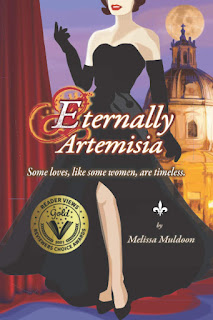
Weekly Reader: Eternally Artemisia by Melissa Muldoon; Beautiful Historical Fantasy About The Timeless Links Between Art, Romantic Love, and Female Friendship


  Weekly Reader: Eternally Artemisia by Melissa Muldoon; Beautiful Historical Fantasy About The Timeless Links Between Art, Romantic Love, and Female Friendship

By Julie Sara Porter

Bookworm Reviews


Spoilers: I have it. I figured out the solution.

Last year's literary themes were biker gangs, motorcycle clubs, and travels by motorcycle, multicultural teen superheroes, post apocalyptic dystopian science fiction and fact, and trips through Heaven and Hell with plenty of religious allegory. It makes sense, except for the travel by motorcycle bit, every one of these subjects in one way or another wanted to face the real life traumatic situations head on. 2020 was a dark year and we were looking for solutions even in fiction. 

This year the themes seem to want to get away from the darkness as much as possible. With Regency Romance and Epic Fantasy (not yet but five yes five Epic Fantasy reviews are on their way) there is an overwhelming urge to escape the darkness that surrounds us. This is also evident in one of the biggest themes that I have encountered this year: science fiction and fantasy featuring time travel and reincarnation starring friends and lovers who encounter each other who meet from different times or travel across oceans of time to find one another once more. 

These types of books offer the strongest escapism. After all, what better way to escape than to a seemingly simpler time or even better various times? (Never mind that those periods had similar problems or worse, as well but whatever, we are reading here!)

I have read Canvas of Time by Amelie Pimont, Rosemary for Remembrance by Nikki Broadwell, and Trapped in Time by Denise Daye all with similar themes. Now we can add Melissa Muldoon's Eternally Artemisia to that list. This book is one part fantasy about a woman discovering that she has shared a long link with Renaissance painter Artemisia Gentileschi, but also one part historical fiction about Gentileschi's life and the legacy that her art has inspired through the years.


For those that don't know, Artemisia Gentileschi was a portrait painter in Renaissance Italy. She was an exception to the rule of many talented but unsung women of her day in that she was taught to paint by her father, Orazio. She was also tutored by Agostinio Tassi. One day, Tassi raped her. Gentileschi was put through a very public and humiliating trial in which her body was observed. Tassi was found guilty and exiled but the damage was done as Gentileschi was seen as a fallen woman and damaged goods. She was also estranged from her father who cared more that Tassi had stolen a painting than the violence inflicted upon his daughter.

 She was then practically sold into marriage to Pierantonio Stiattesi, a fresco painter, for money. The two made their way to Florence where Gentileschi became the only female to be accepted to the Arts Academy in Florence. Even though she gave birth to a daughter, Palmira and two other children, her marriage to Pierantonio ended in a separation because of his jealousy of her talent and his infidelity.

Gentileschi was a student of Caravaggio in that her paintings often revealed shadows, dark colors, and violent scenes. Her two most well known portraits are based on stories of the Bible and many believe reflected her rage about the rape and the trial. The first, Susannah and the Elders, shows a young woman walking and being the subject of gossip by older men. 

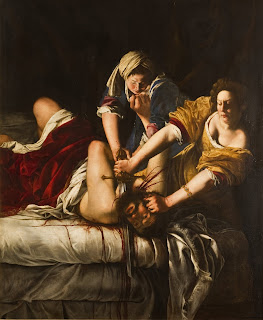
Her most famous painting is Judith Beheading Holofernes. This painting depicts Judith and her handmaid, Abra, holding the king down right as the Biblical heroine goes in for the kill. The blood around Holofernes' horrified visage and the looks of determination on the two women's faces speaks volumes.


For a straight historical fiction on Gentileschi's amazing life look no further than The Passion of Artemisia by Susan Vreeland which tells of her life from beginning, middle, and end. (It can be found as #7 in this Historical Fiction Novel list.) For a tale that is more wide reaching that is more than about Gentileschi herself, but is also about her legacy and how those who are drawn to her story are drawn to each other, then Muldoon's is the book for you. 

I am saying this because while Gentileschi is frequently discussed, her actual life experiences only cover a third of Eternally Artemisia. Instead it is her art and spirit that are shown through various lifetimes from the Bible, to the Renaissance, to the 1930's, to modern day, to the distant future.


The book begins with an introduction from Biblical days when Judith and Abra are standing over the drunk and sleeping Holofernes. They both are ready to commit violence in vengeance over the death of Judith's husband and many Israelites. The bond between Judith and Abra is clearly felt beyond mistress and servant as the two are forever united in this bloody moment which will be immortalized in art.


The moment between Judith and Abra is emphasized and recalled in the present with the experiences of Maddelena AKA Maddie, an art therapist. Maddie travels to Italy to get in touch with her roots and get some artistic inspiration. She flourishes in the Tuscan landscape by creating a circle of creative women that inspire and encourage one another and becomes romantically involved with Matteo, one of a very old established Italian family. Maddie falls in love not only with Matteo but the whole Florentine landscape like she knew him or had been there before. 

She also has a fascinating "woman-crush" on Gentileschi and begins to see Gentileschi's life through her eyes. She also gets visited by Gentileschi's spirit who advises her to take a real close look at the portrait of Judith Beheading Holofernes, and tell her what she sees. Maddie sees that Judith has Gentileschi's face and that Abra has her own. Yes, Gentileschi replies, she and Maddie have been friends practically sisters for centuries. Not only that but Maddie has shared multiple lives with Matteo. The rest of the book focuses on those other lives.


Like I said, since the book travels through time, Gentileschi's actual personal life is given a surprising short shrift. Only her time in Florence, her unhappy marriage, and the patronage of the Medicis towards her art are discussed. She also makes some equally talented friends in Michelangelo Buonarroti the Younger and Galileo Galilei. 

It is through these talented friends that Gentileschi encounters this version of Maddie and Matteo. In the Renaissance, Matteo is an astronomer fascinated by the studies of Galileo and Copernicus.

Maddie is a courtesan who is looking to soak up the local arts and cultural scenes. She even models for various paintings including (of course) Judith Beheading Holofernes.


The chapters are some of the best parts in the book because of the intricate plot and characters that are woven throughout. For those hoping that Tassi should get some retribution, it comes swift and clever. Gentileschi and Maddie give Gentileschi's rapist vengeance that hits him right where he deserves...right in the reputation.


Muldoon also gives much attention to how Maddie, Matteo, and Gentileschi flourish in their Renaissance environment. These are three people who are excited for the opportunities that the Renaissance provides for artists and scientists, particularly under the protectorate of Cosimo de Medici. Medici encourages great ideas even if, like Galileo's, they counter the church. They are allowed to flourish,  educate, and encourage others.  Unfortunately, that protection only lasts as long as Cosimo does. After he dies, the Archduchess and her priests go on a cleansing to get rid of ideas that they find offensive so the artists, scientists, and thinkers scatter. The Power Trio of Gentileschi, Matteo, and Maddie are separated only to reunite next time.


The second best section is in the 1930's which intersects the fictional incarnations of Maddie and Gentileschi with a real life pair. According to Muldoon's notes at the end, the 20th century version of Maddie is based on Elsa Schiaparelli, a fashion designer who was known for her eccentric styles such as elaborate embellishments on clothing and unusual accessories like shoe shaped hats. She was also known for her antifascist stance which she openly spoke against Hitler and Mussolini (in contrast to her frequent rival, Coco Chanel who cozied up to the Nazis. Their rivalry is played out in the juicy historical fiction, The Last Collection by Jeanne Mackin.).


 Gentileschi's counterpart, called Luciana, is based on Anna Banti who was the first to gather information on Gentileschi and write about her. Through Banti, we now know  Gentileschi's name. Without her preservation of her art and research into her life, Gentileschi might have been one of those women hidden by history that Virginia Woolf spoke about. It is wonderful that Muldoon paid tribute not only to the artist, but the woman who gave her a second posthumous life. Like all researchers, Luciana protects her research with her life. When Mussolini comes in, she makes sure when she leaves that her research either comes with or is expertly hidden.


As the Schiaparelli stand-in, Maddie also shines as does her husband, the latest Matteo. One of the more interesting moments when she is told that someone is interested in her pantsuit and is looking to revitalize her look for her Hollywood image. Into her shop strolls Katharine Hepburn. This moment links the arts of painting, fashion, and cinema in one continuous cycle. Maddie is naturally incensed when the strict fascist rule deprives women of many of their rights including running their own business. The more Maddie and Matteo remain in Italy the more dangerous their life becomes, particularly when they are at a party that is also attended by Mussolini and Maddie literally finds herself dancing with the devil. 


There is a brief epilogue where Maddie, called Lena, is in the future and arrives at a space station named Artemisia (of course) and meets another astronaut named Matt (also of course.) Like many books that explore reincarnation, bodies may die but souls remain and the things that capture our souls: art, history, literature, science, memories, families, friendships, and all of those things are what are preserved and continue.


Saturday, March 20, 2021

Weekly Reader: Rosemary for Remembrance by Nikki Broadwell; Dark War-Torn Reincarnation Novel Reveals Struggles, Conflicts, and Love Lasts Through The Centuries


 Weekly Reader: Rosemary for Remembrance by Nikki Broadwell; Dark War-Torn Reincarnation Novel Reveals Struggles, Conflicts, and Love Lasts Through The Centuries

By Julie Sara Porter

Bookworm Reviews


Spoilers: In a strange bit of coincidence, Nikki Broadwell's Rosemary for Remembrance is the second book that I am reviewing in a row that has a theme of reincarnation. While the two books tell a somewhat similar story of lovers discovering that they were together in one lifetime and are in love again in the present, they couldn't be more different in their approach. Amelie Pimont's Canvas of Time is a beautiful novel of lovers torn apart in different life times and realizing that they were always fated to be together. It is idyllic and dream-like as they rediscover each other time and again and are able to go through their differences by realizing that they are meant to be.

 Rosemary for Remembrance takes a far darker approach to the idea. This book seems to say that "Yes you were together and you will be together again. You will get that and all that comes with it: including the arguments, conflicts, separations, stress that you had before and get to relive it again in another life. Oh yeah and you may not have been happy the first time or this time either."

I don't want to say one is inherently better than the other, just that they certainly make you think different things about the idea of reincarnation and whether you want to spend more than one lifetime with a person.


We first encounter Rosemary and Dylan Hughes in 1957, right as they are planning to divorce. Rosemary's father has just died and the estranged couple are going through his estate. There are some hints as to the reasons behind their separation: presumed infidelity, different lifestyles, PTSD from WWII, Rosemary gaining independence, take your pick. As if that's not enough, Rosemary has waking dreams and visions of a woman in the 19th century named Rebecca and her husband, Edgar. A further twist occurs when Dylan confesses that since he came back from the war, he has had similar but foggy dreams of the same  couple. The book fills into the Hughes' meeting, at times tempestuous marriage, their wartime experiences, separation, and the strange connection that they have to Rebecca and Edgar  revealing that they were once them in a former life.


Rosemary for Remembrance could be considered an anti-Romance novel or maybe not so much anti-Romance as it is a realistic novel about the struggles that romance and marriage can bring. After all the books I read these two months where marriage is the be all and end all (and a couple of books where it shouldn't be), this and The Second Mrs. Thistlewood are the most thought provoking, troubling, and in some ways the best. Even Canvas of Time is lost in a haze of romantic fantasy, even more so by suggesting that love can outlast a life span and be reborn if two souls are meant for each other. Rosemary for Remembrance and The Second Mrs. Thistlewood pull the same trick that George Eliot did with Middlemarch: deconstruct a love story by getting the courtship and marriage out of the way early to give us the troubled disillusionment that occurs once the ``I Do's" have been said and the honeymoon's over. It also helps since we already know that Rosemary and Dylan are bound to be separated, even their early marital bliss is tempered with the cynicism in knowing that this marriage may not survive.


Broadwell one ups Dionne Hayes, author of The Second Mrs. Thistlewood on one aspect. Hayes shows what happens when an innocent woman is married to an abusive jerk, so all the unhappiness in the marriage is caused by one spouse who is justifiably punished for it. Broadwell's book shows that the Hughes' unhappiness is spread equally between both parties. 

It's like reading about a celebrity divorce and siding with one party. Then you hear something else that makes you turn to the other side. After awhile, you think both parties are nuts and you are left hoping that they either break up permanently and move to opposite sides of the planet so they don't come anywhere near each other or realize that they are the only people crazy and stubborn enough to put up with each other, get back together, and leave the rest of us alone.


To her credit, Broadwell captures both Rosemary and Dylan rather well so their marriage is not an "either or" situation of hopeless neurotics who can't live with or without each other and make everyone else miserable in the process. They are two people who like and want different things, spend much of their time separated, and never really take the opportunity to talk out their issues.

We see some of their incompatibility begin the moment their marriage does. Dylan is a military captain hoping to marry into a wealthy family so he could move up a few notches in Washington society. Rosemary is from a wealthy family but is starting to regret the privileges that her wealth provides. She would rather take art classes than attend functions with the other officer's wives.


We also experience Rosemary suffering from the isolation when she and Dylan are assigned to the Philippines. Despite the heat, mosquitoes, and constant chit chat with the officer's wives, Rosemary gets her first real moments to shine. She learns more about the world by befriending a Filipino woman, rekindles her passion for Dylan (particularly during monsoon season), and begins to take her painting seriously.

In fact Rosemary's painting is what keeps her active and going when she returns to the States and Dylan remains to fight in the Pacific Theater. She sells her art and begins to enjoy an independent life in the country. True, she worries about Dylan and is pestered by dreams about Rebecca and Edgar. But for the first time, she is not bound by a father or husband and she likes it. When Dylan returns, he feels out of place with the New Woman that his wife has become and wants her to return to the life of an obedient military wife.


However through Dylan's struggles, we realize that he is more than an old school social climbing military man. We experience his harrowing time on the Front and as a POW. We understand why it's difficult for him to return to a life that has gone on without him, a life that he is uncertain that he wants anymore. 

Dylan's time in the POW camp is the most gripping and most honest part of the book. His journal entries tell of forced marches, malaria, dysentery, and torture. Dylan is constantly surrounded by death and is torn between fearing his death and hoping for it. The prison chapters are extremely graphic and realistic depictions of war in the middle of a troubled romance and supernatural novel. There is a difference to these sections that highlight over the rest of the book and with good reason. 


According to the Introduction and Acknowledgement, Broadwell used her own father's journal entries of his POW experiences during WWII with only some slight name changes. In fact, the journal is what inspired her to write the novel in the first place. Surrounding the fictionalized version of her father's wartime experiences, she created a couple unlike her parents and built a supernatural romance around them. 

Dylan's time as a POW is intentionally a distraction from the rest of the book because of this real world genesis. It also gives a lot of motivation to Dylan's post war character as a man who is guarded and unwilling to recall the past. He wants to move ahead and not go back to that place.


As compelling and troubling as Rosemary and Dylan's marriage is, Rebecca and Edgar's is even more so. The two are surrounded by societal pressure and frequent separation but their incompatibility is never breached. Instead it gets wider as Edgar has an affair and fathers a child and Rebecca is later institutionalized. Unlike Pimont's Eli and Sarah, this is a couple that are not destined to be soulmates. It's not the love that lasts beyond their deaths, it's their struggles and conflicts. Those are what haunt Dylan and Rosemary, along with the troubles that they have within their own marriage.


The final third of the book that covers the aftermath of Rosemary's father's death goes in some odd directions like introducing some characters who add further complications and could have used stronger introductions (particularly one who also shares the past life with Rebecca and Edgar). It also veers towards a happy ever after with a vengeance or at least a "let's work things out" conclusion. It is kind of difficult to picture Rosemary and Dylan having a subsequent happy reunion with so many problems hanging over their heads. (In fact the book gives several good reasons why they shouldn't be.) 

One could say that they recognize the fractures within their marriage and are determined not to explode the way Rebecca and Edgar did. It could also suggest not happy ever after and end of conflict forever but conversation and compromise. Recognizing their own difficulties and strengths are what help Rosemary and Dylan exorcise Rebecca and Edgar's torments once and for all.


Rosemary for Remembrance is a dark  supernatural romance, one that doesn't gloss over troubles then or now. Instead, it forces characters to confront them head on as individuals before they can confront them and become a couple.


Sunday, September 16, 2018

Weekly Reader: Cloud Atlas by David Mitchell; A Beautiful Transformative Novel About Life, Death, Reincarnation, and The Legacy We Leave Behind


Weekly Reader: Cloud Atlas by David Mitchell; A Beautiful Transformative Novel About Life, Death, Reincarnation, and The Legacy We Leave Behind


By Julie Sara Porter


Bookworm Reviews


Spoilers: I admit that when I first approached Cloud Atlas, I did with great trepidation. I had heard about the book's structure and I was concerned whether I would be able to follow it. After having read difficult books like Ulysses and Infinite Jest, I thought this would be another book that tries to show off to its Readers only to confuse them.


I shouldn't have worried. Instead what I found was one of my favorite books that I read this year. David Mitchell didn't tell just one memorable story. He told six of them. I joke that he probably couldn't decide whether he wanted to write an adventure, a romance, a political thriller, a comic satire, a science fiction, or a post-Apocalyptic fantasy then just said, “Screw it, I'll write all of them.” That he could take these extremely different genres and provide extremely different narratives from various people that are diverse in gender, age, ethnicity, and social status shows not only a tremendous writing talent but an ability to use that talent to provide the Readers with these multiple stories and characters.


It is a brilliant and beautiful book that focuses on six people over the course of many centuries.
The six characters are:
Adam Ewing-An American notary in 1840’s New Zealand and Hawaii who protects and befriends an escaped slave and becomes involved in the Abolitionist cause.
Robert Frobisher- A disinherited bisexual composer in 1930’s Europe who writes letters to his male lover, Rufus Sixsmith, about his relationships with an abusive older composer and his seductive wife.
Luisa Rey-An investigative reporter in 1970’s California who becomes involved in a conspiracy concerning the mysterious death of a nuclear scientist and his research on the company he works for.
Timothy Cavendish- An elderly vanity publisher in 21st century London who is stalked by members of a criminal family and ends up incarcerated in a nursing home by his scheming brother.
Sonmi 451-A clone in futuristic Seoul, South Korea who is rescued from her monotonous life at a fast food restaurant and gets caught up in the Resistance against the Neo Capitalist Police State she works under.
Zachary- A young man in the distant post-apocalyptic future Hawaii who aids a newcomer to his village who tells him a great deal about the past of his people.


On the surface, these characters and stories don't appear to be related but the more the Reader digs, the more they learn how these stories are linked as one gigantic chain that transcends centuries.
While living with the disagreeable composer, Vyvyan Ayres, Robert discovers the first half of Adam Ewing’s journal and is upset that he couldn't find the other half considering “a half-finished book is a half-finished love affair.”
Luisa finds an album of Robert’s “Cloud Atlas Sextet” and is moved by the music. Not to mention that the nuclear scientist/informant who aids Luisa is none other than Rufus Sixsmith, Robert's former lover who gives her Robert's letters.
Timothy receives a novel of Luisa’s exploits and at first dismisses it as trite as though it were written by a child. (The book implies the novel about Luisa was written by a young neighbor that she took a maternal interest in.) While he is incarcerated, Timothy seems to enjoy reading about Luisa's exploits and gutsiness.
Sonmi 451 watches films which she calls “disneys” (In this future proper nouns replace common terms for objects) with a fellow rebel. One of them is based on Timothy's life, incarceration in the nursing home, then escape from it.
Zachary’s people worship Sonmi 451 as a goddess. (In her story, while escaping she stayed temporarily in a community whose members are implied to be the ancestors of Zachary's people.) Later Zachary's friend, Meronym shows Sonmi's interrogation on a device called an orison. She then says that Sonmi was a human woman not a goddess.


These traces of the characters and how each one learns of the last are like those Russian matryoshka or nesting dolls where one leads to another to make a full picture. They show that our works such as primary sources like letters and journals, music, books, movies, and stories are what will last and how people will remember us long after we are gone. Bodies may die but history, art, and literature will continue to tell our stories in one form or another.


Another common theme that these stories carry are those of struggles between the powerful and powerless, those who are corrupt and imprison and those who fight and escape.
In Adam’s journal entries, we learn that he befriended a slave, Autua who stowed away on the same ship he traveled. At first Adam is ambivalent about slavery, following the presumed “White Man's Burden.” When he sees the goodness and loyalty in Autua and also the cruelty and deception of many white people, including a doctor who is poisoning him just to rob him later, Adam and his wife become committed abolitionists and help free other slaves.
Robert is made a pariah because of his sexuality and is used by Ayres who steals his work and seduced by his conniving wife and daughter. Robert is then left with a shattered reputation, tremendous debt, and a broken heart. He pours out his love in his sextet and final letter to Sixsmith (whom he realizes too late is the real love of his life) before he escapes the only way he can: through suicide.
Luisa fights against the corrupt corporation that murdered Sixsmith to keep quiet about his research concerning a flaw in the nuclear power plant he worked for. (Tellingly enough this would be the same corporation that Sonmi works for in the future.) She plans to go public with Sixsmith’s research despite multiple attempts on her life. (Including in one passage where her car is pushed into the ocean. Thankfully, she survives.) The idealistic reporter manages to smuggle the information to Sixsmith's niece and forces the dismissal of the greedy CEO who had Sixsmith and his allies murdered.
Timothy is incapacitated by his brother, his weakened body after he suffers a stroke, and above all a tyrannical staff particularly a nasty head nurse who prefers to medicate her patients rather than help them. In a humorous section (contrasting with the other more serious stories), Timothy engineers an escape from the nursing home with three other patients who manage to steal one of the patient's family member's car. (He always leaves the keys in the ignition during his visits.)
In her report to an interrogator called the Archivist, Sonmi explains how the death of a more obstreperous friend caused her to question her life of sameness, forced cheerfulness, and routine work of serving people drug enhanced food. When she is “kidnapped” i.e. liberated by a Resistance member, she tells the Archivist about her journey into forbidden areas, real friendships and emotions for the other rebels as compared to the phony ones in the cloning facility. She also learns some harsh discoveries about the world around her and the clones’ real purpose. She also is aware that much of her journey was fabricated by spies and traitors but she wants her story to be told anyway so future generations will know who she fought and why.
Zachary’s world is reduced to an almost primitive state. He is aware of warfare between various tribes and also suffers from a traumatic experience in which his father was killed and brother, Adam was enslaved. He appeals to Meronym, who though an outsider, is a Prescient, someone who still has memories of history. During their night journey, Zachary and Meronym protect each other from slavers and Meronym empowers Zachary with knowledge of the past. He is able to use that knowledge to counter his fears which manifest as a demonic figure called Old Georgie that once cripplied him with guilt and terror.


The strongest link within these characters is revealed as we learn that they are the same character reincarnated over time. This is proven as each one learns that they share the same birthmark shaped like a comet somewhere on their bodies. While this may seem odd to some people, many Readers who are aware of other stories of reincarnation know that souls can be reborn as different genders or races. The characters share memories, dreams, and connections to one another. Zachary's brother is named Adam who is sold into slavery; the same name as the first character, Adam Ewing, a man who fought against slavery.
Both Ayres and Robert share a dream about a brightly colored restaurant in which the servers are all identically dressed women with the same faces foreshadowing Sonmi's life.
When he first encounters Luisa in a broken elevator, Rufus Sixsmith reveals that he feels an intense connection to her that he can't explain. This implies that he recognizes his late lover, Robert in her.
While Timothy's connections to the others are through popular culture, he uses these references to link himself to the others. He compares one character to “Mrs. Robinson” in The Graduate (referring to Robert's ill-advised affair with the older and married, Mrs. Ayres and the unfortunate love triangle with her daughter, Eva.) Timothy also makes a reference to the movie, “Soylent Green” (referring to Sonmi's discovery that clones are made and processed for food, the same food she used to serve at the fast food place.)

These connections are made even deeper in the 2012 movie, Cloud Atlas directed by the Wachowksi Siblings where the characters in all six stories are played by the same actors playing multiple roles. Some that follow reincarnation believe that not only are we reborn in different lives but the people around us are as well. In multiple lives the people we know now may have been or will be lovers, family members, heroes, or people we just met or will meet on the street.


Cloud Atlas is a strange book, no doubt about it. It is also a beautiful book about how connected
humanity is through delicate strands or ripples in time and shows that after we die, our souls and legacies live on and carry over into future generations.