Tuesday, August 10, 2021

New Book Alert: Lady Be Good: The Life and Times of Dorothy Hale by Pamela Hamilton; A Fascinating and Brilliant True Story About The Life and Mysterious Death of A Talented But Now Forgotten Entertainer


 New Book Alert: Lady Be Good: The Life and Times of Dorothy Hale by Pamela Hamilton; A Fascinating and Brilliant True Story About The Life and Mysterious Death of A Talented But Now Forgotten Entertainer

SoBy Julie Sara Porter

Bookworm Reviews


Spoilers: There are probably not many people today who are familiar with the name of Dorothy Hale (1905-1938). If they are admirers of the artwork of Frida Kahlo, they may recognize her as the subject of Kahlo's painting of The Suicide of Dorothy Hale, which depicts Hale as a beautiful woman falling from a building to her death. So in other words she is similar to Peg Entwhistle, the stage actress who tried to find success in Hollywood only to jump off the 13th letter of the Hollywood sign to her death. Like Entwhistle, if Hale is known at all, it is by the way that she left this world rather than her contribution within it. However, former NBC News Producer, Pamela Hamilton aims to change all of that with her fascinating and brilliant fictional biography Lady Be Good: The Life and Times of Dorothy Hale.


Hale, nee Dorothy Donovan, was from an affluent Catholic family with Victorian values. Hale rebelled against her upbringing by pursuing a career. She eventually became a dancer and Ziegfeld Follies girl and was part of the chorus of the Broadway production of Lady Be Good. Hale also starred with her friend, Rosamond Pinchot in Abide With Me, a play written by another friend, Clare Boothe Luce. She also had small roles in the movies, Cynara and Catherine the Great.

Hale was married twice. Her first marriage to millionaire stockbroker, Gaillard Thomas ended in divorce. Her second to muralist, fresco artist, and portrait painter, Garland Hale ended with his death in 1931. She had many love affairs including with Constantin Alajalov, a cover artist, Russell Davenport, a writer for Time Magazine, Isamu Noguchi, a sculptor, artist, and designer, and Harry Hopkins, a WPA administrator and Roosevelt's top advisor. She was also a regular member of New York's Cafe Society having friends such as Kahlo, Luce, Cole Porter, Frank Crowninshield, Buckminster Fuller,and many of the best and brightest of New York society in the 1920's and '30's.


Her death was the subject of much speculation at the time which Kahlo's painting was a part of it. What is known is that the day before her death, she hosted a party inviting many of her close friends as a farewell party explaining that she was soon going on a long trip. The next day she fell sixteen floors to her death from her Central Park South apartment.

 It was unknown whether she fell, jumped, or was pushed. However, second hand accounts at the time reported of "financial troubles" and "disappointments about her age and unhappy love affairs." The press portrayed Hale as a fragile vulnerable woman who took her own life. Despite Kahlo's genuine grief over the death of her friend, her painting did much to add to that unverified assumption that Hale committed suicide.


Hamilton's book does a lot to discredit the speculation of Hale's death and instead focuses on her life. Far from the fragile depressed lonely woman that the press portrayed her after death, Hale is written by Hamilton as a vibrant and bright woman full of life and excited to be surrounded by a talented and eccentric group of friends and lovers.


Lady Be Good is practically a whirlwind of color, art, entertainment, glamor, and excitement. One that Hale is glad to be a part of even though she does not achieve as much personal success as she would like. She is surrounded by bright and talented people and for the most part, she is happy to be with them. The famous names that come in and out of the book and appear throughout Hale's life include Clare Boothe Luce, Frida Kahlo, Fred Astaire, Frank Crowninshield, Dorothy Parker, Rosamond Pinchot, Alva Vanderbilt Belmont, Eugene O'Neill, Isamu Noguchi, George Gershwin, Cole Porter, Gertrude Stein, Samuel Goldwyn, King Vidor, John Barrymore, Buckminster Fuller, and many many others. It is a brilliant cast of the intelligentsia and literati of New York's Cafe Society and The Golden Age of Hollywood. 

Dorothy enjoys the life that she is in and the freedom that being a part of that group implies.This is the main reason why her first marriage doesn't work out.


 Hale is an exciteable and enthusiastic woman who enjoys going to clubs, theater performances, salons, and art shows. Gaillard is stiff and dull and is only interested in making money. Hale marred him mostly out of fear when a serious injury ended her dancing days. After the fear subsides, their differences becomes insurmountable and Hale heads for Reno to file for divorce.

Hale finds a happier life with Gardner Hale who because of his artistic talent and connections is also a welcome member of Hale's wide social circle. His death causes Hale to fall into a deep depression which takes her a long time to get through. Hamilton's writing suggests that her romances with Isamu Noguchi and Harry Hopkins were because of loneliness and to fill an empty void in her life.


After Gardner's death, Hale attempts a Hollywood career. She films a screen test that is widely received and she is even described as a "beautiful up and coming star." Unfortunately, she is unable to receive success with so many other stars in Hollywood's galaxy. 

She also stars in Abide With Me which even though critics brutally panned it, she had a good time performing in because of her friendship with Luce and Pinchot.


The point that Hamilton is trying to make with this fictional biography is to celebrate Hale's life rather than focus on her death. In fact when it does happen, the circumstances are rather aribtrary and are given short shrift. To Hamilton, Hale's life was more important and she was a woman who lived it to the fullest.



Sunday, August 8, 2021

New Book Alert: The Titanic Sisters by Patricia Falvey; Fascinating But Misleading Historical Fiction About Two Sisters On Divergent Paths


New Book Alert: The Titanic Sisters by Patricia Falvey; Fascinating But Misleading Historical Fiction About Two Sisters On Divergent Paths 

By Julie Sara Porter

Bookworm Reviews 


Spoilers: Somebody should remind either Patricia Falvey or the people at Kensington Books that it's not 1997 and just because something has the Titanic in it doesn't mean that it's the most important feature in that work. That if a book only has the ill fated voyage for the first third, all of 60 pages, then it's not necessary to call the book, The Titanic Sisters. The Sisters are the most important parts of the book, not the Titanic and the title should reflect that. Falvey has written other historical fiction with simple titles like The Yellow House, The Linen Queen, and The Girls of Ennismore. 

The Titanic Sisters is about Irish sisters, Delia and Nora Sweeney as they emigrate to America and find love, independence, self actualization, and a way out of the roles that had been programmed into them. Okay, The Sweeney Sisters might call to mind the SNL sketch starring Nora Dunn and Jan Hooks, but the Irish Sisters, The Donegal Sisters (where they originated), or The Irish Roses of Texas (where they end up) would make good alternate titles.


Well misleading title aside, it's actually a very good book and the protagonists are a great attraction of opposites and their individual journeys. When the book begins, Nora and Delia have a long running case of sibling rivalry. While most parents should never choose a favorite child, no one apparently told Ma and Da Sweeney that. Mrs. Sweeney belittles and verbally abuses the bookish Delia and favors the beautiful Nora who she believes will fulfill her dream of marrying in wealth and living in luxury. Mr. Sweeney ignores Nora and confides in his older, more active daughter who assists him on the farm. The Sweeney parents' preference for one daughter over another spills into the sister's interactions with each other and shapes them into the women who they became. Nora is a vain social climber who wants a way into wealth and high society while Delia is a surly rebel who just yearns for a way out.


A way out arrives in the form of an invitation for Nora to become a governess in the home of rich American widower, Aidan O'Hanlon. Mr. Sweeney pulls some strings and manages to get Delia a housekeeping job in New York provided that she and Nora travel together. Both sisters are hopeful about their future prospects but not looking forward to traveling together. Nora is particularly beligerant insisting that "it's (her) turn." Reluctantly, the duo travel together on a certain White Star ocean liner on its maiden voyage. 

The Titanic of course sinks and the sisters are separated. A misunderstanding causes Delia to be mistaken for Nora and she takes the governess job at the O'Hanlon's. Meanwhile Nora ends up with amnesia and recuperates in the home of Felicity Barrett Shaw, a wealthy suffragist.


The different paths that the two sisters go on are some of the most interesting parts in the book and reflect the characters of who they were and who they grow to become. Delia bonds with Lily O'Hanlon who has been mute since the death of her mother. One of the most heartfelt moments is when after Aiden finds out that Delia isn't the promised Nora, Lily speaks defending the kind woman with whom she has become close.

Aiden and Delia go through the typical poor governess and rich employer romance that has been seen since Jane Eyre had eyes for Edward Rochester. It's predictable but they share some sweet moments especially concerning their love for Lily.

Delia's story picks up when she, Aiden, and Lily move to Texas. Delia adapts well to the wide open spaces and western lifestyle, no doubt putting her farming experience to good use. She also befriends several eccentric characters like Hans and Mayflower Humboldt, an easygoing German immigrant and his tough talking American wife. Some of the most memorable parts of Delia's story are when she visits Shotgun City, an area outside of Dallas that lives up to its name.

 In Texas, Delia finds a society free from the constraints that she has lived with previously. She feels acceptance in a world where everyone is able to move forward in life. She shares her love of Texas with her author, Falvey, who also emigrated from Ireland and moved to the Lone Star State. In the desert dry wide state of Texas, Delia finds the acceptance that she has longed for.


As interesting as Delia's story is, Nora's is even more so. There is some romance involved with a rich man and again with a fellow emigre, but what stands out the most is Nora's relationship with Mrs. Shaw. 

 Mrs. Shaw lets Nora recuperate in her home and the young woman develops a friendship with her. She is baffled by the older woman's characteristics like driving her car fast but she becomes interested in her commitment to causes like women's suffrage and labor unions. Through Mrs. Shaw's influence, Nora sees a world beyond her small corner of it. She becomes just as dedicated as her friend to help others. She also compares Mrs. Shaw to her vain and superficial mother and realized that the American woman is more understanding and supportive than her mother ever was. Mrs. Sweeney saw her daughter as an extension of herself, one who can fulfill her deferred ambitions. Instead Mrs. Shaw sees Nora as an extension of Nora, one who has plenty of potential but hasn't had the opportunity to show it. Nora finally finds that opportunity thanks to her older friend and mentor.

Nora's character changes particularly when she is hired by an unscrupulous businessman to spy on other characters for his benefit. While Nora takes the job specifically to get some long delayed questions answered, she sees her new employer as a avaricious and vengeful crook. She realizes that the old Nora wouldn't have cared as long as he was rich. She now has more scruples and self respect than to sell herself for money.


The Titanic Sisters gives us two brilliant protagonists who grow into better, more independent women. It's about a lot more than a sinking ship.


Wednesday, August 4, 2021

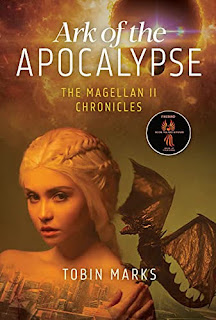
New Book Alert: Ark of the Apocalypse (The Magellan II Chronicles) by Tobin Marks; The Dark Somber Final Word on Earth's Destruction By Human Cruelty, Arrogance, Apathy, and Ignorance


New Book Alert: Ark of the Apocalypse (The Magellan II Chronicles) by Tobin Marks; The Dark Somber Final Word on Earth's Destruction By Human Cruelty, Arrogance, Apathy, and Ignorance

By Julie Sara Porter

Bookworm Reviews


Spoilers:There are science fiction books that are so dark that you fall into a black hole of personal depression. Then there are those that cause you to just throw up your hands and go "No hope! We're doomed!"

 If Court of The Grandchildren is a final warning for humanity to prevent climate change and to mind what we are doing before it's too late, then Ark of the Apocalypse The Magellan II Chronicles by Tobin Marks is the final message. It's the suicide note that Gaia will write as if saying "The Earth is dying because you weren't good to it. Now you are dying too."

Last year, I reviewed The Girl Who Found The Sun right when Missouri was in the process of shutting down because of the Covid pandemic. A Science Fiction novel in which the characters live in an underground world kept from the outside suddenly seemed more real when compared to a real life situation in which people were kept inside their homes because of the ravages of a pandemic and the arrogance of many people and a then Presidential Administration that chose not to follow simple common sense advice and allowed the virus to spread.

Once again a Science Fiction novel has become too real. With the Delta Strand variant of Covid creating another wave and many people around the world being unable to or choosing not to be vaccinated, with wildfires the size of New York City, Chicago, and Los Angeles spreading throughout the United States, and above all billionaires like Richard Branson and Jeff Bezos engaging in a "measuring contest" to see who can spend less than 15 minutes in space in a private spaceship instead of using that wealth to pay taxes or to help the people on this planet. The Magic 8 Ball prediction for Ark of the Apocalypse switches from "Maybe possible" to "Absolutely certain."

Once the future hits in 2035, it really hits and it's written in a way that is extremely believable. Temperatures in Mexico have reached 120 on normal days (the last time it hit under 115 was in 2027). Rising global sea levels have made most coastal cities flooded and uninhabitable and many once thriving water regions, like the Sea of Cortez, have become dead zones. Also hurricanes no longer operate through seasons and form supercells on a regular basis. Snow no longer appears on mountain ranges like the Rockies and the Alps.The rivers in India and China have dried up and the Great Lakes are becoming smaller because the waters dumped into them have dried up.

Earth is no longer able to produce enough food to maintain its increasing population. With the scarcity of water, only 20% of the Earth's population of 12 billion can be adequately fed.

 Countries, most notably Russia and the United States, are going to war over diminished resources. The U.S. President Abigail Moore is particularly eager to fire off her country's space orbital weapons system The Theater High Orbital Rover or THOR. (Typical USA in financial, environmental, and sociopolitical ruin but of course the government has the money to install and use a high tech brand new weapon for defense. I told you this book was spookily accurate.) 

The war ends in less than four minutes but one of the Iranian missiles explodes over Russia causing more tension between nations. Of course nuclear blasts unleash disease, famine, and a depressed and angry populace (at least the ones that survive.) Moore and Russian President Yuri Volkov exchange accusations and blame until they come to an uneasy agreement.

This is the kind of world where at the International Convention on Climate Control, climatologist Dr. Randall Burt's speeches could be summarized as "We tried to warn you. Everyone is guilty including myself. So long, Suckers!" Before he goes home to attempt suicide. His only suggestion is to eliminate 90% of the population or watch as we all drop dead. The only chance for humanity's survival is for a small group to travel into the stars and live on another planet. 

Two families are important to this mission. Their plan was centuries in the making. In the 1930's The Yanbeyevs, a Tatar family is ordered to be deported to Siberia. However, they have a secret up their sleeves which will help them get through the future struggles: A strange gift of prophecy shared by the seventh child of the family. This prophetic gift is passed through Anatoly's descendant Olga and her granddaughter, Nadya. Olga is determined that Nadya is to be one of the people on that space mission and she isn't above doing secretive underhanded things to ensure that future comes to pass and Nadya is able to survive to fill that destiny.

Another important family is that of Hikaru Mizushima's from Japan. After the bombing of Nagasaki, they have been holding onto a secret project contained within a metal box, a secret which will enable humanity to travel to the stars. Hikaru is able to use his ancestor's research to create spacecraft without rocket propulsion. 

This possibility of interstellar travel saving humankind is on the surface optimistic but that optimism is tempered by many realities.

 1) That only a select few people get to go so the majority of the population is left on Earth to die. In fact the cold attitude of many of the characters like The Yanbeyevs, Mizushimas, Moore, and Volkov is that "Everyone else can go f#$@ t&$#@(+-@_s," which is not the best way to make the Reader want to actually like these people and root for their mission to succeed.

2) Since the majority of the book is set on Earth, the focus isn't on space exploration or what this new planet is like. We do have some chapters where the characters encounter dragon-like beings and Nadya's dreams in the hyperspace sleep travel prove useful to the survival of the expatriate Earthlings. However, most of the book deals with the slow death march that Earth is on. 

We are given pages and pages of war and environmental catastrophe which is slowly strangling the remaining population. While you can't blame characters like Burt for reminding people that this could have been avoided, the callous tunnel vision that many characters have for the interstellar mission is is like ripping open a bandaid on a gaping wound. The wound is still there.

Especially since they are also willing to leave their families behind including small children. Unless they are planning subsequent space missions, they leave knowing that they are essentially consigning loved ones to their deaths by allowing them to remain on Earth. Also the chapters where they are on that planet suggest that they haven't lost their warlike nature or the desire of control and domination.

3) Of course the realism in how Marks writes this future cannot be avoided nor can the comparisons to the world that surrounds this fictional universe. It gets to the point that it's no surprise that the final two leaders of Russia and the United States: Viktor Petrov (replacing Volkov who was assassinated after 66 years as Russian President) and Crissy Caryn (an attractive former media celebrity) still engage in threats of war even as the world is dying around them suggesting that with some people power, any power, is more important than protection and survival. Nor is it any surprise that when Burt delivers the bad news, the people blame him for it instead of accepting their own share of the guilt.

This scenario is all too real and in real life may only be a few short years away (if not already here). The impending destruction and the callousness of the people living within it is something that we all have experienced and may continue to experience.

Ark of the Apocalypse The Magellan II Chronicles is one of those types of Science Fiction novels where even the hopeful moments convey a sense of despair because of what is left behind. It's a nightmare that is all too true and while we can close this book and forget about its contents, we can't close the real world around it. The only thing that we can do is turn things around, before this nightmare fictional scenario becomes the complete inescapable truth.


Monday, August 2, 2021

New Book Alert: Fractured Lives (An Angela Hardwicke Sci-Fi Mystery) by Russ Colchamiro; Science Fiction World Builds A Gripping Mystery


New Book Alert: Fractured Lives (An Angela Hardwicke Sci-Fi Mystery) by Russ Colchamiro; Science Fiction World Builds A Gripping Mystery 

By Julie Sara Porter

Bookworm Reviews


Spoilers: Remember earlier this year when I praised settings in mystery novels? In works like Under The Volcano A Quito Murder Mystery and Indecent Exposure A Father Hardy Alaskan Mystery the settings were so intrinsic to the plot that they went hand in hand. That is doubly true when Murder Mysteries are cross bred with Science Fiction. Many of the mysteries are set on another planet, another galaxy, another universe, or in cyberspace. 

The authors not only build a different world with unusual characters, lifestyles, and societies but they also have to consider the laws, penalties, and the socioeconomic structure that often lends itself to producing the crime.


One of the most engaging science fiction mystery worlds is Eternity in Russ Colchamiro's Fractured Lives: An Angela Hardwick Sci-Fi Mystery. According to Angela, Eternity is the cosmic realm responsible for the design, creation, and maintenance of the entire Universe. As a private eye, Angela's past cases have involved investigating android murders. shapeshifters, disfigured wormholes, alternate dimensions, and "a miles long helix of the Universe's DNA."


In fact everyone works for Eternity in one capacity or another. Some design the patterns of the galaxies, others like Angela's missing husband are Patches, they repair tears and holes in the Universe. Even children like Angela's son, Owen are trained to perform some job to help keep the Universe running. (Owen shows an aptitude for Patching like his father.)

Angela says that this society's drive to keep Eternity running is not only important to the residents, but to the Minders those who oversee the Cosmos. The Minders, Angela says "want us to accept that as Eternitarians we're all just stardust in living form. That we are the Universe and the Universe is us and all the existential wank that comes with it."


So Angela knows that she has a job to keep the Cosmos running by solving mysteries and stopping those who harm the people from making Eternity unravel. Her most recent case happens when Wanda Fyne walks into her office to hire Angela to find her daughter, Darla. Darla is a student at The Wrolen School of Celestial Design, and she's not actually missing. At least her body is present, but someone has stolen a part of her soul.

One minute Darla was a brilliant overachieving plucky enthusiastic college student, the next she became a sullen mistrusting argumentative and distant teen. In a normal world, that could just mean that she has developed a mental Illness, under a lot of stress and pressure from school, or acting like a typical rebellious teen. 

However in this Universe, something more sinister has happened. Angela, and her sidekick/assistant, Eric Whistler, who is also a family friend of The Fynes, discover that Darla has been left fractured and the missing part of her soul has been taken on behalf of a strange figure called The Scarlet Raj.


Fractured Lives dances a delicate balance between the Science Fiction and Mystery genres. Angela walks through the usual tropes of a mystery like interviewing the student advisor and Dean of the Wrolen School, Darla's fellow classmates, and getting intimate details about the Fyne's stormy marriage. Then something comes along to remind you that yes, this is a Science Fiction world. The students don't just create art of the cosmos, they are literally cosmic designers. Only a select few are chosen for their designs to be used among the stars. It's a cutthroat competition and only a few are selected. It's easy to see why there is a high dropout rate and why designs are often stolen.


The Scarlet Raj herself is a contradiction even by eyewitness accounts.  Not many have seen her and when she moves, even vid cams don't always catch her. She is a striking presence in front of her designers and they are often left fractured when they encounter her. Even Angela and Whistler are left briefly intimidated by her appearance. They know that she is the source for the soul stealing but they don't know who she actually is. The Scarlet Raj is a projected identity, but they don't know by who or what their goal is.


The investigation also opens up troubled aspects in Angela and Whistler's lives. Angela has to deal with her feelings towards the father of her child and a long buried secret from her youth. Whistler has to contend with his abandoned neglected childhood as he peers into the sordid private lives of the Fynes, a family that he once felt secure abd protected around. They are troubled noir hardboiled detectives in an automated alien world of the future.


Fractured Lives is a great union of Mystery and Science Fiction. Criminals commit crimes  and detectives fly into the stars to catch them.


New Book Alert: The Hunt For The Troll by Mark Richardson; Witty Engaging Cyber Search For A Mysterious Tech Savvy Creature


New Book Alert: The Hunt For The Troll by Mark Richardson; Witty Engaging Cyber Search For A Mysterious Tech Savvy Creature

By Julie Sara Porter

Bookworm Reviews


Spoilers: Mark Richardson's novel, The Hunt For The Troll is a witty engaging search for a troll in both terms: someone who deliberately provokes and disrupts others online and also takes the form of the monstrous figure from folklore (and has some very strange abilities beyond cyberspace implying that there could be something paranormal in the presentation).


The Narrator's first encounter with the Troll isn't through the Internet. It's in his sleep. He sees the Troll surrounded by a vast stream of binary code. The Troll informs his new friend that this conversation is taking place inside his mental processor on a cloud in the Internet. The Troll then tells the Narrator that "It's time to change the world."

The Troll is also seen in cyberspace and many people would like to see him apprehended so they solicit The Narrator to find and identity him.


The Narrator could be a second cousin to Corvus Okada from The Hysteria of Bodalis and Graham Weathered from Orange City. He is a tech genius with a big mouth and a sardonic sense of humor that gets him through his difficulties. He was a software programming prodigy when he got the attention of the Captain, a hacker with an idea for a start up company. The company did not exactly go the way of Facebook or Google, more like MySpace. It folded, leaving The Narrator and The Captain to go their separate ways. The Narrator ended up in Italy where he "became an expert in loafing."

When even loafing got boring, The Narrator returned to the United States, where he eventually accepted a job as a sweeper for an online gaming company called Centre Terrain. (Any similarities to any fantasy world created by J.R.R. Tolkien is completely intentional, he assures us. "The company's founders had hired a marketing team to come up with a deliberately catchy name, but after weeks of deliberation and dozens of focus groups, Centre Terrain was the best name that they came up with." )


The Narrator's job is to assume the form of Roma, a human warrior with "a physique that brought to mind Thor though Roma was darker and more brooding." Roma goes through the game and searches for problems or glitches in the system.

 It's an exciting fantasy world that The Narrator plugs himself into which is probably why while we learn much about him, we don't know his name. He feels like he's a nothing guy, one of several programmers. He doesn't have an identity beyond the one that he creates in Centre Terrain, the avatar in a world that isn't his. He isn't too far off from The Troll, a person hiding behind an online persona to give him a god-like presence.


Speaking of The Troll, since he and The Narrator have developed a connection there are many people that would like to use him to find The Troll. Many like The Narrator's boss Whitfield and Larry Gosling, a tech giant nicknamed The Architect, recruit The Narrator to hunt down the Troll. A big problem is that no one knows who the Troll is.

He doesn't leave a trace and many of his background information is purposely contradictory. 

The Narrator is able to put some clues together and profiles the Troll as someone who may have been an outcast, socially awkward, and a genius but not much of an opportunity to show it except through this mysterious avatar version of himself. Not unlike The Narrator himself.


That is probably why The Troll contacts The Narrator through the Internet and in his sleep. He sees a kindred spirit, someone who understands him. Together, they can create a new world that would allow them to come our from their alternate selves and be counted and accepted.


Mark Richardson presents an engaging hunt for a mythological creature but ends up becoming a hunt for one's purpose and identity. This is definitely a book that would please even the most disruptive of trolls.

Thursday, July 29, 2021

Weekly Reader: Demons of Time: Race to the 7th Sunset (Time Travelers Book #1) by Varun Sayal; Time Travel Adventures Offers Unique Society of Travelers


Weekly Reader: Demons of Time: Race to the 7th Sunset (Time Travelers Book #1) by Varun Sayal; Time Travel Adventures Offers Unique Society of Travelers

By Julie Sara Porter

Bookworm Reviews


Spoilers: Varun Sayal's Demons of Time: Race to the 7th Sunset is unique among books about time travel. It presents an interesting organization and world of time travelers.


While the time travel missions in the book are amazing, what is particularly fascinating is the organization and world in which the time travelers live (that is when they are not hopping through time.). They are not observing time from some future date but in the distant past. The book begins in 3077 BCE and is set at the University of Time Readers. From this vantage point, time readers see signs and premonitions, research information, and read documents from and  of the future. Since the future is not linear, they see possibilities. They can see what could happen if things are unchanged and the probability rates of potential destruction. To fix any problems in the time stream, they send for time travelers to a certain point in time to fix the problem. Then the readers scan the information to see what if anything changed.


In this assignment, Time reader Rigu is on the trail of a pair of time demons, Kumbh and Vetri. While fighting the demons, Rigu encounters mother and son, Dhara and Tej. Tej helps Rigu to defeat the demons. Rigu is impressed with the young boy's skill so twenty years later, Rigu reunites with Tej to give him a very interesting and exciting job offer. 

Kumbh has escaped from his time prison and traveled into the future. Rigu and the other time readers have seen the potential futures and have seen that a chain of events will result in humanity's destruction by 2076. The first link in the chain is set to occur in 2024 when Kumbh merges with someone's body. Tej has to merge with the body of Ravi Kumar Cheri, former illegal arms dealer turned businessman, find out who Kumbh is hiding inside, and stop his plan. Oh yes and he only has seven days. No pressure there.


Rigu and Tej have a close mentor student relationship. Rigu shows the younger man around the university and the difficulties of being a time traveler. Tej's first trip through time is somewhat stomach churning and sickening as he lands into the lair of a necromancer, three hundred years in the past to give him instructions on how to share consciousness with someone's body after they have been restored to life. Tej also travels through blackness and a long murky river which represents the River of Time. This journey is magnificent to read about and picture in one's head.

 Rigu realizes the difficulties that such a journey could produce and gives him some advice and recommends sandalwood and other oils to soothe his body and focus his mind so he can go to the right destination. Rigu also teaches Tej on how to live inside the host body and to return to his original timeline as a sanctuary. 

Rigu is also on hand to talk to Tej about other matters. Even though Tej is married to a woman and a father, he confides that he has thoughts about a male friend and has always had erotic feelings towards men. Rigu tells him that it is no sin for men to love other men and the only real sin is to hurt others. Rigu is practically the father that Tej lacks and has always longed for.


When Tej is on his own in 2024, this exciting original Science Fiction concept takes a back seat to Mystery as Tej-in-Ravi has to discern which of Ravi's colleagues or enemies Kumbh is hiding inside. He has to do some detective work as he scans Ravi's files to find the potential recipient of Kumbh's not so charitable donation of his spirit.

The kind hearted naive Tej's transformation into the ruthless avaricious Ravi is difficult for him to handle. He has to act like Ravi on the outside without anyone acting suspicious while still remembering that he is Tej, the time traveler with a fast approaching deadline, on the inside.


There are some twists towards the end, some that are rather unfortunate because they cause the Reader to question everything that had gone before. However, Demons of Time Race to the 7th Sunset is a brilliant first look at a unique world that will be great to explore in some future, or past, date.


Weekly Reader: Hades Forest by Simon Elson; Dystopian Science Fiction Marries 1984 and Lord of the Flies and Creates A Very Dark Weird Baby


Weekly Reader: Hades Forest by Simon Elson; Dystopian Science Fiction Marries 1984 and Lord of the Flies and Creates A Very Dark Weird Baby

By Julie Sara Porter

Bookworm Reviews


Spoilers: The usual trajectory of dystopian science fiction is when the protagonist leaves their oppressive regime and joins the Resistance Movement, the Resistance consists of better characters that intend to speak and fight against the dictators and create a newer and better society. It's rare that the protagonist discovers that the rebels are just as bad or worse than the people that they left behind. Sometimes if the rebels don't have a decent society and structure planned, they can turn the dystopia into further chaos.

Simon Elson's Hades Forest is just such a science fiction novel. It begins as a dystopia describing a world right out of 1984, Fahrenheit 451, Brave New World, or The Handmaid's Tale. Then halfway through the novel, the book seems to get lost on its way to Lord of the Flies, featuring characters struggling to survive within various tribes that attack and kill each other.


The style of the book is similar to Reality Testing by Grant Price in that the book is separated in two distinct sections: the one set in the dystopia and the other with the resistance. However, unlike Reality Testing which shows better characterization and a distinct goal from the rebels on how to improve their society, neither side looks particularly good and both have their share of problems


Perry Benson lives in futuristic Tambamba, in the country formerly known as South Africa, now called the Holy States of Borea. In the future, governments and countries have collapsed. Perry lives in a society where he has a voice recorder on his neck and a tracking device on his foot. Everyone gives thanks to Borea as part of a greeting and parting much to Perry's chagrin. 

Borea's government controls every aspect of its citizens' lives including that they are assigned a partner after thirty and are only permitted one child. Eradicts like Perry are ordered to destroy any item that is considered evil i.e. things of the past: things like tinsel, rugby balls, DVD players, and a copy of Alice's Adventures in Wonderland (the last from my cold dead hand!). Citizens like Perry and his wife, Mabel are required to attend public events which talk about Borea's history and how "wonderful" their society is. 


Perry and Mabel's marriage is similar to that of Guy and Mildred Montag in Fahrenheit 451. Mabel is the loyal card carrying member of Borean society. There is nothing that she does or says that isn't approved of by Borean's Codes and Society. She even schedules her and Perry's copulations when Borea says that they need to procreate. Mabel is practically a robot created only to please the state.

Perry on the other hand has to play the role on the outside while challenging the standards on the inside. The way that Borea is structured makes someone who questions it believe that there is something wrong with them and not the society. In fact they have a term for that (similar to how psychiatrists in Soviet society actually created mental disorders for people who denounced Soviet politics.)

People with physical and mental disorders are considered Crolax and are exiled. Anyone who denounces the state is considered Crolax. Perry discovers for himself what being a Crolax is like when he denounces Borea in public and ends up in prison.


Borea is terrible no doubt about it but when you think Perry is going to become a hero, things take an even more disturbing turn.

Perry breaks out of prison with the help of a man named Dolphin who leads him to Hades Forest. If Borea represents too much order and control in which every move and every aspect is micromanaged and planned, then the world of Hades Forest represents too much chaos. The only laws involve survival of the fittest. People are separated into five tribes which use cutthroat means to attack the others.

 Left alone in the forest, Perry encounters The Leagros, a tribe of survivalists who steal from other tribes to survive. The Leagros battle against other tribes that specialize in rape, slavery, murder, and torture. Each tribe feels that it is their right to strike back at those who oppose them in any means possible with no laws, no ethics, and no compassion. The tribes use the methods that they learned from the Boreans who hurt them.  However, they fight amongst themselves rather than against Borea which puts them in this mess in the first place.


Perry and the other tribe members stand out as interesting characters despite the bleak circumstances. There's the excitable Kirito who constantly talks in third person and once he befriends Perry, becomes a loyal staunch friend. Chintu is a hard edged veteran of the Tribal Wars and has no time for Perry's ethical arguments. Crank is the shifty leader of Leagros who has cunning means of stealing from other tribes and a grudging respect for those in his tribe. Then there's Miist, an enigmatic member of another tribe who mysteriously saves Perry and the others on occasion.


Some plot twists get introduced towards the end that are genuinely surprising and cause Readers to question the characters' behavior. One revelation caused this Reader to go back and reread some passages to follow the leads to this revelation. Upon second reading it made sense and added a bit more to the Boreans and the Hades Forest residents than originally perceived.


There have been many dystopian fiction novels written in the past year. Sometimes a writer can still add a new twist to what could be a tired subgenre. Luckily, Elson is that writer.