Showing posts with label Dystopia. Show all posts

Wednesday, April 1, 2026

A Collection of Tiny Stories: Diminutive Tales From The Tips of My Imagination by C.K. Sobey; The School of Optimal Futures by Annie Flint


A Collection of Tiny Stories: Diminutive Tales From The Tips of My Imagination by C.K. Sobey; The School of Optimal Futures by Annie Flint 

By Julie Sara Porter 

Bookworm Reviews 


A Collection of Tiny Stories: Diminutive Tales from The Tips of My Imagination by C.K. Sobey

This review is a summary. The entire review can be found on Reader Views.

Sometimes writers can say much with very few words. That's what C.K. Sobey demonstrates with the anthology A Collection of Tiny Stories: Diminutive Tales from The Tips of My Imagination. Sobey presents 24 short stories no longer than one or two pages or a few paragraphs to describe a conflict, a setting, a character, or a specific moment. 

A babysitter discovers dark secrets about her neighbor. A bookworm receives a personal message from their latest book. A woman receives a newspaper with a prophetic story. A woman writes to her husband during WWI. A little girl wants a new doll for her birthday. A janitor longs for a different path in life. An abusive man encounters a witch. Workers make the most of the dockyard night life. A woman finds an abandoned teddy bear and takes it home with her.

Sobey doesn't use many words. The words that are used capture those brief flickering moments which dare readers to read, visualize, and understand a brief point in time. They are descriptive, lyrical, visceral, and skillful in depicting a single lasting image within each story.


The School for Optimal Futures by Annie Flint

This review is a summary. The entire review can be found on LitPick.

The School for Optimal Futures by Annie Flint book is a YA dystopia science fiction novel that acknowledges the conflict between the domineering authority figures and the young courageous rebels but also comments on many of our current conflicts with technology, government overreach, and education.

 Ginger is sent to The School for Optimal Futures, an elite bizarre private school. The curriculum is strange. The faculty are very secretive and students disappear. Ginger and her new friends, Zoe, Matty, and Aiden discover a conspiracy between the school’s founder and the tech company that owns the school and the nearby town. 

The School for Optimal Futures gives a pleasant exterior but is questionable internally. It has a beautiful campus, interesting curriculum, welcoming students, supportive faculty, but it's all surface.

There is something performative and uncomfortable about the whole situation, like the school is playing the part of a welcoming empathetic place for misfits and outsiders but isn't really. Things like constant surveillance and.missing students and faculty members are highly suspicious plus a giant tech company has complete control over the school.

 The book’s plot is a savage commentary on surveillance, corporate control, and the manipulation of educational standards to serve the goals of the oligarchs and the world they strive to create. The school is written as a microcosm of what is already being done on a larger scale by large corporations who focus on gain and control rather than humanity and preservation.


The School for Optimal Futures calls to attention many of the real-life world problems but also offers ways in which they can be countered, challenged, changed, and maybe defeated.


Sunday, December 24, 2023

Lit List Short Reviews: Exiles by Miles Watson; The Kuiper Rogue by C.P. Schaefer The Mango-Lion: The Mangoes Have Fallen by J'yren Christenvie

 Lit List Short Reviews: Exiles by Miles Watson; The Kuiper Rogue by C.P. Schaefer; The Mango-Lion: The Mangoes Have Fallen by J'yren Christenvie


Exiles (The Chronicles of Magnus) by Miles Watson 


Spoilers: Miles Watson’s previous short work, Deus Ex, was a gripping story about the dramatic fall of tyrant Magnus Antonius Magnus. In my review, I suggested that there was enough interest to write another installment or even a full series set in this universe. Apparently, Watson thought so too. The follow up is Exiles which tells of Magnus’ reign of terror from two people who are right in the thick of it. One is an outsider in every sense of the word and the other  was the ultimate insider, the one who helped turn Magnus into the tyrant that he later became.


Marguerite Bain is the pirate/smuggler captain of the ship, Sea Dog. Her crew despises her for being a woman but they follow her anyway. She is hired by an anonymous employer who wants her to deliver supplies to a man who is exiled on a small remote abandoned island. She is not to interact with him nor allow him anything with which to communicate. However, her curiosity gets the better of her and she enters the cabin to see the Exile. Upon arriving, Marguerite wakes the Exile and runs in surprise. While inspecting the return cargo, Marguerite finds a notebook that tells of the Exile’s life story. The Exile explains who he is, Enitan Champoleon, and how he changed history by fighting against the Order and allying with an idealistic young man named Magnus Antonius Magnus who had his own sights set on leadership.


Through Marguerite and Enitan, we get the full account of life under Magnus’ rule and the government before it that Magnus fought against and took over. Marguerite is someone who may have lived most if not all of her life under Magnus' governance. She knows no other life. She had been abused, abandoned, left in squalor, and sold into prostitution and smuggling. She has been forced to survive on her own in a world of corruption, tyranny, and abuse. 


Marguerite is part of an organization called the Brotherhood, but that name appears to be a mere suggestion rather than demonstrating anything resembling allyship or brotherhood. In fact, she is warned that one of her crew members is a spy and potential assassin. She has to ferret out the traitor amongst her band of misogynistic murderous scum while learning about how Enitan helped put the Lead Scum in charge.


Marguerite’s story is that of the outsider, the effects of Magnus' reign and how it affected the lowest level of people in this society. Enitan’s story is from a different place. He is the one who has been there and shaped history. His actions are the cause, the one who helped Magnus obtain power and saw the tyrant that emerged from the front row.


Enitan recounts a life of intellect but also abandonment, where he had a great mind but little opportunity to use it. The only way he can use his mind is to read escapist adventure novels that mentally take him places that he wants to go. (In one of the saddest reveals, Enitan confesses that he still has those books, even in exile, because all he has left is the imaginary world that was nothing like the real one that he helped change). 


Enitan goes AWOL from the military and runs into a group of activists protesting the current government, The Order. They claim that the Order must end and they are the Solution. At first, Enitan sees a quick way to earn money and gives a stirring speech to open up activists’ hearts and especially wallets. He doesn't really believe in the rebel cause, though he hates the Order. He just sees some people who can keep him safe and earn him money.


Enitan changes his tune when he meets the eloquent, firy, idealistic Magnus. The man who wants to put an end to the old Order. Like many rebels before and since, Magnus has a just cause when he sees people getting hurt and being degraded as second class citizens. His far reaching vision promises a better future and his active aggressive personality shows that he's not afraid to fight alongside the soldiers. Enitan is sold, especially when Magnus is impressed by his friend's intelligence and strategic thinking. Unfortunately, that strategic thinking is unable to see the future tyrant's manipulative nature and true ambition until it's too late and Enitan realizes the full scope of what those plans lead to and how much Magnus has changed or rather how much he kept hidden until his true nature emerged. To quote The Who’s “Won't Get Fooled Again,” Enitan “meets the new boss same as the old boss.” Spending years in exile on this tiny island, Enitan feels the weight of remorse and regret for the world that he helped create.


While Deus Ex gave us a glimpse into the Magnus dictatorship, Exiles strengthens it by showing us the people who suffered through it. History is often written on the blood of those who were crushed under the dictator's boot and those who gave the dictator power to do the crushing.


The Kuiper Rogue by C.P. Schaefer 

C.P. Schaefer's The Kuiper Rogue is a tech heavy Hard Science Fiction novel that is perfect for that type of Science Fiction fan. Those who are more interested in character and world building, well there is some of that too.

On the Gaia 3 Titan Moon Base, hopes are high for a new Earth based space colony. There have already been bases established on Earth’s moon and on Mars. Saturn’s moon is the latest. However, something in the sky might put those plans to a screeching halt. Will Vandoloh, astronomy prodigy and son of Margaret, Gaia 3’s captain, sees a curious object in a computer simulation. An enormous comet passes through Saturn and triggers a chain reaction of catastrophic events including oxygen depleting on the base, crew members acting delirious and succumbing to insanity, and radiation levels rising to fatal levels. Worse, this comet is heading for Earth and even worse according to ancient writings from Earth’s history, this happened before and the results weren't good. It may lead to the extinction of not only Titan’s population, but maybe Earth’s as well.

The technical details in Kuiper Rogue are plentiful. They are very reminiscent of a Star Trek episode where one of the crew members, like Spock or Data, will go into a long winded explanation of what is going on and what if anything can be done to stop it.
For the tech heavy Sci-Fi fan, there is a lot of talk about orbital singularities and the schematics of the Gaia 3 project. Sometimes those passages can be a bit dense and unwieldy for the less scientific minded. 

The most memorable aspects of the book are the rare moments of characterization underneath all of the science hardware. There are some chilling chapters when the crew goes insane because of the high radiation, low oxygen levels, and the comet’s arrival. One appears to be eating human flesh and another’s eyes glow red and face distorts into a very monstrous appearance. It's like a horror movie in outer space.

Some of the best moments are between Margaret and Will. Margaret is the tough as nails strong willed head of her crew but also a loving mother. There are many times when she has to walk a tightrope between those roles, worried about the danger that her son is in but knowing that he can help save the rest of the crew.
Will is a brilliant young man who finds his niche in examining space and working on other worlds. He also wants to make his mother proud. The duo’s love for each other is paramount throughout the whole book.

While the technical detail in The Kuiper Rogue is massive, so is the human element, particularly the family ties between mother and son.

The Mango-Lion: The Mangoes Have Fallen by J'yren Christenvie.

J’yren Christenvie’s book, The Mango-Lion: The Mangoes Have Fallen, is one of the strangest allegories that I have ever read. It is about the youth and maturity of a mango. Yes, a mango, the fruit. Once you get past the odd premise, you will find an uplifting story about growing up and striving for one's goals.

Liligu is a young mango spending his days on a tree with his mango family and friends. His mother tells him that one day, he will become a big beautiful mango tree. Before he can ask how, the tree is invaded by humans, called “bigmouths.” They eat some of Liligu’s friends and family and pluck him, carrying him away from the tree and his mother. He is then given to a human girl named Lilibeth and through her and the new friends that he makes, Liligu learns exactly what he needs to become a big beautiful mango tree.

Liligu starts out like a small child. He is curious but afraid of everything. He wants to become a tree but is afraid of the Bigmouths. Left on his own, he is scared, uncertain, shy, and nervous about everyone around him. 
He befriends two stuffed animals, a giraffe named Girigu and a pig, Piligu. Because their memories come from being made in factories alongside their “brothers and sisters” (other stuffed pigs and giraffes), Liligu gives them his memories of having a mother and being close to family. 
He also learns to trust some bigmouths. They aren't all bad. Lilibeth is very kind to him and treats him like a favorite toy or pet. Through her, Liligu learns to trust those even if they are part of people that he thinks that he won't like.

During his journey, Liligu obtains knowledge. He has dreams of his mother and wants to know what they mean. He wants to be educated. He receives wisdom from Mr. Wateru, a watermelon, Dr. Uki, an apple, and Bozero, a dog who advise him based on their own experiences. They only give him some information, which while helpful, is incredibly limiting. It takes his friendship with an orange named, Orange where he learns about love, sacrifice, independence, and what it takes to fulfill one's dreams. 
Liligu learns that it takes growing up, experiencing the world, and making a positive choice to make it better.




Wednesday, December 20, 2023

New Book Alert: Kutri by Blake Rudman; On Danger, Beauty, and The Future of Reality Programming


New Book Alert: Kutri by Blake Rudman; On Danger, Beauty, and The Future of Reality Programming

By Julie Sara Porter

Bookworm Reviews


Spoilers: Between Dark Beauty and his latest work, Kutri, Blake Rudman knows that there can be danger found in great beauty. His previous book, Dark Beauty, was a psychological thriller about a pair of beautiful twin models turned actresses who take their rivalry to fatal proportions. Kutri shows a future in which women exist solely as objects of beauty by men who use a declining population as an excuse to dominate and control women.


In the future, a Slow Plague killed off millions of women and girls world wide severely depleting the future populations. Females are now a rare commodity and marriage is considered so highly desirable that the Powers That Be created a reality show (figures).called Good Breeding. Good Breeding’s premise is that women are recruited from all over the world selected for their appearance, intelligence, background, ethnicity, and anything to make them desirable to their future grooms. They are selected in a process that reeks more of a sleazy beauty pageant than any promise of eternal love and personal commitment.

Trouble begins when matchmaker Jakob Freeman recruits Kutri Chandigarh, who was selected because she is one of the few remaining female Punjabi around and matching race and ethnicities is very important. (Chandigarh is not even her surname. It was the place where she was found.) She seems really good on paper, so good that Jakob falls in love with her and vice versa.


Like most good science fiction dystopian writers, Rudman crafted interesting details about a world that is in decline. Women in this universe are treated as valuable rare commodities like gold or oil. They are put on pedestals and valued specifically for what they bring to marriage and breeding. Their appearance and abilities to bear children are their only means of collateral. While claiming to respect women to the point that crimes against women are punishable by death or dismemberment, this male dominated society objectifies women by depriving them of freedom or choice in their own destinies. 


Jakob works for The Studio, the real power in what used to be Los Angeles. What studio? It never says. More than likely in this day and age of studios merging and buying each other, it's quite possible that by Kutri’s time, they simply became one gigantic media and entertainment corporation.

 In a government  controlled by corporations in Kutri's world, is it any surprise that the one that openly controls California is an entertainment conglomerate? It is they who feature the Good Breeding series and they who decide which marriages will be arranged and how the population will grow under its tight rule. When entertainment and the arts becomes propaganda to promote the government instead of the channels in which to satirize, challenge, mock, argue against, or even question that same government, it loses its bite and becomes a means of control. It becomes something to fear instead of something to engage in, enjoy, and even escape into. 


Jakob and Kutri are the typical protagonists in this kind of science fiction novel. They are participants of a system that they don't always like but can do little about. Kutri agrees to be on Good Breeding because she has very few options. She was abandoned by her father and her Punjabi heritage makes her stand out. She knows that she is being sold and forced into marriage but it her choices are limited to either being owned in public or assaulted and possibly murdered in private. From the moment that she arrives in California, Kutri is constantly monitored and on the air. People study what she wears, what she eats, where she goes, and who she talks to so they can assess her potential as a bride. Despite the pampering and celebrity treatment that she receives, Kutri is always on, a prisoner of instant fame.


Jakob has his reasons to stay within this system because he literally cannot think of any other options. He is a widower and remembers how his wife died but nothing else about her: her appearance, personality, or even her name. He was given a modification chip inside his brain to forget everything about her except for the fact that he was once married. This chip also causes Jakob and other men to be unable to resist or act with violence towards the Studio and their representatives.


It is only after Jakob and Kutri start to develop feelings for each other, that they decide to actively rebel. In this process they meet other characters who also would like to see The Studio and the rest of these tyrants taken down.

The resistance has many faces and takes many forms. There's Jason's former partner, Sven, who collected memorabilia from the time before the Slow Plague (things like Pokemon cards, old cell phones, board games, acid free paper books, and vinyl records). There's Kirmi Teng, the previous groom who commits an act of violence live on air. There's Jimmy Ching, a pawn shop owner with his own secret connection to Jakob and Kutri. 


In one chilling chapter, the couple encounter the A&L Club, a private club for men who lost their appendages after being convicted of various crimes and now want to restore the right to divorce. Then there's La Vie, a group consisting mostly of former Good Breeding couples who are planning an all out rebellion in which the women will fight to free the other women from bondage and deactivate the chip from men's brains.


The resistors are various individuals and groups that have their own agendas for fighting the Studio. Some are more trustworthy than others and some show that just because they have the same end goal in mind, getting rid of this oppressive government, doesn't necessarily mean that they are good human beings. What they have in common is they want this oligarchy gone and will use any means necessary to achieve it.


Kutri is a sharp warning about the future where beauty is valued too highly, audience dependence on exploitation entertainment becomes destructive,  and love, friendship, and commitment are distant memories. It demonstrates that we have the ability to let our forms of entertainment destroy or save us.


Thursday, November 17, 2022

Weekly Reader: The Descendants (The Descendants Series Book One)by Destiny Hawkins; Intriguing Concept in YA Science Fiction About Finding One's Own Personal Power in a World Full of Energy Abilities


Weekly Reader: The Descendants (The Descendants Series Book One)by Destiny Hawkins; Intriguing Concept in YA Science Fiction About Finding One's Own Personal Power in a World Full of Energy Abilities 

By Julie Sara Porter

Bookworm Reviews


Spoilers: Many Science Fiction dystopian novels have characters being separated by some arbitrary type, as an analogy on how modern society separates people from larger categories like race and social class to minor sets like IQ's or personality types. Whether it's by brain type like in Brave New World, social and personality factions like in Divergent, or assigned careers like in The Giver. 

In each one, there is a character (or characters) that doesn't fit into these assorted categories and questions the system that does this. 


The themes often are that people are people. They are flexible, learning, adaptive, complex, messy, and can't always be put into a box. Human nature by its own definition is changeable and often resists such placement. A person who prefers to be introverted in private may be extroverted in their jobs. A person with a high IQ may not have a lot of common sense or street smarts. 


While sometimes exploring such concepts may be interesting, that's a poor way of viewing the society at large.

Studying one's race and culture may drive a person to look into their own family history and where they came from. When someone takes a personality quiz, they could find favorite interests or a career in which they shine. But what is problematic is when people use those types to maintain superiority rather than equality. When they use those categories as an excuse to isolate and segregate people as a means to maintain that superiority.


That is the main theme that can be found in Destiny Hawkins' YA Dystopian Science Fiction novel, The Descendants. It is set in an alternate future in which people have different abilities in which they can control energy. They are called Lighters and are in charge of the Lighter Nation. 


The Lighters are then put into three categories: Brighter (possessing incredible speed and strength), Elem (the ability to control earth, air, fire, and water), and Dim (create darkness). They are then separated into subcategories depending on the color that the Lighter emits like soma for dark blue, vex for turquoise blue, and kali for white. They then operate on different levels depending on the brightness of their light. As if to make the point less subtle, the narrator even remarks that it's a terrible way to separate people by color and by shades of that color (get it?). 


Then there are the Nulls, people who cannot bring light forward at all. Rayah Bardeau, the narrator and protagonist,  is one such Null. Nulls are treated horribly. If they can't demonstrate Lighter powers by the time they finish school, then they have to become slaves.

 Major Artemis St. James, Rayah's former owner, is licking his lips in anticipation for that moment. While Rayah is at the Academy, her mother has taken her place as a slave but it is clear that he intends to use Rayah for more than chores.


Nulls are subjected to pain tests and other students are allowed to bully them. There are many intense scenes where Rayah is bullied by Artemis and the Lighter students. She isn't a slave by name, but it is apparent that most people in Lighter Nation do not treat her as a human being with equal rights.


What is particularly fascinating about the scenario that Hawkins writes is that The Descendants is almost the exact opposite of the scenario of X Men. Whereas the Marvel franchise depicts the people with powerful abilities as the outsiders, The Descendants portrays the ones without abilities as "The Others." Either way, they make the same point: that somehow bigoted people will find someone different to scapegoat, to look down upon, to isolate, to hate, to threaten, to hurt, and sometimes to kill just for who they are.


Some of the most interesting passages are when Rayah is in the Wild Lands, an area outside her homeland in which the citizens are forbidden to go. Of course, Rayah does and encounters people who live outside of Lighter rules and regulations. Her romance with Soren, one of the people from the Wild Lands, is a typical one for this genre though they are likable characters.

 Soren is particularly helpful in that he sees Rayah as a person not a Null. She also sees Soren as a person and not a wildling. They see beyond the programming that society has given them into the soul inside.


What the Wild Lands chapters do is give Rayah chances to reveal her own power. During her academy studies, she has shown a strong talent for hand to hand combat. She is able to use that to defend her new friends when they are threatened. She also discovers new abilities that were never dead, just dormant.


Without spoilers, on the one hand this revelation plays into the problems in Rayah's society by revealing that she fits in after all. However, on the other hand, that could also be the point. The Lighter Nation citizens may believe that they need someone to look down on to the point that they will deprive someone of their innate abilities to make it happen. They would rather have a class of slaves than admit that everyone could be treated as an equal.


The Descendants has a lot to say about how we separate people into various types and categories and sometimes use them to look down upon others. It also shows how we can use our personal power to stand against that categorization and be seen as individuals.


Wednesday, August 4, 2021

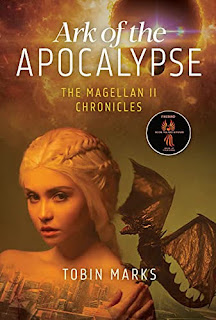
New Book Alert: Ark of the Apocalypse (The Magellan II Chronicles) by Tobin Marks; The Dark Somber Final Word on Earth's Destruction By Human Cruelty, Arrogance, Apathy, and Ignorance


New Book Alert: Ark of the Apocalypse (The Magellan II Chronicles) by Tobin Marks; The Dark Somber Final Word on Earth's Destruction By Human Cruelty, Arrogance, Apathy, and Ignorance

By Julie Sara Porter

Bookworm Reviews


Spoilers:There are science fiction books that are so dark that you fall into a black hole of personal depression. Then there are those that cause you to just throw up your hands and go "No hope! We're doomed!"

 If Court of The Grandchildren is a final warning for humanity to prevent climate change and to mind what we are doing before it's too late, then Ark of the Apocalypse The Magellan II Chronicles by Tobin Marks is the final message. It's the suicide note that Gaia will write as if saying "The Earth is dying because you weren't good to it. Now you are dying too."

Last year, I reviewed The Girl Who Found The Sun right when Missouri was in the process of shutting down because of the Covid pandemic. A Science Fiction novel in which the characters live in an underground world kept from the outside suddenly seemed more real when compared to a real life situation in which people were kept inside their homes because of the ravages of a pandemic and the arrogance of many people and a then Presidential Administration that chose not to follow simple common sense advice and allowed the virus to spread.

Once again a Science Fiction novel has become too real. With the Delta Strand variant of Covid creating another wave and many people around the world being unable to or choosing not to be vaccinated, with wildfires the size of New York City, Chicago, and Los Angeles spreading throughout the United States, and above all billionaires like Richard Branson and Jeff Bezos engaging in a "measuring contest" to see who can spend less than 15 minutes in space in a private spaceship instead of using that wealth to pay taxes or to help the people on this planet. The Magic 8 Ball prediction for Ark of the Apocalypse switches from "Maybe possible" to "Absolutely certain."

Once the future hits in 2035, it really hits and it's written in a way that is extremely believable. Temperatures in Mexico have reached 120 on normal days (the last time it hit under 115 was in 2027). Rising global sea levels have made most coastal cities flooded and uninhabitable and many once thriving water regions, like the Sea of Cortez, have become dead zones. Also hurricanes no longer operate through seasons and form supercells on a regular basis. Snow no longer appears on mountain ranges like the Rockies and the Alps.The rivers in India and China have dried up and the Great Lakes are becoming smaller because the waters dumped into them have dried up.

Earth is no longer able to produce enough food to maintain its increasing population. With the scarcity of water, only 20% of the Earth's population of 12 billion can be adequately fed.

 Countries, most notably Russia and the United States, are going to war over diminished resources. The U.S. President Abigail Moore is particularly eager to fire off her country's space orbital weapons system The Theater High Orbital Rover or THOR. (Typical USA in financial, environmental, and sociopolitical ruin but of course the government has the money to install and use a high tech brand new weapon for defense. I told you this book was spookily accurate.) 

The war ends in less than four minutes but one of the Iranian missiles explodes over Russia causing more tension between nations. Of course nuclear blasts unleash disease, famine, and a depressed and angry populace (at least the ones that survive.) Moore and Russian President Yuri Volkov exchange accusations and blame until they come to an uneasy agreement.

This is the kind of world where at the International Convention on Climate Control, climatologist Dr. Randall Burt's speeches could be summarized as "We tried to warn you. Everyone is guilty including myself. So long, Suckers!" Before he goes home to attempt suicide. His only suggestion is to eliminate 90% of the population or watch as we all drop dead. The only chance for humanity's survival is for a small group to travel into the stars and live on another planet. 

Two families are important to this mission. Their plan was centuries in the making. In the 1930's The Yanbeyevs, a Tatar family is ordered to be deported to Siberia. However, they have a secret up their sleeves which will help them get through the future struggles: A strange gift of prophecy shared by the seventh child of the family. This prophetic gift is passed through Anatoly's descendant Olga and her granddaughter, Nadya. Olga is determined that Nadya is to be one of the people on that space mission and she isn't above doing secretive underhanded things to ensure that future comes to pass and Nadya is able to survive to fill that destiny.

Another important family is that of Hikaru Mizushima's from Japan. After the bombing of Nagasaki, they have been holding onto a secret project contained within a metal box, a secret which will enable humanity to travel to the stars. Hikaru is able to use his ancestor's research to create spacecraft without rocket propulsion. 

This possibility of interstellar travel saving humankind is on the surface optimistic but that optimism is tempered by many realities.

 1) That only a select few people get to go so the majority of the population is left on Earth to die. In fact the cold attitude of many of the characters like The Yanbeyevs, Mizushimas, Moore, and Volkov is that "Everyone else can go f#$@ t&$#@(+-@_s," which is not the best way to make the Reader want to actually like these people and root for their mission to succeed.

2) Since the majority of the book is set on Earth, the focus isn't on space exploration or what this new planet is like. We do have some chapters where the characters encounter dragon-like beings and Nadya's dreams in the hyperspace sleep travel prove useful to the survival of the expatriate Earthlings. However, most of the book deals with the slow death march that Earth is on. 

We are given pages and pages of war and environmental catastrophe which is slowly strangling the remaining population. While you can't blame characters like Burt for reminding people that this could have been avoided, the callous tunnel vision that many characters have for the interstellar mission is is like ripping open a bandaid on a gaping wound. The wound is still there.

Especially since they are also willing to leave their families behind including small children. Unless they are planning subsequent space missions, they leave knowing that they are essentially consigning loved ones to their deaths by allowing them to remain on Earth. Also the chapters where they are on that planet suggest that they haven't lost their warlike nature or the desire of control and domination.

3) Of course the realism in how Marks writes this future cannot be avoided nor can the comparisons to the world that surrounds this fictional universe. It gets to the point that it's no surprise that the final two leaders of Russia and the United States: Viktor Petrov (replacing Volkov who was assassinated after 66 years as Russian President) and Crissy Caryn (an attractive former media celebrity) still engage in threats of war even as the world is dying around them suggesting that with some people power, any power, is more important than protection and survival. Nor is it any surprise that when Burt delivers the bad news, the people blame him for it instead of accepting their own share of the guilt.

This scenario is all too real and in real life may only be a few short years away (if not already here). The impending destruction and the callousness of the people living within it is something that we all have experienced and may continue to experience.

Ark of the Apocalypse The Magellan II Chronicles is one of those types of Science Fiction novels where even the hopeful moments convey a sense of despair because of what is left behind. It's a nightmare that is all too true and while we can close this book and forget about its contents, we can't close the real world around it. The only thing that we can do is turn things around, before this nightmare fictional scenario becomes the complete inescapable truth.


Tuesday, May 25, 2021

New Book Alert: Court of the Grandchildren by Michael Muntisiov and Greg Finlayson; Somber Warning About The Future World The Next Generations Will Inherit


New Book Alert: Court of the Grandchildren by Michael Muntisiov and Greg Finlayson; Somber Warning About The Future World The Next Generations Will Inherit

By Julie Sara Porter

Bookworm Reviews


Spoilers: While reading Michael Muntisiov and Gregory Finlayson's Science Fiction novel, Court of the Grandchildren, I was reminded of the proverb, originally attributed to environmental activist, Wendell Berry, "We do not inherit the Earth from our ancestors, we only borrow it for our children." I am also reminded of Greta Thunberg, the young climate activist and Nobel Peace Prize Nominee, addressing the world leaders at the UN Climate Action Summit with the passion of her youth but the wisdom of someone twice her age with: "How dare you? You have stolen my dreams and my childhood with your empty words! And yet I am one of the lucky ones! People are suffering! People are dying! Entire ecosystems are collapsing! We are in the beginning of a mass extinction, and all you can talk about is money and fairy tales of eternal economic growth! How dare you?"

As older generations, we have to take into account the world that we have destroyed either on purpose for corporate gain or accidentally through apathy and inaction, the world that future generations will inherit. According to NASA's Global Climate Change Website, the global temperature has increased by 2.12 degrees with most of the increase occurring in the last 40 years. This causes rising sea levels, decreased snow cover and shorter winters, shrinking ice sheets and glacial retreat, declining Arctic seas, ocean acidification, and extreme weather patterns like hurricanes, tornados, floods, drought, blizzards, and famine. This is the world future generations will be given and may worsen.


This is also the world envisioned by Muntisiov and Finlayson in their novel. It is only set in a few short decades in 2059. This is a world where a massive flood caused by increased sea levels and inadequate protection occurred. The results were that many of the coastal states were destroyed or declared uninhabitable.

 New states are formed in the absence of old ones. Because people haven't learned anything about welcoming asylum seekers, the constitution limits entry of out of state residents into one of the states, Concord. Of course, these former residents are taunted and threatened by locals that complain about sharing resources and employment with out of staters. 

The environment is on the precipice of destruction and extinction of the human race is happening. To make up for the lack of human workers, artificial intelligence is on the rise. Some anti technology zealots have joined a group called Humans First. Younger generations have turned violent against the elders because of the state of the world that they have been left with by calling them "burners" and attacking them. (Forget, "Okay boomer." The term "burner" carries much deadlier connotations.) Death and loss are so common that the Euthenasia Law is enacted so people can acquire the right to commit suicide.

In this world, 96 year old David Moreland is at a loss. He is ordered to appear before the Climate Court because he is charged for being one of the people who caused the massive floods that destroyed the bicoastal states. He is guilty about the devastation but has also appealed to the court and reunited with his great niece, Lily for one reason: he wants to acquire the right to die.


This book is extremely dour and dark with a bleak future projected. However, there is a sense of detachment and world weariness within the writing. It alternates between David and Lily's points of view with transcripts from David's trial and memoranda provided by the Climate Court, police, and Presidential candidates. The overall effect is that the Reader is experiencing David's trial as though it were a real event. 

We are only getting parts of the information without providing an emotional investment. This is one of those books where the authors don't have to resort to melodrama or cheap gimmicks to appeal to emotion. The situation is sad enough to imagine the destruction of various beaches, coastlines, and once vastly populated cities, and the deaths of millions of people. It doesn't need theatrics, it just needs to report the events.


David and his great niece Lily reflect the generation gap that is inflicted in this book. David is grouchy, witty, and argumentative. He fights not only with Lilly but Sarah, his AI housekeeper, and everyone else unfortunate enough to be caught near him. However, he is a man who is using his snark and foul temper to hide the hurt that is inside. He knows that he is responsible for much of the blame and suffering that has  incurred including personal losses of his own. 

Lily on the other hand represents the younger generation, the one that has to live and work in the environment that her forebears created. She does not have the luxury of wanting to die so she has to push herself forward. Even though she just met David, she feels responsible for him since they both lost various family members. She realizes that granting permission for his death is a difficult request and has to weigh the consequences on allowing someone to die because by all intents and purposes, he is guilty for the deaths of many or letting him live because he is about the only family that he has.

One of the more heartbreaking moments occurs when David finally reveals what happened at the disaster that killed his family and was instrumental in the mass flooding. It becomes sadder when it is revealed that it was caused not by a slow natural progression from climate change but by human means, corporate greed, and human desire for cheap and easy rather than safe and energy efficient.  

We see this loss that has surrounded David and understand why he feels that he can't live with these ghosts any longer. 


Court of the Grandchildren is a dark book that makes us look at the consequences of our actions of the past and present. We can look at what we have caused and declare us, all of us, guilty. 


Thursday, May 6, 2021

New Book Alert: The Sun Casts No Shadow by Mark Richardson; Dystopian Fantasy Takes Some Unique and Bizarre Turns


New Book Alert: The Sun Casts No Shadow by Mark Richardson; Dystopian Fantasy Takes Some Unique and Bizarre Turns

By Julie Sara Porter

Bookworm Reviews


Spoilers: Mark Richardson's The Sun Casts No Shadow is sort of like what would happen if 1984's Oceania was populated not only by humans enslaved by Big Brother but if Faeries also existed and were treated as outsiders and second class citizens. It's a strange but clever mix of Dark Fantasy and Dystopian Science Fiction that has twists that fit both genres and strangely mix well together.


In this efficiently organized world, Wellington Thorneycroft, the protagonist, lives in a city that is completely surrounded by a large wall that keeps the citizens from the outside world. The City is colorless, smog ridden, structured, and dull. No one can even see the world beyond the Wall. 

The citizens take pills to be sedated, docile, and never questioning. Not because the government allows it but Felix does. Felix is a feared creature who seems to have control over the entire city. He has a reputation like a supernatural creature who will swoop down and catch anyone who breaks the City's laws. (The type of character that children are warned "Be good and obedient or Felix will come and get you!") He is a despotic tyrant with a whole city to act as his playthings.


 On his way to his job at the Factory, Thorneycroft encounters Lilith, a beautiful woman who gives him passionate heat whenever he sees her and hears a voice, maybe hers, saying "we will escape together." Well Lilith is the type of woman that most straight men would risk escape for as well as certain torture and possible death for and he is no different. He also is convinced that she may know a way outside the city. For someone whose only escape is to read forbidden books, Thorneycroft hopes for a life outside the Wall and is willing to risk his life to see if she knows of a way out.

 Thorneycrofts's friend, Dempsey suggests that she might be a nymph, one of various creatures who lived in the City and performed magic before the "Transformation" and the wall was built. (It's never said what specifically the Transformation was that kept the City from the rest of the world, possibly an environmental disaster or a nuclear war.) 

Nymphs and other magical creatures exist in this universe but were kept on the other side of the Wall, except Lilith. So Lilith is stuck in this dull colorless prison away from her people. No wonder she is looking for someone like Thorneycroft to help her.


There are some confusing parts to the book that are clearly meant to throw Thorneycroft and the Reader off kilter. Thorneycroft becomes involved with Riba, an exotic dancer who may or may not be Lilith taking another form. For a long time, it's never fully stated but considering what we know about Fairy Lore it's not out of the realm of possibility that Lilith is taking a separate glamour form to lure, entice, and maybe betray Thorneycroft.


Felix and his entourage are nothing like what you would expect either. Felix himself is only large in reputation and control. In reality, he is a Little Person. But despite his size, Thorneycroft sees someone who assumes total control. Now is he a Little Person like we know, a very short human being or since we know that Nymphs are real, could Felix himself be a magical creature himself, a dwarf or a gnome? He exhibits a lot of power and knowledge about the people underneath him almost supernaturally so it is possible that he isn't completely human.


His assistant, Woden, seems to have gotten lost on his way to Nicole Givens Kurtz's Kill Three Birds. Thorneycroft insists that no Woden isn't bird like, he's an actual bird "wings, talons, feathers...a crane to be precise." Of course since it's established that since fairies and nymphs exist in this universe are talking sentient animals really that far fetched? With an exotic dancer who may be a nymph, a Little Person/dictator who may be a magical creature, and a talking bird assistant The City seems to come from the dark creepy depths of the imagination that only David Lynch could dream about.


Thorneycroft is a sardonic narrator but is the type of rebel who isn't born. He is made. An orphan, he is raised and educated by the City's laws. Until he met Lilith, his only form of resistance was to read books provided by Dempsey. Until he meets Lilith and goes on this journey, his rebellion is all internal. Lilith inspires him to take action.


Throughout the book, Thorneycroft is taken down the resistance path found in such novels.

There are the usual night time meetings citizens who may or may not be members of a Resistance organization. Of course there is a mole in the works. We also see the moments where Thorneycroft's new found resistance breaks down.

 However, through his interactions with characters like Lilith, Thorneycroft is free to imagine and dream of a world beyond the Wall. That world allows him to resist even when he is forced to outwardly conform. Thorneycroft's dreams become more vivid and real.


The Sun Casts No Shadow is a brilliant mix of Fantasy and Science Fiction. It throws into a world devoid of color and imagination and gives us glimpses to imagine the better world that could be waiting beyond that Wall.