Showing posts with label Women Writers. Show all posts

Sunday, March 29, 2020

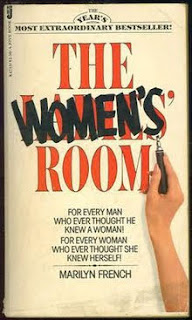
Classics Corner: The Women's Room by Marilyn French; The Troubled Lives of Women in the Mid-20th Century


Classics Corner: The Women's Room by Marilyn French; The Troubled Lives of Women in the Mid 20th Century

By Julie Sara Porter

Bookworm Reviews


PopSugar Reading Challenge: A book published the month of your birthday (February, 1977)

Spoilers: Marilyn French's novel, The Women's Room, could best be summarized as Feminine Mystique: The Novel.

Betty Friedan's 1964 landmark book, The Feminine Mystique is considered the book that kick-started the second wave of Feminism. It laid out the problems that many women had when they married young, had children, and settled into lives as stay at home mothers. Friedan wrote about the "Problem That Has No Name," women who were bored, listless, and unfulfilled with their lives. They had education, but no idea what to do with it and were unable or unwilling to use it for a career or to find a life outside the home. Many of these women developed physical, psychological, and emotional disorders and used alcoholism, drug addiction, and sexual gratification as means to cope with that dissatisfaction. Friedan's book received criticism, but many women read, understood, and related to that situation. Enough to create a movement.

If The Feminine Mystique described the problem and offered potential solutions, then The Women's Room is the case study, albeit a fictional case study. However, French graphically illustrated what happened to these women as they moved from giggly schoolgirls and conformist housewives of the 1950's and early '60's to divorcees, single mothers, and feminist activists of the late '60's and '70's.

The Women's Room focuses on Mira Ward. When we first meet her, it is 1968 and she is hiding in the Ladies' restroom at the college where she is taking classes. However, it has gone through a change like everything and everybody around her. French tells us, "She called (the Ladies' room) that even though someone had scratched out the word 'ladies' in the sign on the door and written 'women's' underneath. She called it that out of thirty-eight years of habit, and until she saw the cross-out on the door, had never thought about it. 'Ladies room' was a euphemism, she supposed, and she disliked euphemisms on principle."

This book is about women like Mira who argued and challenged being called "ladies" and all that the word implies ("young ladies", "proper ladies," sophisticated ladies who dress nicely, behave properly, and don't question society's standards) to being called "women." ("Wonder Woman,", "career women," women who fight for equal rights, careers, and the rights to being treated as equally to men.)

Mira is a product of a post-WWII upper-middle class upbringing, the type of upbringing that expected her to only have an advantageous marriage. All of her education and training, primarily from her mother, was made for that specific goal. However, Mira starts out life independent. She reads books by people like Nietzsche and Radclyffe Hall that are considered forbidden and asks important questions about sex, religion, and politics. At first, she tries to be independent. She doesn't want to be someone's secretary. She would rather have the adventures and be the boss. When she becomes involved with a boy, Lanny, she imagines herself scrubbing the kitchen floor with a baby crying in the background.

After she and Lanny break up, Mira begins dating Norm, a medical student. When she and Norm get married, Mira can feel her own life and independence slipping away. She suggests teaching and ultimately getting a Ph.D. in English Literature. Norm scoffs at the idea, thinking that she wouldn't have time what with taking care of the house, cooking meals, and raising the children. (It never occurs to him to share the household tasks. When she suggests this, it is clear that he thinks the very idea is repellant.) The picture of Mira's dependence becomes clearer and more haunting when after she gives birth to two children, Normie Jr. and Clark, Mira finds herself scrubbing the floor with crying children in the background, exactly like she feared.

Some of the hardest chapters to read are the ones that not only peer into Mira and Norm's troubled married life, but the troubled lives of all of the married couples that surround them. The Feminine Mystique doesn't just hit them, it hits everyone around them. Natalie is jealous when her husband, Hamp starts making eyes at the other women in their circle. Adele has a bad temper that constantly yells at her children and worries when she is pregnant with another. Bliss is engaged in an affair with her best friend's husband. Martha is taking night school courses and becomes involved with a French teacher. Sean and Oriane move to the Bahamas where Sean abandons her, leaving her broke and ill from cancer. Samantha and Simp end up financially stranded after Simp loses his job. The most troubling story is that of Lily, who is abused by her bullying husband and budding sociopathic son into a mental breakdown. Lily moves in and out of psychiatric care and constantly receives electroconvulsive therapy, shock treatments.

What of our main couple, Mira and Norm? Norm subjects his wife to verbal abuse and is judgemental towards his wife and her friends. He neglects his children. One night, he drops a bombshell on Mira when he tells her that he wants a divorce. (The reason is never specified, but is implied that Norm is leaving her for another woman, a woman whom he later marries.) During their separation, a devestated Mira attempts suicide by slashing her wrists only to be rescued by Martha.


This book illustrates the problems that women have with the institution of marriage. The female characters are more three dimensional than the males. They are flawed hurt characters who are desperate for happiness and are instead miserable. The men are flatter, more cardboard, and more interchangeable. It makes sense when the Reader realizes that the book is exclusively told from the female point of view, from a first person female narrator who isn't revealed until the end of the book. It presents the world how she sees it.

In her eyes, men are the dominant force unknowable and powerful. The women around her are the ones who are suffering. The Narrator makes no apologies for how she writes. She challenges the idea of marriage itself and how it transforms people into someone that they don't want to be.
She also mentions how when books are written by men, they make the female characters flatter and less interesting as mothers, children, or love interests. They can't write about women, because they can't get into their heads. (Though she cited that there were exceptions like Henry James.) In retaliation, the Narrator portrays the male characters from her outside perspective because she can't get into their heads.


After the divorce, Mira finds her life completely different. She finds the life that she once wanted. The first taste of freedom is felt when she gives Norm a bill, itemizing all of the work that she did for him all of those years. Even though Norm refuses to pay, she makes her point clear that she is becoming aware of her own mind and desires.

Mira has more freedom to further her education by taking English Literature courses in college. She becomes involved in a sexual relationship with Ben, another student, and meets some wild new friends that navigate her into the Women's Movement and living life on her own terms.


That's not to say that her and her friend's lives are problem free. Isolde, a lesbian, goes from one troubled relationship to another particularly with women who are afraid to take their romance with her to another level. Val, the leader of this group of feminists, wants to start her own women-only separatist community, but seeks vengeance when her beloved daughter, Chris, is raped.

But what differs between these women and the ones before is how they deal with their problems. The women that Mira knew during her marriage are more internal. They are unable to express their discomfort. Their only ways they can challenge their unhappiness is to act upon their frustrations and neuroses. They are so dependent on their husbands, that they can no longer become the agents of change. When that dependence is removed, the Marthas, the Samanthas, the Blisses, and the Lilies don't know what to do with themselves.

The Isoldes, the Vals, and the Chrises are the agents of change. Many of them are divorced or purposely unmarried, so they rely only on themselves. If something goes wrong in their lives, they seek to change it through action. They go through emotional break ups, sexual explorations, and class and work overload but are able act on their own. Part of independence is dealing with the positive and negative aspects of living your own life, becoming aware of your own emotions, and making your own decisions. It is an independence that is won because it is earned

Mira in particular, loves her new found and hard won independence. She enjoys it so much that she turns down Ben's marriage proposal knowing that she will end up with more of the same, another stifling crippling married life of dependence. In the end, Mira realizes that she has achieved the fulfillment that she long ago wanted by herself.

The Women's Room covers that dramatic moment when women challenged their right to be thought of as independent people who should receive equal rights and protection under the law and society. It showed that time when they stopped thinking of themselves as girls and ladies and started thinking of themselves as women.


Thursday, February 20, 2020

Classics Corner Birthday Book: The Joy Luck Club by Amy Tan; Emotional Moving Novel About Chinese-American Mothers and Daughters


Classics Corner Birthday Book: The Joy Luck Club by Amy Tan; Emotional Moving Novel About Chinese-American Mothers and Daughters

By Julie Sara Porter

Bookworm Reviews


Birthday February 19, 1952

PopSugar Reading Challenge: A book that takes place in a country that starts with "C" (China)


Spoilers: I don't know anything about Mah Jong and I don't have any children, but I do know what it means to be a daughter and to not always understand my mother and vice versa. So I completely understand and sympathize with the plight of the characters in Amy Tan's classic, The Joy Luck Club.


The book is a series of interconnected short stories of four mothers: Suyan Woo, An-Mei Hsu, Lindo Jong, and Ying-Ying St. Clair who emigrated from China and their daughters Jing Mei "June" Woo, Rose Hsu Jordan, Waverly Jong, and Lena St. Clair who are more American than their mothers. The book is a truly emotional and moving work that while focuses on many of the issues that are faced by Chinese and Chinese-American women, any recent emigre as well as any parent and adult age child can find the conflicts relatable. We have all had situations where we felt that the previous or the next generation doesn't understand us. Then when we look deeper, we learn that we had a lot more in common than we were previously aware.


The four mothers are part of a group that meets weekly to play mah jong and talk about their lives. The book begins after Suyan's death and the other three mothers convince Jing Mei to take her place as the fourth in their mah jong games. Like the game itself, the book is divided into four parts of four stories each making 16 stories total.

The first eight tells of the mothers' and daughters' childhoods. The next eight covers the problems that they receive upon entering adulthood and within their marriages and families.


One of the central themes that carries throughout the book is who the mothers left behind in China. This is particularly strongest in Suyan and Jing Mei's story. After an argument when Jing Mei is still a child, Suyan accidentally blurts out that she had been married previously in China and had fled leaving behind two daughters, neither of which were Jing Mei. Realizing that she has two half-sisters that she never knew changes Jing Mei's relationship with her mother. Jing Mei feels their presence even though they aren't there physically. She feels that her mother preferred the daughters that she missed, so the daughter that is in front of her fails in comparison.

When Jing Mei grows, Suyan pushes her to become successful piano prodigy. After a substandard performance, Jing Mei gives up the piano for good. She spends much of her life believing that her mother doesn't approve of her job, friends, and life. It is not until well into adulthood after Suyan gives her a jade pendent that she learns that she had her mother's approval all along. Late after Suyan's death, the other three Joy Luck mothers contribute money so Jing Mei can travel to China to meet her half-sisters.


Another daughter who feels pressured by her mother into success is Waverly Jong. In fact, Suyan and Lindo turned bragging about their daughters almost into a contact sport. They build up so much competition between the two daughters, that Waverly and Jing Mei become rivals. Lindo's boasts about Waverly are about her genius at chess. Waverly excells at competition to the point that her mother's boasting gets embarrassing. Waverly gets so irritated by her mother talking up her success that she gives up chess. However, she hasn't lost trying to live up to her mother's expectations as a later story testifies when she introduces her white American boyfriend to Lindo. While Lindo seems to be non-committal especially when he commits various embarrassing faux pas at the dinner table, she later tells Waverly that she likes him.

Through Lindo's point of view, we discover that her way with words proved helpful in her past. She has a humorous courtship with her husband in which their respective Cantonese and Mandarin dialects make each other difficult to understand, but Lindo manages to get their conversations steered towards the words "matrimony" and "I do."

More dramatically was an incident in Lindo's youth in which she was forced into marriage with a prepubescent boy and was abused by his cruel mother who kept forcing the young couple to produce grandsons. Lindo manages to find her way out of the situation by pretending that their ancestors are displeased with the marriage and for her husband to accept marriage to a pregnant servant girl instead. Her in-laws get the grandson they coveted, the servant girl moves up a few notches, and Lindo gets free and manages to make her way to America.


While Lindo is a more dominant presence to the point that Waverly considers her mother unbearable, Ying-Ying and Lena St. Clair are more passive and that passivity has shaped their lives in very negative ways. Their stories are among the most heartbreaking. As a child, Ying-Ying got lost from her family during a Moon Lady ceremony. She naively asks the Moon Lady (really a male actor in a costume) to find them. This little scene foreshadows the sadness that Ying-Ying and Lena encounter throughout their lives, often being manipulated and abused by the men in their lives. Ying-Ying survives a torturous first marriage with a womanizer who abandons and results in her aborting her first child. She later marries a white man who is incredibly condescending and mocking towards her. Unfortunately, she also gives birth to an anencephalic child and becomes haunted by his death. She is consumed with depression, nightmares, and hallucinations. This makes her a cypher to Lena.

Lena takes her mother's passivity to heart during her marriage to Harold. Harold is also her supervisor at work and he financially as well as verbally abuses her. Seeing her daughter suffer the same way that she did under the thumb of a dictatorial husband, Ying-Ying convinces Lena to stand up for herself.


The different stories all carry their share of triumph after heartbreak. Among the saddest but ultimately rewarding stories are those of An-Mei and Rose Hsu Jordan. An-Mei's youth was shaped by her mother who became the fourth wife of a wealthy merchant. At first, An-Mei was raised by her grandmother, but after her grandmother's death, she finally moved in with her mother. An-Mei and her mother are abused by the merchant's second wife. The Second Wife plays various manipulative games to assert her dominance in the household such as attempting to win An-Mei over by giving her glass bracelet that she says is really pearl. She yells, screams, threatens suicide to get her way, and keeps An-Mei's half-brother as an emotional hostage by claiming to be his mother. An-Mei's mother finds no escape except through her own suicide. Though, An-Mei is clever enough to warn that her mother's spirit will haunt the cruel Second Wife, silencing the older woman's abuse for good.

An-Mei's family is hit by tragedy again when her youngest son, Bing accidentally drowns during a family trip to the beach. Rose is stricken with guilt for the rest of her life because she was supposed to watch Bing. She is haunted by Bing's death and continues to be held at an emotional distance. That emotional distance continues into her marriage to Ted Jordan. Rose was abused by Ted, a guy who after his bigoted mother insulted Rose put the blame on Rose, asking why she didn't stand up for herself. He also has every intention of getting remarried after his divorce and insults Rose by saying that she will never find anyone else. Rose doesn't want to surrender to her version of the Second Wife, so she challenges him in court for the right to keep their house and commands to be treated with respect.


The Joy Luck Club is filled with beautiful and emotional stories where the mothers and daughters believe that they don't understand each other, but realize that they understand a lot more than they thought. They are similar women with loves and hurts that carried between the generations. As soon as they recognize their similarities, they no longer see themselves under the family terms of mothers and daughters. They see complex women who have been hurt and are trying to find ways to move beyond that hurt. They recognize themselves into their journies that the mothers started and the daughters completed.

The Joy Luck Club is a book that has a lot of tears, a lot of heart, and ultimately a lot of joy.


Wednesday, January 29, 2020

New Book Alert: The Power to Deny: A Woman of the Revolution Novel by Wendy Long Stanley; Powerful Novel About A Woman of the Age of Enlightenment


New Book Alert: The Power to Deny: A Woman of the Revolution Novel by Wendy Long Stanley; Powerful Novel About A Woman of the Age of Enlightenment


By Julie Sara Porter

Bookworm Reviews

Spoilers: The 18th Century was a time of Enlightenment where many questioned and fought in revolutions to change their status. Women were no exception. Many feminist authors and philosophers, such as Margaret Fuller and Mary Wollstonecraft argued for better educational and legal opportunities for women. Recently, I reviewed a biography about such a woman, Elizabeth Craven. One of these women who challenged her role in society was Elizabeth Graeme Fergusson. (1737-1801)

Fergusson was a literary genius and former girlfriend of Benjamin Franklin's son, William. She had a prominent writing career as a poet and translater. One of her most important works was her translation of the French poem, Telemachus. After her mother's death, Fergusson hosted "Attic Evenings"- literary salon gatherings which had the best writers, thinkers, and intellectuals. She did not marry until well into middle age when she wed Henry Hugh Fergusson. They had no children, but Fergusson adopted her niece and nephew. The Fergusson marriage was troubled, particularly after Henry was revealed to be a committed Loyalist. Fergusson stuck to her Patriotic beliefs even after she was accused of passing missives for the British. The Fergussons separated when she learned that her husband impregnated a servant girl. For the rest of her life, Fergusson continued to write poetry and prose until her death in 1801.


Wendy Long Stanley captures this amazing life in her brilliant historical novel, The Power to Deny: A Woman of the Revolution Novel. The 18th century particularly The American Revolution, is seen through the eyes of this vibrant, talented, and intelligent woman.

From the beginning, we already see Elizabeth, called "Betsy" by friends and family, is a highly intelligent forward thinking young lady. While her friends talk about handsome soldiers, colors and styles for gowns, and the latest European fashions, a teenage Elizabeth's eyes glaze other as she thinks about bigger important topics, the ones usually discussed by the men in her life. She is concerned about conflicts with the Native American tribes, whether the Penn family has too much power in her native Pennsylvania, and whether the colonies are being properly represented uner English regulation and legislation.

Elizabeth is a unique person even within her own family. Her sisters, Jane and Ann, have more traditional roles as wives. Elizabeth considers the quiet and domestic, Ann, as her father's favorite because Ann reflects what he believes a woman should be like. Her mother only thinks that Elizabeth's study of poetry and literature as mere ornaments in the ultimate goal towards marriage. Elizabeth's adopted sister, Liza, is supportive but is of a more practical mind that often brings Elizabeth down to earth. Elizabeth however has different ideas: "What called my heart was books and reading and all the words that came to me and asked to be written. I was lifted by great writing: Spenser, Swift, Locke, Johnson. Alas, this wasn't the work for a woman beyond dinner conversation or a turn around the park."


It's no wonder that Elizabeth is captivated by William Franklin. Besides being handsome and charismatic, he is the only person her age with whom she can have a decent intelligent conversation and isn't going to shush her or degrade her opinion because she's a woman. Besides William is just as opinionated as she and his famous father are. Unfortunately, it's this opinionated nature that causes dissension in his and Elizabeth's impending engagement. He publishes humorous articles that criticizes the Penn family and earns the ire of Penn and his supporters-including the Graeme family.

Because of these articles and the fact that Dr. Graeme doesn't like William's father to begin with, William is sent to England and he and Elizabeth have to wait a year to get married. Elizabeth is devestated by the news but continues corresponding with him. That devestation turns to anger when William marries someone else. Elizabeth is naturally furious not just that he broke with her, but that he wasn't honest about it. He married without telling her.


Elizabeth is definitely a woman of high standards. After her sister, Jane, dies and her family takes in her niece and nephew, she can't resist calling their father out for not only being an absent father but for absconding money and leaving his children without any financial support.

Of course those standards play into her marriage with Henry Hugh Fergusson. When she first meets him at one of her Attic Evenings, she at first thinks Henry's a learned intellectual man, someone who is as free spirited as she is. That first impression turns out to become completely false. During the Revolution, Henry manipulates his wife to deliver coded letters even though it causes distrust against her from other Patriots that lasts for years after the war ends. When she learns about his infidelity, Elizabeth severs ties with him and engages in an ultimately successful three year battle to get back her family home, Graeme Park, from Henry after he used his rights as a husband to put it in his name.


Some of the best sections focus on Elizabeth's literary career. After her break with William, Elizabeth accompanies a family friend, Rev. Peters, to England and Scotland, eventually living alone in London when Peters cares for his ailing sister. While in London, she becomes involved in the literary and intellectual circle, befriending notables like Laurence Stern, author of Tristram Shandy, and her former future father in law, Benjamin Franklin.

Even after Elizabeth returns to Philadelphia after her mother's death to assume her role as the female head of the household, she doesn't lose sight of her literary ambitions. She writes and gets some poetry published, including epitaphs for her mother and sisters and a poem called The Dream, encouraging colonists to forgo English goods. She also writes about various medical and scientific breakthroughs, including the discovery of the planet Uranus.

While she is an involved surrogate mother to her niece and nephew, Anny and Johnny, Elizabeth manages to make time for her own interests. Her Attic Evenings, are the center for much political debate, inviting men and women to participate, particularly when such issues as the Stamp Act and the Townshend Acts are discussed.

Elizabeth's crowning achievement is her translation of Telemachus, an epic French poem about the son of Odysseus. Many paragraphs describes the intense work that she did on the poem by translating the work line by line for over three years. Elizabeth takes pride in adding notes for future Readers and inserting her own poems at the beginning and end. She looks at the end results of Telemachus almost like a mother pleased with the labor and birth of her creation.

This was a woman who throughout her long life knew her own mind and knew how to express it.


The Power to Deny's title comes from advice Elizabeth Graeme Fergusson's mother gives her. She tells her that the only power women have is that of denial, to reject or accept a man's proposal. It is clear from this novel that Elizabeth Graeme Fergusson wielded a lot more power than that.