Showing posts with label Queen Elizabeth I. Show all posts
Friday, June 5, 2020
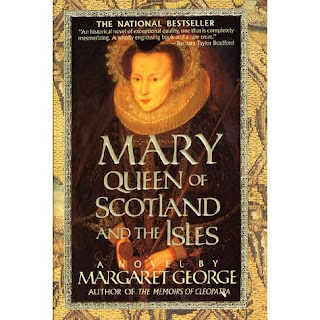
Classics Corner: Mary Queen of Scotland and The Isles by Margaret George;Grand and Definitive Historical Fiction of Scotland's Most Famous Queen
Classics Corner: Mary Queen of Scotland and The Isles by Margaret George; Grand and Definitive Historical Fiction of Scotland's Most Famous Queen
By Julie Sara Porter
Bookworm Reviews
PopSugar Reading Challenge: A book with a map
Spoilers: John Lennon was right. Life is what happens when you are busy making plans to finish reviewing the final book in a series for your blog but the Coronavirus pandemic causes the library to close, so instead of reviewing that book, you instead review another book about the same subject. (At least I think that's what he said or something like it. Anyway, it was pretty close.)
I was supposed to wrap up my Philippa Gregory series with the final Plantegenet and Tudor Court Series, The Other Queen about Mary Queen of Scots. But since I don't have a copy and the library is closed for now (though is supposed to reopen soon), that review will have to wait. Instead I decided to review another book about Mary Queen of Scots, Margaret George's Mary Queen of Scotland and The Isles.
Actually, right now I am reviewing the better of the two. While Gregory did a brilliant job capturing the Cousin's War, the six wives of King Henry VIII, Queen Mary I, and Queen Elizabeth, Mary Queen of Scots belongs to Margaret George. Gregory's version was short and anemic which only covered a small fraction of this famous Queen's history, but George covers the whole scope of this fascinating woman's vibrant passionate colorful life.
From the moment she was born and her father James V died, Mary Queen of Scots (1542-1587) is held under scrutiny and criticism. Her dying father expresses displeasure that she isn't a son to replace the legitimate sons that died. She is separated from her mother, Marie de Guise, to be raised in France while her mother acts as regent. Her French relatives judge her for being Scottish. Her Scottish subjects are suspicious of her gender, French upbringing, and Catholic religion. Her illegitimate half-siblings, particularly her brother James are jealous of her becoming the heir. Calvinist religious leader, John Knox considers Mary, the Whore of Babylon because of her religion and her status as a female assuming the Scottish throne. Her cousin, Elizabeth feels threatened by her status as the second heir to the throne. It's already not an easy life and it gets harder.
Mary's childhood establishes much of the character that she carries throughout the book. She has a fondness for pretty things because of her upbringing in France surrounded by beautiful clothes, delicate dishes, and poetry some of which is dedicated to her. She also shows a strong will. When she first encounters the formidable, Catherine de Medici, acting Queen of France she is able to stare her down and stand up to her. Her independent streak also carries over into her wedding to Francois II, future King of France, when she insists on wearing white, even though it's the French color of mourning. She later rues that decision after Francois dies and she finds herself wearing white again, this time at her husband's funeral.
The book also is rich in capturing the people around her. Both Marie de Guise and Catherine de Medici are both strong willed leaders, inspiring Mary with their leadership skills and ability to survive in a man's world. James Stewart, Mary's half brother hovers between being close to Mary because she is his sister and being competitive and resenting everything she stands for.
Mary's four ladies in waiting, who are also named Mary, form a loyal sisterhood to their beloved queen and are individuals in their own right-Mary "Flamina" Fleming is the boldest and most outspoken, Mary "Lusty" Livingston is the robust tomboy, Mary Beaton is the quiet daydreamer, and Mary Seton is the most serious and spiritual.
Francois is also well written as an embodiment of youthful innocence. They marry when he is 10 and Mary 14, so unsure of what to do, they spend their wedding night...falling asleep. Instead of a husband, Francois is more like a kid brother with whom Mary plays games, tells stories, and create elaborate ideas for their future kingdom. Francois is an eternal child who would have a hard time reaching adulthood, which unfortunately he does not. Mary is barely crowned Queen of France upon her father in law's death before she loses her husband less than a year later.
When Mary returns to Scotland after her mother's death, she gets a frosty welcome, literally. The weather is cold and misty so that she can't see anything. If ever there was a sign that her reign would not be a peaceful one, that would be it. The peasant and working class love her, considering her a return to civility. However, the Kirk, the noblemen who act as her council, are mistrustful of her, suspicious of her Catholic religion, dislike her de Guise relatives, and mock her French ways. Even though France and Scotland are allies as part of the Auld Alliance, against England, that's far from saying the Scots actually like the French especially after they convert to Protestantism. Many of the Kirk favor Knox's conservative dour approach and fear the queen simply because he tells them to.
Her antagonists include her brother, James, who more and more sees better advantages siding with Knox and his crew over her, The Hamiltons, a family that often looks out for their own interests, and Lord Ruthven, who is rumored to be a warlock and is certainly creepy enough if he isn't. Queen Elizabeth also has her reasons to fear her second cousin. Since Mary is the closest heir to the throne and a staunch Catholic, the Protestant Elizabeth is fearful that her Catholic subjects would favor Mary over her.
Standing at the center of her antagonists is Knox who puts fear into his followers' hearts that Mary will start another Inquisition. In actuality, she will do nothing of the kind. She respects her subjects' Protestant religion. She only asks that they respect hers. She is very passionate and fair minded, but is willing to compromise to make other's happy. But for some unyielding stubborn individuals, that's not enough.
Partly because of her lonely widowhood and the general dislike of her, Mary throws herself into a second marriage to Henry Stewart, Lord Darnley a relation of hers and Elizabeth's. At first, it seems pleasant enough. Darnley is handsome and charismatic, but he very quickly reveals his true nature. He is a big drinker and a philanderer. He is also intensely jealous of Mary's power and demands that she make him King. George doesn't sugarcoat Darnley's chatacter. He is a spiteful abusive weak willed bully who goes along with whatever scheme benefits him the most. The Reader is rooting for his comeuppance long before he receives it.
Mary has several loyal friends to her defense. Besides the Marys, another is David Riccio, her secretary who also acts as confidant, psychologist, public defender, stand up comedian, minstrel, and best friend. He is a very witty character who isn't afraid to tell Mary the truth whether she wants to hear it or not. He also isn't afraid to call out Darnley or his allies, which he does one too many times. In one of the most heart wrenching moments in the book, Darnley leads a group to come in and stab Riccio to death right in front of Mary.
Another loyal supporter is the man who becomes her third husband, James Hepburn, The Earl of Bothwell. Bothwell is everything that Darnley isn't brave, decisive, strong willed, even if he is a bit of a womanizer to begin with. To her credit, George does not make his and Mary's marriage an abrupt thing. They meet in France when he is part of the party that escorts Mary to Scotland. He then appears periodically in Mary's life, sometimes as an outspoken critic but mostly as a staunch ally and a good friend even before they become romantically involved. One of the best moments is when Mary apologizes that she couldn't make Bothwell king and he tells her that is fine. He is satisfied with his lands of Shetland and the Orkney Islands. Mary muses that Bothwell, a man who is better suited for the role of king doesn't want the title, while Darnley whines about wanting the title but exhibits behavior that could not be considered kingly or leader-like.
There are three mysteries that surround Mary's life and George gives interesting theories to answer them. The first is who killed Lord Darnley. What is known is that Darnley died in an explosion and was involved in the death of David Riccio. Most believe that the most likely suspects were either Mary herself or Bothwell. George's version stops short of actually accusing Mary of her second husband's murder, she certainly doesn't miss him.
The second mystery concerns her marriage to Bothwell. Publicly, Bothwell abducted Mary and she married him while in captivity. However, what muddies the waters of this claim is that there were love letters exchanged between Mary and Bothwell dated before Darnley's death and were found in a silver casket in Bothwell's home. The so-called "Casket Letters" were considered evidence that Mary was complicit in her second husband's death and became evidence for her forced abdication in favor of her son James VI (Later James I of England)
Again George gives her own interpretation to these events that the love between Mary and Bothwell was genuine and the abduction was staged so the blame would fall entirely on him and not her for running off with him. Mary and Bothwell's romance is one that is loving but made from bad timing (She chose not to make Bothwell her second husband because he was already married to a woman whom he would later divorce) and short lived. They end up separated when she escapes to England and he sails to Sweden where he is imprisoned and later dies. Their marriage was short, but it was one of love and loyalty in this book.
The final third of the book where Mary seeks refuge in England is probably the most boring part but it leads to the third mystery in her life. How involved was Mary in plots to bring down Queen Elizabeth. While she is under house arrest and moved about, she makes friends with many noblemen like George Talbot, the Earl of Shrewsbury. Many of these allies want to see a Catholic ascend the throne and promise to aid in Mary's escape. Mary knows that she is playing a dangerous game with these men but she writes letters in code requesting their aid and support. Just as she does with Mary's involvement with Darnley's death, George doesn't outright accuse her, but Mary knew that her release could only come from Elizabeth's death so she turns a blind eye to the consequences and what the end result would be.
Even though Mary is the main character, George also makes Elizabeth believable as well. She is somewhat jealous of Mary's appearance. During his first meeting with the Scottish Queen, Elizabeth pesters her ambassadors with comparisons about her height and her appearance asking if she's more attractive. When Mary gives birth to James, Elizabeth complains that she "is of barren stock." She also gets upset when Mary's family uses the English crest on their china (something Mary doesn't agree with either).
However despite her pettiness, Elizabeth relates to Mary as another female ruler in a man's world. Even though, they never meet face to face they write often calling each other "Sister," and giving tokens of friendship. When Mary finally is arrested for conspiring against Elizabeth, the English queen suffers remorse about having to put her cousin to death and wavers for a long time before she finally signs her death warrant.
Margaret George captured Mary Queen of Scots and made her passionate, headstrong, emotional, reckless, strong willed, and a very vibrant,, colorful, unforgettable woman. Some Royal characters like Elizabeth Woodville, Anne Boleyn, Anne of Cleve's, and Queen Elizabeth belonged to Philippa Gregory. But in this case, Mary Queen of Scots belongs to Margaret George.
Friday, February 21, 2020
Weekly Reader Philippa Gregory Edition: The Last Tudor (The Plantagenet and Tudor Court Series Vol. XIV) by Philippa Gregory; The Tudor Family Line Ends on an Average Note
Weekly Reader Philippa Gregory Edition: The Last Tudor (The Plantangenet and Tudor Court Series Vol. XIV) by Philippa Gregory; The Tudor Family Line Ends on An Average Note
By Julie Sara Porter
Bookworm Reviews
Spoilers: It's fitting that The Last Tudor is the final book written and the penultimate chronologically in The Plantagenet and Tudor Court Series. It presents the best and worst qualities that the previous books had in one book. This book alone is a checklist of what Phillippa Gregory did right and wrong in the entire series.
This time the book focuses on Jane Grey and her sisters, Katherine and Mary. Jane was the cousin of King Edward VI whom he declared his heir after his death instead of his sisters, Mary and Elizabeth. After, Edward's death, his guardian Lord Dudley connived to have Jane and her husband, his son, Guildford, put on the throne. Jane was queen for only nine days when supporters of Mary Tudor intervened, dethroned Jane, and declared Mary queen. Jane was eventually executed along with her husband and both of their fathers.
Jane Grey probably gets a minor footnote in history if that, but her sisters get barely any mention at all. Katherine Grey married Ned Seymour, a courtier and distant cousin by marriage, despite refusal from Queen Elizabeth. She eventually got arrested and gave birth to one son while in prison. She was released, but ended up giving birth to a daughter and spending the rest of her life separated from her husband and son while under house arrest.
Mary Grey's story was even more interesting. She was a Little Person, under 4" tall. She too married without the Queen's permission to Elizabeth's sergeant porter, Thomas Keyes who stood at 6"7. Mary served as lady in waiting under Elizabeth, but eventually she too fell out of favor and both she and her husband were arrested. Keyes was reportedly confined to a cell much too small for his large body. While Mary was under house arrest, Elizabeth eventually had her released.
The Last Tudor covers many of the themes that make the Gregory novels so great. Among them is the strength and rivalry of sisterhood. Unlike the previous sisters, the Boleyns, the Nevilles, and the Tudors, the Greys don't bare any animosity towards each other. Oh, they have differences of opinion, but those are mostly confined to just conflicting personalities rather than any real attempt to steal the throne or a position from each other. It's nice to see at least one Gregory sorority act like real sisters instead of sworn enemies.
Part of the way that Gregory does this is contrasting the sisters' personalities so they bounce off each other. Jane is much more bookish and studious. She is the most spiritual as she looks upon her ascendency as a calling from God to lead the English into Protestantism. Katherine is the most easy-going and dizziest. She is also an animal lover and is usually seen with different cats, dogs, birds, and a monkey that she names Mr. Nozzle. She is swept up in her love for Ned and when they are separated longs to be a family with him. Mary is the boldest and most outspoken. She constantly cracks jokes about her height or other things. She also has a steadfast determination to survive and she does everything she can, even deny her marriage, to ensure that survival.
We also see the theme of seeing historical characters through different eyes. Just like Katherine of Aragon and the players during the War of the Roses, Elizabeth is looked on differently here than she is in the previous books. The Queen's Fool and The Virgin's Lover were aware of her flaws, but also recognized her strengths as a cunning leader, a master strategist, a learned scholar, and a courageous fighter and survivor. The Grey Sisters see her as at best a frivolous egoist who values her own happiness (such as her relationship with Robert Dudley) over anything else. At worst, they see her as a cruel and capricious tyrant who turns on people for a whim and then just as quickly pardons them.
The reasonings behind Katherine and Mary's arrests are not fully explained, as they are meant to be arbitrary. Though they more have to do with being the last in the line of Protestant Tudor heirs. (Most of the others such Mary Stuart and Margaret Douglas are Catholic). While the book goes out of it's way to show that The Grey Sisters themselves are innocent of any plots against the queen, Elizabeth's haters aren't above using them as pawns in their means to dethrone her (like Jane was).
However the Gray Sisters themselves have another theory on why Elizabeth is so hateful towards thrm. Both believe that it is because Elizabeth envies their chances for happy marriages and she feels that if she has to be miserable then so do they. They think that she doesn't want the spotlight on anyone but herself. Their views are a bit childish, but they do come from fear and uncertainty. Sometimes, you don't know the specific reason why you fell out of someone's favor, so you simplify it in your head. Gregory does a good job of translating that uncertainty.
Gregory's gift for narration also falls into play here. She wisely separates the sisters' stories into three individual parts, allowing each sister to tell her story with the appropriate beginning, middle, and end. She also does some interesting framing devices that tie the three parts together. Each husband is introduced as a minor character in the previous story, only to take center stage in the next story as the intended of his Grey sister.
Some situations play out in all three stories. For example, Katherine's monkey companion, Mr. Nozzle is a source of irritation to Jane and she constantly wants to have him removed from her sight. For Katherine, he is an exotic pet to love, spoil, and let him be admired as a pet of the lady's chamber. By the time he gets around to Mary after she is under house arrest, Mr. Nozzle becomes her last link to her sisters so she keeps him into old age. One of the more delightful images in the book is the final scene in which an older Mary, still small, is dressed in black with a red petticoat underneath and walks a now gray Mr. Nozzle wearing Tudor green.
The biggest framing devices are the letters each sister writes to the next one while she is in prison. They reveal a lot about who they are as people. Jane's letter to Katherine is very clinical and impersonal. Instead of appealing to Katherine as a family member, Jane regards her just as someone that she thinks will carry on her legacy. The words that echo throughout are "learn you to die." Jane is someone who lives her life in her own head and according to her Protestant values. She goes along with her father and the Dudley family because she feels that becoming queen is God's plan. However, when it falls apart and her supporters turn against her (most heartbreaking of all is the moment when Jane's own father turns his coat and pleads for Mary), she realizes that it was brought upon by pride and ambition, things that she thought that she was against. She realizes that she too was ambitious in her own way and that she went along with the plot not for God's glory but her own. The only thing that she can do now is die for her faith as a martyr.
By contrast, Katherine's final letters to Mary are warm and filled with emotion and love, the kind of person that she was. Rather than learning to die, Katherine is more interested in learning to live or more specifically learning to love. She is someone who has a deep love for people and animals. While she is often the central
figure in plots against Elizabeth, she is never really involved in them. In fact there are several times when she states that she would rather have a happy marriage to Ned and lots of children than the throne.
Mary of course has no letter to write and no sister to receive it. But that makes sense to her character. Unlike Jane who is acted upon by the ambitions of others and her religious views and Katherine who is acted upon by her emotions, Mary is only acted upon by herself. She is the most active of the trio. When Katherine dithers whether marrying Ned is the right decision, Mary marries Thomas. Katherine languishes in prison brokenhearted, Mary remains outside still serving under Elizabeth but secretly plotting her escape. Even in prison, she manages to make the most of her survival by reuniting with the few family members that remain such as Katherine's children and trying to send letters to Thomas.
As I mentioned before, Gregory did so much right with this book, but she also did so much wrong too. One of the biggest problems with this book is that the longest story, Katherine's, is the most boring. While the early passages of Katherine and Ned's courtship is sweet, her imprisonment is less interesting and that covers most of that part. It might have been salvageable if Katherine was able to do anything while in there, perhaps but she spends most of the time in tears unable to do anything about her situation. Yes, I know prison is tough but that's no excuse to waste over 200 pages talking about it.
Jane and Mary's stories are far more interesting, but way too short.Jane's story is the most well known and Mary's not so much. But either one could have been expanded upon. For example, we get some tell of Jane's education, but we aren't shown it particularly her friendship with Kateryn Parr. Okay, she was queen for nine days but she barely sits on the throne before getting forced off. A few more chapters, even short ones, to describe her plans for ruling could have been added. And what about Mary? We are given very little of her and Thomas together. Shouldn't we get to know them as a couple before fate and Elizabeth drive them apart from each other?
Another problem in this book calls back to Lady of the Rivers, forgoing a more interesting protagonist for a lesser interesting one who only hears about the interesting one's adventures. This time Mary and Katherine get told about Mary Queen of Scot's marriages to the Dauphin of France, Lord Darnley, and the Earl of Bothwell. We are particularly given great details about Darnley's death and hints about Mary's possible involvement in it. This Reader read that section and thought, "Why aren't we reading about that?"
I know, I know. Mary Queen of Scots has been done to death but come on this is Philippa Gregory. The Cousin's War and the Six Wives of Henry VIII aren't exactly big historical secrets. Plus, there are ways that Gregory could have told that story from a fresh perspective, perhaps from Darnley himself, or Bothwell, or even Mary's ladies in waiting (who were all named Mary incidentally). She could dip into historical mystery with "Who Killed Lord Darnley?" just as easily as she did with the mysteries of the Princes in the Tower and Amy Dudley. Instead this is a missed opportunity. (That missed opportunity continues into the next book, the chronological final volume in the series, The Other Queen. More on that later.)
Above all, this book carries a sense of lethargy throughout. I compare The Last Tudor to the last time we saw the end of a family, The King's Curse. The latter carried a sense of darkness and tragedy as though an era really was dying out. It's felt through the characters as one by one they are either executed or survive by getting with the program. In the case of The Last Tudor, that despair isn't near as emotional. Instead it is muted by several pages of inaction and dullness. At least Margaret Pole tried to fight her fate by screaming and running from the executioner. The only one who really shows any spunk to challenge her situation is Mary and at least she lives.
Instead the intrigue is more stale. The characters are more predictable. The conflicts are less interesting.
It is clear that Gregory wanted to end the series and was pretty much running on autopilot throughout. She was probably looking forward to writing the words, "The End" as much as Jane Grey was looking forward to being martyred.
The Last Tudor is not the worst way to nearly end a series, but it could be better. At most it's average. However, for a series, that is so superb that makes the average worse.
Monday, January 27, 2020
Weekly Reader Philippa Gregory Edition: The Virgin's Lover (The Plantagenet and Tudor Court Series Vol. XIII) by Philippa Gregory; Gregory's Look At The Early Years of Good Queen Bess, The Not-So-Virgin Queen
Weekly Reader Philippa Gregory Edition: The Virgin's Lover (The Plantagenet and Tudor Court Series Vol. XIII) by Philippa Gregory; Gregory's Look at the Early Years of Good Queen Bess, the Not-So-Virgin Queen
By Julie Sara Porter
Bookworm Reviews
PopSugar Reading Challenge: Fiction or Nonfiction Book About The Leader of a Country
Spoilers: Of the protagonists in Philippa Gregory's Plantagenet and Tudor Court Series, none probably had the biggest impact in British and World History more than Queen Elizabeth I. The third longest reigning monarch (only Queen Victoria and the current Queen Elizabeth II have had longer), Elizabeth so affected the era in which she ruled that it was called the Elizabethan Age. As Queen, Elizabeth managed to soothe the religious turmoil led by her sister, Mary I whose Catholic rule involved the arrest and execution of many Protestants and the uncertainty of her father, Henry VIII who switched religions depending on wives. She did this by creating the Church of England which bore many of the same rituals as Catholicism but was Protestant in most of its tenets and beliefs. As for conversion, she insisted that "the crown did not look into men's hearts" and that as long as they payed lip service to the new church, they could believe what they want. The compromise wasn't perfect and later generations still questioned and debated the religious practises but it was what was sorely needed at the time to create some much needed stability.
She forged alliances with other countries but was bold enough to stand for battle with her soldiers when war was declared. One of Elizabeth's most famous moments is when she faced the Spanish Armada in full armor proudly declaring that she "may have the feeble body of a woman but had the heart and stomach of a king and a king of England."
She commissioned people like Sir Walter Raleigh and Sir Francis Drake to go on sea voyages and explore other countries, thereby opening better trade routes and making London an important thriving city in the world market. She was also a strong patron of the arts supporting artists and writers like Edmund Spencer, Christopher Marlowe, and William Shakespeare giving her era great cultural significance.
Elizabeth affected an air of intelligence, poise, and confidence that many admired and was called various names like "Gloriana," "Good Queen Bess," and "The Virgin Queen." She did all of this, ruled her country for over 40 years, without a husband.
However, the Elizabeth that we meet in The Virgin's Lover is not the bold confident epoch making leader from history. She isn't even the brazen flirtatious self-centered princess that was last encountered in The Queen's Fool. Instead, she is someone who projects an image of self assured leadership but inside is quaking with fear, uncertainty, and deep emotion.
From the moment the bells ring to announce Mary's death and Elizabeth's reign, Elizabeth knows that she has to prove herself. She has to add to a treasury that has been depleted by funds used by the vacated Prince Phillip for the disastrous War for Calais. She has to maintain broken alliances with not only other countries but within her own as Protestants and Catholics have turned against each other. She also has to lead the Privy Council who since the last female leader proved to be a huge disappointment are not too willing to be led by another woman. All Elizabeth sees are fears and challenges towards her right to ascend the throne.
Two other characters hear the bells and have their own emotional connections to them. Robert Dudley hears them and sees his chance for love and advancement. A childhood friend of Elizabeth's, Robert has grown to become Elizabeth's Master of the Horse, strongest confidant, and secret lover. He knows that Elizabeth would be overwhelmed by her new role and will need a shoulder to cry on. Robert's shoulder will be conveniently there when she needs it. The ever ambitious Dudley also sees a chance for his family to retrieve much of the wealth and prestige that they once had under King Edward but lost under Queen Mary. Robert longs for a chance to be accepted into Elizabeth's Privy Council as well as her bed and who knows maybe king.
Unfortunately, Robert has a very specific reason that prevents him from openly courting Elizabeth: his wife, Amy. Amy Dudley hears the bells announcing Elizabeth as Queen and reacts with loathing, disgust, and the certain fear that her husband will leave her. Unlike her husband who lives to be center stage, Amy is content to remain in the country of Norfolk at her estate and away from palace life. She wants Robert to remain with her. However, she knows that Robert is going off to be with Elizabeth and there is nothing that she can do about it but seethe with hatred towards the Queen.
Robert's influence on Elizabeth begins during her coronation. Despite the tight budget, Robert wants to make it a coronation to remember. He arranges the various details such as the gown Elizabeth will wear, the stops that she will make, and the alleged "spontaneous" outpourings of praise such as a peasant shouting for God to bless her. There has never been a more rehearsed bit of spontaneity.
From the coronation, it's clear that Robert wants to make Elizabeth the center of attention and in turn himself. He is in love with Elizabeth and they have some romantic moments together such as when they lie in bed and declare themselves husband and wife in God's eyes. But Robert is also arrogant, conceited, and always on the lookout in his own self interest. He creates rivalries within the Council, particularly with Elizabeth's chief advisor, William "Spirit" Cecil. Robert can't resist lording any victory over Cecil such as when Elizabeth gives him the Order of the Garter.
But every victory makes Robert greedy for another. While Robert loves Elizabeth, it is also clear that he also loves power. If Elizabeth were just a peasant woman or a minor courtier, Robert would quickly bed and then discard her. He loves Elizabeth's beauty, intelligence, and personality, but he also loves her crown. And it is entirely possible that it's the crown he loves more.
Robert's hold on Elizabeth is great, partly because of her own uncertainty in her role. Elizabeth's nervousness makes sense when we take her upbringing into consideration. She was the third choice for the role and sometimes not even that. Once her brother was born, she was dismissed for being a girl and once her sister was restored to the family line, dismissed for being the second girl. She had been bastardized and many questioned her paternity. She lost her mother at three and was distant from her stepmothers except Kateryn Parr, her last one. She did not have the royal training nor the assumption that she would ascend the throne until Mary did not produce heirs. She barely lived at the palace, a fact made painfully clear when she enters for the first time, unsure about where to go. Whereas Robert who had lived there expertly guides her as though he already sees himself as king consort.
Every major test seems to show Elizabeth looking around and asking, "How am I doing?"
When she was princess everyone thought that Elizabeth's most important duty would be to have an advantageous marriage, something that she doesn't mind playing as Queen. Several times she offers her hand to Europe's Most Eligible Royal Bachelors in acceptance for alliances. Many of her advisers especially Cecil pester her about which man she should marry believing that Elizabeth could never possibly lead on her own.
On the contrary, the debacle about her marriage ends up being the moment that Elizabeth is able to come into her own as a leader. She courts various royals such as Prince Erik of Sweden, the Earl of Arran of Scotland, and even her former brother-in-law, Prince Phillip of Spain. She claims to consider marriage just long enough for an alliance to form, but then withdraws it once the alliance is officially secured. It becomes a clever force of diplomacy that Elizabeth grows into.
Meanwhile, Robert hypocritically stews in jealousy over Elizabeth's various marriage proposals conveniently forgetting about his wife nestled in the country. To her credit while Gregory writes Amy as sometimes a clingy jealous bitch, she also makes her sympathetic partly because Robert is such an arrogant piece of work. Instead of placing blame entirely with either one, it becomes clear that their marriage is one of complete incompatibility. This is evident in the passages when Amy looks for a country home and believes that Robert's interests match her own. She selects a small home in the heart of the country far away from palace life. Not surprising to anyone but Amy, Robert dismisses the house as a hovel and doesn't even stay a day.
Amy and Robert are so different that it's hard to understand why they got married in the first place. We are told that they were in love when they were wed and Amy still continues to be obsessed with him, putting friendships, her relationship with her bitter stepmother, and her own health at risk. Perhaps their marriage is a good reason for Elizabeth not to marry. She doesn't want to be that dependent on a man. Elizabeth sees who she could be if she married not just Robert but anyone else.
Amy clings to her Catholic faith as a balm to soothe her ache from her loveless marriage but also because the priest tells her what she wants to hear. He agrees with her opinion that Elizabeth is a whore and that Robert can never divorce her. When Robert tells Amy that he wants a divorce, she refused citing the Catholic prohibition against it. The Dudley marriage is one that has made both miserable and cannot end, as many observe, until one or the other is dead.
As she did with the Princes in the Tower, Gregory offers another potential solution to History's Mysteries. This one is "Who Killed Amy Dudley?" What is known is that Amy Dudley tumbled down a flight of steps, breaking her neck and killing her instantly. What is also known is that despite the opportunity, Robert Dudley did not marry Elizabeth. Instead their relationship cooled and Robert ultimately married Elizabeth's second cousin, Lettice Knolleys who bore a strong resemblance to the Queen. Elizabeth had other lovers including Robert's stepson, the Earl of Essex but when she died she had her last letter from Robert by her side.
The Virgin's Lover offers a possible answer to this mystery that also answers why the pair broke up. It takes into consideration Robert's ambitious interest in the throne and Elizabeth's unwillingness to surrender her hard won leadership over to anyone especially to someone who shows signs of making decisions on his own without consulting her though she is Queen. Robert wants the throne and for Elizabeth to give up her independence. Those are things that she cannot and will not surrender even for him. This leads to not only Amy's death but the inevitable end of their relationship.
The Virgin's Lover gives us an inside look at the early years of one of the most famous female monarchs in history to show us the woman underneath that reputation as well as the love that shaped her and the actions that led to the making of a great Queen.
Monday, December 30, 2019
Weekly Reader Philippa Gregory Edition: The Queen's Fool (The Plantagenet and Tudor Court Series Vol. XII) by Philippa Gregory; Fictional Protagonist Sees Reign of Queen Mary I Up Close
Weekly Reader Philippa Gregory Edition: The Queen’s Fool (The Plantagenet and Tudor Court Series Vol. XII) by Philippa Gregory; Fictional Protagonist Sees Reign of Queen Mary I Up Close
By Julie Sara Porter
Bookworm Reviews
Spoilers: Of Philippa Gregory's The Plantagenet and Tudor Court books, The Queen's Fool has a peculiar legacy. It is the only one of the entire series that tells the book through the eyes of a fictional character.
The advantage of this unique volume is that the fictional character is just as well-written and developed as her real-life counterparts.
The fictional character is Hannah Verde, also known as Hannah Greene, a young Jewish woman. Hannah has fled Inquisition-era Spain with her father and Daniel Carpenter, her betrothed. They now live in an England that is reeling from the death of King Henry VIII and ascension of his frail son, King Edward VI.
Hannah tries to settle into life in England by working in her father's print shop making and selling books and not looking forward to her upcoming wedding. One day three men stroll into the shop. Two are Robert Dudley, the son of John Dudley, King Edward's regent and the most powerful man in England, and John Dee, astrologer and advisor to the king. However, the third man gets the most attention when it is revealed that only Hannah can see him and no one else can. Dee reasons that she must have seen an angel and that Hannah possesses clairvoyant abilities, called the Sight.
Seeing a distinct advantage to having a psychic friend, Robert begs for Hannah's services as a fool to King Edward. Hannah finds herself acting as a fool to Edward then after his death to Edward's sister, Queen Mary I. Hannah then is recruited as a spy and go-between among Mary and her younger sister, Princess Elizabeth. She then finds herself caught between worlds:. Raised Jewish but forced to conform to the religions that the Royals practice, arranged to marry Daniel but falling in love with Robert, and becoming a close confidant and unofficial advisor to both Queen Mary and Princess Elizabeth.
Hannah is a fascinating protagonist in that she is completely different from the other narrators of these books. For the first time, we see the court through the eyes of a commoner with no noble or royal distinction. It's interesting reading about how the average working person lived and survived in Tudor England.
We also get to see what it is like to be an outsider and minority in this era. Hannah and her friends and family have to hide their Jewishness from the outside world. They practice their religion in secret by celebrating the High Holy Days in dark rooms behind locked doors and closed drapes. They whisper Hebrew prayers and only privately call one another by secret names that reveal their religion. They hide all of their Torahs and Hebrew language books away from curious customers. It gets to the point where Hannah is ashamed of all of this hiding and becomes dismissive of her religion. She later recants these feelings to the point that she proudly insists that the child who is put into her care is circumcised.
In one heart tugging moment, Hannah is left alone with her father's books and considers destroying them. She can't bring herself to do it, because she realized that she would be no better than the Inquisition that burned her mother and considered “ideas to be dangerous.” As a woman who has a deep thirst for knowledge and learning that is found in books, she cannot bear for that to happen.
Through Hannah's narration, we meet three rulers of England and hear about a fourth. King Edward is young and sickly and unfortunately dies before he can leave any lasting impact. However, he is ruled by regents who use the prince to get their way. After Edward's death, Dudley tries to get his Protestant daughter in law, Jane Grey to become queen and gets her on the throne for nine days before they are arrested and executed. (We only hear about Jane and get no sense of her as a character. Her story is saved for The Last Tudor).
However, we do get to meet Mary and Elizabeth who are interesting in their characterization. Mary is written as a woman who has a full awareness that time is running out for her. She does not ascend the throne until she is in her late-30’s so she is desperate to create a lasting legacy after years of being disgraced, bastardized, and ignored.
She throws herself into a hasty marriage to Prince Phillip of Spain and is desperate to conceive a child. Even though Hannah's Sight warns Mary that this is a marriage destined for heartbreak, Mary doesn't care. She placates her young husband and looks the other way when he flirts with other women including her own sister. On two emotional occasions, she announces that she is pregnant and goes into seclusion to deliver. Both times, no baby appears and she stays in seclusion long after the believed due dates.
Mary is also fervently devoted to her Catholic religion considering it the only comfort in her tumultuous past of the banishment and death of her mother, the disgrace and dismissal by her father, and the revolving door of stepmothers. Mary's Catholic faith was the one constant in her life, so it's no surprise that she would find solace in it upon adulthood.
However as Mary's life implodes she becomes more ruthless and fanatic. She constantly pressures Elizabeth to convert to Catholicism not listening to the princesses’ claims of illness and not knowing the catechism. Even though she is concerned for her sister's soul, she is still highly suspicious of her and has her put under house arrest numerous times.As her marriage to Phillip disintegrates, Mary becomes a dictator putting Protestants to death if they do not conform to Catholicism. Hannah is horrified as the Queen that she once loved and respected becomes another Inquisitor in her life.
By contrast, Elizabeth gives Hannah someone to admire. Unlike Mary who is dour and shriveled up from all of the waiting, Elizabeth is young and has plenty of years ahead of her. She is vibrant, witty, and alive with fire and passion. When she enters a room, she makes everyone else fade away by her brilliance, especially her sister. (Hannah realizes that Mary had better marry Elizabeth off and fast otherwise she will be in complete competition against her.)
While Hannah looks at Mary as a mother figure and pities her because of her sorrows, she sees Elizabeth as almost an older sister, someone whom Hannah could be like. She sees Elizabeth's independence and how she carries herself at court and wishes she could be that self-assured. She sees how Elizabeth openly flirts with men, loving the attention but refusing to give her heart to them and wishes that she didn't have to be tied down and married. Elizabeth is a woman that Hannah hopes to become.
Elizabeth is a shrewd game player. Her every move, word, and action is calculated to ensure her survival. She will do anything from remaining bedridden from stress related illness to studying the catechism while greeting Protestant ministers in secret, to not only play the game, but to win.
This plays into her romantic relationship. When she lives with her stepmother, Kathryn Parr and Kate's fourth husband, Thomas Seymour, Elizabeth allows Thomas into her bed and plays sexual games with him. Then when Thomas is arrested for treason, Elizabeth denies being with him. (In reality, no one is sure how active Elizabeth was in Thomas's Seymour's seduction of her. Most of her enemies said she was a willing participant. Supporters believed her. Most modern historians believe at the very least, Thomas had committed statutory rape with her and she was a victim who was coerced into being with him.)
Elizabeth pulls the same trick with other men including Prince Phillip and Robert Dudley. She flirts with them to gain powerful allies and the upper hand in her rivalry with Mary. However, what is clear is Elizabeth is a woman with her own mind and will not allow any man to rule over her.
Mary and Elizabeth's influence play into Hannah's life as well. As the Fool, her role in court is to wear men's clothing, tell jokes, and predict the future using cryptic clues. Since she can say whatever she wants, she has the unusual task of being blunt and honest to the monarchs and keep her head. Her gift of the Sight also holds great interest in court.
Through her involvement with Mary and Elizabeth, Hannah sees other alternatives to how a woman could live her life. She had been reluctant to marry Daniel in the first place, and now likes the freedom this strange role as a Fool gives her. Not to mention that she harbors a crush on the handsome and charismatic Robert Dudley. For a time, Hannah is separated from her father and Daniel as they move to Calais and then Genoa. Hannah enjoys her independence and freedom that comes with the territory of being the Fool.
Unfortunately, Hannah's happiness is short lived when Mary suspects her of treason. Hannah flees to Calais and settles into marrying Daniel, giving up her former life of palace intrigue and friendships with the Queen and Princess.
In some of the slowest portions of the book, Hannah has to uncomfortably settle into the life of a Jewish wife and then later, after the English lose possession of Calais, has to go into hiding in the country home of Robert’s wife, Amy. However, they both reveal Hannah's difficulties of conforming to the life of a normal woman of the Tudor era. They also show her reconciliation with her Jewish heritage as she begins to find common ground with Daniel and her father and cares for a young abandoned boy.
While Hannah Greene was not a real person, Philippa Gregory's writing makes her a compelling character that is just as real as everyone else around her.
Subscribe to:
Posts (Atom)


