Showing posts with label Shapeshifters. Show all posts

Saturday, March 22, 2025

The Slither Queen by Tamera Lawrence; A Slithering Sizzling Scintillating Success


 The Slither Queen by Tamera Lawrence; A Slithering Sizzling Scintillating Success

By Julie Sara Porter 

Bookworm Reviews 

Spoilers: I suppose there are worse things to turn into than a serpent. You would be on the shortlist to play The Serpent in an adaptation of The Garden of Eden. You would be yelled at by Samuel L. Jackson in one of his meme-tastic roles. You would be coldblooded all year round especially in the hot summertime. At the very least, you would strike fear into the hearts of anyone with ophidiophobia and would look really awesome doing it. The Slither Queen by Tamera Lawrence is about a group of Shifters who can transform into such creatures in a novel that is slivering, scintillating, and sizzling.

Blake Howard, a conniving and ruthless leader of a serpent cult has kidnapped his newborn daughter, Prisca and her mother, Lustra so Prisca can be used in a ritual. But what Blake doesn't know is that Prisca has stronger abilities than he is aware of. One of these is to send telepathic messages in distress. She sends one out to Rachel Garth, who also possesses snake shape shifting abilities. She recently joined with some magic users including her new boyfriend, Gabe and Ariel, a friendly enemy. Rachel is determined to help Prisca and her mother and discovers that her link to Prisca goes beyond similar powers.

The Slither Queen hovers the right amount between Supernatural Horror and Urban Fantasy. There are some truly chilling skin crawling moments made even creepier by the fact that the characters can turn into serpents and therefore frighten many onlookers and Readers. One of the most startling scenes involves Rachel, who is still new to the shape shifting game and is only learning the difficulties of her powers. One of the difficulties is turning during the worst, most inopportune moments and not knowing when to turn it off. One chilling moment reveals this when she turns into a giant serpent while on a ferris wheel in full view of the public and has trouble reverting back to her human form.

The characters are interesting and complex. Rachel is the type of empathetic self-sacrificing protagonist in this type of subgenre, but she has some edges. Her past is a particularly dark one of abandonment, addiction, and estrangement from her mother and sister. Someone with such a toxic past as hers, could either become a bitter misanthrope living for only themselves or a caring idealist so others don’t suffer the way that they did. In Rachel’s case, she is the latter. 

However, Rachel is somewhat bitter about her past, particularly at her mother. There is a running subplot where she has an uncomfortable reunion with her mother who stumbles into this predicament and she is briefly held captive by Blake and his worshippers. Mother and daughter are torn between their angry resentment and the hope for reconciliation.

Gabe and Blake are a little less complex but serve their purpose. Gabe is both a mentor and love interest to Rachel by guiding her through her shifting mistakes with compassion and knowledge. Blake alternates between seductive charisma and ruthless efficiency. He gives off a dangerous and sophisticated aura where it’s easy to see why he has no trouble mesmerizing potential followers and lovers. When he displays his authoritarian violent murderous tendencies,is when his true nature is revealed underneath the charming exterior.

By far the two most complex and interesting characters in this book are Ariel and Prisca. Ariel walks a thin line between good and evil, being a friend of Gabe’s and a follower of Blake’s cult. She fancies Gabe and resents Rachel’s intrusion in their lives. She conspires with Blake because of her intense romantic feelings for Gabriel and her burning jealousy for Rachel.

 On the one hand, it is somewhat understandable that Ariel would feel possessive of Gabriel for years and rage at his attraction to Rachel, whom they just met. But there also comes a time where she has to learn that she is not entitled to him, nor does her love for Gabriel, justify the harm that she puts on Rachel and Prisca, especially the latter. It’s this line between understanding her behavior while not condoning her actions that make Ariel a complicated fascinating character.

Despite being a newborn, Prisca has more going for her than just sleeping and being breastfed by her mother. Despite being an infant, she has a wide range of powers including shifting and telepathy. This awesome but unskilled power is wrapped inside of a tiny body that can’t even sit up yet. It could be great but also explosive and Blake certainly recognizes this deadly possibility.

She also has some awareness of her surroundings that suggest deep wisdom despite having just been born. Her telepathic communications with Rachel come out in visuals, feelings, and short words to suggest a limited vocabulary and understanding, but an awareness of concepts like cause and effect, danger and safety, and possibly good and evil. 

Prisca’s awesome power and how it relates to Rachel become more evident when we learn some secrets about them that link them together in various ways, physically, emotionally, and magically. 

The Slither Queen might not be the best book for snake haters, but for everyone else it’s a highly recommended Urban Fantasy with plenty of magic, plenty of twists, and plenty of serpentine spirit.

Friday, July 26, 2024

Hell's Beginning by John T.M. Herres; Bloody, Graphic, Paranoiac Horror/Thriller About a Unique Killer


 Hell's Beginning by John T.M. Herres; Bloody, Graphic, Paranoiac Horror/Thriller About a Unique Killer

By Julie Sara Porter 

Bookworm Reviews 


Spoilers: I will have to reveal a very important plot twist so I will reiterate that this review has VERY IMPORTANT MAJOR HEAVY DUTY SPOILERS!!!!

 What can be worse than facing a creature that defies human explanation, has superhuman abilities, has origins that date back to ancient times, has no compassion, empathy, or human emotions, and is seemingly unstoppable? How about one who is all of that and one that you can't see and could potentially be anyone around you?

That is the concept surrounding John T.M. Herres’ Hell's Beginning, a graphic, bloody, paranoiac Supernatural Horror about a hunt for a creature just like that.

In the beginning of the book, we receive a first person narration from a very creepy character who is planning to rape and abduct Sharon, a woman whom they see in a bar. After that happens, they pursue a group of young people at a make out session. When one of the kids at the session, Tammy, is reported missing, the search is on for her and Sharon's kidnapper and potential murderer.

Okay, not bad, not good but familiar. It’s from the point of view of a serial kidnapper, possibly killer, a human serial kidnapper and their victims. We’ve read that before. 

The book alternates perspectives. The Abductor gives theirs as they psyche themselves up before they put their awful thoughts into action and the victims give theirs as they struggle to survive and fight this terrifying ordeal.

The book is very tense and there is definitely a sense that The Abductor is driven by uncontrollable obsessions and compulsions. “It's just a Psychological Thriller,” we might be heard to say, “Just a very real frightening human Psychological Thriller.”

Then something happens that completely changes how we see The Abductor and the society in which they live. When The Abductor is murdered in retaliation by Mike, one of Tammy's friends, a blue mist emerges and enters inside Mike. Suddenly, Mike has a different voice and outlook and is also compelled by a desire to claim and destroy everything around him.

Hell's Beginning shifts from a Psychological Thriller to a Supernatural Horror. What was once human now is something demonic. It was someone with a form, a shape, and a body.

There may have been a reason, an actual origin for their hatred and what they did. While it's hard to get into the minds of a serial killer, at least you know what might happen when you're in there. At least a human psychotic can be stopped by a bullet, their own hand, or a prison cell. We know what the characters are getting into when they confront them. It may not end up well for everyone but at least they can be defeated.

Now what we read about is something completely different. A human killer is replaced by a demonic force that enters a human body and forces it to commit violence. The human host has completely mentally disappeared leaving the parasite demon in its place. 

This exchange with Mike isn't the first and only time that The Demon has done this. It's done this before and since several times throughout the book, hopping from body to body and controlling one mind after another.

Just think about it. This Demon can't be killed because it goes from the victim to the murderer. It takes a different form and voice and is smart enough to access its new host’s memories and experiences to imitate them flawlessly and gain access to their stuff. Its pursuers don't know who it is inside next. 

It could be in anyone and anywhere. A bystander, a witness, a family member, even their own spouse or partner. The paranoia is justifiably thick as characters have to face an enemy that is potentially all around them.

There is an interesting subtext concerning the Demon. It slips between human forms when the human kills the previous body. Perhaps The Demon is a metaphor for violence itself. Jumping from body to body suggests that we all have the capacity to commit violence. 

That urge lays dormant inside us and is just waiting for an outlet to bring it forward. Whether because of hatred, vengeance, self-defense, or commitment to patriotism and justice, sometimes we want to hurt others. This demon is just a manifestation of our worst desires to do so.

It's easy to defeat a monster that exists outside of oneself. It's a Hell of a lot harder to fight the one within.

Wednesday, January 19, 2022

Weekly Reader: The Thorn Princess (Iron Crown Faerie Tales Book 1) by Bekah Harris; Captivating World Building of Faerie Kingdom Rescues Average Chosen One YA Fantasy


Weekly Reader: The Thorn Princess (Iron Crown Faerie Tales Book 1) by Bekah Harris; Captivating World Building of Faerie Kingdom Rescues Average Chosen One YA Fantasy

By Julie Sara Porter

Bookworm Reviews


Spoilers: One thing to take away from The Thorn Princess, the first book in Bekah Harris' Iron Crown Faerie Tales Series is how beautiful and unique that she writes about the fairy kingdom, The Fae of the Winter Court. That is where her true writing talent lies.


It is at the Winter Court where Lyric the Fairy Queen is dying. Her magic strengthens the Court and now that she is ill, temperatures are rising and the court is left vulnerable. There are plenty of rivals that would love to take advantage of this obvious weakness, especially Lyric's sister, Alena, and the Unseelie King. Well the magic could be passed to Lyric's daughter, but there is one slight problem. Her child was kidnapped and exchanged for a human one. So her fairy daughter is out in the human world somewhere and Violet, the girl raised in the Fairy Court, is all too human.

Meanwhile, teenager Ivy Hawthorne has had some weird experiences lately. She feels that she is being followed by some sinister magical creatures like an owl who keeps following her even during the day. She also begins experiencing some strange abilities like seeing auras and demonstrating tremendous power and strength. Also, the cute new student, Bear, seems to have declared himself Ivy's new protector. Gee, I wonder why all of this is happening, don't you?


The world building of the Winter Court is dream-like with just the right touch of whimsy from fairy tales with the dark enchantment of early Celtic and Teutonic fairy lore. One of the loveliest aspects that the book in general and The Winter Court in particular reveals is of winter's beauty. 

Many of the works that show Fairy Kingdoms often portray the lands in perpetual spring or summer but Harris' writing shows that there can be a great appreciation found in winter as well. The book is filled with delightful scenes of snow drenched landscapes and winter flora like hawthorne and ivy. It is reminiscent of "The Waltz of the Flowers" sequence in Disney's 1940 animated film, Fantasia in which blue winter fairies use their magic to put frost on leaves, skate along a frozen pond, and pirouette with snowflakes. Winter has a natural beauty of its own and Harris recognizes it.


Harris also portrays the Winter Court rather well with excellent characterization and recognition of their unique structure. While powerful, fairies are all too mortal as seen with Lyric's declining health. While Fairies have individual powers of their own, the queen is the heart or center of the magic. When she is sick, like now, the court around her sickens. It's similar to the Fisher King in Arthurian legend. When there is disruption in the sociopolitical order, an interruption in the natural passing of ruler and heir, that leads to disruption in the natural world. She is also emblematic of the Goddess figure who is the Earth so when she goes, Earth goes with her. 

It could very well be that the dying Lyric and the melting Winter Court could be metaphors for climate change and Ivy represents the next generation who will have to live in it and strive to work through it, perhaps young environmentalists like Greta Thunberg. But I wouldn't go that far.


Lyric herself is a complex, often contradictory character. Concerned for her kingdom, but affecting a detached demeanor. Concerned about her sister's vile machinations but aching for a familial bond. Strong enough to lead the search for her daughter but aware of her diminishing strength. Wanting her daughter to take up the crown and sceptre at once, but fully aware that Ivy has a life that she must say goodbye to. Lyric is kind but icy, nurturer and dominator. 


Ivy has some of that complexity as well. She has known that she doesn't fit in. Her nagging fears manifest when she uses her discovered innate powers to fight off of a bully in a very frightening way. She also learns where the woman that she believed was her mother has been all these years. This strange news of her fairy origins explains a lot but still leaves her with a lot of confusion, discomfort, and questions especially when knowing that she has no choice. She has to ascend the throne or the Winter Court is gone.


Once Ivy arrives in The Winter Court is when the book really starts to develop. She becomes acquainted with the magical characters and the inner workings including the potentially antagonistic Unseelie King and Alena. Then there's Violet, Lyric's adopted human daughter. It's not hard to feel sorry for the girl who had been raised her whole life to believe that she had great power and would succeed her mother. But when the time came, she fell short. Violet doesn't say much in this volume but it's clear there will be some conflict between the birth and adopted daughters.


Thankfully, the parts in the Winter Court make up for the dull parts in the human world of which unfortunately this book has too much of. We have the typical Mean Girl Bully, the Quirky Best Friend, Stern Teacher. All of them repetitive, all of them we have seen before. Even Ivy's romance with Bear is typical for a YA Fantasy and unfortunately there are hints of the worst sin of YA Speculative Fiction, the bane of writing existence: An upcoming Love Triangle! Seriously, we're doing this here too? I shudder to think of it.


Only when the setting takes place in The Winter Court does the book really shine with originality and pulls the book from the average to the above average pile. In fact, since the later books appear to be set entirely in the Faerie Kingdom, the series should greatly improve despite the (shudder) upcoming love triangle. 


Sunday, October 24, 2021

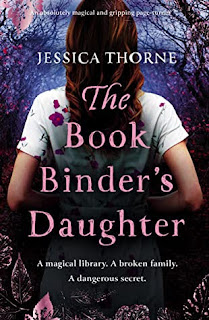
New Book Alert: The Bookbinder's Daughter by Jessica Thorne; Enchanting Special Collections Library Is Backdrop For Year's Best Fantasy


New Book Alert: The Bookbinder's Daughter by Jessica Thorne; Enchanting Special Collections Library Is Backdrop For Year's Best Fantasy

By Julie Sara Porter

Bookworm Reviews


Spoilers: Through this blog, we have seen book lovers and collections that have magic, not the traditional kind where a love of reading and a great imagination can send a Reader anywhere they want with the turn of a page. I mean real magic. From books that literally talk to Readers, books that appear to provide answers when someone is at an emotional crossroads, books that pull Readers inside their magical world, literary characters taking breaks from their storylines to hang out and chill with Readers, and libraries that hold every book that has or will be written and where characters congregate between reads and sometimes wait to become characters in a new work or taking over for other characters.

These Book Worlds could be a dream for me and my fellow Bookworms. 


That network of magical libraries and book keepers can add another member: The Ayredale Special Collection from Jessica Thorne's enchanting modern fantasy novel, The Bookbinder's Daughter.

 On the surface, it looks like a typical special library with a learned scholarly staff that know their collection and the knowledge it contains, researchers who come in to study the contents, comfortable chairs, a fireplace, and a very cozy, quiet, and welcoming atmosphere. It seems normal, but it's not.


 Sophie Lawrence knows this. She and her father left the Special Collection after her mother disappeared when she was a teenager. Now, Sophie is an adult whose father has died and she is in a loveless relationship with a verbally abusive boyfriend. She has constant dreams of walking around a tree that reaches the sky and a voice that calls to her. Her only comfort is her job as a bookbinder. She repairs and builds books with the care of a doctor to her patients.

Sophie is visited by her uncle, Dr. Edward Talbot who sends her an official job offer to become a conservator and specialist binder at the Ayredale Special Collection. Because of the trauma of her mother's disappearance and the blocked memories of her time in Ayredale, Sophie is extremely reluctant but as soon as she reenters the library and meets its odd staff, she feels a sense of being drawn in and welcomed. She also feels a surge of energy surrounding the library, something ancient, powerful, hypnotic, and potentially dangerous.


The characters and setting are what makes The Bookbinder's Daughter truly magical. There are so many great touches that enchant and draw the Reader into this spellbinding world of deep magic, knowledge, and wisdom.

Once Sophie enters the Special Collection, it becomes apparent that the collection and staff are one of a kind. The Ayredale staff are an eccentric unique bunch. Many of them practice some form of magic or what they call, The Art.

There's Uncle Edward who comes and goes on a whim always insisting that the "family must always return to the library." Will Rhys, Sophie's childhood best friend has grown into a handsome young man that sees himself as a protector of the library and Sophie. Professor Hypatia Alexander, the Keeper, never misses a thing but is looking for a replacement. Arthur Dee, Will's half brother has an obsession with the darker aspects of the collection. Villus, the library cat has his own sense of self importance. Delphine, one of three young library assistants (the other two are named Hannah and Meera), sets her amorous sights on the available and important men in the library. 

Then there's my favorite character, Tia, a flamboyant and flashy archivist who has a tragic past and powerful abilities behind her flowing red hair, glamorous appearance, and fashionable wardrobe. (Sort of like if Maggie Smith's earlier character Miss Jean Brodie had the knowledge of her later character Professor Minerva McGonagall.) The staff fills Sophie with a sense of welcome with their mostly kind nature but unease as the collection's real value becomes apparent.


And what a value that collection is. There are some very old magic books with a lot of power. One of them has leaves, no not leaves like pages, actual golden leaves written with words. This book is written in a strange language that none of the staff can decipher, except Sophie. Sophie, who has dyslexia and often has a hard time understanding written language, completely understands this book and many others. It appears that Sophie has her own untapped Art that needs to be put into practice. She has been  called to this job by outside forces and she does her job well.

The collection has a history that goes back to John Dee, Queen Elizabeth I's astrologer, advisor, and sorcerer who allegedly knew and wrote about various magical ancient languages. 


If the books aren't enough, there's the very large tree that stands in the center of the rotunda. A tree that contains much knowledge that can be transferred just by looking at it. It's a tree that is familiar to followers of various myths and religions. (Of course since books come from trees, it makes sense that the books and their original source would be together.) The books and tree are now in the care of the Ayredales who protect them from being misused even as they are pulsing with power and draw the unsuspecting, unwary, curious, avaricious, and greedy.

Of course, greed and opportunism set in and the collection is misused and opened wide. Dangerous things happen and many characters are revealed to be something else, something more frightening and deadly. Sophie finds out some truths about her family and the people that she works with and slowly has begun to regard as a second family.


The Bookbinder's Daughter is one of those type of books that draw a Reader in so much that they are immersed in the world and lost in the setting and characters. That magic  makes The Bookbinder's Daughter one of the best books and certainly the best fantasy of 2021.