Showing posts with label Jazz Age. Show all posts

Wednesday, January 27, 2021

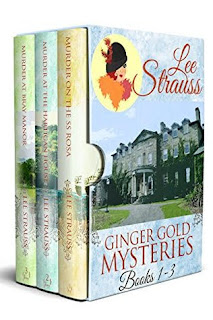
Weekly Reader: The Ginger Gold Mysteries 1-3 by Lee Strauss; Brilliant Jazz Age Historical Mystery Series With Brilliant, Sharp Tongued and Stylish Lead


 Weekly Reader: The Ginger Gold Mysteries 1-3 by Lee Strauss; Brilliant Jazz Age Historical Mystery Series With Brilliant, Sharp Tongued and Stylish Lead

By Julie Sara Porter

Bookworm Reviews


Spoilers: Last year, I was introduced to Mona Moon, cartographer turned businesswoman in 1930's Kentucky, and one addition to the illustrious sisterhood known as historical mystery female protagonists. Well, rewind about ten years and she would find a kindred spirit in fellow historical detective club inductee, Ginger Gold.


Lee Strauss' lead protagonist is a sharp and sassy war widow and fashionista in 1923. After the death of her father, the Boston based Ginger returns to her childhood home of England to inherit her father's vast estate, Hartigan House.

Ginger always is ready with a quick wit and an adventurous curious spirit. When murder is there, she doesn't mind defying authorities to conduct her own investigation and has something quick to say in her defense. In one instance in Murder on the SS Rosa, after the handsome and potential love interest, Chief Inspector Basil Reed warns her not to get involved with the official investigation, Ginger searches anyway and wants to speak to the deceased's widow. She reminds her bemused friend, medical student Haley Higgins that Basil said "not to officially investigate. (Ginger) only wants to offer condolences." Then wonders if she should bring a gift.


Ginger is a very stylish woman with an outfit for every occasion. In Murder on the SS Rosa, Ginger patiently demonstrates to Haley the difference between a day dress, a Jeanne Lanvin, "suitable for afternoon tea or semiformal dining," and a Coco Chanel evening gown that is "perfect for a night of dancing." Her clothes sense makes for some humorous moments such as when she holds up a murder interrogation because she doesn't have a thing to wear. However, she has an eye for style and what is suitable for women to wear on any occasion. Those attributes plus a desire to do something instead of being one of the idle rich allows Ginger to eventually open a women's clothing boutique called Feathers and Flair. 


However despite her style and penchant for barbs, there are darker aspects to Ginger's character that are gently revealed throughout the series. She is in mourning for her late husband, Daniel Lord Gold, who was killed during WWI. She, like many of her generation, is still reeling from the ramifications of a great war that sent young men from nearly every country to their deaths while she is simultaneously trying to uphold the "live life to the fullest" spirit of the 1920's. This grief makes her wary around men particularly Basil who seems to like her more than friendship and vice versa. One of the most emotional moments occurs in Murder at Bray Manor when Ginger finally visits Daniel's grave and reveals her mixed emotions towards moving on.


Ginger also has a past during the war as a spy. While as of Murder at Bray Manor, it is not fully explained, there are some implications that Ginger was pretty close to some dangerous and duplicitous characters. One was Captain Smithwick who wanted to bring her back into the Game. She also may have been betrayed and nearly died, so even before she begins her career as an amateur detective, Ginger is no stranger to murder or dangerous situations.


The book that I read contains the first three volumes of the series. Each mystery is in a different style, but all are brilliant, suspenseful, and filled with great historic detail for the time, customs, dialogue, and of course the wardrobe.

The first three books are:


Murder on the SS Rosa-Ginger and Haley travel to England so Ginger can inherit her father's estate and Haley can begin her medical studies to become a doctor. The two and Ginger's Boston terrier, Bossy, sail on board a luxury liner, the SS Rosa. Unfortunately, this is no pleasure cruise as the captain, Walsh, winds up dead.

In a seagoing version of a locked room murder mystery, the suspects are a small confined bunch. They include the captain's temperamental widow, a beautiful silent film actress and her dour minder, and a crew with secrets of their own. Because of the limited cast, the murderer and their connection to the captain are pretty easy to guess. However, this book serves as a great introduction to Ginger's character as she uses charm, urbane sophistication, and her quick wit as a means to ascertain information. She is also able to run circles around Basil's investigative methods by using clever observation, intuition, daring, and simple pluck to the point that Basil allows her to listen in on inquiries and act as an unofficial partner.


Murder at Hartigan House-Turns out Ginger's homecoming is just as eventful as the trip over. While getting reacquainted with her childhood home, the staff, and the English ways, the family butler, Pippins, directs Ginger to the attic where a skeleton has been discovered. Apparently, it has been there for over ten years since the house was shut up. This leads to some uncomfortable questions such as who was the body? How did they die? What was the reason behind their death? Above all, what did Ginger's father know and when did he know it? The questions increase as another body is added.

Of the three first books in the series,this one is probably the best. The dead body in the attic seems almost to come from Edgar Allan Poe, an urban legend, or a grim fairy tale. It is a very chilling situation and investigation as Ginger has to question many of her father's old friends and the house staff, some who knew her as a child. She also has to ask some uncomfortable questions about her late father with whom she was close. The mystery has some interesting twists. The reveal is genuinely a surprise and flip flops the notion of who is truly innocent or guilty in this world. Also, the moment when the killer is revealed is genuinely suspenseful as Ginger is put in a helpless situation and at the killer's mercy.


Murder at Bray Manor-We saw Ginger's family home, now we take a trip to her late husband's and meet her in-laws. While Ginger's grandmother-in-law Ambrosia and sister-in-law, Felicia had small roles in Murder at Hartigan House, this book solidifies them as important characters in Ginger's life. Felicia summons Ginger to investigate the appearance of a poltergeist in the Gold family home.

Bray Manor has fallen on hard times and Felicia opens the home as a meeting place for various clubs like knitters, stamp collectors, gardeners and such. It is after one of these gatherings that Felicia's friend, Angela Ashton is murdered. It is up to Ginger to investigate this death and reopen some wounds from her past.

If Murder on the SS Rosa is the wittiest, and Murder at Hartigan House is the most gruesome and suspenseful, then Murder at Bray Manor is the most emotional in the series. There is the aforementioned sadness that Ginger feels about visiting Daniel's grave. Her grief is realistic as is the post trauma that she feels over her war experiences. It's very possible that her sassy fashionable attitude are just covers for the broken soul underneath.

 Besides her problems, the Gold family is caught up in their own turmoil. This is a family that has been steadily losing money for years (in fact Daniel married Ginger for her family's money though their marriage blossomed into love). Ambrosia is an elderly woman so stuck in the past that she would rather be homeless than reshape her life to fit in the new world by letting visitors in her family home. Felicia might seem like a bubble headed flapper on the surface, but as the sole heir to Bray Manor has the foresight to save it. 

The passages between them balancing tradition vs. progress are heartfelt as the two women would otherwise be left alone by an uncaring world.

The emotions shared by Ginger, Ambrosia, and Felicia aren't the only ones that are truly moving. Without revealing too much, the murderer's motives are understandable and almost empathetic. In their confession, we don't see a remorseless cruel person, we see someone who was desperate, broken, and driven by their rage and grief to commit the ultimate crime.


The first three books in the Ginger Gold Mysteries gives us a brilliant sparkling character that is among the galaxy of great historical female detectives. Just like her name, Ginger is pure Gold.


Monday, November 12, 2018

Classics Corner: The Vicious Circle: Mystery and Crime Stories Written By Members of the Algonquin Round Table Edited by Otto Penzler; A Witty Dark Collection From Some of America's Funniest And Most Notable Writers


Classics Corner: The Vicious Circle: Mystery and Crime Stories Written By Members of the Algonquin Round Table Edited by Otto Penzler; A Witty Dark Collection From Some of America's Funniest And Most Notable Writers

By Julie Sara Porter

Bookworm Reviews


Chances are if you are a frequent Reader of early 20th century American Literature, then you probably wondered what it must have been like to be a member of the Algonquin Round Table. This was a group of intellectuals, writers mostly but also actors, musicians, comedians, and producers who met from 1919-1927 at the Algonquin Hotel in New York City to drink, argue, discuss, drink some more, curry favors, hook up, write, and no doubt to drink again.


While people hovered in and out of the group, some of the known members included some of the brightest of 1920’s society including columnist, Alexander Woollcott, humorist, Robert Benchley, critic and author, Dorothy Parker, playwrights, Robert Sherwood, Edna Ferber, and George S. Kaufman, and comedian, Harpo Marx among others. The group would meet to prank or trade clever barbs and comebacks with one another. (One example involves Woollcott observing the normally tweed-suit-wearing Ferber in a gown. Woollcott: My dear, you almost look like a woman. Ferber: So do you.) Even in modern times, the Algonquin Round Table members are known for their caustic wit and one-liners, but they also served a more serious purpose by inspiring one another's writing talents, collaborating on works, and becoming involved in various mostly liberal causes.


The Algonquins were heavily criticized as sophisticated elitists who traded comments but did very little (sort of a precursor to the so-called “Liberal Elite” stereotype), but in reality were very involved in labor union disputes, civil rights, and anti-censorship movements. (They didn't just talk the talk either. After her death, Dorothy Parker bequeathed her estate to Martin Luther King Jr. who then bequeathed it to the NAACP. The NAACP dedicated a memorial garden to her outside their Baltimore office.)


While their works were often clever and funny, the Algonquins weren't unaware of the dark side of human nature. They were aware of hatred, prejudice, envy, and death. That dark side often appeared in their writings so the Algonquins were naturals to write crime and mystery stories.


Otto Penzler, proprietor of the Mysterious Bookshop in New York City gathered the Algonquin's mystery and crime stories to create The Vicious Circle (a nickname for the Algonquins), a collection that displays the Algonquin's clever wit and love of the dark side of life. Many of the stories aren’t whodunits in the traditional sense and the emphasis is not on the plot angles of solving murders. Instead the focus of the stories is mostly on sharp wit and dramatic irony usually involving characters in criminal illegal situations all while providing clever barbs and commentary.The characters in these stories might stab someone in the back but not before delivering a clever bon mot beforehand.


The five best stories that display the Algonquin wit in deadly situations are:


“Coroner’s Inquest” by Marc Connolly- Pulitzer winning playwright, Connolly wrote this short story which could be the inspiration for the “Twilight Zone-Tales-From-The-Crypt-M.-Knight-Shyamalan” twist ending. In a dialogue heavy story, a witness recounts the deaths of a friend, Jimmy, a Little Person and his brother-in-law, Robel. The situation is grotesque as Jimmy becomes obsessed with the thought that he is growing (therefore no longer marketable as a Little Person). The story builds to a climax that is dipped in irony and farce, making the story a dark comedy-mystery turned into a revenge tale.


“Farewell, My Lovely Appetizer” by S.J. Perelman-Readers who are familiar with the hard boiled detective works by Dashiell Hammett, Raymond Chandler, and Jim M. Cain, would enjoy Perelman’s parody story. Perelman, a frequent writer for the New Yorker magazine and collaborator of the Marx Brothers sent up the clichés of the world-weary cynical detective, the bright but not too bright female assistant, and the gorgeous femme fatale who hires the shamus to solve her case or be her fall guy. The story particularly skewers Hammett’s classic, The Maltese Falcon by offering us a main character whose resemblance to Hammett's Sam Spade is no doubt entirely intentional. To add to the parody, the femme fatale who is not-supposed-to-be-but-really-is Falcon’s Brigid O'Shaughnessy, tells her hard luck story and makes a casual reference to a golden spintria in her story of murder and betrayal. In contrast to the Maltese “stuff that dreams are made of”, when asked about what the spintria has to do with her story, the Fatale responds: “It doesn't. I just thought it added glamour to the story.”


“Haircut” by Ring Lardner- Sports columnist, Lardner's short story is an excellent example of dialect storytelling. In the story, a barber tells a customer about a love triangle that resulted in a murder. What makes the story stand out is the tone and style that brings the narrator to life. Through the Narrator's account, Lardner expertly captured those verbal tics that we all recognize in storytellers like constant repetition, subject changes, and endless digressions. We all know someone like that: a Big Talker who will ramble on and on leaving his listeners glancing at their watches and watching the outside skyline get lighter while they sit there intensely fascinated. The Reader hovers between telling Gardner's protagonist, “Please continue” and “Get to the point!”


“The Great Warburton Mystery” by George S. Kaufman and Howard Dietz- If Perelman's story brilliantly mocks the hard-boiled mystery, then Kaufman and Dietz's one-act play is a clever send up of the drawing room mystery written by the likes of Agatha Christie, Dorothy L. Sayers, and Ngaio Marsh. A detective solves a murder at a fancy dress party using solutions that mock the deductive reasonings of Sherlock Holmes or Hercule Poirot. Instead of using logic to come to his conclusion, Inspector Cartwright appears to pull solutions out of his ass, once almost literally. (He insists that no two chair impressions are alike so starts measuring the sitters). He moves his way through a party of bizarre suspects, particularly an irritating heiress who insists on becoming the center of attention by inserting herself into the investigation and claiming to be linked to various characters.


“Big Blonde” by Dorothy Parker- If the kingdom of the Algonquin Round Table had a queen, she would be Dorothy Parker. Parker was certainly the most well-known of the Algonquins particularly for her wisecracks, witty poems and screenplays (including the original, A Star is Born), and caustic book and theater reviews. She also wrote plenty of short stories that were filled with ironic situations and dry humor that characters used to get through life’s troubles. These weren't gut busting hilarious stories but Parker's characters were often caught up in difficult situations which they faced with sarcasm, cynicism, and a brazen “what the hell" attitude. Dorothy Parker's characters laugh, so they don't cry.


Parker's story, “Big Blonde” captures not only the wit and irony of Parker's writing but it perfectly encapsulates the division between humor and darkness found in the Algonquin's stories making this the best story in the anthology and Parker the best writer of the Algonquin Round Table.


On the surface nothing seems remotely funny about Hazel Morse's life as she moves from one unhappy relationship to another and ultimately attempts suicide. Parker's narration provides some sharp contrast to this sad situation with witticisms about Hazel's life. Before her marriage, Hazel weighs out potential suitors by their locations: “She could not regard as serious proposals that she share a western residence.”


Some of the darkest passages offer humor that is wry, sarcastic, and sometimes uncomfortable such as when she weighs out the different methods towards suicide. Hazel dismisses various means such as guns (“Too noisy.” She always turned her head during shooting scenes in plays), knives (“Hurts like hell.”), and poison (“They wouldn't sell it to you because of the law.”). Similar to Parker’s terse poem, “Resume”( Razors pain you, Rivers are damp, Acids stain you, And drugs cause cramp. Guns aren't lawful, Nooses give, Gas smells awful. You might as well live”)., the narrative provides an ironic gallows humor that could be summarized by saying “I can't kill myself. I might get hurt!”


There is also something empathetic in Hazel (and in turn Parker who attempted suicide several times in her lifetime) in her cynicism in the midst of despair. She is someone who faces life's hardships with a smirk, a good stiff drink, and saying “Here's mud in your eye” (sort of the Jazz Age version of flipping the bird) before her attempt. She may feel down but Hazel will give the world an earful before that happens. Hazel is like the comedian giving a monologue about their mental health issues while inside a psychiatric ward recovering from them.


While Dorothy Parker is the best writer of the Algonquin Round Table, all of the writers provided their Readers with clever original ways of looking at the world of crime and death. They allowed their Readers to see that world with a chuckle or a smirk along with the firm grimace.