Classics Corner:
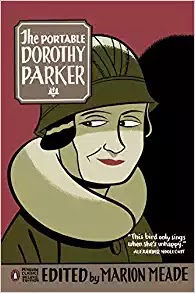
The Portable Dorothy Parker by Dorothy Parker; A Dark Witty Collection of the Algonquin Queen's Best Work
By Julie Sara Porter
Spoilers: When I want a good laugh, I go to Dorothy Parker (1893-1967). When I want a good cry, I go to Dorothy Parker. She was a writer who was capable of making her Readers feel various emotions sometimes at once.
Last year I reviewed
The Vicious Circle, a collection of short stories from the members of the Algonquin Round Table and I called Parker their Queen. I did not exaggerate. Though not handy with a sword or a joust, Parker fought anyone with her sharpest weapons: her words and wit.
Dorothy Parker was born in 1893 as Dorothy Rothschild. (No relation to the banking family of the same name). Her mother died before she was five and Dorothy did not get along with her father or stepmother. She already had a reputation for sassiness as she called her stepmother “the housekeeper” and got in trouble at her Roman Catholic school for referring to the Immaculate Conception as “the spontaneous combustion.”
She sold her first poem to
Vanity Fair in 1914 and later worked at
Vogue as an editorial assistant. After two years at
Vogue, Parker was hired as a staff writer for
Vanity Fair eventually becoming a drama critic.
The 1920’s was among the most fruitful times for Parker. In 1919, she and colleagues, Robert Benchley and Robert E. Sherwood became members of the Algonquin Round Table, a group of writers, entertainers, publishers, and other intellectuals who met at the Algonquin Hotel in New York City for lunch to drink, wisecrack about each other, and discuss inspirational ideas. It was through her association with the Round Table that Parker acquired her reputation as a wit. For example when she heard that the U.S. President Calvin Coolidge was dead, she said “How can they tell?” in reference to his noted silent demeanor.
In 1925, Parker joined the staff of the
New Yorker as a writer and columnist. Her most popular column was her “Constant Reader” book reviews in which she used her biting wit to praise or deride the frequent literary efforts that she read. Throughout her life, Parker wrote poetry, short stories, plays, screenplays, and reviews and essays. Most of her work retained her sarcastic brazen sense of humor and wisecracks that she was known for.
However, her personal life was not a pleasant one. She married Edwin Pond Parker II in 1917 and the two divorced in 1928 (though Parker kept her married name.) Parker then married Alan Campbell, a writer and actor in 1934. Their marriage was rocked by her alcoholism and Campbell's infidelity with men and women. They divorced in 1947 only to get remarried in 1950 and separate two years later. They however remained legally married until Campbell's death in 1963.
Parker was a frequent alcoholic and had depression. She made a few suicide attempts and was often estranged from close friends particularly Benchley though they later reconciled.
Later in life, Parker was dismissive of her writing and of her time at the Round Table. She would later deride the Algonquins as: “There were no giants. (Ring) Lardner, (F. Scott) Fitzgerald, (William) Faulkner, and (Ernest) Hemingway were the real Literary Giants The Round Table was just a lot of people telling jokes and telling each other how good they were. Just a bunch of loudmouths showing off saving their gags for days waiting for a chance to spring them…...There was no truth in anything that they said. It was the terrible day of the wisecrack so there didn't have to be any truth.”
Parker was known for her liberal stance which she carried to her grave, literally. In 1927, she protested the arrest and execution of Sacco and Vanzetti, two anarchists who were charged with murder. She was arrested for the protest and charged $5.00 for “loitering and sauntering.” When asked why she paid the fine, Parker answered “Well I did saunter.”
She also reported on the Loyalist Cause in 1937 during the Spanish Civil War and spoke out against Fascism in the 1940’s. In 1950 she was listed as a Communist by Red Channels magazine.
After her death in 1967, Parker bequeathed her estate to Martin Luther King Jr. and he in turn bequeathed it to the NAACP. The Baltimore chapter of the NAACP erected a memorial garden in her memory.
The Portable Dorothy Parker contains a wide collection of her best works including her poetry and short story collections Enough Rope, Sunset Gun, and Death and Taxes, her drama reviews for Vanity Fair and the New Yorker, her “Constant Reader” reviews for the New Yorker, her book reviews for Esquire, and other short stories and articles. All of them reveal the many aspects of Dorothy Parker's character the quick wit, the depressed temperament, and the social commentary. Above all her work is honest, revealing, and funny. The best of her writing including the best quotes are as follows:
Short Stories
“Arrangement in Black and White”
As I mentioned earlier, Parker bequeathed her estate to Martin Luther King Jr. who in turn bequeathed it to the NAACP so she was well acquainted with the subject of racism.
This story describes an encounter between Mrs. Burton, a white society matron, and Walter Williams, an African-American singer. Instead of being outwardly racist, Mrs. Burton rambles on about how racist “other people” are while ignoring her own prejudices. She is the type of person who would begin a conversation with “I'm not racist but…… “ and describe various stereotypes that show that indeed she is racist. I'm surprised she didn't throw out the old chestnut “some of my best friends are black.”
Parker's take on the so-called soft racism showed that it's just as harmful perhaps even more so than the behaviors of the standard racist. Mrs. Burton sticks to her prejudice and her narrow minded views of who she thinks Walter is or should be, insults him Walter and his girlfriend, and makes herself look like an idiot.
Quote:
Mrs. Burton: “ But I must say for Burton. He's heaps broad-minded than those other Southerners. He's really awfully fond of c&$#@ed people. Well he says himself that he wouldn't have white servants….. All he says is he says is he hasn't got a word against c$#@&ed people as long as they keep to their place. He's always doing things for them-giving them clothes and I don't know what all.
The only thing he says, he says he wouldn't sit down at the table with one for a million dollars. 'Oh,’ I say to him 'You make me sick talking like that.’ I'm terrible to to him. Aren't I terrible…… Now me I don't feel that way at all. I haven't the slightest feeling about c$#@&ed people.
Why I'm just crazy about some of them.. They're just like children-just as easygoing, and always singing and laughing and everything. Aren't they the happiest things you ever saw in your life. Honestly it makes me laugh just to hear them. I like them, I really do.”
“Dusk Before Fireworks” (Enough Rope)
Since Parker was particularly active in the 1920’s, many derided her as the prototypical flapper. In fact her poems were mocked as “flapper verse.” Critics considered her poetry short, to the point, and with little meaning (though clearly that's wrong). In many ways, Parker embodied the free spirited flapper style by being brash, upfront about her opinions, and having a “what the hell” attitude about life. However, Parker also used her familiarity with her generation to satirize it's aspects.
Her short story, “Dusk Before Fireworks” mocks the power plays between men and women who are incapable of committing themselves to one person.
In this story, Hobie and his girlfriend, Kit are on vacation in Paris. They are planning for a romantic evening. Unfortunately, they keep getting interrupted by phone calls and visits from Hobie's other girlfriends.
This story depicts how the free love attitude can be a detriment to the possibility of long-term relationships. Hobie is incapable of committing to one girl. He is shallow and is only interested in his temporary affairs.
Kit, however, is aware of his womanizing personality and is even attracted to it. She wants to play the free spirit and insist that she isn't jealous. However, Kit realizes that knowing about his affairs and accepting it are two different things. She realizes how meaningless declarations of love are when he does not share them with only one person.
Quote:
Kit: “There's just as much hell as there are in shrill unnecessary people….It's the second raters that stir up hell; first-rate people wouldn't. You need never have another bit of it in your beautiful life if-if you pardon my pointing-you could just manage to steel yourself against that band of spitting hellcats that is included in your somewhat over-crowded acquaintance, my lamb.
Ah but, Hobie my dear, I've been wanting to tell you for so long. But it's so rotten hard to say. If I say it, it makes me sound just like one of them-makes me seem inexpensive and jealous. Surely you know after all this time, I'm not like that. It's just that I worry so much about you. You're so fine and so lovely, it nearly kills me to see you eaten up by a lot of things like Margot Wadsworth, Mrs. Holt, and Evie Maynard and those. You're so much better than that. You know that's why I'm saying it. You know that I haven't got a stitch of jealousy in me. Jealous!
Good heavens, if I were going to be jealous, I'd be about someone worthwhile and not about any stupid, silly, idle, worthless, selfish, hysterical, vulgar, promiscuous, sex ridden-”
Hobie: “Darling!”
“Big Blonde” (Enough Rope)
“Big Blonde” is Parker's most famous story. It won the O'Henry Prize for Best Short Story and is frequently anthologized. It is also no doubt Parker's most personal because it deals prominently with alcoholism, depression, and attempted suicide.
The story follows Hazel Morse throughout her life. When we first encounter her, she is a model and party girl in her early twenties. She marries Herbie Morse before she turns 30 and the two fight because of frequent affairs and alcoholism. They divorce and Hazel hooks up with various men. When one of her lovers dumps her, a now aging Hazel gives into her despair and attempts suicide.
Hazel Morse is the type of character who embodies the quote “laugh so you don't cry.” Around various lovers, she behaves like “a good sport” someone who is light-hearted, funny, and faces life with a song, a laugh, and a bottle of whiskey. Her ex-husband and boyfriends insult her when she drops her party girl persona and becomes more serious.
Hazel shows what happens to someone when the laughter and the good times stop. Her desire to retain her once cheerful behavior imprisons and exhausts her because she can't express herself in meaningful ways. Instead all she can do is hang onto life with a smirk, a glass, and a declaration of “Here’s mud in your eye.” She tries to retain a sense of humor that becomes more desperate, bitter, and more cynical the older she gets.
“Big Blonde” was first released in 1929 when Parker was 36 years old. She was certainly aware of the problems of aging women but in some ways, Hazel's journey was similar to her own and predicted her own fate. Like Hazel, Parker was often considered “one of the guys” and described as a “good sport” as one of the few female members of the Algonquin Round Table. While her marriage to Alan Campbell was still in the future, it too would be troubled by affairs and heavy drinking. Like Hazel, Parker had depression and attempted suicide. Also like Hazel, Parker's humor contained a detached cynical pessimism and sarcasm that would be their counterattack against the world probably the only one that they had.
Even though the story is pessimistic, there is almost something admirable in Hazel's character and Parker's writing. They tried to find meaning with a sense of humor that acknowledges the bad things and find something light in them no matter how bizarre and dark that light actually is.
Quote:
Narration: “But how would you do it? It made her sick to think of jumping from heights. She could not stand a gun. At the theater, if one of the actors drew a revolver, she crammed her fingers into her ears and could not even look at the stage until the shots have been fired.
There was no gas in her flat. She looked at the bright blue veins in her slim wrists-a cut with a razor blade and there you'll be. But it would hurt, hurt like Hell and and there would be blood to see. Poison-something tasteless and quick and painless-was the thing. But they wouldn't sell it to you in drugstores because of the law.”
“Lady with A Lamp” (Sunset Gun)
Many of Parker's short stories are one person monologues where a character just talks endlessly in a rambling first person narrative. The dark humor of these stories is that the character is so self-involved that they don't realize the other characters are going through an actual crisis and the speaker's meaningless words are not only not helping but are making the situation worse.
“Lady with a Lamp” is a story like that. A woman visits her sick friend, Mona who has been bedridden for two weeks. As the Narrator talks, we learn that Mona had been in a relationship with a man named Garry for three years and he just broke up with her. As the Narrator's monologue continues, we further learn that Mona was pregnant and had an abortion.
There is situational irony as the Narrator administers what she believes is TLC and believes that she is acting like a good friend, but the Reader is aware that the Narrator is not a good friend to Mona. She is clearly a woman who loves the sound of her own voice without caring whether her words have any real meaning to them.
She gives Mona not really helpful advice that she should get married, that she should have known Garry was a heartbreaker, and that she just needs to pick herself up and buck up. The Narrator doesn't understand that Mona has been depressed and ill from such a stressful time and decision. She won't just “pick herself up” from it because she can't.
This situation is similar to many who go through a bad time and are surrounded by people who are well meaning but their words end up being condescending and counterproductive.
Quote:
The Narrator: “What doctor did you have darling? Or don't you want to say? Your own? Your own Dr. Britton? You don't mean it! Well I certainly never thought he'd do a thing like- Yes, dear of course he's a nerve specialist. Yes, dear. Yes, dear. Yes dear of course you have perfect confidence in him. I only wish you would in me, once in awhile; after we went to school together and everything. You might know I absolutely sympathize with you. I don't see how you could possibly have done anything else.
I know you talked about how you'd give anything to have a baby, but it would have been terribly unfair to the child to bring it into the world without being married. You'd have to go live abroad and never see anybody and-And even then, somebody would have been sure to have told it sometime. They always do.
You did the only possible thing, I think. Mona for heaven's sake! Don't scream like that, I'm not deaf you know. Alright, dear, all right, all right. All right of course I believe you. Naturally, I take your word for anything. Anything you say. Only please do try to be quiet. Just lie back and rest, and have a nice talk.”
“Little Curtis” (Death and Taxes)
Parker had a lot to say about the many roles in society. One of them is the relationship between parents and children. Though Parker herself never had children, her writing skewers the toxicity that resides within families when adults and children are both besought with emotional problems.
In “Little Curtis,” Mr. and Mrs. Matson adopted a little boy when he was four years old. Now, they are parading him in front of their friends, forbidding him to play with children from a different class, and control his words and actions.
The Matsons, especially Mrs. Matson, are clearly people who are all surface and artifice. As she first appears window shopping and appraising clothes based on their class, Mrs. Matson is someone who cares more about status than anything else. She has very little maternal affection for Curtis because she often treats him more like a plaything as she puts words in his mouth and controls his various actions.
She enjoys the compliments of people saying what a wonderful mother and selfless woman she is for adopting a young boy than she is interested in actually mothering him. It is a subtly mentally abusive situation that Curtis is placed in, one that potentially has long term effects for him.
This story shows that the most seemingly altruistic selfless acts have dark connotations if they are done for all the wrong reasons.
Quote:
Narration: “She always enjoyed the first view of the house as she walked towards it. It amplified in her a sense of security and permanence. There it stood, in its tidy treeless lawns square, solid, and serviceable. You thought of steel-engravings and rows of Scott's novels behind glass and Sunday dinner in the middle of the day, when you looked at it.
You knew within it, no-one banged a door, no-one cluttered up-and downstairs, no one spilled crumbs or dropped ashes or left the light burning in the bathroom.” (Remember, all of this is said about a house in which a four-year-old boy lives.)
“The Bolt Behind the Blue”
Some of Parker's stories involve class conflicts, internal struggles between the wealthy members of high society and those in the lower working classes, usually their employees. Often times, these stories involved the prejudices and assumptions that people make about the people who are not in their income bracket.
“The Bolt Behind the Blue” explores that conflict between Mrs. Hazelton, a wealthy divorced mother and Miss Nicholl, her secretary. As Miss Nicholl works according to Mrs. Hazelton's wishes, the two are filled with compliments and kind words toward each other and towards Mrs. Hazelton's daughter, Ewie. However, we find that their positive working relationship is a mask for their passive aggressive insecurities that they subtly encourage in each other as they mention their flawed lives to each other. (Miss Nicholl subtly mocks Mrs. Hazelton's distant relationship with Ewie implying that she is a bad mother. Mrs. Hazelton claims to admire Miss Nicholl’s work ethic but inwardly thinks of her as a charity case.)
When they are alone, the two women think of each other as a symbol of their social class (the wealthy snob vs. the jealous worker) stereotyping each other's lifestyle. They don't look deeper and see that they are similar to each other. They don't see each other's envy nor their loneliness caused by Mrs. Hazelton's divorces and Miss Nicholl's singlehood.
Quote:
Miss Nicholl: “What kind of life is that sitting around in her tearoom counting her pearls? Pearls that size are nothing but vulgar anyway! Why should she have all those things? She's never done anything-couldn't keep a husband. It's awful to think of that empty existence; nothing to do but have breakfast in bed and spend money on herself. No sir, she can have her pearls and her hangers and her money and her twice a week florist and welcome to them. I swear, I wouldn't change places with Alice Hazelton for anything on earth!”
Narration: “It is a strange thing but it is a fact. Though it had every justification, a bolt did not swoop from the sky and strike Miss Nicholl down….”
….. Mrs. Hazelton: “Why she hasn't any responsibilities and she has a job that gives her something to do every day, and a nice room, and lots of books to read, and she and her friend do all sorts of things in the evenings. Oh let me tell you, I would be more than glad to change places with Miss Nicholl!”
Narration: “And again that bolt, though surely sufficiently provoked, stayed where it was, up in back of the blue.”
Poems
“Resume” (Enough Rope)
With Parker's most famous poem, we get a look at her mindset especially about depression and attempted suicide. This poem looks at depression not with seriousness but with a dark comic touch.
There is a world weariness and pessimism in the writing that says that life can be more painful than death but might as well be lived. There is also a gallows humor as the Speaker contemplates the various forms of death and cannot bring themselves to go through with it. It is similar to the old joke where someone says, “I can't kill myself. I might get hurt!”
Like Parker's “Big Blonde,” the poem finds humor in such a dour situation by shining a bit of light on it, a dark, cynical, pessimistic light but a light nonetheless.
Quote:
Razors pain you;
Rivers are damp;
Acid stains you;
And drugs cause cramp;
Guns aren't lawful;
Nooses give;
Gas smells awful;
You might as well live.
“Love Story” (Enough Rope)
As a reviewer and writer, Parker read many different types of writing and could parody the best.
This poem subverts expectations in which the Speaker describes her lover in seemingly romantic terms then uses the final line of the stanza to say what she really thinks about him.
The poem hovers between romance and realism showing Readers that the attributes that some might find romantic and chivalrous, others might find desperate and stalkerish.
Quote:
My own true love is strong and bold
And he carries not what came after.
His words ring sweet as a chime of gold,
And his eyes are lit with laughter.
He is jubilant as a flag unfurled-
Oh a girl, she'd not forget him.
My own dear love-he is all my world.
And I wish I'd never met him.
My wish, he's mad, and my love, he's fleet,
And a wild young wood-thing bore him!
The ways are fair to his roaming feet,
And the skies are unlit for him.
As sharply sweet to my heart he seems
To the fragrance of acacia
My own dear love, he is all my dream
And I wish he were in Asia.
My love runs by like a day in June
And he makes no friend of sorrows.
He'll tread his galloping rigadoon
In the path of the morrows.
He'll live his days where the sunbeams start,
Nor could storm or wind uproot him.
My own dear love, he is all my heart-
And I wish somebody'd shot him.
“Comment” (Enough Rope)
This poem is a variation of the old “And I'm the Queen of Sheba” line where someone deflects a fact or opinion with sarcasm. (“My boyfriend is faithful to me.” “And I'm the Queen of Sheba.”)
Like “Love Story”, Parker's writing takes well-worn clichéd advice and turns it into something darker and more pointed. This time it attacks optimism and the feel good attitude some people have about life. It reminds us that we have very right to feel bad about a situation and to admit it is more honest than the cheerful homilies we are forced to endure.
Quote:
Oh life is a glorious song,
A medley of extemporanea;
And love is a thing that can never go wrong;
And I am Marie of Romania.
“Frustration” (Sunset Gun)
We have all had situations like this where we encounter people that just get on our nerves. Some days, we get so mad that a part of us would like to really hurt somebody.
This poem reflects that stress that comes with those feelings. Instead of burying that anger behind propriety, social norms, and the law, the Speaker acknowledges it. The poem reminds us that anger is inside all of us. Though the majority of us would never act on rage, we still feel it. In accepting that rage, we allow it to surface and then float away so we don't act on those darker impulses.
Parker herself had an outlet for her anger. What she couldn't express with violence, she could through her writing and sometimes that lasted longer.
Quote:
If I had a shiny gun,
I could have a world of fun
Speeding bullets through the brains
Or the folk who give me pain;
Or had I some poisonous gas,
I could make the moments pass
Bumping off a number of
People whom I do not love.
But I have no lethal weapon-
Thus does Fate our pleasure step on!
So they still are quick and well
Who should be, by rights, in hell.
“Lines on Reading Too Many Poets” (Death and Taxes)
In her poetry, Parker made frequent references to other works that she read. Sometimes she wrote a few lines talking about other writers. In othe poems, she intentionally parodied their writing styles as pastiches and tributes. This poem is the latter category.
This poem reads as almost a checklist of clichés that are found in Romantic poetry particularly the works of William Blake, Percy Shelley, William Wordsworth, and John Keats. She details nature scenes, working class children (complete with accent), and the obligatory mythological reference and Latin phrases like the best of them.
However, this poem is not mean spirited. To parody something properly, one must be aware of the original source. Part of what made Mel Brooks movies so memorable was his love for the genres like Broadway musicals, Westerns, horror movies, or swashbuckling adventures, that he mocked.
In her own way, Parker paid tribute to the detailed imagery and flights of imagination that were found in the works of these late 18th and early 19th century poets.
Quote:
Roses, rooted warm in earth,
Bud in rhyme, another age;
Lilies know a ghostly birth
Strewn along a patterned page;
Golden lad and chimbley sweep
Die; and so their song shall keep.
Wind that in Arcadia starts
In and out a couple plays;
And the drums of bitter hearts
Beat the measure of a phrase
Sweets and woes but come to print
Quae cum ita sint.
“The Lady's Reward” (Death and Taxes)
This poem is another one that changes expectations by providing us a few lines from one perspective then the final lines reveal the real meaning.
“The Lady’s Reward” mocks the advice that was often found in women's magazines and books. They were usually things that a proper young lady “should” do to get a man in her life. Most of them were condescending by telling ladies to conform to gender roles as it told women to be silent and passive even in the presence of a man who is cruel and argumentative.
Parker's poem reveals that women who followed that advice ran the risk of losing themselves to conform to a societal standard of feminine behavior and to catch a man.
Quote:
Lady, lady never start
Conversation towards your heart;
Keep your pretty words serene;
Never murmur what you mean.
Show yourself by word and look,
Swift and shallow as a brook.
Be as cool and quick to go
As a drip of April snow;
Be as delicate and gay
As a cheery flower in May.
Lady, lady never speak
Of the tears that turn your cheek-
She will never win him, whose
Words had shown she feared to lose.
Be you wise and never sad,
You will get your lovely lad.
Never serious be, nor true,
And your wish will come to you.
And if that makes you happy, kid,
You'll be the first it ever did.
Reviews and Essays
“Oscar Wilde: An Ideal Husband.” Vanity Fair, November, 1918.
I know it's a bit meta to review reviews, but Parker was known for them and her sharp wit is at its best in her reviews. To not mention them would be like doing an analysis of Hemingway's work and ignoring his short stories (more on him later).
Parker's first steady writing job was as a drama critic for Vanity Fair. She gave her perspective on the various plays which ranged from dislike to love. Sometimes, she liked the play itself but had issues with the performers or some aspect of the production.
In this case, her review of Oscar Wilde's An Ideal Husband, her rancor is not for the play itself but specific playgoers. She mocks the Sophisticated Pretentious Elite who insult others, especially those who go see musicals at the Winter Garden Theater (later famous for being the home of Cats). These playgoers believed that only they were intelligent enough to understand Wilde's works and everyone who didn't was a bucolic idiot (but of course if others did, it would ruin Wilde's exclusivity for only the privileged few).
We all know people like that and personally having known many Hipsters, especially among the Indie-only Films Crowd, I can definitely relate.
Quote:
“They walk slowly down the aisle and sink gracefully into their seats, trusting all note their presence for the very fact of their being there as proof of their erudition.
From the very moment of the curtain's rise, they keep up a hum of appropriation, a measuring signal of their patronage and comprehension. ‘Oh the lines, the lines,’ they sigh one to another as if to discover this Oscar Wilde as a promising young writer and they use the word 'scintillating’ as frequently and proudly as if they just coined it.”
“Valedictory, (Getting Married by George Bernard Shaw, Lady Beyond the Moon by William Doyle, Right of Happiness by Roy Davidson).” The New Yorker, April 11, 1931.
Before her famous “Constant Reader” column, Parker wrote other articles for the New Yorker. She did a stint reviewing plays there as a substitute for the vacationing Robert Benchley. (Supposedly, this assignment is actually what led to Parker being offered the position as book reviewer.)
In this, her final article subbing for Benchley, Parker was at her most sardonic, tearing into three plays that she hated. One, Getting Married, was so bad that Parker even admitted that she left before the second act and doubted that she missed anything.
Quote:
“I regret to say on the first act of this I, for what I hope will be the only time in the theater, fell so soundly asleep that the gentleman who brought me piled up a barricade of overcoat, hat, stick, and gloves between us to establish a separation in the eyes of the world and an impersonation of A Young Man Who Has Come To The Theater Unaccompanied.”
“Edmund Wilson: The American Earthquake; Jack Kerouac, The Subterraneans; Edna Ferber: Ice Palace,” Esquire, May, 1958.
Throughout the ‘30’s and ‘40’s, Parker and Campbell lived in Hollywood where she wrote screenplays such as the original A Star is Born and became actively involved in political causes. In 1952, Parker separated from Campbell and returned to New York. She wrote book reviews for Esquire magazine from 1957-1962.
While her articles were as sharp as ever, there was something of the “cranky old woman” in her writing. She looked very negatively at the current generation of the Beatniks which is prominently shown in her review of Jack Kerouac's The Subterraneans.
As many members of an older generation before and since, she derided these youthful kids with their music, politics, culture, and ideals.
She even compared their behavior to her own “Lost Generation” bemused that the Beats wander aimlessly, drive fast, and seem to have no ambition except park themselves in friend's houses. Of course her generation was never like that Parker insisted. Alright sometimes but it wasn't their whole life. They did stuff with their lives. (I was waiting for a paragraph saying they walked miles to school barefoot in the snow.)
If you want to read a current comparison with this review, click on any article about Millennials. The generation may be different, but the words are the same.
Quote:
“Mr. Kerouac possibly the inventor and certainly historian of the Beat Generation calls his latest work The Subterraneans. The Subterraneans are 'hip without being slick; they are intelligent without being corny, they are as intellectual as hell and know all about Pound without being pretentious or talking too much about it. They are quiet, they are very Christlike.’
So those are the Subterraneans. The only point in the summary with which I can agree is that they are hip; or as Grandma used to say, hep.
Doubtless my absence of excitement over Mr. Kerouac's characters is due to a gaping lack in me, for and I regret the fact that I do not dig bop. I cannot come afire when I hear it, and I am even less ecstatic in reading about it.
I am honestly sorry about this for who could not do with a spot of ecstacy now and then? I envy this generation its pleasure in music. And that is all I envy it.”
“James Thurber: The Years With Ross.” Esquire, September, 1959.
There is a touching melancholy about Parker's reviews for Esquire. She outlived many of her contemporaries. While she became more outspoken against her Algonquin days, her reviews carried a sense of nostalgia of the past as well as her regrets about growing older and saying goodbye to so many literary figures that she knew personally.
Her review for The Years With Ross by James Thurber is just such an article. Her review is a tribute to New Yorker founder and editor, Harold Ross. Ross encouraged her talent at The New Yorker, hired her as staff writer and editor, and helped Parker and many others become well-known.
Parker's reminisces are touching as she recalled Ross’ appearance and expressive mannerisms. She also recalled his editing and how he asked questions like “who he?”, “what mean?”, and “why in Hell?”. She wrote about Ross's work drive and ambition in getting the magazine issued calling The New Yorker, Ross's “bitch-mistress”.
Parker's review of Thurber's book is a eulogy and a thank you letter to a man who was an important figure in her life.
Quote:
“James Thurber, the while that St. Jude the patron saint of impossible things must surely have been interceding for him, set himself the task of making believable in writing the façade and the workings of the late Harold Wallace Ross, founder and editor of The New Yorker.
It is not only that Mr. Thurber accomplished this. It's that he did it thoroughly but vitally, he did it a deep love but a sort of benign outrage.
It's that his Years With Ross is a fine, funny, and touching book and an admirably written one though that last goes without saying-after all, it was written by James Thurber.”
“The Siege of Madrid,” November 23, 1937.
There comes a time when the laughter stops and the humorist must write about dark topics in a serious manner. No one understood this more than Parker.
She was very liberal and spoke and wrote frankly about causes that were important to her. One of those was supporting the Loyalists during the Spanish Civil War.
Her article, “The Siege of Madrid” written for Communist publications, is a moving, descriptive, tense piece of a city torn apart by war and fascism. She brought to life the guns in the distance, the stubborn woman who refused to relocate from Madrid so her husband could find her when he was on leave from the army, and the children who played in the streets only when there wasn't gun fire.
Her essay outlined the progress the republican government in Spain made including educating a largely illiterate populace and how even after the bombs cleared, people united to rebuild the schools. Parker expressed pride in these people and a hope that they would win.
Quote:
“But in the meantime, it makes you sick to think of it. That these people who pulled themselves up from centuries of oppression and exploitation cannot go on to decent living, to peace, and progress, and civilization without the murder of their children, and the blocking of their way because two men-two men-want more power.
It is incredible, it is fantastic, it is absolutely beyond all belief…..except that it was all true.”
“The Middle or Blue Period.” December, 1944.
Turning forty can be difficult for many people. Parker's article about her fortieth birthday is in the guise of a pep talk that she gave herself during that monumental birthday.
Parker's words as she tried to comfort herself are hilarious as she alternated between welcoming middle age and warning it to stay away. There is some slight desperation as she wondered whether her fruitful years disappeared and if she had anything else to offer.
Many who are growing older can understand those feelings of dread, anxiety, and maybe some proud insistence that they have something to look forward to even when they don't feel like it.
Quote:
“Well alright. Middle Age. You've been hanging around here for ten years. Take your foot out of the door and come on in….No, please wait a minute! Please, just another….. I can't quite …
It's that word, 'Middle’. Any phrase it touches becomes the label of a frump; middle of the road, middle class, middle age. If only you could leap these dreary decades and land up in the important numbers. There is chic to seventy, elegance to eighty.
People ought to be one of two things, young or old. No; what’s the good of fooling? People ought to be one of two things, young or dead.”
"Constant Reader" (From the New Yorker 1927-1933)
“Re-enter Margot Asquith-A Masterpiece from the French (Lady Sermons by Margot Asquith, Countess of Oxford and Asquith; The Counterfeiters by Andre Gide).” October 22, 1927.
So begins presenting the best of Parker's works from her “Constant Reader” book reviews. These reviews reveal that despite Parker's barbs and wisecracks, she had a deep love of books and wanted to share that with others. She wasn't afraid to praise those she liked and criticize those she didn't.
Even when modern Readers are not familiar with the reference, they will understand the underlying message of what she is trying to say.
The name Margot Asquith may not be known nowadays. (She was a socialite and the wife of Prime Minister H.H. Asquith and was also an ancestor of actress, Helena Bonham Carter.) However, we know Celebrity Culture when we see it. We know when the spotlight is constantly on someone who has no discernible talent whatsoever but has their face in the public eye because they are a rich scandal maker and that's it.
It's interesting to learn such figures existed long before this era of selfies, Youtube personalities, reality television, the Kardashians, and even a U.S. President who was a reality show star for a time (and acts like he is still on one). Of course when someone like that takes to writing a book, the results are often hilarious.
Parker's review of Asquith’s book proves that just because a talentless big name can put words on pages between covers does not mean that it is by any stretch of the imagination good or even readable.
Quote:
“I think it must be plesanter to be Margot Asquith than to be any other living human being. …
The lady seems to have more self-assurance than has the argumentative birdman. Her perfect confidence in herself is a thing to which moments should be erected; hers is a poise that ought to be on display in the British Museum.
The affair between Margot Asquith and Margot Asquith will live as one of the prettiest love stories in all literature.”
“A Book of Great Short Stories (Men Without Women by Ernest Hemingway).” October 29, 1927.
Unlike Asquith, Ernest Hemingway is a name that is very familiar to modern Readers. What is interesting is that since Parker's reviews were made when Hemingway was still alive and actively writing, his works hadn't yet achieved Legendary Status, so Parker treated his books as she did any other writer at the time.
While she had a lot of respect for him and wrote a profile about him in 1929 called “The Artist's Reward” she did not always like him as a writer. She disliked most of his novels, but preferred his short stories such as the ones that were gathered in his anthology, Men Without Women. This review is an excellent reminder that no matter how well-known someone is, or was, not everyone is going to like their work.
On a personal note, while I like some of Hemingway's short stories and A Farewell to Arms, I thoroughly dislike The Old Man and the Sea and The Sun Also Rises, considering them some of the worst books I ever read. So it is nice to read about Papa Hemingway getting knocked down a peg.
Quote:
“As soon as The Sun Also Rises came out, Ernest Hemingway was the wire-haired boy. He was praised, adored, and analyzed; best-sold, argued about, and banned in Boston; all the trimmings were accorded to him. People got into feuds about whether his story is worth telling……
They affirmed and passionately that the dissolute expatriates in this novel of a “lost generation” were not worth bothering about; and then devoted most of their time to discussing them. There was a time when you could go nowhere without hearing of The Sun Also Rises. Some thought it without excuse; and some they of the tall cool foreheads called it the greatest American Novel, tossing Huckleberry Finn and The Scarlet Letter lightly out the window. They hated it or they revered it. I must say with due respect to Mr. Hemingway, I was never so sick of a book in my life.”
“The Short Story Through a Couple of Ages (The Best Short Stories of 1927, Edited by Edmund O'Brien).” December 17,1927.
I love being a Book Reviewer. I wouldn't trade it for anything. It is my dream job to read books all day and tell people what I think of them. However like every job, it has its issues such as clients not paying on time, authors and publishers who want to dictate how the review should be written as if telling me what my opinion of their book should be, and the repetition of books that I read. If I have read one epic fantasy or addiction memoir, I read them all. They aren't bad but after awhile they start to run together. (A crossover in which a protagonist is struggling through a drug addiction and time in rehab set against the backdrop of an epic fantasy world of elves, sorcerers, and magical quests, now there is a possibility.)
So I completely relate to this review in which Parker reviewed The Best Short Stories of 1927. She wittily recounted the various tropes in the short stories that she read, clearly showing career fatigue and burnout. It showed that even the best jobs have difficulties and sometimes those difficulties can affect how we view the finished product. (After all despite evidence to the contrary, we critics are only human.)
Quote:
“I read about bored and pampered wives who were right on the verge of eloping with slender-fingered quiz-eyed artists, but did not. I read of young suburban couples caught up in the fast set about them, driven to separation by their false nervous life and restored to each other by the opportune illness of their baby. I read tales proving that P&$#@k servant girls had feelings too. I read of young men who collected blue jade and solved mysterious murders on the side.
I read stories of transplanted Russians, of backstage life, of shopgirls’ evening hours, of unwanted mothers, of heroic collies, of experiments in child-training, of golden-hearted cow punchers with slow drawls, of the comicalities of adolescent love, of Cape Cod fisherfolk, of Creole belles and beaux, of Greenwich Village, of Michigan Blvd., of the hard-drinking and easy-kissing younger generation, of baseball players, sideshow artists, and professional mediums. I read in short more damn tripe than you ever saw on your entire life…..
……. Recently though, I took things up again. There were rumors that the American short story had taken a decided turn for the better. Crazed with hope, I got all the popular and less expensive magazines that I could carry on my shoulders and sat down for a regular old read. And a regular old read is just what it turned out to be.
There they all were-the golden-hearted cow punchers, the Creole belles, even dear old Granny Wilkins was twinkling away, in one of them. There were the same old plots, the same old characters, the same old phrases, dear Heaven even the same old illustrations. So that is why I shot myself.”
“Poor Immortal Isadora (My Life by Isadora Duncan).” January 14, 1928.
As passionate as Parker was about books that she hated, she was equally as passionate about books she loved and the people who wrote them. Like Tyrion Lannister, Parker believed that people lived on through the stories that they told and wrote. Sometimes that passion in how the author viewed their life transcended beyond the horrible writing style that they implemented to tell it. Case in point: Isadora Duncan's posthumous autobiography.
Duncan was a dancer who was known for her graceful beauty and talent. She was also known for her glamorous appearance and fashion sense, particularly her long, beautiful silk scarves. On September 14, 1927, her silk scarf became entangled around the open spoked wheels and rear axle of her lover's Amilcar CGSS, pulling her from the car and breaking her neck instantly killing her.
Published four months after Duncan's death, Parker didn't like the technical aspects of her book. She thought that Duncan's book was badly written, the prose was overly flowery and naive, and the sentences long-winded. However what Parker didn't like in the writing, she felt the content more than made up for.
Parker's descriptions of Duncan's life and legacy are beautiful and haunting. She is someone who greatly admired Duncan's talent and free spirited ability to get through life. Parker also sympathized with the troubles in Duncan's love life and other issues. This is less a book review than it is one talented woman paying tribute to another.
Quote:
“Please read Isadora Duncan's My Life. You will find you won't care how it is written; you will find you will not be eager to trace to their sources the current rumors that it has been expurgated. There is enough in these pages. Here is the record of a grand person. Undoubtedly, she was trying. She could not do anything that was not dramatic.
Take for instance, the occasion of cutting her hair short. Other women go and have their hair bobbed, and that is all there is to it. But Isadora….. writes 'I cut my hair off and threw it into the sea.’ She was like that. It comes again from belonging to that cursed race that cannot do anything unless they see, before and after, a tableau of themselves in the deed.”
“Duces Wild” (The Cardinal's Mistress by Benito Mussolini; All Kneeling by Anne Parrish).” September 15, 1928.
Imagine if a modern reviewer got the chance to review a book written by Kim Jong Un or Vladimir Putin. I guess the results would not be good but it would definitely be a memorable assignment.
That is what happened when Parker reviewed The Cardinal's Mistress by Benito Mussolini. Yes, that Benito Mussolini, dictator of Italy, Fascist Party representative, Il Duce: that Benito Mussolini. Parker's Anti-Fascist stance is at play here in that she not only criticizes the book but Mussolini himself. (Keep in mind, this review was published in 1928 long before WWII and Mussolini was known and hated by the general American public.)
The results are what you would expect. According to Parker's review, there is a reason why Mussolini the Writer was never as infamous as Mussolini the Dictator. Parker's description of the consulted plot and characters are hilarious as is the mental image of this sassy American columnist reading her review out loud and yelling at the Italian leader “And what's more you can't write a book anyone can read, you old Il Duce you!”
Quote:
“It is rumored that Il Duce is having one of those old fashioned Latin tantrums over the translation and publication of this literary gen. That would be for me, that one bit of cheer in the whole performance. Anything that makes Mussolini sore is velvet as far as I'm concerned.
If only I had a private income, I would drop everything tight now and devote the scant remainder of my days teasing the Dictator of All Italy. If anybody comes up to you in the street and tells you that he is my character in history, would you mind saying that it's all a black lie? I want to scotch any rumor that I am what Mr. Walter Winchell would call ‘that way’ about him. Indeed my dream life is largely made up of scenes in which I say to him, 'Oh Il Duce yourself you big stiff!’ and thus leave him crushed to a pulp.”
“Oh Look, A Good Book (The Glass Key by Dashiell Hammett).” April 25, 1931.
We all have favorite genres and authors that we come back do often. It's like encountering an old friend. We relax because we know what to expect so our relationship towards reading the book is an informal one, maybe one of comments on the formula that we recognize but still return to.
For Parker that was the work of Danielle Hammett.
Parker loved reading Hammett's hard boiled mysteries. In her review for The Glass Key, she recognized the tropes that she found in his work but still enjoyed the way he told them.
Quote:
“It is true that Mr. Hammett displays that touch of rare genius in his selection of undistinguished titles for his mystery stories-The Maltese Falcon and The Glass Key, in this one sounding like something by Carolyn Wells. It is true that had the literary lads got past those names and cracked the pages, they would have found the plots to be so many nuisances; confusing to madness as in Red Harvest, fanciful to nausea as in the Maltese Falcon, or as in the case of the newly published The Glass Key so tired that even this reviewer who in infancy was let drop by a nurse with the result that she has ever since then been mystified by amateur coin tricks was able to guess the identity of the murderer in the middle of the book.
It is true that he has all the mannerisms of Hemingway, with no inch of Hemingway's scope nor flicker of Hemingway's beauty. It is true that when he seeks to set down a swift, assured well bred young woman, he devises speeches for her such as are only equalled by the talk Theodore Dreiser compiled for his society flapper in An American Tragedy. It is true that he is so hard boiled, you could roll him on the White House lawn.
And it is also true that he is a good hell-bent, cold-hearted writer with a clear eye for the ways of hard women and a fine ear for the ways of hard men and his books are exciting and powerful and-if I may filch the word from the booksy ones-pulsing. It is difficult to conclude and outburst like this. All I can say is that anybody who doesn't read him misses much of modern America.”
The same could be said about Dorothy Parker. All hail the Queen.