Showing posts with label Art. Show all posts

Tuesday, July 14, 2026

The Arts Council by Dolly Gray Landon; The Writing Writes The Writer Taking Kev to Sizzlin' Meats and Salads by Kevin Cann

The Arts Council by Dolly Gray Landon 

 The Arts Council by Dolly Gray Landon is a bizarre book. It can't really be said to be highly recommended. It can't even be considered particularly good or well written. Instead it is a messy, loud, disturbing, darkly comic, vulgar, inappropriate, immature, witty, bizarre, trippy, unforgettable, sharp, and ruthless satire. You don't go into a book like this to like anyone or anything. You read it to cringe, laugh bitterly, compare it to real life, maybe think, and more than likely wonder “What the heck did I just read?”

The plot mainly involves Honoree Oinkbladder and Modesty Greedance, two high school artists who are constantly trying to one-up each other. It also concerns the Pimpleton Regional Arts Council who determines whose artwork is praised and promoted but are often swayed by famous family names, bribery, and other more nefarious means in selecting pieces. There are also various other subplots that involve cheating spouses, hook ups, break ups, murders, public humiliation, illicit lobotomies, and feral attack therapy dogs.

The Arts Council walks that strange line between being a very intelligent satire and an immature joke. There are savage takedowns everywhere from aggravating political figures, to pretentious artists and art experts, to judicial corruption, to inept intellectuals, to kangaroo courts, to depraved socialites, to obnoxious teenagers, and especially to a society which pays lip service to hard work and merit but lets money and names lead to success.

The attacks especially on the art industry are spot on. Landon skillfully dissects an industry which talks a big game about artistic integrity and free expression but only promotes art that is deemed acceptable when it is financially beneficial for collectors, council members, and gallery owners. 

They determine what is considered fine art and will try to assign an arbitrary meaning to make it more valuable. For example, a painting of Honoree’s that was defaced in the most horrible way during a bullying incident is considered a worthy piece. Honoree then displays it, despite its rancid odor and disgusting visuals. She periodically makes some slight additions and changes to make it look like an entirely new piece each time to the delight of her prestigious and unaware fans.

The intellectual satire is augmented by more childish humor making the book a bizarre concoction of humor. Various characters have double entendres and dad jokes for names such as Dweebaldo Van Boofus, Poppin’ Jay Godandy, and Ian Tickleman. The two protagonists named Honoree and Modesty suggest virtue but are conniving manipulative young women who have multiple sexual relationships.

There are moments that over emphasize scatological function and humor. Readers might be torn between sardonically smirking at the satire or rolling their eyes at an obvious dirty joke, sometimes doing both in the same paragraph.

There are many things that prevent this from being a highly recommended book or even a great work of satire and parody. The characters are off putting in that exaggerated way that is found often in satire where everyone is written to an obnoxious extreme and no one is particularly likeable. Some plot points go nowhere or are arbitrarily resolved. It's hard to care about anyone in a cast of shrill annoying caricatures who do stupid obnoxious things as plot devices.

That is probably the point but the incomprehensible plot and one dimensional characters also cause the book to run far too long. Readers might say, “We got the joke the first time. Can we move on please?” It's a book that is not well constructed but also revels in how ill constructed that it is. Technically that makes the book a potential work of genius.

Trigger warnings but there are also moments that are incredibly disturbing. A few characters get publicly humiliated in sexually and physically abusive ways that are treated as graphic and disturbing jokes. One could say that is the point and comedy is subjective. In a world that is becoming increasingly satiric on its own, those who point out society's flaws in arts and entertainment need to be more graphic, more satiric, and crazier to get their points across.

However, these are chapters that go to an extreme that is beyond humor. The excessive nature of these passages turn dark satire into psychological horror. The characters don't just suffer but others stand around, watch it happen, and take part in the humiliations. Once read, the reader can't unsee them and has a hard time focusing on the rest of the book. Because of them, the book could be considered recommended but with extreme reservations that it is definitely not for everyone. It is for people who like bizarre satire, dark humor, sexual innuendo, and have strong stomachs.


The Writing Writes The Writer Taking Kev to Sizzlin' Meats and Salads by Kevin Cann 

This review is also on Reedsy Discovery.
Spoilers: Some books capture large moments. Characters dealing with politics, life transitions like birth and death, trauma, and sweeping changes. Some capture little moments concerning friendships, couples, and daily life. 
That is the case with The Writing Writes The Writer: Taking Kev to Sizzlin' Meats and Salads by Kevin Cann. There isn't much in the way of plot but it's heavy in characterization.

The book mostly focuses on Kev and his best friends, married couple Jeb and Mae. Kev is legally blind and Jeb and Mae often drive him around. One of their favorite places to go is Sizzlin' Meats and Salads, the local eatery. It's just a few weeks of their lives punctuated with trips to Sizzlin.’

The three characters and setting are relatable and identifiable. Those who live in small towns will understand the comfortable routine found in a town like Peculiar, California. It presents a history of the town and how it got its, well, peculiar name. It's the type of story that townspeople know by heart and retell. Maybe celebrate it in historical reenactments and guided tours. 

There is also recognition of the important locations that give the town character. In this case Sizzlin' Meats and Salads. It's a local mom and pop place where people arrive every week, order their favorite expected meals so often that sometimes even the servers memorize it before they order, and recognize co-workers, classmates, neighbors, or just the regular gang of diners. It's so beautiful because it's so familiar and comforting.

The three protagonists are the type of characters who depend on daily lives and routines. This is especially vital to Kev. An intellectual and writer, Kev hates being dependent on his friends but still relies on them to be his contact with the world outside his house. 

He is such a devotee to this routine that he looks forward to it like a kid waiting for a trip to a theme park. When things get in the way like car trouble or a family issue, Kev makes them swear that they will go the following week and it's non-negotiable. Of course unlike most people, he doesn't have the luxury of going some other day because of his lack of transportation. It's just as aggravating for him as it is for them and the frustration is easily understood.

We also see Jeb and Mae as a couple that are comfortable with each other. They compliment each other with different personalities but a yin yang dynamic that recognizes each other's strengths and vulnerabilities. 

They have shared memories, inside jokes, unfinished sentences that they answer. They know each other so well and treat Kev like another family member that's welcome in their lives and not an unwanted third wheel. It's a power trio that relies on warmth, familiarity, and connections as their strongest assets.

The Writing Writes The Writer is a simple book. But sometimes the simple books tell the strongest truths.


Monday, October 6, 2025

Life Into Death And Other Stories About The Two Gods Who Balance The Earth by E.S. Sibbald; The Hidden Raphael's Banker The Art and Finance Mystery Series Book 1 by Alessandra Oddi Baglioni; Labyrinth of Shadows (The Witch's Rebirth Part 1) by Michaela Riley

 Life Into Death And Other Stories About The Two Gods Who Balance The Earth by E.S. Sibbald; The Hidden Raphael's Banker (The Art and Finance Mystery Series Book 1) by Alessandra Oddi Baglioni; Labyrinth of Shadows (The Witch's Rebirth Part 1) by Michaela Riley 

By Julie Sara Porter 

Bookworm Reviews 


Spoilers:


Life Into Death And Other Stories About The Two Gods Who Balance The Earth by E.S. Sibbald

E.S. Sibbald’s Fantasy short novel, Life Into Death and Other Stories About Two Gods Who Balance the Earth is a lyrical, visceral, and powerful meditation on life and death. These two transitions are personified by a pair of gods who are on opposite sides, banter, vie, and love one another. 

They are present in the literal beginning. In the primordial sea, Life watches single celled organisms form and reproduce. Death appears when one stops moving. They are together at the end when after environmental and nuclear disasters have taken their toll, Life and Death stand in a global wide wasteland where nothing can ever be born or grow. If nothing can live, then nothing can ever die. So Life and Death just fade from existence. The book combines their first meeting, their last reunion, and many of the times in between to give us the full experience of this odd but loving immortal couple. 

Life and Death naturally are a study in contrasts. The first paragraphs of the book remind us that Life is in the bright places of the world while Death is in the shadows. Life exists in the birth of babies, the growth of plants, and in the forests, seas and skies. Death exists in street corners, graveyards, hospital beds, mausoleums, and in the dark corner of the human mind. Life is loved and praised while Death is feared and sometimes hated.

 Both are beautiful, powerful, awe inspiring, and are everywhere in everything and everybody. They are genderless and can take many forms, children, animals, soldiers, elderly people, men, women, married couples, single celled organisms but they always recognize each other. They are drawn together so it is no surprise that their coexistence transforms over the eons into a partnership, to a flirtation, to a friendship, to a romance, to an undying love for each other. It’s a union developed from years of observing each other watching the global experience. 

Many of the most compelling chapters occur as the duo observe mortals in many situations. They see soldiers on the battlefield killing one another, then sees soldiers on different sides calling for a Christmas Day truce during WWI (true story by the way). They participate in a Pride March when same-sex marriage becomes legal in the U.S. Death despairs over having to take a suicidal young woman and silently cheers when Life interferes giving her extra years. They see families sharing love, craftspeople and artists proud of their work, adventurers seeking another thrill, parents holding their children for the first time, and people closing their eyes for the last. 

Each experience leaves their marks on Life and Death and exposes their deeper emotions and vulnerabilities. It is no wonder that they express their love for each other as they see humans do the same. It would be impossible to dwell among mortals and not be emotionally affected by their transience and their desires to find meaning in the short time in which they are given. They try to find out who they are. Life and Death don’t have to.They just are. But that doesn’t mean that they can’t feel, can’t connect, and can’t love. 

In exploring the most important transitions of life and death, Life Into Death tells Readers about what happens at the beginning and the end. But it also tells us that what we do in between is what gives us meaning and existence. They make us alive. 


The Hidden Raphael's Banker (The Art and Finance Mystery Series Book 1) by Alessandra Oddi Baglioni;

Alessandra Oddi Baglioni’s The Hidden Raphael's Banker is a continuation to her Historical Fiction short novel, The Red Wedding. Instead of a family history about a Renaissance era family scheming and conniving against other families and each other, it's a modern Mystery Thriller with a wide conspiracy involving a painting once commissioned by said Renaissance era family.

In The Red Wedding, we learn that Atalanta Baglioni commissioned Raphael to paint a portrait of Jesus’ Deposition as an act of contrition after family members were killed during the wedding of her cousin Astor Baglioni and his wife Lavinia Colonna Orsini. This book continues the story of what happened to that painting. 

Architect and art aficionado, George Lacroix is in Rome at the Borghese Museum. He sees the painting and becomes fascinated by its origins and history. While researching the history of the Baglioni Family, the painting, and its previous owners, George stumbles across a conspiracy that reveals other motives connected to the painting. 

This book is an intricate thriller in which art and history provide clues and hints leading to modern day events. What in The Red Wedding was a simple act of repentance and memorial to those lost, in this volume became symbolic of the institutions that hold real power through politics, finance, culture, business, philanthropy, and leadership. In a meta moment, George uses Baglioni’s own previous book, The Red Wedding, for research, complete with passages lifted from the book. 

 It sounds bizarre that this painting would lead to such a conspiracy. But the commission was made by a very influential Renaissance-era family that was involved in high circles including The Pope and had rivalries with other families like the Medicis and the Borgias. It makes sense that they would be involved with some secret inner circles. It also makes sense that these circles would have a ripple effect into modern day with despots in suits that prefer to do their power grabs by spreading money around and remaining hidden rather than poison or stab someone at a wedding.  

There are genuine moments of suspense during George’s investigation. He meets betrayal from people who he thought that he could trust. He becomes romantically involved or is enamored with a couple of women who have their own agendas. There are many global agents who want to keep this discovery hidden and aren’t above killing to get it done.

By far the most enigmatic character is Colomba. At first she appears to be a tour guide who gives George information about The Deposition then disappears. Her story becomes more complicated when George learns that there is nobody employed at the Borghese with her name and appearance. George also encounters her other times on the streets, inside museums, and other places. She acts as a guide or guardian angel who helps George.

 Sometimes Columba provides information, warns George of danger, or keeps him away from pursuers. It’s also interesting to note that there is a similar character in The Red Wedding who also provides a similar function. This suggests that the current Columba is a ghost of the former Columba and is atoning for the death and destruction that happened in the Renaissance by preventing it from happening again. 

The Hidden Raphael’s Banker is for those who like their adventure thrillers to be widespread with conspiracies that tie history with current events, are led by brilliant experts in their field, and excite readers while making them think.

Labyrinth of Shadows The Witch's Return Part 1 by Michaela Riley 

Michaela Riley’s Historical Fantasy Labyrinth of Shadows (The Witch's Rebirth) is a rich, enchanting, and complex novel about a witch that is reincarnated over the centuries.

The Witch is a very powerful being. While there are other witches, this specific figure, The Witch, is said to be the most powerful. She has been reborn countless times. In 1590 Copenhagen she is Anna facing a witch trial in which she is to be burned at the stake. In 478, she seduces young Prince Clovis of the Franks to tell him that he will lead his armies into victory. 

The majority of this book is set in the 5th Century when Mairead, a Druid High Priestess conducts a Samhain ritual to rid her tribe of Armaeus, the most feared Daemon in the entire realm. During the ritual, she discovers an abandoned baby and takes her in. The baby, named Merona, is the current incarnation of The Witch and is destined to fight and hopefully defeat Armaeus. She shows flashes of insight from her former lives but she also has to receive training. To do that Merona must be taught by Murdach, Mairead’s friend.

This book has an abundance of witch lore weaved into the narrative. Those who have an interest in folklore and legends of witches and their origins will be fascinated with the references. Mairead and her Druids follow ancient rites and rituals

Mairead’s authority was high during a time period which still respected Druids and the Ancient Celtic traditions that they represented even as they were also aware of the transition towards Christianity that was on its way. This is a society that is firmly holding onto the old ways, even as new ones are starting to gain influence. 

An interesting twist to this book is the appearance of Armaeus and his goal. Instead of being an instrument of Satan or dark magic, he is an instrument of the evil in humanity. He encourages the Witch Trials to attack women who could fight against him and fan the flames of human prejudice. It’s interesting that the Christians who claim to be fighting Satan end up serving someone just as powerful and dangerous. But hatred often clouds judgement. People can’t always tell who their enemies really are as long as they use the right words and hate who they hate. Merona certainly has her work cut out for her. 

Some of the most fascinating chapters occur during Murdach’s training of Merona that increases her knowledge and abilities. The flashes of intuition from other lives become stronger and more concrete as she explores past lives. She also explores future lives like her time as Anna, to give herself foresight and precognition and begins to recognize patterns of people and situations that keep reoccurring. She recognizes that she, Murdach, and Armaeus have a history that stretches through time. 

Meronia also has to expand her magical abilities. Murdoch takes her on a series of tests to train her in elemental magic. She faces trials of earth, air, fire, and water to channel her abilities and control the elements. The training takes several years and many revelations before Merona is considered powerful enough to fight Armaeus.

The final test is for Merona to go to the Labyrinth of Shadows where she has to encounter her fears, face her biggest challenges, and discover her inner power. It is a challenging trial, the kind in which one could emerge as an insane threat or an extremely potent witch. 


Monday, July 24, 2023

Weekly Reader: Chasing Dragons: The True History of the Piasa Including Excerpts from To The Gates of Feng Tu Translated by Laurie Bonner-Nickless and Written by Mark Nickless and Laurie Bonner-Nickless; Fascinating Hidden History About Chinese Exploration of The Missouri-Illinois Area


Weekly Reader: Chasing Dragons: The True History of the Piasa Including Excerpts from To The Gates of Feng Tu Translated by Laurie Bonner-Nickless and Written by Mark Nickless and Laurie Bonner-Nickless; Fascinating Hidden History About Chinese Exploration of The Missouri-Illinois Area

By Julie Sara Porter

Bookworm Reviews


Spoilers: It's amazing how a long awaited discovery could lead to a huge change in the history that we were taught in school. Who would have thought that a journal entry about a strange painting would lead to potential proof that Chinese explorers may have arrived and visited the Midwest decades before Spanish and Italian European explorers found their way to the Americas?


That's exactly what is discussed in Chasing Dragons: The True History of the Piasa Including Excerpts from To The Gates of Feng Tu Translated by Laurie Bonner-Nickless and Written by Mark Nickless and Laurie Bonner-Nickless. This is a fascinating study of a history that has been long hidden but now needs to be brought to light.


The search began when Mark Nickless read an article in his local newspaper, The Jefferson County Leader, that described a painting of two monsters called The Piasa on the bluff overlooking the Mississippi River near St. Louis and discovered by Jesuit explorer Jacques Marquette in 1673. The painting's origin was a mystery to Marquette and to the Native Americans who traveled with him. 


Marquette described it as "large as a calf..horns on their heads like those of a deer…red eyes, a beard like a tiger's, a face somewhat like a man's, a body covered in scales and so long a tail that it winds all around the body, passing above the head and going back between the legs, ending in a fish's tail. Green, red, and black are the three colors composing the picture." Sounds very draconian doesn't it?


This article stirred a memory inside Nickless who saw a Book Talk on C-SPAN by Gavin Menzies about his book, 1421: The Year China Discovered America, detailing explorers from the Ming Chinese Dynasty that used a massive fleet of ships to map the world including North America. 


According to Menzies's book, the Emperor Zhu Di appointed Zheng He as admiral of his fleet. Zheng He was commanded in 1406 to explore the entire world. With a fleet of two hundred 480 foot long ships.and 90 foot auxiliaries, crewed by 27,000 sailors and soldiers, Zheng He traveled around the world seven times in twenty-eight years. During these voyages, Menzies wrote that Zheng He traveled from the southern tip of Greenland to Antarctica, even voyaging to the Americas in 1420-1421. They mapped the various voyages. Unfortunately, the Ming government issued an edict prohibiting all voyages. The ships were destroyed and all maps, charts, and records were gathered and burned.


Putting these two events together, Nickless and his wife, Laurie Bonner-Nickless, researched the description of The Piasa and realized that Marquette's description matched that of two dragons, two Chinese dragons. Did members of Zheng He's fleet find their way to the Missouri-Illinois area? The Nicklesses suggest that it's possible.


The Nicklesses compared Marquette's description to other literary depictions of Chinese dragons and the details matched perfectly. That particular pictograph style was known to Chinese artists but not by any local Native American tribe. (In fact, Marquette's Native American fellow travelers were as stunned and frightened as he was about the picture) nor did the creatures resemble any told in local myth and legends.  It is also worth noting that in Chinese legends, dragons are depicted as wise and benevolent creatures that represent good fortune and luck and are seen as symbols of the Emperor. The colors green, red, and black are also symbolic of the Chinese emperor.


Okay, one picture may not mean anything. It could be a coincidence, but upon further investigation, it was revealed that banker George M. Doherty discovered jade items in Piasa Creek in the 1880's. In 1924, banker E.W. Payne said that even a superficial examination of the Piasa could tell that they were dragons. 


To add to the mystery, an acquaintance of the Nicklesses who spoke Mandarin Chinese and several Native American languages interpreted the word "Piasa" to mean "little men." Considering many of the men of the local tribes, like the Osage, were over six feet tall, the word may not have been a description of the creatures but of the shorter men who painted them.

Not to mention that petroglyphs have been found in Jefferson County, Missouri which strongly resemble Chinese characters. One appears to spell out "Love is here." (Another is of particular interest to me because it is five miles north of Hillsboro which is near my hometown of De Soto, Missouri).

Another interesting link is Bonner-Nickless' discovery in Luo Mao Deng's writings of a walled city of people with peculiar head dresses that could be a description of the city of Cahokia and its tribe, a tribe that later disappeared leaving behind their legendary mounds. All of this is mostly circumstantial, but certainly paints a picture that Chinese explorers not only may have made their way to Missouri and Illinois but encountered the local natives and were determined to leave their mark.


However, not everyone agreed with the assessment that the Piasa was a dragon or of the Chinese influence. In 1836, Professor John Russell offered a different view of the painting, a view that unfortunately stuck in local consciousness way more than Marquette's original description did. His entries contained much exaggeration and moral teachings for a religious audience. Instead of two wingless dragons, he described a large winged bird that devoured humans. 

He made up a legend in which the bird would pounce upon human beings leaving skeletons in its cave until a chief sacrificed himself to end the monster's tyranny. In other words, Russell's description transformed a picture of what appeared to be a benevolent Asian dragon into a fearsome European draconian-like creature courtesy of cultural and religious assumptions about the magical mythical creatures.


It didn't help that the painting had been assaulted by gunfire many times and then the limestone bluff in which the painting was quarried for housing material. So no way of verifying the creature's original appearance. So the location of the original painting was thought lost. 

In 1925, a new version of the Piasa was painted above the Great River Road in Alton copied from a catalog illustration and no doubt inspired by Russell's version of the creature. 

It was this description of the Piasa that carried over into cryptozoological legends and was repeated by various sources (including a YA unexplained phenomena book that I previously read). 


Chasing Dragons is interesting from a historical and academic perspective as it describes the various steps that researchers take to find answers to their questions. It's a mystery or a treasure hunt in which the prize is a greater knowledge and understanding about our world. 

The Nicklesses did extensive research by scouting the area and reading local accounts to learn that the location of the original Piasa painting was in Elsah, Illinois,10.9 miles north of the redone Alton one. Bonner-Nickless located a guidebook from the 19th century of Elsah that clearly had "Piasa Bluffs" marked.

 This actually fits the timing since Elsah was founded in 1847 and structures made from limestone quarried beginning in 1852-1853, the same time that the original Piasa painting was destroyed to become a limestone quarry. This information, combined with a clear copy of "Der Piasa Felsen" or "The Piasa Rock", an 1847 illustration by Henry Lewis, provided the clues that the Nicklesses needed to determine the real subject and location of the Piasa painting.


The Nicklesses' book is an interesting account of how art and culture is changed, altered, interpreted, and sadly sometimes destroyed by those around them. This is particularly telling in the story of what happened to the original Piasa painting and why the history of Chinese explorers and their dragon friend has been largely unexamined.


One reason that Chinese exploration of the Americas in general and the origins of the Piasa specifically are not well known is because of the Ming Dynasty's destruction of information about Zheng He's voyages. Nickless writes, "If not for this unimaginable disaster, Zheng He's costly achievement would have enabled China to dominate the globe. So far no one can be certain why the Ming government did this. It is a mystery. Because of this ill-advised decision, China then vanished as a player from the world stage for half a millennium."


Thankfully, not every item was destroyed. One was a map dated 1428 showing part of North America's East Coast including the Gulf of St. Lawrence. This route would have taken Zheng He's fleet from Lake Michigan to Alton with a portage in the Illinois River which flows to the Mississippi River right where the original Piasa was located. The other possibility is that they made their way to the Caribbean, through the Gulf of Mexico into the Mississippi River. There is a strong Chinese presence in the Caribbean to suggest this. Marquette's description of the Piasa is the final piece of the puzzle that the fleet made it to the Midwest and to the Missouri-Illinois area.


Another reason that the Piasa and its artist/explorers are not more well known can be summarized in two unfortunate words: "Manifest Destiny" and two more words: "James Semple." Semple was an attorney, a Brigadier General in the Blackhawk War, an Illinois Supreme Court judge, confidant of Abraham Lincoln, and eventual U.S. Senator. He was also a true believer in expanding the U.S. territory to the Pacific Coast and the concept of Manifest Destiny.


 Semple took part in American expansion to Oregon and returned to Illinois in 1847 where the Piasa would have been seen by many, particularly on the steamboats which went up and down the Mississippi River every day, and had already appeared in Lewis' painting. With an already inflamed over exaggerated sense of "White Superiority" and fueled by the anti-Chinese immigration rhetoric of the day, the thought of visual evidence that the Chinese arrived in the area before Europeans was something that Semple would not tolerate.


In 1852, Semple purchased a riverfront property which he later named Elsah. He then advertised that if anyone could build a house, they would then get the deed. There was plenty of limestone that was quarried and other materials for the taking. The practically free land and housing was tempting. The people of Elsah got their land and homes. Semple got property, money, and changed history and the original Piasa was no more, painted over, forgotten, repainted, and remade. 


However, the story doesn't end there. Thanks to new historical emphasis on Zheng He's voyages, as well as books and articles like Menzies' and those written by the Nicklesses (including a history conference in Nanjing, China to commemorate the 600th anniversary of the beginning Zheng He's journeys), the history of the Chinese explorers and the remainders of their arrivals are finally being recognized and known to the world.


The Piasa and its creators would have long been buried in history if not for the curiosity, persistence, and research provided by scholars, historians, artists, authors, and particularly a determined couple from Jefferson County, Missouri who asked questions, looked up information, and peered through sources to find answers. Truly, It is a historical journey of draconian proportions.




Friday, June 10, 2022

Weekly Reader: The Incomplete Artist (A Detective Ashley Westgard Murder Mystery) by Phillip Wyeth; More Show Less Tell is Needed In This Science Fiction Murder Mystery


Weekly Reader: The Incomplete Artist (A Detective Ashley Westgard Murder Mystery) by Phillip Wyeth; More Show Less Tell is Needed In This Science Fiction Murder Mystery

By Julie Sara Porter

Bookworm Reviews


Spoilers: The more I review books, the more I think that it's true that every action has an equally negative or positive reaction. That sometimes in reviewing one book, its polar opposite will follow close behind.


I previously reviewed Fearghus Academy October Jewels by I.O. Scheffer, a book that combined the fantasy of a magic school, the science fiction of intergalactic travel, the horror of a supernatural mystery, the diverse powers of a superhero story, and the hardships of a Dickensian historical fiction and created a unique imaginative work. The elements shouldn't work but they do and merge beautifully.


Now we have a book where different genres are combined and don't work so well at all. Phillip Wyeth's The Incomplete Artist strives to combine the fears of technology of science fiction and the drawing locked room murder mystery of Agatha Christie. On paper, it should be interesting. I have read Science Fiction and Mysteries that have worked very well together. But in this case, it doesn't. 


Allegedly, the book is set in the near future of 2045 where Artificial Intelligence has taken over every aspect of life including the arts. Detective Ashley "Ash" Westgard attends a gallery of human artists who stand against automation and the rights to be human and express themselves in a human manner. Ash becomes involved with the wealthy and sophisticated Thomas Templeton. Later that night one of the artists, Stanley Bennett is found dead and his canvas destroyed.


The Incomplete Artist is guilty of one of the most basic rules of fiction writing: "Show, don't tell," The book is allegedly set in 2045 but we aren't shown very much of this futuristic world. 

I know, I know there probably wouldn't be much difference between 2022 and 2045. In the grand scheme of things that's 23 years, not a whole lot of time for many huge differences. I mean we laugh at movies like 2001, Blade Runner, the Terminator franchise, and Back to the Future II that showed the years as more well futuristic than we ended up getting. But if you are going to go through the trouble of telling us that we are in a futuristic world, you should go through the trouble of showing us the futuristic world.


While we are told that the world of the Incomplete Artist is bursting with artificial intelligence and technology, we aren't shown this. There are no robots working in the gallery or on the police force (the two main locations of the book). We aren't shown Ash walking around this futuristic setting being spied on by constant surveillance or looking at her information spread out on the Internet. Technology should be omnipresent for people to complain about it, but it really isn't any more present than it is now. The artists should be written as freethinkers fighting against an automated system. Instead, they come across as pretentious technophobes. 


It doesn't help that the science fiction setting is merged with the drawing room murder mystery style of Agatha Christie. A combination of genres can work really well but in this case, it doesn't. 

The trouble is science fiction relies so much on the outer world and the troubles that function in that society. This type os murder mystery is more about the internal. It's a confined space that could be set anywhere so the Science Fiction setting is unnecessary.


In fact it mimics the Agatha Christie style so well that the pace is almost glacial. The murder happens ten chapters in. Instead of getting to know the potential suspects and possible motives, the book is distracted by Ash and Thomas attempting to be a couple. Most of Bennett's connections to the suspects are later revealed in interviews. Another bit of telling rather than showing. It's not that the murderer is easy to guess, it's that the mystery is so plodding that it's hard to care.


The Incomplete Artist lives up to its name. It is incomplete as a science fiction, a mystery, or a decent novel.


Friday, June 18, 2021

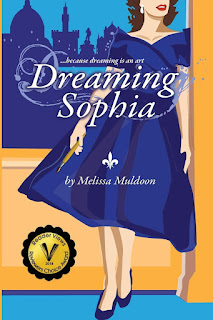
Weekly Reader: Dreaming Sophia by Melissa Muldoon; Muldoon's Work Is A Love Letter To Italy Itself And The Various Creative Souls That Lived There


Weekly Reader: Dreaming Sophia by Melissa Muldoon; Muldoon's Work Is A Love Letter To Italy Itself And The Various Creative Souls That Lived There

By Julie Sara Porter

Bookworm Reviews


Spoilers: Melissa Muldoon's Dreaming Sophia is the first of her Italy series, written in 2016. In some ways, it sets the stage for many of the books: a modern woman is drawn to Italy by a mysterious figure, a woman from Italy's Renaissance past and there is a connection between them. An outsider of the series is The Secret Life of Sofonisba Anguissola in that it tells of Anguissola's life with no detours into the present.

Another outsider is Dreaming Sophia. It carries the familiar trope of the modern woman meeting important historical figures from the past' but unlike Eternally Artemisia and Waking Isabella, Dreaming Sophia doesn't stop at just one brilliant figure. Instead Muldoon gives us several that appear before our protagonist to help guide her on her path to embrace a home in Italy.


Sophia, a young woman, is left alone and devastated after the deaths of her parents in a plane crash. Her mother studied in Italy in the 1960's even taking part in rescuing art and architecture from an approaching flood. She became one of Florence's Mud Angels. Also Sophia's mother's passion for Italian cinema like Federico Fellini, Marcello Mastroiani, and the breathtakingly lovely Sophia Loren caused her to name her daughter after the film actress. 

Sophia's father, a lawyer, also was fascinated by the country. He nicknamed his daughter, "Bella," Italian for beautiful. He bought property in Sonoma, California because he and his wife were fascinated by the Tuscan style architecture. The two transferred their love of the country so that after their deaths, Sophia holds onto that dream as a way to keep their memory alive.

At first Sophia takes small steps in her dream of living in Italy. She studies the language in university and becomes reacquainted with classic literature like The Divine Comedy. After a time of indecision and sadness, Sophia hears a voice encouraging her to dream. She knows to follow her dream and move to Italy.


During her life in Italy, Sophia receives assistance from various figures. Unlike the other books, she is inspired by several: Eleanora De Medici, Lorenzo "Il Magnifico" de Medici, Michelangelo Buonarroti, Leonardo Da Vinci , Lucrezia Borgia, General Giuseppe Garibaldi, Venus, Signor Brunelleschi, Casanova, and La Loren herself. It seems the spirit world all has their sights on this young woman and wants to guide her through all aspects of Italy, its history, its art, its architecture, it's mythology, and its entertainment. They give Sophia the whole picture of the country that she feels a close connection to, a place that she can call home.

The spiritual visits are magical and inspiring but also provide some humor. Sophia gets so used to them that when she visits Rome, she is surprised when she doesn't run into Caravaggio. 

A very metafictional moment involves the glamorous Sophia Loren, both as a spirit and a real woman. When Sophia encounters her in spirit form, she is her younger self when she starred in various films like Two Women and Marriage Italian Style. However, in a later chapter she sees the glamorous actress in the flesh and how she looks currently. (No word on what Loren herself thought of Muldoon inserting her into the book via a strange magical realism, age regression and progression.)


The book isn't as plot heavy as the other three. Sophia studies painting and obtains a rival. She falls in love with Lorenzo, a descendant of the Medici family. Most of the book explores Sophia living in Italy, getting to know every street and city, becoming familiar with the customs, and feeling a sense of belonging. She stays with a family that is very affectionate and curious about her. She begins to see them as a substitute family in absence of her parents. 

One of the best scenes involves her visiting a masquerade ball in Venice. The elaborate costumes, the somewhat sinister masks, the canals give a sense of mystery,magic, and intrigue especially when she encounters a various flirtation man who calls himself Casanova (of course considering her track record of meeting various figures, he might actually be the famous lover and spy.)


What stands out in Dreaming Sophia,, actually in all of Muldoon's books, is the setting. Italy becomes a character itself as the various people and places are lovingly detailed. They show Italy as a place of beauty and passion. For the protagonists in the books, Italy is a home.


Thursday, June 17, 2021

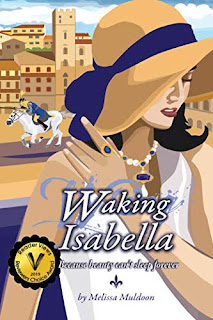
Weekly Reader: Waking Isabella by Melissa Muldoon; Muldoon is At It Again With Florentine Tribute To Isabella De Medici


Weekly Reader: Waking Isabella by Melissa Muldoon; Muldoon is At It Again With Florentine Tribute To Isabella De Medici

By Julie Sara Porter

Bookworm Reviews


Spoilers: Melissa Muldoon has given us a slightly fanciful historical fiction novel about portrait artist, Sofronisba Anguissola in The Secret Life of Sofonisba Anguissola. She has given us a journey through the centuries with portrait painter, Artemisia Gentileschi, who inspired her, and who followed in her footsteps with the novel, Eternally Artemisia. Her next volume, Waking Isabella, takes us into the life and legacy of another great woman of the Italian Renaissance. Only this time she is not so much an artist as she is a patron of the arts. In fact she is a member of one of the most famous artistic patron families in the Western world, Isabella de Medici.


Unlike the previous two books, Isabella de Medici is more talked about than shown. In fact, except for the prologue which captures Medici right at a moment of great betrayal and danger, we take no trips to the Renaissance era. Instead we are treated to two stories which use Medici as a connecting device. The first involves Nora, a jewelry designer and documentary filmmaker who is drawn to Italy and Medici herself. While filming, she falls in love with an Italian man named Luca and becomes embroiled in a mystery involving a ghost and a missing painting of Medici.

The other involves Margherita Lancini, a woman in 1941 who assists artist Frederico Donati with hiding some very valuable paintings, including Picasso's Guernica and of course a portrait of Isabella de Medici,the same one that Nora is looking for in the present.


Of the books in Muldoon's series, Waking Isabella is probably the weakest. However, it is the weakest in a very outstanding series so the weakness isn't very much. Like the others we get a brilliant look at a compelling Renaissance woman. Also since Isabella herself was not an artist, this allows the Reader to recognize that many could show their contribution to the art world even if they are not themselves artists. A patron of the arts is just as important as those that sculpt and paint.

We also see how important the Medicis were to Florentine society. Their contribution to the Renaissance was vast. They were friends and patrons of many artists, scientists, philosophers, writers, and political figures. Without the influence and guidance of the Medicis, much of what we know of the European Renaissance would have been lost.


In the brief chapters that we are shown Isabella in action, we are given a complex woman. She is filled with brilliant thoughts and a lot of passion. Despite being the Florentine equivalent of a superstar, Isabella is surrounded by enemies some because of her famous name and some by her own actions. One moment has her face to face with her soon to be assasin and she stands up to him with the wit and grace that a woman like her would possess. Isabella's brief chapter makes this Reader long for more of her.


The 1940's story is very well written as we meet Margherita and Frederico. Similar to the characters in Eternally Artemisia, these characters would preserve the arts from the flames of Nazis and Fascists even if they have to die for it. Margherita and Frederico understand that. That is how their bond is developed by sharing and appreciating the arts as well as hiding them from those who would destroy it. Despite the huge age difference, Margherita and Frederico develop a romance based on this shared interest and living in a time where emotions are at the forefront because any moment could be your last. Just like Isabella, they worked to preserve the arts so it can never be destroyed.


What isn't as interesting is the modern story. Nora is a  decent enough protagonist. The Reader gets an inside view on the work it takes to make a documentary by choosing the subject, framing it in an interesting way, finding and interviewing experts on the subject, and editing the film to fit the theme. Sometimes the filmmaker has to do it with very little budget or fanfare when they are completed.

Nora's search for Isabella's painting has some suspenseful moments such as when she thinks that she sees Isabella's ghost. There are also some Nancy Drew like clues where Nora searches for the painting in secret panels and hidden compartments.


What doesn't work as well is Nora's romance with Luca. He has a familial connection with the past stories, but it's not as explored as well as it should be. He also has a secret which eats up a lot of Nora's time when she should be working on her film or studying Isabella. In fact Luca's, past struggles takes a lot of time when he is behaving unnecessarily cryptic about it. When all is revealed, the big secret is extremely underwhelming.

There is one brilliant moment where Nora and Luca meet a pair of the lovers from one of Muldoon's other books. This suggests that the books are in a shared universe in which more than one Renaissance guide is in action to help these mortals find their way in the country shaped like a boot.


While Eternally Artemisia and The Secret Life of Sofonisba Anguissola are much better, Waking Isabella is also a brilliant tribute to the women of the Renaissance and how their legacy can still be felt today.

Monday, April 26, 2021

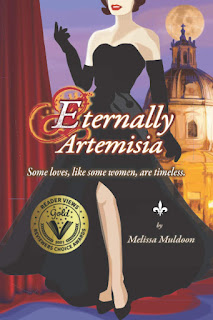
Weekly Reader: Eternally Artemisia by Melissa Muldoon; Beautiful Historical Fantasy About The Timeless Links Between Art, Romantic Love, and Female Friendship


  Weekly Reader: Eternally Artemisia by Melissa Muldoon; Beautiful Historical Fantasy About The Timeless Links Between Art, Romantic Love, and Female Friendship

By Julie Sara Porter

Bookworm Reviews


Spoilers: I have it. I figured out the solution.

Last year's literary themes were biker gangs, motorcycle clubs, and travels by motorcycle, multicultural teen superheroes, post apocalyptic dystopian science fiction and fact, and trips through Heaven and Hell with plenty of religious allegory. It makes sense, except for the travel by motorcycle bit, every one of these subjects in one way or another wanted to face the real life traumatic situations head on. 2020 was a dark year and we were looking for solutions even in fiction. 

This year the themes seem to want to get away from the darkness as much as possible. With Regency Romance and Epic Fantasy (not yet but five yes five Epic Fantasy reviews are on their way) there is an overwhelming urge to escape the darkness that surrounds us. This is also evident in one of the biggest themes that I have encountered this year: science fiction and fantasy featuring time travel and reincarnation starring friends and lovers who encounter each other who meet from different times or travel across oceans of time to find one another once more. 

These types of books offer the strongest escapism. After all, what better way to escape than to a seemingly simpler time or even better various times? (Never mind that those periods had similar problems or worse, as well but whatever, we are reading here!)

I have read Canvas of Time by Amelie Pimont, Rosemary for Remembrance by Nikki Broadwell, and Trapped in Time by Denise Daye all with similar themes. Now we can add Melissa Muldoon's Eternally Artemisia to that list. This book is one part fantasy about a woman discovering that she has shared a long link with Renaissance painter Artemisia Gentileschi, but also one part historical fiction about Gentileschi's life and the legacy that her art has inspired through the years.


For those that don't know, Artemisia Gentileschi was a portrait painter in Renaissance Italy. She was an exception to the rule of many talented but unsung women of her day in that she was taught to paint by her father, Orazio. She was also tutored by Agostinio Tassi. One day, Tassi raped her. Gentileschi was put through a very public and humiliating trial in which her body was observed. Tassi was found guilty and exiled but the damage was done as Gentileschi was seen as a fallen woman and damaged goods. She was also estranged from her father who cared more that Tassi had stolen a painting than the violence inflicted upon his daughter.

 She was then practically sold into marriage to Pierantonio Stiattesi, a fresco painter, for money. The two made their way to Florence where Gentileschi became the only female to be accepted to the Arts Academy in Florence. Even though she gave birth to a daughter, Palmira and two other children, her marriage to Pierantonio ended in a separation because of his jealousy of her talent and his infidelity.

Gentileschi was a student of Caravaggio in that her paintings often revealed shadows, dark colors, and violent scenes. Her two most well known portraits are based on stories of the Bible and many believe reflected her rage about the rape and the trial. The first, Susannah and the Elders, shows a young woman walking and being the subject of gossip by older men. 

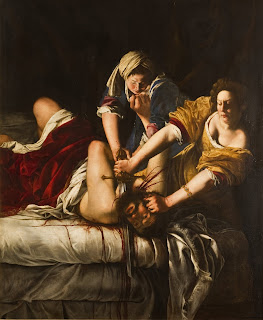
Her most famous painting is Judith Beheading Holofernes. This painting depicts Judith and her handmaid, Abra, holding the king down right as the Biblical heroine goes in for the kill. The blood around Holofernes' horrified visage and the looks of determination on the two women's faces speaks volumes.


For a straight historical fiction on Gentileschi's amazing life look no further than The Passion of Artemisia by Susan Vreeland which tells of her life from beginning, middle, and end. (It can be found as #7 in this Historical Fiction Novel list.) For a tale that is more wide reaching that is more than about Gentileschi herself, but is also about her legacy and how those who are drawn to her story are drawn to each other, then Muldoon's is the book for you. 

I am saying this because while Gentileschi is frequently discussed, her actual life experiences only cover a third of Eternally Artemisia. Instead it is her art and spirit that are shown through various lifetimes from the Bible, to the Renaissance, to the 1930's, to modern day, to the distant future.


The book begins with an introduction from Biblical days when Judith and Abra are standing over the drunk and sleeping Holofernes. They both are ready to commit violence in vengeance over the death of Judith's husband and many Israelites. The bond between Judith and Abra is clearly felt beyond mistress and servant as the two are forever united in this bloody moment which will be immortalized in art.


The moment between Judith and Abra is emphasized and recalled in the present with the experiences of Maddelena AKA Maddie, an art therapist. Maddie travels to Italy to get in touch with her roots and get some artistic inspiration. She flourishes in the Tuscan landscape by creating a circle of creative women that inspire and encourage one another and becomes romantically involved with Matteo, one of a very old established Italian family. Maddie falls in love not only with Matteo but the whole Florentine landscape like she knew him or had been there before. 

She also has a fascinating "woman-crush" on Gentileschi and begins to see Gentileschi's life through her eyes. She also gets visited by Gentileschi's spirit who advises her to take a real close look at the portrait of Judith Beheading Holofernes, and tell her what she sees. Maddie sees that Judith has Gentileschi's face and that Abra has her own. Yes, Gentileschi replies, she and Maddie have been friends practically sisters for centuries. Not only that but Maddie has shared multiple lives with Matteo. The rest of the book focuses on those other lives.


Like I said, since the book travels through time, Gentileschi's actual personal life is given a surprising short shrift. Only her time in Florence, her unhappy marriage, and the patronage of the Medicis towards her art are discussed. She also makes some equally talented friends in Michelangelo Buonarroti the Younger and Galileo Galilei. 

It is through these talented friends that Gentileschi encounters this version of Maddie and Matteo. In the Renaissance, Matteo is an astronomer fascinated by the studies of Galileo and Copernicus.

Maddie is a courtesan who is looking to soak up the local arts and cultural scenes. She even models for various paintings including (of course) Judith Beheading Holofernes.


The chapters are some of the best parts in the book because of the intricate plot and characters that are woven throughout. For those hoping that Tassi should get some retribution, it comes swift and clever. Gentileschi and Maddie give Gentileschi's rapist vengeance that hits him right where he deserves...right in the reputation.


Muldoon also gives much attention to how Maddie, Matteo, and Gentileschi flourish in their Renaissance environment. These are three people who are excited for the opportunities that the Renaissance provides for artists and scientists, particularly under the protectorate of Cosimo de Medici. Medici encourages great ideas even if, like Galileo's, they counter the church. They are allowed to flourish,  educate, and encourage others.  Unfortunately, that protection only lasts as long as Cosimo does. After he dies, the Archduchess and her priests go on a cleansing to get rid of ideas that they find offensive so the artists, scientists, and thinkers scatter. The Power Trio of Gentileschi, Matteo, and Maddie are separated only to reunite next time.


The second best section is in the 1930's which intersects the fictional incarnations of Maddie and Gentileschi with a real life pair. According to Muldoon's notes at the end, the 20th century version of Maddie is based on Elsa Schiaparelli, a fashion designer who was known for her eccentric styles such as elaborate embellishments on clothing and unusual accessories like shoe shaped hats. She was also known for her antifascist stance which she openly spoke against Hitler and Mussolini (in contrast to her frequent rival, Coco Chanel who cozied up to the Nazis. Their rivalry is played out in the juicy historical fiction, The Last Collection by Jeanne Mackin.).


 Gentileschi's counterpart, called Luciana, is based on Anna Banti who was the first to gather information on Gentileschi and write about her. Through Banti, we now know  Gentileschi's name. Without her preservation of her art and research into her life, Gentileschi might have been one of those women hidden by history that Virginia Woolf spoke about. It is wonderful that Muldoon paid tribute not only to the artist, but the woman who gave her a second posthumous life. Like all researchers, Luciana protects her research with her life. When Mussolini comes in, she makes sure when she leaves that her research either comes with or is expertly hidden.


As the Schiaparelli stand-in, Maddie also shines as does her husband, the latest Matteo. One of the more interesting moments when she is told that someone is interested in her pantsuit and is looking to revitalize her look for her Hollywood image. Into her shop strolls Katharine Hepburn. This moment links the arts of painting, fashion, and cinema in one continuous cycle. Maddie is naturally incensed when the strict fascist rule deprives women of many of their rights including running their own business. The more Maddie and Matteo remain in Italy the more dangerous their life becomes, particularly when they are at a party that is also attended by Mussolini and Maddie literally finds herself dancing with the devil. 


There is a brief epilogue where Maddie, called Lena, is in the future and arrives at a space station named Artemisia (of course) and meets another astronaut named Matt (also of course.) Like many books that explore reincarnation, bodies may die but souls remain and the things that capture our souls: art, history, literature, science, memories, families, friendships, and all of those things are what are preserved and continue.