Showing posts with label Historical Mysteries. Show all posts

Thursday, August 28, 2025

A Deadly Promise (A Dr. Margaret Demery Book) by Paula Harmon; Brilliant Protagonist Outshines Convoluted Plot


A Deadly Promise (A Dr. Margaret Demery Book) by Paula Harmon; Brilliant Protagonist Outshines Convoluted Plot

By Julie Sara Porter 

Bookworm Reviews 

Spoilers: Sometimes the plot is the best part of a mystery. Sometimes it's the murder victim, the suspect, or even the murderer. Other times, such as in the case with A Deadly Promise, a volume in Paula Harmon’s Dr. Margaret Demery series, it's the lead protagonist. In fact, the protagonist in this book is such a memorable character that she is easily the best part of an at times confusing and convoluted mystery.

In 1914, Amos Chalkley, a young man, dies shortly after pathologist Dr. Margaret Demery gives him directions to the War Office. It seems to be a robbery gone wrong, but Margaret doesn't think so especially after another man, Luther Byrd, dies close by in a similar manner. They both have similar symptoms of some unknown contagion. Margaret and her husband, intelligence operative, Inspector Fox Foxcroft investigate while there is talk of rebellion in Ireland and predictions of a great world war especially after Astro-Hungarian Archduke Franz Ferdinand and his wife, Sophie are assassinated.

Let's start with the good stuff. Dr. Margaret Demery is the type of independent strong willed female detective that occurs often in Historical Mysteries and with good reason. Not only are they often excellent detectives with adept observation skills, empathetic understanding of the people involved, and plucky persistent spirits that pursue justice to the end, but Readers get to see what life was like for women of that era.

 In many times, women were suppressed, marginalized, either treated as fragile objects or constant workhorses, and raised to be wives and mothers and that's it. These protagonists often counter these assumptions. Some have careers of their own or are independently wealthy. Even if they take traditional paths and don't earn a living as investigators, they are able to use those skills as amateurs. The approach that these authors take are often intentionally subversive, even Feminist, in how their protagonists are written.

That is especially noticeable with Dr. Margaret Demery. She is a respected pathologist in a time period when female doctors existed but were still held under intense scrutiny and suspicion. Pathology was not looked upon as a suitable field for women as it was believed that women were too fragile and vulnerable to look at and investigate a dead body but Margaret shows that she has the stomach for it. She also works with living patients as well and uses her studies in respiratory illnesses to deduce short and long term complications.

The book explores the rampant misogyny and sexism that is not only personally experienced by Margaret herself but by other women. One of the most intense chapters involves a suffrage march which quickly becomes violent. Even before the violence occurs, the marchers are insulted and mocked by men in the crowd. Some women say that they sneaked out or had to get their husband's permission to march. Even though Margaret is happily married to a man who is empathetic to their cause, her husband, Fox reads her the riot act for being involved in a potentially dangerous situation. His concern is duly noted but he can't resist infantilizing his wife and chastising her like a child incapable of her own agency.

A very important lead that occurs in the book is the institutionalization of Iris Byrd, the wife of Luther one of the murder victims. She was institutionalized by her husband before his death after a domestic dispute. It shows that many people in that time period could have someone committed to a mental hospital for the flimsiest reasons including arguing with family members. Some men, like Luther, and we later learn another character, did this to wives and female relatives as a display of dominance if they felt that they stepped out of line or defied authority. This is the kind of world which Margaret has to navigate through to learn the killer’s identity.

When the book focuses on Margaret's individual investigation in the central murders, the book succeeds. However, it falters when combining it with the larger international picture. There are various characters and situations thrown in that represent different topics of the time such as the Irish Rebellion and WWI, some of which only have a peripheral involvement in the actual murders. There is the reappearance of a former enemy of Fox’s whose involvement with this plot only makes things more confusing. Then there are the obligatory red herrings, false leads, and betrayals which only hinder the investigation and it becomes hard to remember who is who, what their motives were, and what they had to do with the central mystery. 

It seems as though Harmon had too many ideas for this volume. Instead of focusing on one specific plot angle, she threw them all in. The results are an overwhelming Mystery which contains far too many subjects to create a streamlined focused mystery. 

Sometimes that's a good approach to focus on both the political and personal struggles particularly in an important historical time period like the days before WWI, but they need to be evenly balanced instead of thrown together. It needs to deliver a case where this point and that point lead to a specific conclusion rather than create a situation where it is hard to remember who is who. 

A Deadly Promise is not a terrible historical mystery so much as one with great potential especially with its lead character. Margaret is definitely the brightest spot in this book that needs more focus.

Saturday, July 11, 2020

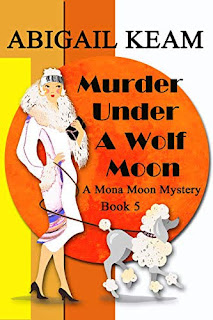
New Book Alert: Murder Under A Wolf Moon (A Mona Moon Mystery Book 5) by Abigail Keam; 1930's Historical Mystery Shines With Fun Feminist Lead


New Book Alert: Murder Under a Wolf Moon (A Mona Moon Mystery Book 5) by Abigail Keam; 1930's Historical Mystery Shines With Fun Feminist Lead

By Julie Sara Porter

Bookworm Reviews


Spoilers: When people ask me where are the novels with strong female leads, I always say "Look no further than murder mysteries especially historical mysteries." The genre is filled with a bevy of strong willed independent women, especially who live in times where they weren't encouraged to be such, facing dead bodies, odious killers, and sometimes a disapproving society to solve the murder, discover the truth, and obtain justice. Such examples include Peter Tremayne's Sister Fidelma, Marilyn Todd's Claudia Seferius, Margaret Frazier's Dame Frevysse, Alissa Cole's Elle Burns, Victoria Thompson's Sarah Brandt, Elizabeth Peters's Amelia Peabody, Tasha Alexander's Lady Emily Ashton, Rhys Bowen's Molly Murphy and Georgie Eugenie, Radha Vatsal's Kitty Weeks, Sujata Massey's Perveen Mistry, Kerry Greenwood's Phrynne Fisher, Rebecca Cantrell's Hannah Vogel, and Alison Montclair's Iris Sparks and Gwendolyn Bainbridge.


Another addition to this illustrious sisterhood is Abigail Keam's Mona Moon. This feisty protagonist is a former cartographer turned businesswoman in 1930's Kentucky. In previous volumes, she inherited her late uncle's fortune, estate, and business. Despite the Great Depression looming, she has become extraordinarily wealthy but that doesn't stop her from being surrounded by suspicion and murder. Many question her actions because she is a transplanted New Yorker and a woman at that. Most men don't think that she is capable of running her uncle's affairs. People also question her friendships and trusted working relationships with black people. In the deep South, that's a no no.

Mona has a strong business sense, an open mindedness, and independent spirit. All of which captures the interest of Lord Robert Farley, an Englishman and spy. The two are engaged and are deeply in love, but Mona is uncertain if she wants to make their relationship permanent.

All of these aspects to her personality make Mona something of an outsider. They also make her empathetic to the problems of other outsiders, especially in the latest volume Murder Under A Wolf Moon. One of whom is Elspeth Neferet Alden Hopper, wife of Cornelius "Connie" Vanderbilt Hopper, a formerly wealthy man fallen on hard times. In fact, Elspeth's money is what returns Connie to social prominence. Elspeth captures Mona's interest because of her fascination with the archaeological career of Elspeth's father, John. She also witnesses Elspeth sobbing in a private moment and little by little gets the details of her unhappy marriage with a verbally abusive controlling husband, racist remarks from others for being half-Egyptian, and death threats that are sent through the mail.

The death threats arouse Mona's curiosity and protective nature. She recruits African-American private investigator, Jellybean Martin to go undercover at the Hopper home and watch out for Elspeth. Jellybean no sooner arrives when Beulah, Elspeth's maid, turns up dead. Jellybean reports the news before disappearing. ("When there's a dead body, the new black man is always the first suspect," he says before Mona helps him evade the racist police and lynch mob that eagerly await him.) It doesn't take much sleuthing before the police trace Jellybean's sudden arrival to Mona's referral and she too ends up a suspect.


The mystery is pretty good as the clues lead to up to inevitable conclusions. Mona receives assistance from her allies such as Jellybean, Mona's maid, Violet, and her personal secretary, Dottie. Some aggravating suspects appear such as Connie's dilletante son, Wally and his horrible sister, Consuelo that further complicate things. Mona also discovers that one of her friends has a closer connection to the Hopper family as initially believed. If the resolution of the murder and the motives behind it are a bit obvious and predictable, at least the means are enough of a twist to throw the Reader off kilter.


What really makes this book as with any good mystery is the lead detective. Mona has a lot of spunk and energy such as when she tells off the local sheriff and boasts that she "just bullied a bully." She also has an extensive knowledge on anything from Egyptian artifacts to civil law which help assist her in her investigation. Many women can relate to her independent spirit and her concerns about choosing a family or career. As much as she loves Robert, she is uncertain whether marriage would cause her to lose her independence. She is a woman not only of her time but any time.

Like her last name, Mona Moon makes her series shine with brilliance. She is one of many great female historical mystery female protagonists that are worth reading about. It is a legacy of which she, and in turn her author, are proud members.


Thursday, June 4, 2020

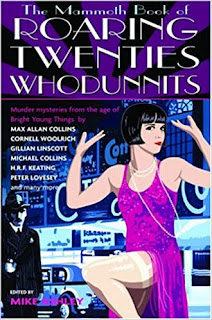
Weekly Reader: The Mammoth Book of Roaring Twenties Whodunnits Edited by Mike Ashley; Jazz Age Mysteries Shine In This Colorful Fascinating Anthology


Weekly Reader: The Mammoth Book of Roaring Twenties Whodunnits Edited by Mike Ashley; Jazz Age Mysteries Shine In This Colorful Fascinating Anthology
By Julie Sara Porter
Bookworm Reviews

PopSugar Reading Challenge: A book set in the 1920's

Spoilers: The 1920's. The Jazz Age. The Bright Young Things. The Lost Generation. This fascinating wild decade conjurs up images of free spirited flappers, smooth, but violent gangsters, jazz music, Prohibition, the Charleston, and noted celebrities like Calvin Coolidge, Charles Lindbergh, Al Capone, Rudolf Valentino, Babe Ruth, Clara Bow, and Charlie Chaplin. Authors like Ernest Hemingway, F. Scott Fitzgerald, James Joyce, Gertrude Stein, T.S. Eliot, Langston Hughes, and Dorothy Parker explored new frank ways of writing that captured the violence, sexuality, and free expression this time allowed. The world of murder mysteries also had its big names. British authors, Agatha Christie and Dorothy Sayers, gave the world their genteel cultured sleuths Christie's Miss Jane Marple and Hercule Poirot and Sayers' Lord Peter Wimsey. In America, The Black Mask literary magazine made its debut and introduced those hard boiled detective genre authors,  Dashiel Hammett and Raymond Chandler. The 1920's were a fascinating decade and one that demands to be explored. 

The Mammoth Books are a series of anthologies which explored various literary genres. They produced some of the best collections of historical mysteries, featuring mysteries set in different time periods. One of these anthologies explores the 1920's in depth with The Mammoth Book of Roaring Twenties Whodunnits. It is a fascinating collection of short stories featuring some of the most exciting murder mysteries, clever sleuths, and fascinating murderers set in this colorful time.

Among the best stories in this anthology are:

"Timor Mortis" by Annette Meyers
The 1920's saw a resurgence in women's independence. Women were granted the right to vote in 1920 and many young women celebrated their freedom in other ways. Many bobbed their hair, wore short A-line skirts, smoked in public, talked openly about sex, and finally got rid of the restraining corsets. They were able to live independently and earn their own money without worrying about marriage. 
Annette Meyers explores that freedom with her protagonist, Olivia "Oliver" Brown, a poet/private investigator who lives in Greenwich Village, among the other artists, writers, and activists. She lives a colorful life with some eccentric friends so when she encounters death, it is bound not to be in a conventional way. She is recruited to look for a friend's missing cousin at the same time as the local masquerade ball. During the ball, Death makes a guest appearance as one of the party goers is stabbed to death while the party goer is dressed in multi-colored feathers and rides on the back of a white stallion. 
Aside from the unique crime scene, the mystery itself is solid with enough clues to point to an obvious finish. What makes this story, however, is its lead character. Oliver is a free spirited independent woman who has an artistic outlook and a very observant eye. She is the embodiment of the 1920's New Woman who lives for herself and her own goals.

"Someone" by Michael Collins
Underneath all of the glitz and glamor, the 1920's had a dark side. It was the time of Prohibition and the gangsters. While many of them such as Al Capone, Bugsy Siegel, and Meyer Lansky achieved antiheroic status and many thought of them as smooth, charming, goodfellas, in truth they were a violent bloodthirsty bunch. 
Michael Collins explored the past of his regular protagonist, Dan Fortune in this short story. Fortune remembers his father, Casey, a police officer who tried to have an honest career. However, honesty means very little when he makes some dangerous acquaintances such as corrupt New York Mayor, Jimmie Walker, Bobby Astor, the so-called "black sheep" of the wealthy family, and mobsters, Owney Madden and Arnold Rothstein. (Rothstein is particularly infamous for being one of the men who fixed the 1919 World Series by bribing eight players in the Chicago White Sox to throw the series, hence the Black Sox Scandal.) 
Casey Fortune becomes mired in his acquaintances' duplicitous dealings and realizes that he can't keep his head above the crime around him. His allegiances and the brutal crimes in which he witnesses consume him and destroys his family forever.
While technically, there isn't a specific mystery, this story shows how a life of crime can affect a family for generations to come and how Innocents can fall because of the actions of the guilty.

"Thoroughly Modern Millinery" by Marilyn Todd
One of the things that I like the most about The Mammoth Historical Whodunnits is that I discover new authors and characters. Many like Peter Tremayne's Sister Fidelma, Steven Saylor's Gordianus The Finder, and Margaret Frazier's Dame Frevysse have become favorite detectives of mine. Another favorite is Claudia Serferus, the saucy Roman noblewoman/amateur detective of Marilyn Todd's I Claudia mystery series. 
In this story, Todd creates another interesting female detective this time for the Jazz Age: Phyllis "Fizzy" Potter, a freelance magazine illustrator with a sense of justice. While names like Fizzy, Bubbles, Squiffy, and Catspaw suggests a lighthearted P.G. Wodehouse-esque comedy, this story can be as dark and grim as the rest. The plot focuses on blackmail, drug addiction, and the lengths people will go to protect family members and keep secrets. There is also a theme of Abstract Art, the popular art trend in the 1920's which allowed artists to express themselves in more outlandish and emotional ways than the concrete clear examples of the past.

"The Hope of the World" by Mat Coward
The 1920's was also a time of great revolt. After the Russian Revolution began in 1917, many in the United States and Great Britain were terrified that the same thing would happen in their countries. Labor Unions went on strike and many activists embraced Socialistic principles. This is the milieu of the story, " The Hope of the World" by Mat Coward.
This story plays on the familiar mystery trope of the dinner party murder in which a party, usually in Britain, is rudely interrupted by the death of one of its members. Of course, anyone could be a suspect. In this case, most of the party guests are Communists and Socialists. While the constant addresses of "Comrade This" and "Comrade That" can be confusing, the story reveals why many of these people looked to these philosophies. Many were disillusioned after WWI. Others saw income inequality and sought to change it. Others saw better opportunities for women. This was a group that may have had a common goal but were also suspicious and mistrustful and with good reason. They were often held under suspicion by authorities. This revolutionary zeal and mistrust is the perfect brew for violence and sure enough in this story, it happens.

"The Broadcast Murder" by Grenville Robbins
Technology saw a massive upswing in the 1920's. Automobiles became mass produced. While airplanes had been in use since before WWI, Charles Lindbergh's trip across the Atlantic Ocean showed what those flying machines were really capable of. Another popular technological source was the radio.
In Greenville Robbins' "The Broadcast Murder" (one of the few short stories in this anthology that was published in the 1920's), the radio becomes not only a source of news, shows, and music, it is also a source for murder. In a play on the locked room mystery, Charles Tremayne, radio announcer, is murdered live on air in his broadcasting booth with hundreds of listeners hearing his final words. The premise is intriguing as the narrator wades through the potential leads. The solution is also pretty clever as it plays on what people think they hear and don't hear as well as what goes on behind the scenes when the radio is on.

"For The Benefit of Mr. Means" by Christine Matthews
One of the most infamous Hollywood scandals was the 1921 murder of actress, Virginia Rappe. The prime suspect was movie comedian, Roscoe "Fatty" Arbuckle. Arbuckle was found not guilty, but the court of public opinion ruined his career forever. 
In this reimagining of Arbuckle's post movie career, he teams up with another scandal maker, Gaston Bullock Means, an author who wrote an expose called The President's Daughter. Arbuckle and Means solve a murder at a party attended by some very familiar faces.
While the mystery is excellent and Means and Arbuckle make a great detective duo redeeming their names in pursuit of justice, the real highlights are the dizzying array of real person cameos. Matthews fills her story with such notables as F. Scott and Zelda Fitzgerald, Dorothy Parker, W.C. Fields, Bing Crosby, and Ramon Navarro. These characters bicker, chatter, and  bounce off each other cleverly and the notable names put Jay Gatsby's parties to shame.

"I'll Never Play Detective Again" by Cornell Woolrich
One of the darkest real life crimes in the 1920's was the murder of 14 year old Bobby Frank by two young men, Richard Loeb and Nathan Leopold. What was most disturbing about this case was the motive behind the murder. The two men killed the boy simply to prove that they could do it, to show people that they thought that they were above such concepts as legality and morality.
The Leopold-Loeb Case was certainly the inspiration for this disturbing tale. At an engagement party for his friends, Dick Walsh, a wealthy young New Yorker investigates the death of the bride's kid sister when the girl succumbs to a poisoned flower. Dick finds himself discovering some troubling things about the bride and groom, people he thought that he knew for years.
The resolution is terrifying as Dick is forced to confront someone with a truly evil heart and intent that goes beyond cold blooded murder. The ending to this story makes this not only the most disturbing story in Roaring Twenties Whodunnits, but among the darkest and most disturbing short stories of the entire Mammoth Book Anthologies.