Showing posts with label Terrorism. Show all posts

Sunday, May 11, 2025

Con and Consequence by Ian Rodney Lazarus; A Simple Cybercrime Leads To Bigger Terrorism


Con and Consequence  by Ian Rodney Lazarus; A Simple Cybercrime Leads To Bigger Terrorism 

By Julie Sara Porter 

Bookworm Reviews 

Spoilers: Who would have thought that a simple cybercrime/con job would lead to a terrorist attack that will create generations of hardship and war between Palestine and Israel?

That is the premise that faces various characters in several countries and two continents in Ian Rodney Lazarus’s Con and Consequence, a suspenseful, tightly plotted, but wide spread Thriller.

The eponymous con artist is Jelani, a Somali genius who is using his vast intellect to create fake crowdfunding sites to draw in potential investors while operating as a ghost on the Web. Not exactly legit but cunning, non violent, and gives him and his family some much needed money. However, this scheme reaches Muhammad Amir Abbas who recruits Jelani to join his organization which has a plan for much deadlier consequences and to stick it to various enemies notably the United States and Israel. 

Meanwhile, Richard O'Brien, a linguist for the FBI intercepts a message that hints at a major terrorist attack in three days time. This investigation soon involves various terrorist organizations, the FBI, CIA, Mossad, the US, Palestinian, and Israeli governments, the Muslim population of Dearborn, Michigan, and O’Brien’s college age brother and girlfriend.

Lazarus does an excellent job of taking all of these various characters, settings, and plot points and tying them neatly together to make a comprehensible and perspicuous plot. The action starts small but leads to widespread complications that can lead to long term consequences for years and even decades afterwards.

This book focuses on various characters but the most interesting are three: O’Brien, Jelani, and an enigmatic character named The Professor who will be mentioned later. They form a triangle that takes the Reader through the various angles in the narrative and personalizes them. 

O’Brien is an anti-hero made for this type of story. Though he works with the FBI, he is himself not an agent so his pursuits are a more scholarly and communicative nature. This particular case puts him up front and center doing the leg work that his colleagues do. 

O’Brien has a very close Irish Catholic family with whom he loves but comes to disagree with, particularly about his job which causes his parents to worry. He is also tight with his brother, Myles who is a well meaning but immature goofball who accidentally stumbles upon the case himself. What starts out to be a funny and contrived coincidence becomes darker as Myles gets closer to his brother's career than he more than likely intended. 

O’Brien’s romantic history is held under scrutiny. He ignores the calls of a former girlfriend until realizing too heartbreakingly late why she called. This subplot and another in which he has a flirtation with a female agent show him as the type of man who is inept in his personal life but adept at his work. His personal life is one of failed relationships and few close connections outside of his immediate family so he devotes his time to his job. He embraces the adrenaline thrills and larger picture of preserving democracy because that's all that he has.

 It's a chaotic existence but it's one that O’Brien can use his linguistic skills and intellect to play an important part to the world at large. It's hard to focus on a personal life with romance, relationships, and daily tasks when one is constantly aware that  terrorist organizations are plotting to commit major fatalities half a world away.

Jelani represents those who join such organizations and live lives of crime. For Jelani, it's a matter of having a lot of brain, feeling like an outsider and not having much money or opportunity. We learn that Jelani has a high IQ and was recently diagnosed with being on the Autism spectrum. Since his diagnosis was as an adult and he doesn't have access to many resources that help him, he has many of the disorder’s symptoms such as memorization, intense fixations on his favorite subjects, discomfort in public places, and sensitivity to sensory triggers. 

Jelani has difficulties functioning, is arrogant about his abilities, lives in abject poverty, and is susceptible to suggestion. Of course he's the perfect target for those who are looking for angry, arrogant, young people with axes to grind, simmering hatred for their situation, and are ready to commit desperate acts for it. 

However, Jelani seriously underestimates the situation that he is in. His fatal flaw is arrogance. He thinks that because he has this online scheme and a genius level IQ, he is ahead of everyone else but he fails to realize that when his superiors are fighting a war in which fatalities, terror, carnage, assault, and violence are to be expected, no one cares about his money making scheme. In fact, compared to their activities, his con job is the equivalent of a Yorkie puppy nipping at the heels of a wolf pack trying to prove that he can be the alpha head. 

To Jelani’s credit, once he becomes aware of the full implication of his new organization’s  crimes, he does what he can to separate himself from them. Hey, he may rob people of their money but he still has a conscience. He might be a genius in academics but an idiot in common sense but he has some standards. One of them is not to commit countless violence towards random citizens to make a point that will only get worse because of the escalation of said violence. 

By far the most interesting enigmatic character is someone called The Professor. Not too much can be revealed in the review because of spoilers. Let's just say they are a cypher, someone who excels in hiding in the shadows.

They have a variety of pseudonyms and identities that are used periodically throughout the book, so characters and Readers are uncertain where The Professor’s real standards and allegiances lie. In one chapter, The Professor guides Jelani. In another, they work as a Mossad spy. You go through the book thinking one thing about them, then turn around and think something else. Then the final pages reveal a final twist that could either clarify or further muddy The Professor's personal truth. 

In fact the final reveal causes the Reader to look at the character and their actions differently. It also causes one to question the extremity of their motives and the means to achieve them. It makes one wonder if they were really sincere in committing their actions for their country or people or just for themselves. When a person manipulates that many people on various sides, and intentionally causes more destruction, do their real motives matter? 

Con and Consequence may start as a simple con job but ultimately that job like any other action eventually has consequences.




Sunday, August 25, 2024

Scars of The Heart by Bob Van Laerhoven; Around the World Trip Into Loss, Grief, Love, and Terror


 Scars of The Heart: Short Stories by Bob Van Laerhoven; Around the World Trip Into Loss, Grief, Love, and Terror

By Julie Sara Porter

Bookworm Reviews


Bob Van Laerhoven knows how to take an around the world trip through different countries right into the dark and damaged hearts and minds of the people who live within those countries. Alejandro’s Lie focused on the aftermath of a dictator’s reign in a fictional Latin American country and the effect on its people, particularly a man who was just released from prison and has PTSD. 

His follow up, Shadow of the Mole is a dual narrative set in WWI France involving a psychiatrist's obsession with an amnesiac patient and the patient’s manuscript which might be a novel or his memories of being cursed by a Romany couple. 

With his anthology, Scars of the Heart: Short Stories, Van Laerhoven does what he does best: peer into the tormented minds and heavy hearts of people in different interesting locations. It is less an around the world trip than it is an “around the human psyche” trip.


The best stories in this anthology are: 

“The Abomination”- In Syria, the narrator is part of a terrorist cell called the Shabah. As he languishes in a Doctors Without Borders facility with an amputated arm, he thinks about his life and what he did to get to that point. 

The Narrator is written to be a truly delusional and angry man. He sees himself as a wrestler or a superhero that he calls The Abomination. His fantasies about fictional heroes and villains, toxic masculine attitude, and confidence in his virility fill his mind with delusions. 

While in the hospital, he is faced with the reality of his actions. It is a reality of broken and injured people, dead bodies, friends and family members violently taken away from their loved ones, a country torn apart by war and hatred, and his own damaged body. His missing arm is a testament to the lives that he took.

Unfortunately, reality comes too late for The Narrator. His violent fantasies are all that he lives for and even when someone reaches out in kindness and compassion, all he knows is rage. All he can feel is anger and toxic pride. The only way that he can act is to commit destruction towards others and ultimately himself.

“Scars of the Heart”- In Belgium, a photojournalist is captivated by Jean-Claude, an octogenarian who tells his life story of being a soldier in Algiers. Jean-Claude recalls his colleague Bisserund who participated in a mission that ended in betrayal. 

Most of the story is a character study of Jean-Claude and his memories of Bisserund. He recalls details about his appearance, personality, and their experiences. It shows that in stressful times, particularly war, friendships develop. Sometimes the people that we encountered during those times are more vivid to us than our own family members. 

The twist in the end offers some interesting reinterpretations of the narrative, particularly Jean-Claude’s voice. It forces the Reader to reflect on what we were told about Jean-Claude and Bisserund. How much of it was real and how much did Jean-Claude make up? How much were his actual memories or how he wanted those memories to be? What about his confession? Why did he feel the need to tell the Photojournalist? Was there a connection between him and Bisserund like Jean-Claude hinted? Were guilt, remorse, illness, or fear of getting caught the reasons behind his end? 

In the end, we are given so much but at the same time not enough. This leaves us to investigate Jean-Claude’s story in our own minds and make our own interpretations about what we were told and what was revealed.

“The Bogeyman and Regina The Street Wench”-In Liberia, a reporter nicknamed the Bogeyman is covering the war torn city of Monrovia. He takes shelter with a nun, Sister Sponza, who is trying to escape with the children in her care. One of them is Regina, a girl who has lost her leg and seems to see right through the Bogeyman.

This story shows how stressful times can make strange friendships. The Bogeyman, Regina, and Sister Sponza are thrown together during violent circumstances. They come to depend on one another to survive. A cynical reporter, a selfless nun, and a former child soldier would have very little need to be together, but now here they are. 

This is also a time of sacrifice and asking questions of oneself and others. Some people rise to the occasion while others do not. Sister Sponza asks a question of The Bogeyman which leaves him to question his motives, the corners that he cut in the past, his earlier plagiarism, and his own egocentric desires to make something of himself. 

The Bogeyman has to examine himself to see whether he has the courage and fortitude to do what Sister Sponza asks or whether this will be the latest in his catalog of disappointments.  

“Abducted and Raped by Aliens”-In New York, failed author, Penman reflects on his ongoing rivalry with Stanislas Nakowski, a fellow writer who has an active sex life and writes about UFOs and alien abductions.

This story has one of the most memorable narrative voices with Penman’s third person point of view. His strange speech patterns like repeating the phrase “looky-looky” or non sequiturs like “this wet and slimy cold invading my nostrils is the swamp-stench of animal sex, eternal sex, war sex” portray him as someone who potentially shows signs of ADHD, or some neurological disorder. 

Penman's thought process could be someone who has difficulties processing information either from birth or trauma. It is also worth noting that he is addicted to cocaine and that may play into his mindset. His thoughts could just as easily be reflective of a mind that is slowly losing connections to reality.  

Stanislas himself is a memorable foil to Penman’s narration. He not only believes and writes about UFOs but he seems obsessed with them, almost aroused by them. A witness's story of an abduction is often interrupted by Stanislas’ lewd commentary and his interest in the witness’ sex life. 

He also had prior history of sexual assault in Kosovo when he and Penman’s paths crossed before. He is fueled by his sexual experiences and many of them either had violence during or afterwards. Stanislas equates sex, violence, and aliens in some crazed fantasy life.

With Penman and Stanislas we are experiencing two men whose minds are traumatized and fractured from earlier events. Both are completely unstable, unhealthy, and are bound to lives of further alienation, frustrations, violence, rage, and death.

“Lilies of The Valley”-In a WWII concentration camp, a Romany girl cares for her brother and ensures their survival by having sex with the guards. 

The Narrator is a resourceful young woman who is brought down to the most basic survival instincts and she knows it too. She was once a talented dancer and her brother an accomplished violinist but none of that matters now in the camps. 

She only uses her talents to be granted favors such as extra food or to live another day. Her morality and self-respect have long ago disappeared and now she is numb and unfeeling to what the guards do to her. The Nazis took everything that was precious to her leaving a broken shell.

Just when the Narrator thinks that she is devoid of all feelings beyond living for the next day, she is given a final tragedy, one that fills her heart and mind with rage. She uses her beauty and mind to engage in a one on one battle against one of the guards and others.

The Narrator becomes a blade of revenge and uses it against those who hurt her. As though she were the human embodiment of karma, she commits an act of vengeance that is equal to the cruelty that was inflicted upon her. 

“The Left-Handed Path of Tantra”-In 1970’s Antwerp, Johnny Di Machio had plenty of nightmares, particularly about a time when he was sexually assaulted as a boy. 

Johnny tries to live a normal life in Antwerp selling books and dating women, but he is completely haunted by these nightmares. His past eats away at him making him unable to function in the present. He has tried many means to overcome his trauma: sex, drugs, travel, meditation, seeking advice from psychologists and gurus. 

Johnny comes close to becoming romantically involved but he freezes upon intimacy. The nightmares and memories won’t leave. Johnny is an adult whose mind is frozen inside his bitter abused violent childhood. 

When Johnny is finally confronted with his memories, he has to evaluate his character: what happened, what he did, what he didn’t do, who was the perpetrator, and who was the real victim in the past. He is confronted with the truth and only when he has the truth can he actually begin to come to terms with himself and finally heal.


Thursday, January 14, 2021

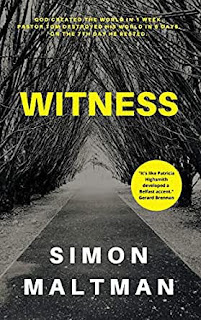
New Book Alert: Witness by Simon Maltman; Character Driven Suspense Thriller About Past Crimes and Sins


New Book Alert: Witness by Simon Maltman; Character Driven Suspense Thriller About Past Crimes and Sins

By Julie Sara Porter

Bookworm Reviews


Spoilers: Witness, Simon Maltman's suspense thriller, shows in graphic detail the proverbial Road to Hell along with the Good Intentions in which said road is paved.


Witness is a tense, edgy, but also character driven novel about Pastor Tom Carter, a Belfast-based minister with the International Church of Tertulian's Trinity (ICOTT). When he was a young man, he was a part of terrorist organizations. However, he has put that all behind him. He is a popular man of the cloth with a large following. He is happily married to Cherry and the father of an adorable daughter, Becky. He even has some far reaching plans to build a youth center that would help street kids, like he used to be, get a new start in life. He just needs some extra money to help build the center.

In a desperate attempt to get that money, Tom appeals to "Uncle" Paul, an old family friend and fellow former terrorist. Well Paul isn't as former as he appears. Even though he had been released from prison, he still has a toe in the old world as Tom learns. Paul says he will hand over the cash if Tom does him a favor.

Meanwhile, there is an extended kidnapping plot in which an unnamed family is abducted by two ruthless kidnappers. At first this subplot is suspenseful but appears unrelated to the main plot until we later learn who the players actually are and how they are linked to the rest of the story.


Maltman captures a Northern Ireland that is still struggling to recover from the violence that played into almost 100 years of their history. While on paper, tensions have cooled down and laws have been set to improve relations between Protestant and Catholic factions, the human heart corroded by decades of hatred is not always so easily swayed. Many of the characters are still caught up in their prejudices and lust for violence and people like Paul love to play into that. 


Paul is like a mob boss knowing others' weaknesses and using them against them. In his conversations with Tom, Paul is like a chess master playing against a new opponent. There are subtle suggestions that his allegiances to his former ways have less to do with national pride than they do with controlling his enemies and quenching a sadistic pleasure for blood. Tom is just one of many that he likes to control and force them to do exactly what he wants.


Tom is also a fascinating character. Unlike many religious figures in fiction, he sincerely practices his faith and wants to live a good life. He does everything that he can to repair the damage that he was instrumental in causing in his youth.

However, when Tom encounters Paul, he realizes that the more he tried to run from his past, the more it catches up to him. It is all too easy for him to be seduced back into that life because those feelings were still there. He tried to be a good faith driven person to hide what had been inside all along.


Once Tom follows Paul, his actions interfere with the rest of his life. He becomes a man easily swayed by darker impulses that were simply buried and just waiting to come out. He has an affair with a barmaid and the guilt eats away at his marriage to Cherry. He blackmails a fellow pastor with pederastic tendencies when he gets too close to the church's financial transactions and the sudden generous donation. While Tom still suffers from intense guilt, he goes along with these actions almost like an addict who can no longer stop himself.


The title Witness refers to a crime that Tom saw when he was a child that he had buried, but had changed his life forever. He is also a witness to his own self destruction as the good man that he tried to be is swallowed by the man he once was. He is helpless to stop his own transition into villainy until the end when he finds a way to stand up to Paul and go from the witness to the actor.