Showing posts with label Nobility. Show all posts

Sunday, August 2, 2026

The Last Wildspeaker by Ivy Rowan, The Weight of Sunshine by Robin Maguire, The North Doesn't Speak by Clifton Wilcox, and A Duchess With a Secret by Alix Nichols


The Last Wildspeaker by Ivy Rowan 

The Last Wildspeaker is a beguiling YA Fantasy novella with a meaningful subtext about preserving and respecting nature and the environment.


In the village of Brindlewood, Mara Fern can understand animals. While that used to be considered a gift, now it's considered unlucky and could be grounds for accusations of witchcraft. Mara is told to ignore animals’ conversations and to live as normally as possible. This normal front is tested when nature has decided that it will not be ignored. Various animals hint that damaging changes are coming. It comes in the form of the Briarthing, a vine-like plant creature that crowds the forest and nearby village and holds forest spirit Elderhorn in its stems. Mara has to use the powers that she suppressed and retreat into the woods outside her village with companions, Sable, a fox, Hoot, an owl, Corbie, a raven, and Turnip, a goat to find out the root (pun not intended) of this problem.


Any book that explores nature is bound to have a strong grip on setting and this book is no exception. It carries a deep respect for nature through the character interactions and the important prominence of plants and animals to the narrative. When Mara hears the conversations of animals, she realizes that they have human arguments, frailties, and vulnerabilities making them a part of the society around them.


Much of the humor derives from these animal conversations. A squirrel insists on territorial rights for his acorns. Turnip the goat brags about how delicious that he finds the mayor’s declarations are (since he’s a goat that’s not metaphorical). A cat critiques his human’s fashion sense. Chickens argue incessantly. A dog just wants biscuits. 


These conversations could come from humans surrounding her and that’s the point. Animals just want someone to listen to them and take their concerns into consideration. Just because they serve as workers, food, predators, prey, or companions to humans doesn’t mean that they don’t have opinions on how humans run things. 


Mara’s time with her animal companions is the highlight of the book as each character is fleshed out. Turnip is a lazy obstinate goat whose sarcastic barbs and “whatever” attitude provide much of the humor. Corbie the raven insists that he’s a prince and is a complete narcissist who has particular views about his plumage, nest, titles, and self-importance. 


Hoot the owl is, like many owl characters in fiction, very wise but his knowledge is tempered with memory lapses that sometimes result in important information being delayed while he tries to remember it. Sable the fox is a charismatic and courageous team leader but is trying to live up to the very large luminous shadow held by his god-like adopted father, Elderhorn who needs to be rescued. 


At the center is Mara who is now thrown into a situation in which the abilities that she once suppressed are now the keys to saving her village. She is overwhelmed by nature’s chatter but realizes her importance as the current bridge between the village and the forest to find out what is affecting both locations and what must be done,


Not just the animals but plants are affected as well. The Briarthing creeps into the village  and crowds those around them leaving a terrifying and sorrowful presence. Mara investigates the presence and learns exactly what caused this disturbance. She learns that human arrogance and error created their own monsters and now are choking under the consequences. 


It’s not hard to recognize this story as a metaphor for climate change and human-caused destruction towards nature followed by natural disasters as though they were from a planet fighting back.Sometimes the theme is a bit on the nose. 


But it is also easy to see that Mara is supposed to represent us, those who are charged with hearing, listening to, and cooperating with nature to find the solutions that will rescue and benefit all of us. 


The Weight of Sunshine by Robin Maguire 

The Weight of Sunshine by Roban Maquire is a deeply poignant and affecting Contemporary Fiction novel about a love story. Oh not a romantic one between lovers. Instead the love story focuses on a long lasting mostly platonic friendship between a man and a woman.


Jackson “Jax” Hart and Nina Welbourne-Rhodes, both from privileged backgrounds, meet in college and maintain a long friendship. Despite debating whether straight men and women can ever be friends and giving into their impulses a few times, the friendship remains constant. Through marriages, job changes, relocations, children, and other massive life changes, Jax and Nina remain constant steadfast presences in one another’s lives.


This is the type of novel that is filled with interesting characters with Nina and Jax as the most developed and fully realized. They have similar backgrounds of wealth and privilege. The type of upbringing where they were born at the finish line and their family names carry a lot of weight. It’s a background that is rich in material goods and economic advantages, but not so in personal experience or individual agency.


 Nina in particular struggles with this as she purposely goes to a different college than intended, chooses an unplanned career trajectory, and lives like other students. It’s somewhat performative as she still retains contact with her family as a family emergency shows and if she gets tired of living a frugal life, she can always go home. But, the fact that she even makes this decision shows a resilient independent need to make her way in the world her own way. 


Jax also shows resilience during his marriage to Penny, a bright but troubled woman. He endures his personal misery while also helping his brother and his friends like Nina with their problems. He is a steady rock for other characters even as his own personal life crumbles. 


In fact it is Nina’s independence and Jax’s endurance that attracts them to each other and keeps their friendship alive. During their reunions, they have insightful conversations about love, life, and death. Their witty dry humor bounces off each other as they are faced with youthful philosophy and adult practicality. 


The book loses its luster during the half-way point when what started out as a platonic friendship becomes predictably romantic. There are some decent moments after this. They continue to support each other. They shine as a duo just as much as individuals, but the set up of a platonic friendship is lost. In trying to prove the point whether a heterosexual man and woman could be platonic friends, it deconstructs it by saying that they can’t because sex, love, and family always inevitably get in the way.


The North Doesn't Speak by Clifton Wilcox 
Coming soon both here and on Reader Views.


A Duchess With a Secret (The Montevor Royals Saga) by Alix Nichols 

This is a summary. The entire review is on LitPick

A Duchess With a Secret is a halfway decent contemporary romance with an old fashioned historical feel. However, it runs far too long, gets too repetitive, and doesn't accomplish much in the way of deep characters, vibrant setting, or an interesting plot.

Eva Castellane’s daughter, Millie is set to become the Duchess of the fictional country of Rohinn. Eva is prepared to help the 14 year old claim her birthright and advise her to make the transition to leadership run smoothly. Unfortunately, Alex, Eva’s late husband's half brother also has a claim to the title and is prepared to challenge Eva and Millie for it. Eva and Alex’s rivalry turns into a romance just as Eva's history compromises Millie’s ascension before it even starts.

The central conflict between lovers-to-be Alex and Eva is a composite of historical power struggles for leadership and Regency Era enemies to lovers tension. It is verbose, witty, and has its share of dramatic moments. 

Much of the trauma is revealed as Eva discusses her troubled marriage which was quite different from what the public saw. She also reveals a private medical struggle that affects her family and the genetic complications that it can cause for future generations. 

There are moments both individually and as a couple in which Alex and Eva reveal more developed sides. They work stronger together than apart. When they get along, they have great ideas and could decently lead Rohinn as a duo. 

The book plays into the “Enemies-to-Lovers” trope but resolves it early before the characters recognize it. Once realized there isn't anywhere else for the book to go. The plot goes around in circles with the same arguments and conflicts. Once they see the resolution, they get back in the game and show those leadership skills that will guide Millie and Rohinn effectively.

Monday, February 22, 2021

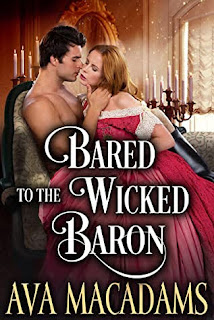
Weekly Reader: Bared To The Wicked Baron by Ava McAdams; Captivating Regency Romance But With A Very Misleading Title


Weekly Reader: Bared To The Wicked Baron by Ava McAdams; Captivating Regency Romance But With A Very Misleading Title

By Julie Sara Porter

Bookworm Reviews


Spoilers: In the Romance genre, certain things sell and are as  omnipresent as scary things are to a Stephen King novel. Sex sells as shown by the covers featuring barely dressed lovers wrapped in each other's arms. Certain time periods sell as shown by the glut of historical romances, particularly during the Regency Era. Certain words in the title, like "Wicked," Naughty,"  "Forbidden," "Sinful," and "Passion," sell as well. Those words reveal something dark and forbidden about the romance that Readers are about to indulge into. It's a business decision, but at times it is an unnecessary one especially when the title is extraordinarily misleading.

Take Ava McAdams' novel Bared To The Wicked Baron. It would be a halfway decent Regency era Romance of a couple getting to know each other despite outside forces attempting to break them up. 

However the title Bared To The Wicked Baron suggests something else. It suggests something more salacious and sultrier than what we get and it seems to do so only to sell the book to more Readers.


The titular Baron is nowhere near wicked. Sir Phillip Andrews, The Baron of Havordshire, is actually a sweet, but private baron who is caring for his ailing mother. He has been steadily losing money and now resides in a humble cottage to care for her. He has a few loyal servants, but he does much of the nursing himself. Because of this, he doesn't have a lot of time to do the usual social routine of a man among the ton. His friends convince him to spend one night away at a ball so he can finally relax. Now does this sound remotely wicked to you?

He is not wicked in temperament nor in reputation. I could sort of understand if Phillip harbored a reputation of being wicked to ward women away from him so they, and the Reader, don't know that he is caring for his mother leaving his family problems to be a surprise. Perhaps it could be the hidden heart inside his Byronic reputation. But his family conflict is revealed in the second chapter. No one describes or refers to Phillip as wicked and he never behaves that way. Arthur Thistlewood from The Second Mrs. Thistlewood has more right to the adjective than Phillip does. At most Phillip could be private, maybe secretive. Were Bared To The Private or Secretive Baron taken as titles?


Because he has been AWOL from social duties, Phillip's friends warn that his time may be up pursuing young viable women to be brides and give birth to his heirs without looking like an aging fool. Another character running out of time is Helena, daughter of the Earl of Brimsey. She is 27 years old and missed an earlier Season, because of her family's dwindled finances. Now her parents say better late than never and she needs to be married before it's too late. Naturally she goes to the same ball in which Phillip is dragged. The two meet, share a dance, and begin to fall in love.

Their courtship is rushed. That could be attributed to their ages in a time period where they were expected to already be married and the implied anxiety that would happen in a time period where death in childbirth is far from unheard, when late in life pregnancies can produce many long term complications, and when the medical profession amounted to guesswork.  Helena and Phillip's courtship is steamy in that it's an emotional release for a long delayed dream, one that satisfies them on a personal level. They are a nice decent couple that couldn't be further from villainous if they tried.


There is a wicked character in the book that complicates Helena and Phillip's courtship. They use underhanded means to come between the couple like physical attacks and secret confidences. More cannot be revealed but that person is definitely not a baron. This character has some development but it is revealed too late since they are unbearable and annoying throughout. In fact, their villainy is pretty transparent and certainly not compelling. 


Bared To The Wicked Baron is a decent romance but it promises to be something else. With so many words that could have been chosen for the title, wicked should not have been one of them.


Friday, February 5, 2021

New Book Alert: The Awakening of the Lost Baroness by Hazel Linwood; Sharp Brisk Plot Driven Regency Era Romance


New Book Alert: The Awakening of the Lost Baroness by Hazel Linwood; Sharp Brisk Plot Driven Regency Era Romance

By Julie Sara Porter

Bookworm Reviews


Spoilers: Regency Romance #2 is The Awakening of The Lost Baroness by Hazel Linwood. Similar to The Heiress of Epsom by Hedley J. Huntt, both take great detail to explore the Regency era with its elegant style, rigid class snobbery, and literature that explored both the witty and passionate sides of the people that lived within it. 

However Huntt and Linwood differ in their approaches. The Heiress of Epsom had a few bursts of plot but brimmed with a pair of likeable characters. By contrast, The Awakening of the Lost Baroness had characters who are less defined but are surrounded by a plot that is a lot more engaging, sharper, and has a few interesting twists.


Amanda Jonson lived her life as a commoner until on her mother's deathbed, the older woman revealed the truth: She was once a maid who was secretly engaged to a Baron's son. When the family found out, the Baron was forced to end the marriage and marry a more acceptable woman. Amanda was finally welcomed into her father, the Baron of Foley's family and is accepted by him, her grandmother, and younger half-sister, Patricia.

She also attracts the romantic attention of Lord Henry, the Earl of Sutcliffe. Unfortunately, Patricia is also in love with him, much to the delight of his mother, and Amanda's grandmother wants to set Amanda up with the Duke of Avery.


The plot moves along at a brisk pace,so brisk that we don't always get to know the characters. The revelation of Amanda's family ties are revealed before the events of the book, so we don't get to know what her former life was like, her mother as a person (besides Amanda remembering her after death), how she feels about her sudden windfall, or the family and Henry's initial reaction about her and vice versa. 

The book is set five years after the reveal and Amanda is already settled into the family. A couple of early chapters or a prologue would help to establish her as a character.


However in this case, the plot moves the characters rather than the other way around. When Amanda's father is taken ill, the question of her marriageability becomes important. She is taken to London to meet Avery. Meanwhile, Henry has made his choice to wed Amanda and he will disinherit himself to do it. He also moves to London to make his own way in the world, either through the army or investing in other friend's businesses.

 It is a bit contrived that both would find their way to London, but since they live in a rural area and London is the central hub of contemporary life at the time, it makes sense.


There are some pretty tense scenes that reveal that in a Regency Era Romance, all is not necessarily fancy dress balls and invitations to tea with Grandmama. Amanda, Patricia, and their grandmother are invited to the opera and Amanda is invited to sit in Avery's box seat. It is in Avery's box seat that he attempts to rape her. Only Amanda's fast feet save her from becoming victimized by the Duke's brutality.

 Besides the deplorable actions of the Duke, even worse is the behavior of her Grandmother who still wants her granddaughter to go through with marrying Avery even after Amanda tells her what he did. ("He is not….the gentleman that he should be, but we are doing this for your own good," Grandma says like a "loving" grandmother should.)


The only one who will defend her is Henry and he is prepared to do so with pistols during a duel. The duel chapter captures how high the stakes can be in such a potentially dangerous situation. It also fortunately takes the romance out of such a conflict by revealing it for the bloody destructive mess that it is, even when both parties survive.


There are some points that leave one scratching their heads especially when it's revealed that much of the plot was orchestrated by some scheming characters. In reality, such characters would be revealed as sociopaths and certainly deserve to be estranged from the others or punished more than they are, but that does not happen. Retribution is cast aside for Happy Ever After.


Where The Heiress of Epsom takes a meandering time where the Reader gets to know the characters, The Awakening of the Baroness speeds through so the Reader can see the world around the characters. Both offer loving tributes to an era that is worth exploring again and again through literature.


Weekly Reader: The Heiress of Epsom: Her Lady's Heart by Hedley J. Huntt; Cute, Charming Character Driven Regency Era Romance


 Weekly Reader: The Heiress of Epsom: Her Lady's Heart by Hedley J. Huntt; Cute, Charming Character Driven Regency Era Romance

By Julie Sara Porter

Bookworm Reviews


Spoilers: For the first romance books of this month, I am reviewing a pair of Regency era Historical Romances. What is it about this era that inspires the romantic side of authors and Readers? Sure there are many romances set in the Victorian and Edwardian eras. Quite a few Westerns and some books set during the World Wars sprinkle with more than enough love stories. But the Regency Era, between 1811-1820, in England tops the list of historical romance fiction time periods and these won't be the only two that I am reviewing this month either. 


The most obvious reason is that the authors and Readers are fans of the works from that period, particularly Jane Austen, so they want to pay tribute to one of their favorite authors. Another reason could be because of the period itself with the elegant styles and architectures, the social customs and manners. There is a quaint elegance that people want to study and escape into. 

With that elegance and fine manners, there was also a contradiction. This was a contradiction in which many rebelled against convention and embraced passion and emotion. This wasn't just the era of the cultured politeness of Jane Austen. This was also the era of the Romantic poets like William Wordsworth, Samuel Taylor Coleridge, William Blake, Percy Bysshe Shelley, John Keats, and the "mad, bad, and dangerous to know" Lord Byron. The time of the Rake, those lady's men who could challenge the norm and arouse the interest of the young swooning ladies and the ladies who mocked and satirized those conventions in Gothic novels and comedies of manners.

It is the convention vs. passion that many authors seem to find so irresistible and like to put in their works. 


That is what is intrinsic in the first two Regency era Romances, the side of convention: young people being forced into situations that they would rather not be in, like arranged marriages vs. their romantic passionate feelings for the right person. In a sense, they tell the same story of young people from wealthy and titled families falling in love with someone considered unsuitable and fighting off family pressure to marry someone more acceptable. However, authors Hedley J. Huntt and Hazel Linwood choose different ways to tell them and in their differences show their writing advantages.


Huntt's version of the Regency Era, The Heiress of Epsom: Her Lady's Heart, is strong on character with a slight plot. Very little goes on story wise, but we are given two charming lovers that are so likeable and packed with brilliant traits that I like the journey that they are on.


The first of the lovers is Lady Caroline Cartoghan, the only daughter of Zachary Cartoghan, the Marquess of Epsom. As is the role of many young women of the time, her only job is to marry up to give her family more prominence. The only thing higher than a Marquess is a Duke and that's one step closer to Royalty. In fact, her parents are practically salivating over the fact that Finley Rashford, Duke of Kirkeby, will be arriving soon to appraise his potential bride. She is more interested in Oliver Russell, the local potstal worker. Oliver Russell, a man with no title.

Or rather Oliver had a title. He was once a Viscont of Barj, and his father an Earl, but that was before his alcoholic and compulsive gambling father lost the family wealth, home, and title. Who help engineered his downfall? Why none other than the Marquess of Epsom, Caroline's father. Once he gets to know Caroline, Oliver sees a potential pathway to romance.


Caroline and Oliver are a winning pair both in their time together and separate. They both question the societal rules. Even though Caroline considers her maid, Vivian, a friend and confidant, she despairs that she doesn't know her as a person or her life outside of working for the Cartoghan Family.

Caroline is a woman who while loves her parents is starting to question her role in this snobbish society. Her older brother, Jack, can romance many, drink himself silly, and do whatever he wants. But if she steps one toe out of line, it is a cause for scandal. She questions the double standard.

The only place that she can feel welcome is the local bookstore. There she reads French Literature, sensational novels, and works that are forbidden, and is free to express herself in ways that are more open.


That is what attracts Oliver to her and vice versa. They are both characters who question the norm. Oliver shares a similar passion for literature, particularly poetry, which he often quotes to swooning maidens like a pop singer quoting their lyrics to adoring fans. He is clearly a charming flirt, but that's not all to him.

Unlike Caroline, Oliver is able to cross class lines. In fact, now that he is outside of his former class, he sees how foolish those people are. That is probably why, even though he tried before like funding a failed expedition, he shows no current interest in regaining his fortune or title. In fact, his best friend is bookseller, John Ruppert, who gives him books and good solid advice. He has an inner circle that includes various people of different social classes from Lady Ryssa, a rich dowager looking for a handsome young wealthy man to marry to Marvy, a poor young boy who delivers messages between the lovers and who Oliver and John treat like a kid brother.


Since Caroline's parents forbid Oliver from calling on the house, the two maintains their relationship via correspondence, hitting each other exactly where their hearts lie: through writing. For example Oliver writes to Caroline, "My heart yearns for you, for an eternity with you, or at least a second in passing." It's the letter writing that one would expect between lovers from that period. They express such emotional heartfelt words through writing that societal constraints deprive them from revealing with their voices.


This is a book that not a lot happen. But when it does, it happens in quick spurts followed by many chapters and pages of contemplation and indecision. Most of the actions are motivated by Caroline and Oliver's behavior and mannerisms. In one chapter, Caroline asks Finley some provocative questions that show that intellectually, she runs circles around this guy.

Another chapter features Oliver and Caroline engaging in a kiss that is seen by Finley and Jack, both of whom are not happy. Oliver and Caroline kiss to express the physical passion which they can no longer deny and only share through letters.

The final third of the book is too delicious to reveal but hinges on Caroline feeling smothered by her family's expectations and desperation to do anything to end their control over her. It also hinges on Oliver's love for her and concerns about gaining back what he lost.


The Heiress of Epsom is a fine tribute to an era that continues to fascinates both Readers and Authors. Caroline and Oliver make for a charming lovely pair to welcome Romantics into that time.