Showing posts with label New York City. Show all posts

Monday, June 2, 2025

Bomber Jackets by Rob Santana; An Insightful, Witty, and Sincere Queer Romance in 1970’s New York


 Bomber Jackets by Rob Santana; An Insightful, Witty, and Sincere Queer Romance in 1970’s New York 

By Julie Sara Porter 

Bookworm Reviews 


Spoilers: I suppose that it's fitting that I would review Rob Santana’s latest novel during Pride Month. As many long time Readers of this blog know that Rob Santana is a long time favorite of mine because Readers don't know what to expect when reading his novels except that it will be unexpected. What you read at the beginning of the book is not the same book when the final page is read.

 The Oscar Goes To deals with the glamor and gossip of Hollywood and becomes a tragic story about the mental breakdown of an abused starlet who commits suicide live on air. Little Blue Eyes starts as a heartwarming family drama about a single woman finding an abandoned baby and transforms into a heady custody battle and savage indictment of racism, class struggles, and addiction. Freeze Frame evolves from a quirky romance between two eccentric characters into an emotional crime drama as a murder is accidentally captured on film and various characters are destroyed by it. Not to mention the short works in which Jane Austen and Adolf Hitler are written in different ways.

Santana's latest and very timely book, Bomber Jackets also creates various tones into one text. It starts out as a desolate Crime Mystery as Patrick Madden, a landlord/building super, is interrogated by a police officer about a murder in which he was either a witness or a participant with his fellow gang members cousin Junior and friends, Frank Rapallo and Bambi. It then turns into a witty Queer Romance between Patrick and Erica Velez, a saucy and delightful transvestite tenant. Finally, it becomes an insightful and sincere Bildungsroman as Patrick finds his life irrevocably changed by the tug of war between his gang and his love interest, his loyalties between who he was to who he could be.

The darker aspects of the book’s Crime Mystery beginning are augmented by its setting and tone. It's probably no coincidence that Santana chose this particular time and place. As many know, New York City was in a severe economic crisis in the 1970’s. Well the whole country was but NYC’s situation was so bad that it faced near bankruptcy in 1975. This led to the infamous New York Times headline “Ford to City: Drop Dead” when the President refused to bail out the city though he later relented. There was massive unemployment, cuts in municipal services, declines in the subway system, and the so-called “white flight” when middle class families fled to the suburbs creating a larger racial and class divide. A city wide blackout in 1977, increased crime in places like the South Bronx, Bedford-Stuyvesant in Brooklyn, and Times Square, and the Son of Sam killing spree only increased the anxiety and uncertainty. 

On the positive side there was an explosive rise in arts and culture much of which is still recognized today. Graffiti art and hip hop were created specifically because of this economic crisis. (Hip hop actually benefited from it by performers hosting street parties and using used technology, second hand clothing, scratched records, and inexpensive items to create the sound and aesthetic). Disco offered escapist entertainment as many danced their troubles away, did drugs, and traded partners. Along with disco was a rise in Queer culture as many LGBT+ people came out and wrote, sang, performed, painted, and possibly for the first time felt free to live their truths.

The New Hollywood filmmakers like Martin Scorsese, Francis Ford Coppola, Walter Hill, and Sidney Lumet, and television shows like All In the Family, Kojak, Taxi, Rhoda, and Barney Miller addressed the times head on. Authors, poets, and musicians like Lawrence Block, Judy Blume, Peter Maas, Don DeLillo, Donald Westlake, Alice Childless, Frank O'Hara, Audre Lorde, Patti Smith, Lou Reed, John Kander, and Billy Joel captured that gritty time with their words and music. This is the milieu in which Patrick lives.

Patrick lives in a dilapidated apartment building with his stepmother, Yanna as his mother drifts from parental responsibilities and his father is in a coma. He collects rent and makes repairs or contacts other people to make those repairs. He has to face many complaining and threatening financially struggling tenants who need roofs over their heads but aren't looking forward to paying for them. Outside is pure kill or be killed Social Darwinism. If one doesn't get mugged, held up, raped, shot, or stabbed, there is always the fear that they will run into Son of Sam lurking in the shadows waiting for another victim. It's a desperate, bitter, and anxious existence.

Patrick is part of a mini-gang called the Bomber Jackets with Rapallo, Junior, and Bambi. His pals are also on the lower rungs of the economic ladder and work in dead end jobs, have unhappy marriages, and boast of criminal reputations. They endlessly mock each other with sarcastic quips and playful threats towards one another and those outside their circle. It's a means to vent out their frustrations, cover up their emotions, face their own insecurities by needling others for their weaknesses. Their antics start out mostly harmless but with a sardonic sharp edge that hints at darker intentions.

Those edges become larger and the intentions become more pronounced when a minority moves in and around Patrick's apartment, LGBT+ people. A presumed gay couple moves into the neighborhood. When Erica moves into Patrick's apartment, they are uncertain whether a man or a woman has moved in. (To answer the question, Erica identifies as female but sometimes wears her previous men’s clothing to avoid being harassed or when meeting her estranged family.) 

As often happens (and we can certainly see now), when people are struggling, they will take their frustrations out on someone different, an other. So Patrick’s gang attacks the LGBT+ around them. They catcall them, insult them, stalk them, and play childish but harmful pranks like throwing bugs and roaches into their apartments. Those interactions become more volatile as the book goes on, particularly as Rapallo becomes more violent and unpredictable. 

With the dark setting comes the Queer Romance between Patrick and Erica. Once Patrick gets over his confusion about Erica's gender identity, he becomes a close friend, which he admits to the police officers interrogating him. While Patrick questioned his friend's attacks on the LGBT+ community, he mostly remains neutral and inactive. He thinks that Rapallo and the others are idiots, but can't quite break away from them partly out of fear of what they will do, confusion about his own identity and sexuality, and misplaced loyalty to people he knew for most of his life. 

It takes Erica to make Patrick look at himself and take some action. Erica is flashy, charming, flirtatious, witty, saucy, independent, and fearless, someone who draws Patrick in with her vitality and effervescence. Her clothing, wigs, and style show us a woman who could be a skilled performer and that life is her stage. She quips at Patrick with lines like “Look at me. This Uptown Girl aims to hit fast ‘cause I'm there to assassinate.”

Erica has flashes of being a Manic Pixy Dream Girl but she also has layers that keeps her from being just a stereotype or a tool that brings out Patrick’s better qualities with no story of her own. Even though she wants to go to Drag Balls, she suffers from insecurity and panic attacks when she's there. She longed to be with people like herself, but once she is, she is intimidated partly because she spent so much time in the closet that it has become her comfort zone. She is more comfortable being outrageous and standing out from people who are seemingly normal than she is with people who are like her. It's a struggle but she is willing to adapt and refocus herself, playing on those hidden character traits as well as her more public persona.

In fact the few times when Erica is in male clothing, and reverts back to her assigned gender identity at birth, Eric, is when she shows the most vulnerability. She is quiet, uncertain, shy, self-conscious, and clearly miserable. As Eric, she hides and stays invisible drifting into the crowd that she would have made them pay attention and look at her as Erica. She reverts to make her family happy and to stay safe but it takes a toll on her. As Patrick bonds with and falls in love with Erica, he sees that her female identity is her real identity and the male identity that she is forced to wear is the disguise. 

As Patrick and Erica grow closer and accept each other, he begins to see his former friend's darker side and is less apathetic towards their actions. He has to make a choice between his old loyalties and new love. In doing so, like Erica he accepts and lives his own truth. 


Thursday, July 30, 2020

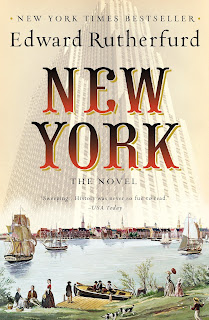
Weekly Reader: New York by Edward Rutherfurd; Another Epic Rutherfurd Success, But With Some Missed Opportunities


Weekly Reader: New York by Edward Rutherfurd; Another Epic Rutherfurd Success, But With Some Missed Opportunities

By Julie Sara Porter

Bookworm Reviews


PopSugar Reading Challenge: A book with the same name as a movie or TV show, but is unrelated to it (New York, New York)


Spoilers: I suppose after writing about Sarum, London, The Forest, Ireland, Russia, and would later write about Paris, Edward Rutherfurd decided to write about New York because he figured that if he could write about there, he could write about anywhere. (Apologies to John Kander and Fred Ebb for the paraphrase.)

New York is yet another of Rutherfurd's sprawling epics which cover the families of one location over the course of several centuries. This time, the English author takes his act on the road to the United States and New York. He does it with his usual grand style that captures these important historical moments, but makes it personal by showing us the individuals who exist in those turbulent fascinating times.


Rutherfurd deserves a lot of praise for writing an American city very well. He captures the various buroughs, streets, locations, accents, ethnicities, and the character of the city expertly. For example, he captures the various speech patterns of the characters without resorting to stereotypical dialect. He tells the points of view of people of various ethnicities and social status, as citizens, but maintains their individual struggles and personalities.
Rutherfurd captures New York so well, that it's easy to forget that he's not an American.

Once again he covers various families and reveals how they relate to the world around them. They are:


The Van Dycks/Masters-The European-American family traces their roots from Dutch lineage back when the territory was New Amsterdam. They eventually married with the English immigrant, Master family. They exemplify the old money families who are often in charge of the stock market, the big Fortune 500 companies, and names that are on guest lists of high society and philanthropic donations. They are present in every chapter from the beginning.

The Hudson/Rivers-The African-American family begin as slaves to the Van Dyck family. They are very prevelant before and during the Revolutionary War as the members argue over whether or not to aid the white Americans. They appear sporadically, but unfortunately their lineage is cut short during the 1863 Draft Riots when one of their members is lynched.

The Whites-A working class family that contrasts with the wealthier Masters. They have a long animosity towards the wealthy family. Their most important role is during the Revolutionary War when they are staunch Patriots and fight for the working class Americans. In subsequent chapters, they take on various occupations like police officers and fire fighters.

The Albions-A family of wealthy English expatriates. They appear mostly as a staunch Loyalist family during the Revolutionary War. Eventually, they return to England but maintain a friendship with the Masters.

The O'Donnells-An Irish-American family that emigrated to New York in the 1840's to escape the Irish potato famine. They begin in the impoverished area of Five Points and work mostly in service. Later, some of the family members gain prominence because of their involvement with Tammany Hall. The O'Donnells gain social success until by the late 20th century, one is an upwardly mobile attorney.

The Kellers-A family that emigrated from Germany in the mid-1800's and are close friends with the O'Donnells. They mostly work as tailors, artisans, and shopkeepers. Later family members develop creative talents, as one becomes a professional photographer and another becomes a caterer.

The Carusos-A family that emigrated from Italy through Ellis Island in 1901 (no relation to the opera singer). They eventually move to the Lower East Side. They experience various important moments from the Triangle Shirtwaist Factory Fire of 1911, to the creation of the Mafia (as one joins), and the construction of important buildings like the Empire State and the Chrysler Building. Like the O'Donnells, they too move upwards, as their final family member becomes a doctor.

The Adlers-A Conservative Jewish family from Flatbush, Brooklyn that appears in New York by 1955. They are mostly seen through the eyes of Sarah, their daughter, an art gallery owner. She gets involved with the Bohemian lifestyle and becomes more Liberal and secular and defies her family traditions..

The Campos-A Puerto Rican family that resides in El Barrio, Spanish Harlem. They appear in 1977, the final family in the book. Like the Adlers because they arrive so late, they are mostly seen through one character, Juan. Juan experiences the poverty of many black and Latino New Yorkers in the 1970's when the city is about to declare bankruptcy. He later becomes an advocate for the poor communities.

Because the book covers roughly four hundred years of history, a short time for a Rutherfurd book, Rutherfurd was able to write it similar to London. He inserted several characters into multiple chapters, so the Readers can see their experiences over many decades and see how they evolve with the times. The Revolutionary War doesn't happen until 11 chapters in. The 19th and 20th century cover 9 and 7 chapters respectively. It's a purposely slow moving process, but like London is the better for it.


Once again there are some excellent characters including:

Dirk Van Dyck-A Dutch immigrant trader in 17th century New Amsterdam, who has a loveless marriage but escapes from it to father a Lenape girl called Pale Feather. She makes the ongoing symbol that is passed from generation to generation, a wampum belt.

Quash-The first, and so far only, first person narrator of a Rutherfurd book. A slave, Quash recounts the transformation of New Amsterdam to New York and he eventually receives his freedom and becomes a shopkeeper.

John Master-One of the first in his family to carry the Master name. When New York is still considered a backwater location, he has a rocky meeting with his wealthier cultured Bostonian cousins (to show the difference between New York and Boston) and an unfortunate courtship. He then has a better marriage with Philadelphian Quaker, Mercy Brewster.

Charlie White-A working class man who was a childhood friend of John Master's only to be snubbed by his family. Later, he becomes a fervent Patriot who organizes protests and resistances against the British government.

James Master-Son of John who is educated in England and marries Vanessa, a well-to-do Englishwoman. Despite, or because of this, James becomes an outspoken Patriot. He leaves his wife and returns to New York. He then raises his son, Weston, as a single parent.

Hetty Master-Introduced in 1849, she is the wife of Frank Master, Weston's son. Despite her intense wealth, she is passionately involved in various social causes like abolition, women's suffrage, and labor unions.

Mary O'Donnell-The first of the O'Donnell family, she gets hired as a maid to the Masters. Later, she becomes Hetty's companion and best friend.

Theodore Keller-The youngest of the immigrant Keller family. By 1863, he becomes a photographer. He shows an artistic eye as he snaps portraits, graphic scenes of war, and landscapes. He becomes a well known artist after death.

Salvatore Caruso-The son of the Italian immigrant family, his sister is killed in the Triangle Shirtwaist Factory Fire and his brother is killed working for the Mafia. He becomes a construction worker and is involved in a love triangle with his brother, Angelo and girlfriend, Teresa.

Rose Van Dyck Master-The female head of the Master family by the early 1900's. She is something of a name dropper, referring to her friend Mrs. Astor, and a snob. However, she has enough financial insight to save her family from the 1929 stock market crash.

Charlie Master-Rose's dilletante son, he becomes involved with the Village scene of the 1920's of artists, writers, and theater types. Later he becomes an aging hippy and becomes involved with a younger woman. He writes about that experience in a semiautobiographical novel, Verrazano Narrows.

Sarah Adler-The daughter of the Jewish family. She owns an art gallery and has very liberal values that put her at odds with her traditional family. She is the woman that has the affair with Charlie Master and inspires his novel.

Juan Campos-An idealistic Puerto Rican immigrant who becomes an advocate for the poor families of color. He begins in the 1970's when New York saw an increase in poverty, union struggles, and crime.

Gorham Master-An investment banker in the 1970's and '80's. While he has the family name and success, he wants more meaning to his life. Ultimately, he assists Juan with a foundation to help others.

Maggie O'Donnell-Gorham's wife, and Mary's descendant, a yuppie attroney. She is pleased to have it all, a good career, husband, and children.

As with Rutherfurd's other works, the characters are an engaging bunch. We see them encountering big issues like the Revolutionary War, the Civil War, the creation of Niagara Falls and the Brooklyn Bridge, the Blizzard of 1888, New York's rise to being one of the largest and most important cities in the world, the Financial Panic of 1901, the Stock Market Crash of 1929, and September 11. So many important events are covered.

Rutherfurd also captures many personal moments for the characters. Frank's proposal to Hetty at the Croton Aqueduct produces fond memories even after they have friction in their marriage. Hetty later befriends Frank's mistress, Lily de Chantal and they conspire to overpower another mistress, Donna Clipp.

Mary lies about her family's connection to Tammany Hall to work as a maid for the Master family. By the time the truth comes out, decades later, Hetty is just grateful to have a long time friend.

One of Theodore Keller's photographs is named, Hudson River. Not because of the River, but because he captures Hudson River, the characters,' death. This photograph ends up being his most popular and infamous.

While Salvatore is working on the Empire States Building, he is so incensed by Angelo and Teresa's affair, that he contemplates killing him. A lucky accident spares his life and he becomes a devoted uncle and godfather.

Gorham Master spends many years feeling unfulfilled by his life of gain. He consults headhunters and weighs other opportunities before finally doing something positive with his wealth by aiding Juan Campos.

The final recipient of the Master family wampum belt is none of the Masters, but Sarah Adler as a gift from her lover, Charlie Master. She wears it when she is trapped inside the World Trade Center just as it is attacked and she is killed.

There are however plenty of missed opportunities. The most important is probably the too early departure of the African-American family, the Rivers. For the first time in Rutherfurd's books, we get a first person account with Quash. He reports of the change from New Amsterdam to New York and the English encroachment on the island of Manhattan. He also talks about his marriage to Naomi, his love for his son, Hudson and his friendly relationship with Dirk, his master who promises to free him on his deathbed. Hudson is eventually sold to a ship captain, but Quash obtains his freedom and opens a store. With that strong beginning and a first person departure from the other books, one would expect Quash's family to be prominent from beginning to end.

Unfortunately, that is not the case. During the Revolutionary War, Quash's son, Hudson raises concerns when his son, Solomon, joins the Sons of Liberty. Once Solomon's son, Hudson is sold, the family does not reappear, until they escape through the Underground Railroad. Then as I said earlier, their final descendant Hudson River is lynched and hanged during the Draft Riots of 1863.

That's it. It is great that Rutherfurd opens up this shameful period in America's past and telling it through a family that suffered through it. However, they should have continued in later chapters. The Rivers could have been actively involved in the Civil Rights Movement, the Harlem Renaissance, redlining, and the Great Migration. Heck, a later Rivers descendant could have been a fellow activist alongside Juan Campos. Many events and perspectives are lost when the Rivers's story ends prematurely.

The Rivers aren't the only ones. It's clear that while the book is another Rutherfurd ensemble, the main family involved is the Masters. They are present in every chapter and get the lion's share of points of view. This leaves a lot of families out of key events.

The White's introduction is very powerful and the book appears that to reveal another multi-generational family feud ala The Wilsons Vs. Shockleys in Sarum. Unfortunately, the White family takes a diminished role after the Revolutionary War and only receives minor appearances in later chapters. The Whites, as well as the Rivers, are the only families to not reappear in the final chapters that focus on 9/11.

Rutherfurd reveals the various immigrant families that make up New York, showing how America is made up of different people. It shows that we all come from somewhere else. Unfortunately, many of these immigrant families are spread out, some taking more prominent roles than others. The O'Donnells, Kellers, and Carusos have strong introductuons but by the mid-20th century, they disappear only to reappear for the finale. There are a few missteps where we could have seen more sons and daughters.

The book also leaves out some key events. The most important events that are short changed are The Great Depression and WWII. The book skips from 1929 to 1955. It seems odd that a book that chronicles the American experience so faithfully would leave these out. We don't get to see how poverty and joblessness affected the families in question. We don't get to see their opinions about the New Deal and their feelings towards Franklin D. Roosevelt (and he's a New Yorker at that. Seriously they left him out?).

We don't get to have the characters experience Pearl Harbor or see the male characters enlist. Nor do we experience the female characters working (many outside the home for the first time.). One of the families is Jewish and they don't even touch on the Holocaust or reveal that one of the Adlers is a survivor. Rutherfurd could have easily introduced two more chapters to cover these events. That he didn't is a real shame.

While the book has some missed opportunities, New York is another wonderful experience in time travel thanks to Rutherfurd. Reading about the people of New York and the way that has changed over the centuries, fills the Reader with a sense of pride in the city and how well Rutherfurd caught it.

Monday, December 24, 2018

Classics Corner: A Winter's Tale by Mark Helprin; A Disappointing and Overly Long Fantasy Romance


Classics Corner: A Winter's Tale by Mark Helprin; A Disappointing and Overly Long Fantasy Romance

By Julie Sara Porter

Bookworm Reviews


Spoilers: I feel like someone's mother when I say, “I am very disappointed in you, A Winter's Tale!”

The truth is I wanted to like it. I really did. I heard the plot and realized that it was a modern fantasy set in 19th New York City. How could I not like it?

Well let me count the ways.

1. Spotty characterization- Many of Mark Helprin's characters only show brief glimmers of being interesting characters but are mired by a convoluted plot in which bizarre things just sort of happen to them with no reason and with no change in character whatsoever. While the protagonist, Peter Lake has a very interesting back story (He was left adrift by his immigrant parents when they were denied entry in the U.S. because they carried consumption. He was then found by a group of Baymen, people who lived in settlements by the water, who raise him in a communal environment. He was then trained as a builder and engineer before stumbling onto a life of crime as a burglar), there are only vague attempts at making him anything beyond a sketch. He has some sweet romantic moments with Beverly Penn, a dying heiress, and when he travels to the Future he actually shows something of culture shock/PTSD of being out of his element. However through most of the book, he is the same dull flat character who doesn't change much even when the world around him does.
Peter is only slightly more interesting than the other characters around him. His love interest, Beverly Penn is presumed to be the love of his life when they only met and became involved for a few days. While she shows some brief signs of intelligence and empathy particularly as she studies the stars, most of the time she comes across as a spoiled brat. When Peter doesn't agree to her terms, she screams at him until he does. Her behavior left this Reader irritated and wondering if she was trying to milk sympathy out of her lover than thinking “Gee, I hope this woman gets her final wishes granted.”
Some villainous characters are there to….well be villainous with no discernible reason. Actually most of the characters have no discernible reason for what they do which leads to my next point….

...2. Unexplained Magical Elements-I don't usually mind ambiguity in a book. It can be very useful and provides the Reader with some interesting analysis and critical thinking when it's done correctly. It however is not so in A Winter's Tale.
When writing a fantasy, an author must be well practiced at world building even in a real world setting. The author must make a conscious effort to create reasons why the magic exists or do it in a way that weaves the magic alongside the mundanities of every day life. (See my review of House of the Spirits by Isabel Allende for a better example of such writing.) But A Winter's Tale never achieves that.
A white horse appears at the beginning and rescues Peter on several occasions and leads him to the Penn home. Is he a spirit guide? We don't know. Is he a guardian angel? We don't know. Is he Silver to Peter's Lone Ranger? We don't know. Helprin fails to mentions it.
When Peter passes through some sort barrier and travels from 1899 New York to 1999, no explanation is given to the barrier nor why Peter is the only one who seems to have crossed it (or why It's even important that he needed to.)

3. Ridiculous Plot Contrivances-If the Fantasy elements weren't bad enough the real world plot elements are much worse. While it may be interesting for Peter to encounter maybe one old friend or enemy or descendant of the same in 1999, it is rather ridiculous for him to have encountered several. Nor is there any explanation given for their sudden longevity, particularly when some of them were several decades older than him in 1899.
While it was okay for Peter to be involved with one woman and maintain a fatherly interest in a young girl in 1899, was it really necessary for him to develop another romance with another woman and maintain a fatherly interest in another young girl in 1999?(The only difference was the girl in the former was Beverly's younger sister while the latter was the daughter of Virginia, the second love interest) Not to mention that the two love interests have a tentative connection to each other.

4. Obvious Padding-A Winter's Tale is one monster of a book and that's not necessarily a good thing. There are plenty of sections that could use a good trim.
The biggest offender is after Peter goes through the barrier and the Reader is given a whole section devoted to some superfluous secondary characters before briefly returning to Peter's story late in the following section.
It might have been interesting to introduce these new characters in a few chapters but not whole sections that last several hundred pages and especially not to characters that are extremely tedious, dull, and have no major bearing on the plot.

5. Anticlimactic Ending-The book just kind of ends with no real purpose. Oh there is some tension particularly as a massive fire hits Manhattan. One thing Helprin gets right is that his writing shows how much he loves New York City. Many sections lovingly describe the streets and boroughs in a way that reads almost like a love letter to the city. Knowing that it is rather heartbreaking to read about the city he loves so much reduced to cinders and ash.
But after the fire, there really is nowhere to go. The Reader prepares for a final battle between Peter and his surprisingly immortal enemy but one never comes. Plots are left unresolved and characters disappear in ways that are ridiculously hand waved.

Unlike many of the other books I disliked this year, I had high expectations for A Winter's Tale But to be let down so much by this book when I had such high expectations, makes it one of the worst books I read this year.