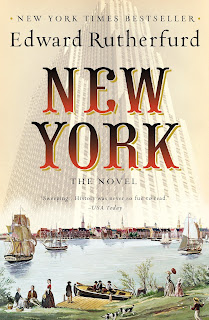
Weekly Reader: New York by Edward Rutherfurd; Another Epic Rutherfurd Success, But With Some Missed Opportunities
By Julie Sara Porter
Bookworm Reviews
PopSugar Reading Challenge: A book with the same name as a movie or TV show, but is unrelated to it (New York, New York)
Spoilers: I suppose after writing about Sarum, London, The Forest, Ireland, Russia, and would later write about Paris, Edward Rutherfurd decided to write about New York because he figured that if he could write about there, he could write about anywhere. (Apologies to John Kander and Fred Ebb for the paraphrase.)
New York is yet another of Rutherfurd's sprawling epics which cover the families of one location over the course of several centuries. This time, the English author takes his act on the road to the United States and New York. He does it with his usual grand style that captures these important historical moments, but makes it personal by showing us the individuals who exist in those turbulent fascinating times.
Rutherfurd deserves a lot of praise for writing an American city very well. He captures the various buroughs, streets, locations, accents, ethnicities, and the character of the city expertly. For example, he captures the various speech patterns of the characters without resorting to stereotypical dialect. He tells the points of view of people of various ethnicities and social status, as citizens, but maintains their individual struggles and personalities.
Rutherfurd captures New York so well, that it's easy to forget that he's not an American.
Once again he covers various families and reveals how they relate to the world around them. They are:
The Van Dycks/Masters-The European-American family traces their roots from Dutch lineage back when the territory was New Amsterdam. They eventually married with the English immigrant, Master family. They exemplify the old money families who are often in charge of the stock market, the big Fortune 500 companies, and names that are on guest lists of high society and philanthropic donations. They are present in every chapter from the beginning.
The Hudson/Rivers-The African-American family begin as slaves to the Van Dyck family. They are very prevelant before and during the Revolutionary War as the members argue over whether or not to aid the white Americans. They appear sporadically, but unfortunately their lineage is cut short during the 1863 Draft Riots when one of their members is lynched.
The Whites-A working class family that contrasts with the wealthier Masters. They have a long animosity towards the wealthy family. Their most important role is during the Revolutionary War when they are staunch Patriots and fight for the working class Americans. In subsequent chapters, they take on various occupations like police officers and fire fighters.
The Albions-A family of wealthy English expatriates. They appear mostly as a staunch Loyalist family during the Revolutionary War. Eventually, they return to England but maintain a friendship with the Masters.
The O'Donnells-An Irish-American family that emigrated to New York in the 1840's to escape the Irish potato famine. They begin in the impoverished area of Five Points and work mostly in service. Later, some of the family members gain prominence because of their involvement with Tammany Hall. The O'Donnells gain social success until by the late 20th century, one is an upwardly mobile attorney.
The Kellers-A family that emigrated from Germany in the mid-1800's and are close friends with the O'Donnells. They mostly work as tailors, artisans, and shopkeepers. Later family members develop creative talents, as one becomes a professional photographer and another becomes a caterer.
The Carusos-A family that emigrated from Italy through Ellis Island in 1901 (no relation to the opera singer). They eventually move to the Lower East Side. They experience various important moments from the Triangle Shirtwaist Factory Fire of 1911, to the creation of the Mafia (as one joins), and the construction of important buildings like the Empire State and the Chrysler Building. Like the O'Donnells, they too move upwards, as their final family member becomes a doctor.
The Adlers-A Conservative Jewish family from Flatbush, Brooklyn that appears in New York by 1955. They are mostly seen through the eyes of Sarah, their daughter, an art gallery owner. She gets involved with the Bohemian lifestyle and becomes more Liberal and secular and defies her family traditions..
The Campos-A Puerto Rican family that resides in El Barrio, Spanish Harlem. They appear in 1977, the final family in the book. Like the Adlers because they arrive so late, they are mostly seen through one character, Juan. Juan experiences the poverty of many black and Latino New Yorkers in the 1970's when the city is about to declare bankruptcy. He later becomes an advocate for the poor communities.
Because the book covers roughly four hundred years of history, a short time for a Rutherfurd book, Rutherfurd was able to write it similar to London. He inserted several characters into multiple chapters, so the Readers can see their experiences over many decades and see how they evolve with the times. The Revolutionary War doesn't happen until 11 chapters in. The 19th and 20th century cover 9 and 7 chapters respectively. It's a purposely slow moving process, but like London is the better for it.
Once again there are some excellent characters including:
Dirk Van Dyck-A Dutch immigrant trader in 17th century New Amsterdam, who has a loveless marriage but escapes from it to father a Lenape girl called Pale Feather. She makes the ongoing symbol that is passed from generation to generation, a wampum belt.
Quash-The first, and so far only, first person narrator of a Rutherfurd book. A slave, Quash recounts the transformation of New Amsterdam to New York and he eventually receives his freedom and becomes a shopkeeper.
John Master-One of the first in his family to carry the Master name. When New York is still considered a backwater location, he has a rocky meeting with his wealthier cultured Bostonian cousins (to show the difference between New York and Boston) and an unfortunate courtship. He then has a better marriage with Philadelphian Quaker, Mercy Brewster.
Charlie White-A working class man who was a childhood friend of John Master's only to be snubbed by his family. Later, he becomes a fervent Patriot who organizes protests and resistances against the British government.
James Master-Son of John who is educated in England and marries Vanessa, a well-to-do Englishwoman. Despite, or because of this, James becomes an outspoken Patriot. He leaves his wife and returns to New York. He then raises his son, Weston, as a single parent.
Hetty Master-Introduced in 1849, she is the wife of Frank Master, Weston's son. Despite her intense wealth, she is passionately involved in various social causes like abolition, women's suffrage, and labor unions.
Mary O'Donnell-The first of the O'Donnell family, she gets hired as a maid to the Masters. Later, she becomes Hetty's companion and best friend.
Theodore Keller-The youngest of the immigrant Keller family. By 1863, he becomes a photographer. He shows an artistic eye as he snaps portraits, graphic scenes of war, and landscapes. He becomes a well known artist after death.
Salvatore Caruso-The son of the Italian immigrant family, his sister is killed in the Triangle Shirtwaist Factory Fire and his brother is killed working for the Mafia. He becomes a construction worker and is involved in a love triangle with his brother, Angelo and girlfriend, Teresa.
Rose Van Dyck Master-The female head of the Master family by the early 1900's. She is something of a name dropper, referring to her friend Mrs. Astor, and a snob. However, she has enough financial insight to save her family from the 1929 stock market crash.
Charlie Master-Rose's dilletante son, he becomes involved with the Village scene of the 1920's of artists, writers, and theater types. Later he becomes an aging hippy and becomes involved with a younger woman. He writes about that experience in a semiautobiographical novel, Verrazano Narrows.
Sarah Adler-The daughter of the Jewish family. She owns an art gallery and has very liberal values that put her at odds with her traditional family. She is the woman that has the affair with Charlie Master and inspires his novel.
Juan Campos-An idealistic Puerto Rican immigrant who becomes an advocate for the poor families of color. He begins in the 1970's when New York saw an increase in poverty, union struggles, and crime.
Gorham Master-An investment banker in the 1970's and '80's. While he has the family name and success, he wants more meaning to his life. Ultimately, he assists Juan with a foundation to help others.
Maggie O'Donnell-Gorham's wife, and Mary's descendant, a yuppie attroney. She is pleased to have it all, a good career, husband, and children.
As with Rutherfurd's other works, the characters are an engaging bunch. We see them encountering big issues like the Revolutionary War, the Civil War, the creation of Niagara Falls and the Brooklyn Bridge, the Blizzard of 1888, New York's rise to being one of the largest and most important cities in the world, the Financial Panic of 1901, the Stock Market Crash of 1929, and September 11. So many important events are covered.
Rutherfurd also captures many personal moments for the characters. Frank's proposal to Hetty at the Croton Aqueduct produces fond memories even after they have friction in their marriage. Hetty later befriends Frank's mistress, Lily de Chantal and they conspire to overpower another mistress, Donna Clipp.
Mary lies about her family's connection to Tammany Hall to work as a maid for the Master family. By the time the truth comes out, decades later, Hetty is just grateful to have a long time friend.
One of Theodore Keller's photographs is named, Hudson River. Not because of the River, but because he captures Hudson River, the characters,' death. This photograph ends up being his most popular and infamous.
While Salvatore is working on the Empire States Building, he is so incensed by Angelo and Teresa's affair, that he contemplates killing him. A lucky accident spares his life and he becomes a devoted uncle and godfather.
Gorham Master spends many years feeling unfulfilled by his life of gain. He consults headhunters and weighs other opportunities before finally doing something positive with his wealth by aiding Juan Campos.
The final recipient of the Master family wampum belt is none of the Masters, but Sarah Adler as a gift from her lover, Charlie Master. She wears it when she is trapped inside the World Trade Center just as it is attacked and she is killed.
There are however plenty of missed opportunities. The most important is probably the too early departure of the African-American family, the Rivers. For the first time in Rutherfurd's books, we get a first person account with Quash. He reports of the change from New Amsterdam to New York and the English encroachment on the island of Manhattan. He also talks about his marriage to Naomi, his love for his son, Hudson and his friendly relationship with Dirk, his master who promises to free him on his deathbed. Hudson is eventually sold to a ship captain, but Quash obtains his freedom and opens a store. With that strong beginning and a first person departure from the other books, one would expect Quash's family to be prominent from beginning to end.
Unfortunately, that is not the case. During the Revolutionary War, Quash's son, Hudson raises concerns when his son, Solomon, joins the Sons of Liberty. Once Solomon's son, Hudson is sold, the family does not reappear, until they escape through the Underground Railroad. Then as I said earlier, their final descendant Hudson River is lynched and hanged during the Draft Riots of 1863.
That's it. It is great that Rutherfurd opens up this shameful period in America's past and telling it through a family that suffered through it. However, they should have continued in later chapters. The Rivers could have been actively involved in the Civil Rights Movement, the Harlem Renaissance, redlining, and the Great Migration. Heck, a later Rivers descendant could have been a fellow activist alongside Juan Campos. Many events and perspectives are lost when the Rivers's story ends prematurely.
The Rivers aren't the only ones. It's clear that while the book is another Rutherfurd ensemble, the main family involved is the Masters. They are present in every chapter and get the lion's share of points of view. This leaves a lot of families out of key events.
The White's introduction is very powerful and the book appears that to reveal another multi-generational family feud ala The Wilsons Vs. Shockleys in Sarum. Unfortunately, the White family takes a diminished role after the Revolutionary War and only receives minor appearances in later chapters. The Whites, as well as the Rivers, are the only families to not reappear in the final chapters that focus on 9/11.
Rutherfurd reveals the various immigrant families that make up New York, showing how America is made up of different people. It shows that we all come from somewhere else. Unfortunately, many of these immigrant families are spread out, some taking more prominent roles than others. The O'Donnells, Kellers, and Carusos have strong introductuons but by the mid-20th century, they disappear only to reappear for the finale. There are a few missteps where we could have seen more sons and daughters.
The book also leaves out some key events. The most important events that are short changed are The Great Depression and WWII. The book skips from 1929 to 1955. It seems odd that a book that chronicles the American experience so faithfully would leave these out. We don't get to see how poverty and joblessness affected the families in question. We don't get to see their opinions about the New Deal and their feelings towards Franklin D. Roosevelt (and he's a New Yorker at that. Seriously they left him out?).
We don't get to have the characters experience Pearl Harbor or see the male characters enlist. Nor do we experience the female characters working (many outside the home for the first time.). One of the families is Jewish and they don't even touch on the Holocaust or reveal that one of the Adlers is a survivor. Rutherfurd could have easily introduced two more chapters to cover these events. That he didn't is a real shame.
While the book has some missed opportunities, New York is another wonderful experience in time travel thanks to Rutherfurd. Reading about the people of New York and the way that has changed over the centuries, fills the Reader with a sense of pride in the city and how well Rutherfurd caught it.

