Showing posts with label Religion. Show all posts

Thursday, February 12, 2026

Oak Logs and Gasoline Tending Your Internal Fire by Jake Knox, Raising Readers How to Help Your Child Learn to Read by Amy Coffey; The Platinum Workforce: How to Train and Hire For the 21st Century's Industrial Transitions by Trond Arne Undheim; The Divine Feminine: From Awakening to Walking to Union by James Compton


Oak Logs and Gasoline: Tending Your Internal Fire by Jake Knox 

  Jake Knox’s personal development book, Oak Logs and Gasoline: Tending Your Internal Fire, uses fire as an extended metaphor for life and the choices that we make. This metaphor is concrete and poetic as Readers are encouraged to consider whether their lives overwhelm with excess heat, are underdeveloped leaving them in the cold, or provide just the right amount of warmth.

Knox used various analogies such as that people are “simply cold” because they don't know how to start their own fires. He advises Readers to find a “woodsman” or a mentor that will build a fire that lasts and guides Readers to use their talents and choices wisely.

This book encourages inner reflection and considers questions like "Why am I here? What drives me? Who am I here for? Who makes this worth fighting for? What do I want in life?" These questions and the answers help readers shape their journeys. They are the sparks that light the flames.

Each chapter includes reflections and conversations. They ask questions like “When was the last time you said or did something that is truly yours not copied, not influenced but born from what you believe?” 

A unique approach is that the reflections ask from the perspective of both the student and the mentor. Mentor questions include “when in your life did you first find your own voice-the moment you stopped echoing and started speaking from conviction?” 

This allows Readers to focus on where they are in their specific journeys either just starting out and looking for advice or if they are experienced and want to guide others. 


Raising Readers: How to Help Your Child Learn to Read by Amy Coffey

Reading is very important as a necessity and as a pleasure. Unfortunately, many statistics state reading problems or have high basic reading skills but none for pleasure. This book discusses what the brain does to read, why reading is important, and what parents, guardians, and educators can do to encourage a generation of readers.

The brain lights up in all four lobes and enables three jobs: visual process of registering orthographic symbols, translates symbols to sounds, and sounds into meaning and comprehension. Many children that have trouble with that process are dyslexic. Educational methods and technology do their part in shaping this process.

The book suggests different means to encourage children to read like online tutoring services like Reading Adventures, reading out loud with children, have interactive questions and answer sessions about the book, sound out and study hard to follow words and terms, compare books to other pop culture touchstones like movies and television, play games like I Spy or card games with words, have book club parties, and high impact tutoring, and of course work with teachers, librarians, principals, and educators together to create a comprehensive plan from all sides.


The Platinum Workforce How to Train and Hire For the 21st Century's Industrial Transitions by Trond Arne Undheim 

The current workforce is changing because of the abundance of AI and the remaining need for the human element. Futurist and author Trond Arne Undheim suggests ways that workers can adjust to work with and not against AI. There are certain things that AI is unable to replicate like creativity, critical thinking, human to human communication, and empathy. This book takes a look at that changing environment and what employers and employees need to do to adapt and adjust to it.

Among the suggestions that Undheim makes is for employers to revamp their reskilling programs to help employees train skills that they may not have learned or known before. It would also do a lot of good for employers to reskill and retrain as well.

Other suggestions include enhancing human capabilities through scientific and engineering interventions like AI systems, genetic modification technologies, biotechnological innovations, nanoscale engineering, neural interface development, and cybernetic integration. Many of these and other fields are transformative in nature and still rely on human technology interaction.

Undheim also suggests changing the workforce by becoming aware of various skills, managing the integration of these skills and employees, and teaching by using immersive real world learning activities. The Human+ workforce features two core skills: human-AI collaboration and interoperability mindset. The future critical capabilities include eco-awareness, maker skills, mediation, megascale operations, mobility, risk aptitude, agile R&D, psycho-resilience, socio-technological insight, agentic AI management, and systems thinking.

This book shows that it is indeed possible to have a workforce that builds on AI innovation and human interaction and connection.


The Divine Feminine: From Awakening to Walking in Union by James Crompton 

This is a summary of the review. The full review can be found on Reader's Views website. The link is provided above.


James Crompton 's memoir, The Divine Feminine: From Awakening to Walking in Union, is a deeply personal and spiritual memoir about a man’s search for faith and finding it in the form of the Goddess Figure who appears within various mythologies and religions under different names.

Because the Divine Feminine takes many forms and names, she isn't limited to any one specific myth or religion. Crompton speaks of her as Mary, Sophia, Shakti, Kali, Lalitha and others. She can offer wisdom, sensuality, abundance, justice, beauty, maternity, shelter anything. 
This book can be seen as a starting point for those who are interested in other mythologies and spiritual paths to find a connection with a deity who represents some personal struggle. 

Crompton describes his own personal issues, the process of meditation, his vision of the Divine Feminine and in what form(s) she took, the message that she conveyed, and how he implemented it into his life. The solutions or messages weren't all quick fixes. Sometimes it took years to find answers, or led to a separate path than the one Crompton visualized. Mostly it took a lot of study, research, openness, understanding, and acceptance. 

Monday, February 9, 2026

Rising Karma by Eugene Samolin; Pulverize Aiko Rising Book 2 by D.B. Goodin; The Dark Chronicles by Karmen Spiljak

 Rising Karma by Eugene Samolin; Pulverize Aiko Rising Book 2 by D.B. Goodin; The Dark Chronicles by Karmen Spiljak 


Rising Karma by Eugene Samolin 

Spoilers: Eugene Samolin wants to say something with his spiritual novel, Rising Karma. He says it well with a clear message and a protagonist who is caught up in a vision but still retains his humanity. However there are concerns with how the message is shared from a storytelling point of view. It's clear that he wanted to say something important first and write a compelling novel afterwards. Unfortunately, the deficiencies found in the narrative keep the main point from being shared.

Rodney Real is part of a Jewish family who emigrated from Russia during a pogrom and settled in Australia. He is interested in his Creative Writing college class and Missy, an attractive Muslim student. One day he has a vision of the Biblical Tree of Life. This vision and subsequent research leads him to the conclusion that all religions are the same. Particularly the Abrahamic religions of Judaism, Christianity, and Islam come from the same source.

 He is driven to create a new sect, Sion, based on the three paths that combine them. Unfortunately he receives derision and attacks from classmates, professors, members of these faiths, his own family, and the College's Administration Board especially one of its members who has a personal grudge against him.

It's clear that Samolin put a lot of thought into writing about the Tree of Life vision. The Afterward reveals that it was based on a dream that he had and Rodney is a wish fulfillment character who acts in ways that Samolin wishes that he did.

The Tree of Life chapter is the highlight of the book. It is described as a giant tree with uncounted human bodies acting as branches with a strong powerful presence of God to the side. Rodney sees Biblical figures and ancestors all the way to his grandfather. It is a vision of warmth, belonging, history, and acceptance. Rodney sees it as the kind of vision that reminds him of hisvimportance and charges him to find a way to change the world around him.

For a character like Rodney who is curious about his faith and history, this vision is very appealing. He asks questions about his heritage that are dismissed by his father. His dad wants nothing to do with the spiritual path in which he was born into and in turn open up the traumas of Antisemitism and genocide which his family had to carry all of these years. Rodney’s religious calling could be seen as an act of rebelling against his father's retreat away from faith.

It's worth noting that Rodney is wholeheartedly committed to combining various faiths. His relationship with Missy is based on an emotional and spiritual connection that transcends their religions which are often at odds. He goes through the initiation rites for Judaism, Christianity, and Islam as he is learning how to incorporate them into Sion. He is not blinded by one following but seeks wisdom from all of them. Sion seems to be a compromise which takes various teachings, philosophies, rituals, and traditions from other religions to create a new inclusive one. 

As a one on one personal relationship of one man with his chosen path and a spiritual and historical guide, it is well written. Perhaps if Samolin marketed it as a nonfiction narrative of his own experience, it might be better. Unfortunately that is not what we get.
As a writer of Jewish history and spirituality, Samolin is fine. As a novelist, he needs work. 

Because the book is written from Rodney’s third person point of view, we see everything from his eyes. Therefore, the book is written without any nuance, subtlety, or character depth.
Everyone is over written as either enemies or followers with no in between. Antagonistic characters, particularly one of the Administration Board members, are not just against Rodney's views. They are maliciously bound to silence him. 

There is no understanding of why they take such an approach and one is even possessed by a demon. This is a subplot that raises more questions and concerns about personal human responsibility. They are just evil because they oppose Sion. That’s all without any understanding about why they oppose it. The objections that are raised end up being hand waved without any real resolution.

The book raises some interesting concerns. Sion is a loaded term and many who emigrated from Palestine like Missy’s family are not unreasonably troubled by it. They came from a country where Zionism was often cited as a reason for people to get away with horrible crimes. In fact all three religious branches have histories of cruelty, murder, and animosity which may take several generations to heal. 

On paper, it's not a bad idea to bring them together. Helping them find some common ground and talk about concerns and prejudice is a good start. There are also plenty of historical and mythological commonalities that actually suggest that various pantheons and faiths have similar stories, archetypes, and beliefs. 
But it is naive and overly idealistic to assume that the people who follow those faiths will instantly abandon their old beliefs to embrace this new one.

 Rodney’s ideal plan only treats the spiritual aspects but ignores the very real physical, political, and historical conflicts that surround them. This is one of those types of situations where Rodney should let his actions do the talking. Instead of creating a new religion, he could have created an interfaith organization that bridges those divisions rather than force more contention on them. Perhaps he could incorporate social events and have real conversations with people who practice these faiths instead of assuming that he knows best and speaks for all of them. Not to convert them but to understand them.

The other concern is that the objections that many of the antagonists give can be reasonable from an outside point of view. If someone suddenly started going on about a religious vision, wanted to create a new sect even to the point of creating an official religious organization, and started using loaded, absolute, and exclusive terms could lead to quite a few possibilities. One is that it's a genuine vision and could lead to enlightenment. But another strong possibility is that we are reading the origin story of a cult leader especially when Rodney throws out more volatile, absolute language like insisting this vision leads to the one true faith. 

To his credit Rodney is never written as someone fatalistic or dogmatic. He is a nice guy who wants to share this vision with others but like many with a new outlook lacks the patience, foresight, or subtlety to gently lead people to it on their own. He is like many young people who grab an idea and won't let go of it. He lacks the filters to be gradual in his interests. As he faces continual challenges, however his character becomes muted by his views and becomes less of a person and more of a mouthpiece for his views or more specifically Samolin’s views.

Samolin clearly wanted to write a book that dealt with his personal spiritual journey then he should have written that book. Unfortunately, he gave this belief to a novel that is too unfocused and too one sided to be a compelling work of fiction.


Pulverize (Aiko Rising Book 2) by D.B. Goodin

Spoilers: Pulverize the second book in D.B. Goodin’s Aiko Rising series is an unsettling Science Fiction and a solid Family Drama.

13 year old Aiko Takahashi wakes up from a coma to find herself accused of a crime that she didn’t commit and sentenced to juvenile detention. Malcolm, a sinister figure at the center of this conspiracy, wants access to Aiko’s mother’s research and technology. 

When Aiko refuses, she is subjected to mind control experiments which awaken hidden powers, rage, and a desire for revenge inside her. Meanwhile Aiko’s uncle Hiroto is looking to save the girl with the help of his AI Kaen. 

The book is very disconcerting as certain moments occur out of time and place because of Aiko’s fracturing mind. She has nightmares of abuse, accusations, and torment which might be real but could be just as easily implanted into her head. While in prison, she compulsively writes numbers and phrases that she doesn’t understand like she is possessed.  

All of this is meant to fill Aiko with unease. If she can’t trust her own thoughts and actions, how much of a defense can she build against outside forces like Malcolm and his cohorts?

If torturing Aiko doesn’t work, Malcolm isn’t above using others to break her. He threatens her adopted family so that even when her sisters visit, there are suspicions that they are being manipulated by outside forces. A fellow prisoner that befriends Aiko is set on fire right in front of her. An enigmatic character named Operator 47 seems to know more about Aiko than he is telling. 

Aiko can’t trust her mind and body and now can’t trust that the people around her won’t betray her or get killed right in front of her.

Despite all of the uncertainty, there is a concrete more straightforward subplot. That of Hiroto researching his niece's whereabouts. He is a steady presence throughout the novel gathering information and interrogating others with dogged perseverance and obvious affection for this girl who is like a daughter to him.

In the chaos surrounding Aiko’s captivity and betrayals, Hiroto is the much needed order and sanctuary. He is the home that she needs and the adult who sees Aiko as a person not a means to an end.


Dark Chronicles by Karmen Spiljak

Spoilers: Sometimes with anthologies, the whole package is great. The set-up is immediately gripping, the characters are memorable, the plot builds in a proper manner, a twist is revealed which makes sense because of the evidence that was previously provided, and a resolution neatly ties up loose ends. Because it's a short work, the details have to work together or the whole project often falls apart. That isn't always the case and sometimes the work can survive with some weak details but it is still very noticeable. That is what is at play with Karmen Spiljak’s Horror/Dark Fantasy Dark Chronicles.

It's not a terrible anthology. The set-ups are well done and the paces are kept at just the right speed. They draw the Readers with the ominous energy and the dark presence of the fantastic unsettling images and words. Unfortunately, the resolutions aren't that great.

The plot twists are mostly predictable and pretty easy to guess especially if you watch and read similar anthology series like Twilight Zone, Outer Limits, Black Mirror, Tales From The Crypt, and so on and so forth. Most of the stories just kind of stop with no real pay off. 

To Spiljak's credit other speculative fiction authors have this same problem. Stephen King’s works are notorious for their lacking resolutions, but great build ups. What do we remember the most about IT, Pennywise the Clown dropping in and out of pictures and peering at Georgie from inside the sewer or the weird spider thing that can be taken out by a simple slingshot? I always found the ambiguous fear of an H.P. Lovecraft cosmic horror demon far scarier before arrival when the mention of its name and hints of its appearance spread insanity rather than the actual presence of an ancient god taking the form of a giant squid.

Spiljak is still new and has plenty of time to improve her craft but she's in good company when it comes to having difficulties ending her work. 

Spiljak knows how to grab a reader's interest.She knows how to keep them there. But she isn't the best at sending them off. Nonetheless, there are some decent stories to recommend.

The five best are: 

A Celebration”

This story makes use of the sight of a limitless barren road and the sound of an intrusive podcast to create a sense of unease.

Donald, a businessman, returns from a triumphant day at work to his loveless marriage. Along the way he drives down an unusual stretch of road and hears a podcast host reveal some things that hit too close to home for Donald.

Quite possibly, this story is a dig at another infamous Donald with a dubious reputation and overall unpleasant behavior but for now this is mere speculation. What it is is an exercise in how a limited setting and a small device can create a terrifying discomfort with their juxtaposition.

The twist is easy to guess which makes the resolution anticlimactic but the paragraphs before reveal the spiraling descent of a man who is on top of the world only to fall down. He is haunted by a place in which he is unfamiliar and a voice revealing things that are all too familiar.

Andy

The rivalry between humans and AI has never been more relevant than now with AIs not only looking and sounding like us, they are able to take on human thought, emotion, creativity, analysis, and physical and verbal nuances.

Fre, an executive, volunteered to test Andy, an AI personal assistant. Fre thinks that Andy will do the boring admin clerical work while he does the Big Picture visionary thinking of a CFO in the making. Unfortunately, that's not what happens here as Andy takes on more human characteristics and responsibilities.

Now under normal circumstances, this type of conflict conditions us to side with the human and there is some of that here. It's perfectly natural for Fre to fear for his job and size Andy up as his competition. But there is something paranoid about his process from the beginning.

 Even while Andy is only doing the original admin work, Fre is already suspicious about him. It makes one wonder if Fre’s tension isn't because Andy is AI. Would he feel this way about a human colleague? Is this less about oversaturation of technology and more about one man's ego? This thought puts some of Fre’s later actions under suspicion. He isn't trying to reject or adjust to a tech heavy world. He is trying to own and control it.

The Blaze”

While most of the story's endings are anticlimactic or arbitrary, the endings to this and the next story kind of work particularly within the context of the stories themselves.

Anita Del Rey, an aspiring actress visits the grave of her favorite movie star, Lilian Gladstone, and thinks about her own stalled career particularly her rivalry with Tatiana, another actress. At Lillian's grave, Anita lights a candle and wishes for fame and for Tatiana to have a little accident that puts her on leave. Anita's wish comes true almost instantly.

Anita's journey is fantastic but it is also an extended metaphor for the real life rise to fame which does not require a lit candle and spoken wish. It is usually talent, attractiveness, determination, who you know, notoriety,continuous presence, and/or a combination of all of the above.

Anita goes through the constant media presence, the micromanagement of her life, the fast pace, and especially the jealousy of another rival with breakneck speed because of her wish. Fame arrives before she is prepared for it, making her climb and her fall even faster. 

It also is indicative of the times that she can't enjoy a slow rise or a long career in the spotlight. As quickly as Anita rises, someone else climbs. Someone  younger, better looking, more conniving, impatient, and also has a candle, a lighter, and a need to spend time with the dead. The ending works because it reveals that the cyclical nature of fame is the same for everyone. It is continuous, unstoppable, and only the faces and names change.

“The Reply”

Like the previous story, the arbitrary end also works here for different reasons. While “The Blaze’s” ending was a commentary on the continuous cyclical nature of fame, “The Reply’s” ending is revelatory, calling to question everything that we have learned.

Francesca, a scientist, is emailed messages from a woman named Fran who knows about her research and wants her to end it. She claims to be Francesca from a parallel universe but is she?

The conflict between the two Frans shows how different choices and experiences affected these two women. One has only known tragedy and wants to end it with her actions. The other has scientific curiosity and longs to satisfy it with her research.

The ending calls to question how much of the alternate Fran’s claims are real and what her actual goals were. It suggests that in her universe, she lost her empathy and humanity and became a literal danger to herself.


For a Good Price”

You know those stories about the quaint little shop full of magical items and arbitrary prices? Yeah this story is about one of those. I admit, that is among my favorite tropes because I always enjoy visiting out of the way, book, antique, and New Age/Occult stores. I always imagine what I would do if such a fantastic shop existed in real life.

The Narrator visits a strange convenience store where Nick, the mysterious owner, sells Nick a hat. The price: time from The Narrator's life. It's a strange request, but The Narrator agrees until he realizes that the deadline for his lost time is approaching and he needs to give something else away for the price.

This story has dark edges but isn't as consumed by graphic supernatural horror like the other stories are. Instead, it is more akin to a slightly dark fairy tale in which a character obtains a magical object and finds out too late that everything has a price.

The Narrator is reminiscent of an addict. Now that he has been introduced to the concept of magic solving problems, he keeps going back for a new enchanting solution. He is on a constant mental loop and it's interesting to wonder how much of himself will be given away to feed this fix. Unfortunately, the story ends just as his addiction starts and before we get the full impact. 


Friday, June 21, 2024

Virtuous Women by Ann Goltz; Contemporary Literature Novel Skewers Religion, Cults, and Restrictive Traditional Gender Roles


 Virtuous Women by Ann Goltz; Contemporary Literature Novel Skewers Religion, Cults, and Restrictive Traditional Gender Roles

By Julie Sara Porter

Bookworm Reviews 

Spoilers: Now we return to a favorite topic of this blog: Religion and Religious Cults. The Quiverfull Movement is a Christian theological position which encourages marital procreation with the intent to create large families. Its followers abstain from contraceptives, family planning, and sterilization reversal. Among the most famous, or rather infamous, adherents are Jim Bob and Michelle Duggar of reality television fame. 

Virtuous Women by Ann Goltz is a brilliant Contemporary Literature Novel that skewers religious cults and the Quiverfull Movement by showing the detrimental effect that they have on the women who are involved within them. In a time when women’s rights are eroding because of interference from Christian Evangelicals, the dangers that such a strict environment can bring cannot be stressed enough. 

Hope Wagner is the oldest girl in a religious family of ten children. Because of her status, she has to fill the motherly role towards caring for her younger siblings left by the death of their mother. However she is soon to approach the marrying age of 18 and her father, Michael will be left without a housekeeper. The elders of the Church of the Covenant order Michael to get remarried and they have the perfect candidate. Enter Jennifer Levine, a newcomer to the Church from an outsider background.

Goltz’s writing is brilliant with how she captures how people fall into such Fundamentalism and how people can be destroyed when they religiously (pun not intended) follow such a path.What is fascinating about the first half of the book is that the Church of the Covenant seems deceptively alright.

If you read a lot of Inspirational Fiction or watch a lot of Hallmark Holiday Rom Coms, you might recognize the pattern: Big city career woman with secret longing for a simple life finds herself in a cute old fashioned town with good old fashioned values. She meets a handsome rugged salt-of-the-earth local, usually a widower with children. Complications ensue but she decides to ditch her old life behind, stay in the town, marry the local, and conform to his ways. Expect quirky locals, beautiful natural settings, a sob story about the couple in question, detailed Holiday seasons, and definitely a trip or two or three to church to remind you that yes these are Faith-driven locals. 

That's all present in Virtuous Women, but something seems off about it. The Wagners seem at first like a decent family albeit very strict. Some details like the kids being home schooled could be attributed to their Conservative upbringing. They seem to be in a community whose members genuinely look out for and communicate with each other. Michael might be stern but he is honest and appears free of religious hypocrisy. 

 In this fast paced world of immediate gratification, ever present technology, and gloomy and doom-driven news, it's understandable why someone like Jennifer would want to be a part of this life, especially someone like Jennifer.

Jennifer is the type of modern woman who has the past in a nostalgia filter. She reads Classic Literature and wears vintage clothing. She works as a nanny and secretly resents her employer’s affluent attention seeking lifestyle. Her career driven parents were more interested in obtaining wealth and status than parenting. She is the type probably much like many of her Readers, who would like to go into a time machine, travel to the past, and stay there. But her vision of the past is not the same as the reality.

There are some early red flags that suggest that life in this Church isn't all that was originally advertised. Those signs are designed to make the hair stand on the back of the mind and eyes narrow in suspicion wondering what Jennifer is getting herself into.

 There's an early moment where Hope is assaulted on her way home from grocery shopping and her father blames her for the attack. There is the moment where Jennifer enters the church wearing period clothing but one that is too ornate and showy for the plain clothes congregation. There are plans to marry Hope off right away to Joel, a young man who comes from another family of believers even though she's only 18 and her younger sisters are also preparing for their future weddings. One of the biggest warnings occurs after Jennifer uses her money to buy her future stepdaughter’s wedding dresses and Michael becomes furious and physically violent, accusing Jennifer of violating his commands as the man of the house. They are present and definitely can't be ignored. It doesn't take long for Jennifer to realize that she may have gotten the old fashioned life that she thought that she wanted but she also got all that came with it including Christian Nationalism and subjugation towards women.

Jennifer is an example of someone from the outside who stumbles into a cult where everything is new and fresh to her and all rules have to be explained. Since she is so new, she questions everything around her when her suspicions and concerns manifest themselves. She sees a patriarchal system where women are second class citizens. Where God's love and forgiveness is minimized and his judgemental wrath and punishment are emphasized. Where education is limited to only what the church allows to be taught and advancement is diminished for boys and practically non-existent for girls. Where distrust in the government is so high that they don't go to hospitals even if they're dying or seek welfare when they are starving. Where girls are raised solely to be wives and mothers and are ordered to breed lots of children and have no choice in the matter. Once Jennifer realizes the dangers that she has gotten herself into, she begins to look for a way out.

Jennifer may have been thrust into the Church of the Covenant but another character reveals the pain of having been born into it: Hope who, after Jennifer leaves the book, becomes the primary protagonist. She had been raised by her father and the Church and never knew any other life. Her brainwashing began so early that she doesn't acknowledge that's what it is. Every time she mildly questions her upbringing, slightly disagrees with the lessons being taught, or considers a career in midwifery, she believes that she is sinning and that she needs to pray and read the Bible to seek attrition. She isn't even allowed the freedom to disagree or think for herself in her own mind. Her father's church has her convinced that as a woman, she is a weak vessel who needs to be controlled and made submissive.

Those nagging worrisome doubts that came into Hope’s head and then disappeared come to surface with the arrival of Jennifer and her subsequent marriage to her father. Suddenly those doubts come in a human form that becomes a catalyst for Hope finding her own independence. She sees the life that she has complacently accepted as one that imprisons and restrains those within it. The seemingly charming old fashioned plot gives way to something darker, more sinister, and more realistic than the life Jennifer imagined and Hope lived with every day.

With such a savage take down of cults, I sort of expected the book to climax in a violent and bloodthirsty manner which resulted in the death of the cult. That is not actually what happens. The cult instead destroys itself. It is destroyed from within as young members grow up and break free from their programming and older members refuse to go beyond their rigid beliefs to accommodate and adapt to the changing world.  

The Wagner Family themselves implode as the children fall into early death, domestic violence, unwanted pregnancy, estrangement, elopement, and rebellion. Some leave and then come back penitent. Others settle into unhappy marriages in which they outwardly follow the values in which they were raised but now makes them inwardly miserable. They become aware that their rigid religious upbringing left them unprepared for the world and in many ways was responsible for the troubles in which they found themselves. 

The only way that some of the Wagner Children can receive any type of fulfillment and contentment is to leave the Church and their family and make a clean break from the way of life in which they were raised. 

Virtuous Women is the type of book that reminds us that religion can be a good thing in small doses but for all too many, it is used as a means of control and oppression. Sometimes the most courageous, faithful, and virtuous thing that a person can do is live outside of and out speak against it.


Sunday, December 31, 2023

New Book Alert: Pagan Worship by Patrick Beacham; Political and Religious Satire Has Great Start But Broad Cartoonish Ending


New Book Alert: Pagan Worship by Patrick Beacham; Political and Religious Satire Has Great Start But Broad Cartoonish Ending

By Julie Sara Porter

Bookworm Reviews 

This book is also reviewed on Reedsy Discovery 

Spoilers: Let's face it, Donald Trump is a man that is screaming to be made fun of. An oversize toddler who threw a temper tantrum because he lost the last election and even though it was investigated to the nth degree refused to accept it, (as far as I know still hasn't), promised his followers that he would pardon them for participating in a violent insurrection (one that I might add included a hangman's noose and chants to hang Mike Pence his Vice President), insults, bullies, threatens, and intimidates everyone on Truth Social, and believes that somehow he should be granted immunity and not seek any justice. All of that and he still has devotees that venerate and deify him instead of moving on to another candidate as though they were afraid to lose without him (or worse are afraid if he wins and their loyalties are questioned).

If he weren't so dangerous, the man would be a total joke and really he is both a joke and dangerous.

The best place to mock someone, especially a controversial contentious figure like Donald Trump, is through satire and parody and that's where Patrick Beacham’s Pagan Worship comes in.

Pagan Worship is a book that starts strong by satirizing Trump and many of the aspects that run adjacent to him like religious hypocrisy, herd mentality, and cult of personality. However its plot and characterization are askew and meanders to an out of place and jarring ending.

David is the son of Britt Hastings, the pastor of the Church of Divine Friendship in Orem, Utah which has made his family very wealthy and famous. Despite the pleasant seeming name, it's definitely a cult. Britt has a tight psychological hold on his congregation and his family including his wife, Maureen, David, and his daughter, Angel. However, his followers supported Donald Trump during the 2016 and 2020 elections. Britt hops on the Trump Train and before too long his family is enthralled by a much larger cult than their own and David questions his own allegiances.

This book is a savage call out to current Conservative politics and what happens when it intertwines with religion. It takes aim at religious leaders and followers who pay lip service to such traits as humility, charity, ethics, values and then back someone who exhibits none of these. When church services are used to disparage political enemies and vilify so-called “sinners” because they look or think differently than them instead of speaking anything about Christ’s love or compassion. When they live in billion dollar mansions yet insist that their flock give more than 10 percent and remain in squalor. When they call liberals snowflakes and scream about “identity politics” but expect separation of church and state to not apply to them because Christians are somehow “special.” When they complain about federal government overreach but want to restrict reading and learning materials in school, strip LGBT rights, and won't let women decide for themselves what to do with their own bodies. They claim to be pro-life when it comes to an unborn fetus but offer only self serving thoughts and prayers when it comes to preventing full grown children from being shot. When mental health is only addressed in deflecting from gun control or vilifying LGBT people but seeing actual mental illnesses as due to a “soft and permissive upbringing” and a need to “pray the illness away.” 

Coming from an Evangelist Baptist upbringing, this is not new to me. As an elementary school aged child, I was familiar with the Jimmy Swaggart and Jim and Tammy Faye Baker scandals of the late 80’s. I was raised a Baptist and had a front row seat in the 90’s when the Evangelical Movement began to taste political power and pastor's sermons became darker and more judgemental by preparing the faithful for the End of Days. This was also when cults like the Branch Davidians and Heaven’s Gate and militia members like Timothy McVeigh made the news. 

I left the church in the early 00’s as Christians used their religion as a tool of vengeance after 9/11 and justification for hate crimes against Muslims and immigrants. I have been very critical and outspoken against the Evangelical Movement ever since. If a religion has to scare you or guilt trip you into joining and forces you to look down and degrade everyone else as deserving of Hell, then in my opinion it's not a religion worth having. 

I have been there and this book is 100 percent dead on. If anything it understates the movement's main actors.

Britt is an example of such an Evangelist. He was raised in the Church of Latter Day Saints but found the Mormon religion “impure.” What he did see however was that starting one's own religion could be a great source of wealth and power. After comparing other religions, Britt created one, financed by Maureen’s family and based on his own interpretation of the Ten Commandments and the Gospels. He tells his flock that they need a friend to guide them to Jesus and who else would be that friend but surprise surprise none other than Britt Hastings himself.

Britt’s arc is one of gaining power and money through his religion. His limited understanding and perception of Christianity appears to strip down to the fundamentals and provide an easy path for others to follow. However, it puts him in a position of power over the followers. Acting as a buffer or an advocate between them and God gives him an advantage in interpreting religion for his benefit. As with many cult leaders, he at first acts like he was sent by God. Then he becomes the only communication with God. Afterwards the leader usually sets themselves up as a Messiah, one who is sent to save the people and was chosen or declared a child of God. Then they make their followers believe that they are God. By that time all bets are off and as Voltaire said “anyone who can make one believe absurdities can make them commit atrocities.”

That's what people like Britt Hastings and Donald Trump demand: complete and utter obedience, devotion, and worship. The monetary gain is the start but the real nucleus is the following, getting gullible desperate people to obey them without question. Setting them apart from others, feeding on their hate and prejudice, causing them to question everyone else around them including friends and family, and mobilizing that hatred and isolation into their devotees. Anyone can get rich by scamming people but not just anyone can create a cult with themselves as Supreme Leader and God. Britt and Trump are masters at that.

While Britt is suspicious of Trump and the church’s involvement at first he is still a large part of it. It is certain that he recognizes the same mentality in Trump that he does in himself. But there is also something else at play. While others see God in Trump, Britt sees the Antichrist. He doesn't want to save the world, he wants Trump to destroy it to fill Biblical prophecy. There is only room in Britt’s cult for one God but that doesn't mean that Trump can't play a crucial part. 

Britt's arc is one of gaining power but David's is one of gaining knowledge beyond what he is taught. His parents mold him and his sister into their good little Christians and while Angel morphs into a perfect little Neo-Nazi inheriting the worst of the Evangelical religious traits, David questions his upbringing. 

In school two teachers gave social experiments that opened his mind up to group mentality and a distinct unease for the people who implement it. This foreshadows his eventual hatred for people like his father and Trump, those who use and control people for gain and deification. 

During homework assignments, he willingly reads news from various sources that his parents had previously forbidden. These acts open up his mind to other perspectives and issues that his church minimizes or derides. However, David's search for knowledge becomes more personal when his friend dies and a schoolmate reveals secrets about his father. David brings forward things that he previously ignored or handwaved and recognizes the hypocrisy and evil that people like his father and Trump represent.

The book definitely has some great potshots at religious hypocrisy and the role that it plays into politics and the satire and commentary is top notch. However on a mechanical level, there are some huge flaws in the book’s presentation especially in the final chapter.

I won't reveal too much but events happen without any build up or foreshadowing. It comes out of nowhere and would have been accomplished much better with a distinct arc leading towards this confrontation. There are also some frustrating questions and logistics with these events that remain unanswered or undeveloped.

For example another far better book which satirized Trump was Paul Chasman’s Lakshmi and the River of Truth. It was not only a good satire but a good story because it followed a consistent path. Because it was set in a dream world, even the illogical became logical and moved the story forward. There was some inconsistency and one plot point left unanswered but for the most part, the book was able to provide a coherent and consistent narrative that flowed.

With Pagan Worship, however, the plot point had nowhere to begin and nowhere to end. It is almost too broad and cartoonish how it was written as well.  It's uncertain whether its meant to be darkly comic or serious. Either way, it is confusing and arbitrary. It probably is meant to shock and provoke but it is very hollow without any meaning behind it and there could have been. This could have been a moment where David recognizes the similar situation between what he witnessed and what he lived through. He could have had an important conversation that could have been filled with irony and double meaning in hindsight. It's almost maddening how much this affects the novel especially when it's the most important turning point and is simply revealed without any setup and minimal following.

The final moments however provide a dramatic irony in the form of an emotional gut punch. David finds himself in the very position that he was trying to get away from and plays the last role that he ever wanted. He becomes a tool in both his father's and Trump’s plans and gives them exactly what they want. In David's drive to be independent from his family and his former politics, he becomes more beholden to and identified with them. In destroying his link to his past, David ends up destroying himself. 


Wednesday, July 26, 2023

New Book Alert: The Covenant Sacrifice by Lee Allan Howard; Metaphorical But Also Timely Supernatural Horror About The Dangers of Religion, Self-Righteousness, and Passing Judgment


 New Book Alert: The Covenant Sacrifice by Lee Allen Howard; Metaphorical But Also Timely Supernatural Horror About The Dangers of Religion, Self-Righteousness, and Passing Judgment 

By Julie Sara Porter

Bookworm Reviews 


Spoilers: Can't imagine why a supernatural horror in which a religious cult kidnaps and kills LGBT people to appease what they see as evil is so relevant. End sarcasm. But that is the premise behind Lee Allen Howard's metaphorical but oddly timely horror novel The Covenant Sacrifice.


Strange happenings befell Anastasis Creek, Pennsylvania during the same time that the cicadas called. People disappeared or mysteriously died only to reappear as undead zombie-like creatures. There were whispers of a demon lurking around and taking souls. Pastor Uriah Zalmon of the Deliverance Tabernacle Church believed that it was a curse brought on by local witch, Agatha Abbott. The only way to end the curse was to sacrifice Kara McPherson, a young woman, whom they consider an "unrepentant sinner" for being a lesbian.

17 years later, the cicadas call again and Roger McPherson, local farmer, is found dead under mysterious circumstances. Nurse Jarod Huntington leaves Pittsburgh to return to his hometown of Anastasis Creek to attend Roger's funeral and resolve unfinished business with his former best friend, Roger's son, Scotty. Then there are more deaths and returns of the undead. It isn't long before Zalmon and his closest followers are sharpening their knives for another sacrifice. 


The Covenant Sacrifice offers plenty of horror both of the supernatural and human variety. The creatures are a very terrifying demonic looking horde that first resemble someone that a person knows but something seems off about them.Then they build a chrysalis around them to eventually transform into a flying demon. 


In one of the scariest and saddest moments, a young girl named Madison goes through the kidnapping and transformation. She starts out as a sweet, active, trusting little girl, then turns into a violent, bloodthirsty, mindless creature. Her attacks climax when one of her relatives has to make the anguishing decision whether to kill her to save the town.


While the supernatural creatures are terrifying, and one in particular is enough to provide nightmares, there is also plenty of terror caused by human monsters, particularly Rev. Zalmon. His diary entries reveal a twisted tale of lust, self righteousness, and hypocrisy. He is a man with many secrets who chastises others for their sins and never acknowledges his own. 


Zalmon is willing to kill to protect his secrets and will get rid of those who he perceives as sinners. Not only that but Zalmon's cult-like followers are willing to go along with him. Agatha Abbott, the Baphomet worshiping town witch, arranges the events from Zalmon's past, but at times, she comes across as a better character than Zalmon. Not much, she's pretty manipulative, violent, and arrogant as well.


While the situation is a fantastic one, it is very easy to see that The Covenant Sacrifice is a sharp commentary about the cult mentality that many religious people, especially Conservatives, have when they are so bound to their own religious interpretation that they isolate and commit violence towards others who do not follow their standards.


However, there are many characters who are the exact opposite by showing kindness, goodness, and the ethics and morals that Zalmon and his ilk pay lip service to. There are many townspeople who spring to action to look for Madison when she goes missing. Twylah Sharpe is a spiritualist whose psychic abilities and magical skills counter Agatha's self-centered arrogant plans. Fanny Fassenden, a local recluse, doesn't have a large part but in one chapter, she demonstrates the difficulties that someone has in a small town when they are considered different from everyone else.


By far, the most heroic characters are Jarod and Scotty. They were once friends, but harbored secret crushes on each other. While acting on their feelings, they were caught by Roger, Scotty's father, and threatened to be ostracized. Jarod ended his friendship with Scotty and left for Pittsburgh. He tried to put his past behind him to start a nursing career and a relationship with Kelly. Unfortunately, he is hesitant to pursue his and Kelly's relationship further. He wants to start a family, but isn't sure if Kelly is the one that he wants to start it with.

Scotty meanwhile remained in Anastasis Creek and worked on the family farm. Now that his father is gone, he is considering selling the place and moving on. However, he never forgot Jarod and remained single.


Jarod and Scotty's journey in this book requires them to show courage and strength in protecting their families. However, they also have to be truthful and honest with each other and the rest of the town. Their love counters the hatred that Zalmon preaches.


The Covenant Sacrifice is a book that despite an unreal premise still resonates in real life with its themes of religious hypocrisy, equality, acceptance, honesty, and love.


Sunday, December 4, 2022

New Book Alert: Eliana Who Sees Us by Amani Jesu; Creepy Demonic Religious Horror


New Book Alert: Eliana Who Sees Us by Amani Jesu; Creepy But Spiritual Demonic Religious Horror

By Julie Sara Porter

Bookworm Reviews


Spoilers: It would make sense that I would review yet another religious themed book around Christmas. Eliana Who Sees Us by Amani Jesu is a religious horror, which has a bit more emphasis on the horror but also focuses on the spiritual aspects as well.


Eliana is a photographer who just had an awful Thanksgiving in which she broke up with her boyfriend and had a severe argument with her mother. She is about to endure her job on Black Friday of taking pictures of kids with Santa and the occasional family portrait when she sees something unusual. She sees demons clinging to people's bodies. One dangles on a woman's throat. Another holds a man's hand. One man is eerily covered with demons that hang off his back and torso. Even her best friend and roommate, Mariah has one that hangs on her breasts.


There are some very creepy eerie moments that occur because of Eliana's newly discovered second sight. No one else can see the demons, so Eliana explores the possibility that it is a hallucination, possibly a sign of a mental illness. The other terrifying aspect is that she just develops the sight during a regular day at work. Nothing foretells it, no Divine light, no voice from beyond. Not even any earthly signs of a migraine or seizure. (Though a seizure occurs after she sees them). They just are there.


The premise is one of those plots that border on whether what they are experiencing is real or a product of insanity. The book straddles that line between what is real and what isn't. After all, if you can't trust what you see and hear, what or who can you trust?


This confusion and lack of trust can be found in the people that do believe her: her friend, Mariah, a young man, Shay and his close friends, and an author and religious scholar, Jon Addison. When something incredible happens, a person could have loyal friends and supporters, but they could just as easily have people that want to exploit and use them for their own personal gain. Eliana's new abilities give her enormous power to see what troubles others but it also leaves her vulnerable to other's greed and religious myopia.


There is a strong religious undercurrent of relying on faith and that perhaps Eliana's abilities are a gift to help others. Jesu shows this in some of the scariest passages when Eliana is confronted with demonic possession and human avarice in one fateful confrontation. 


Thursday, August 18, 2022

Weekly Reader: The Prophecy Has Begun: Donum by Alexandra Lane; Suspenseful and Fantastic Faith Based Dark Supernatural Fantasy (and My Views on Faith Based and Conservative Literature)


Weekly Reader: The Prophecy Has Begun: Donum by Alexandra Lane; Suspenseful and Fantastic Faith Based Dark Supernatural Fantasy (and My Views on Faith Based and Conservative Literature)

By Julie Sara Porter

Bookworm Reviews


Spoilers: This is the second of four Faith Based works that I am doing closely together so I feel that I must make a true confession.

I am not a Christian, regular Readers of my blog know that. But it is worth repeating. 


I grew up in a Christian household and was figuratively beaten over the head with scare tactics about Hell, The Rapture, The Last Days, and "You must be saved or suffer the consequences of burning in the Lake of Fire."

 I was a kid who already had Depression and Anxiety. I was undiagnosed until my first year of college. The religious threats only made my fears worse and I often suffered untold psychological stress including nightmares, trauma, crying jags, mood swings, and other negative emotions over whether I was saved or "saved enough." I replaced what I was told was God's love with God's Judgement.

As if the fear factor wasn't enough, by the time I reached high school, I developed some very strong political opinions which were very different from what I was being indoctrinated with from the pulpit. The views I heard were often racist, homophobic, misogynistic, and were forceful towards who "Good Christians" were supposed to vote for, much of it was espoused by people that my family knew for years. (This was during the '90's when religion and politics were becoming intertwined only to tighten ever further.) 

When I entered college, I realized that since I no longer lived with my parents, then I needed to find a spiritual/philosophical path that was more in line with what I believed and made me feel accepted and welcomed. I realized that I no longer wanted to be a part of a religion that speaks more of judgement and exclusion rather than acceptance and understanding, that has to guilt trip, scare, proselytize, or browbeat a person into joining. In 2002, I became and still remain a Solitary Wiccan. 


Now where does this leave the books that I read and review,

you may ask. Well, I consider myself open minded and accepting of many paths. The various myths and legends share many common tropes, themes, names, and characters and parallel many scientific occurrences so much that they are all telling the same stories. They just use different words to describe them. If you accept me and others then I have no problems with you. 

I am an avid reader of History and certainly understand that religion definitely has its place in history, for good and bad. Many schisms, debates, and wars were and still are fought over different religions, many times the same religion but different denominations. Many people used religion as a standard for their society's rules and regulations or at least allowed their people to have freedom of and from religion. So of course, religion has its place in Historical Fiction and Nonfiction.


For modern times, that can vary depending on book, author, and intent. I find that I can enjoy a religious book if it is well written. I have reviewed a few for this blog including An Elegant Facade by Kristi Ann Hunter, Amora by Grant Halloran, Unraveled and Made Whole Again by Deanna Wood Priddy, and most recently The Book of Uriel by Elyse Hoffman. If a book is well written from a storytelling point of view and a character is fully focused without just being a mouthpiece for the author to insert their religious or political views. If they aren't seen as this perfect model of paragon and virtue because they accepted their faith and all the liberal or disagreeing characters aren't cardboard, then I will read the book. I may even like it, even if the author and I have very different views. 


However, the religious books and works that I don't like are the ones that try to force a conversion out of the Reader. If the character converts after a hard life and this is seen as an individual choice, then that's fine. However, if  every character is either practically forced to convert or become a one dimensional villain shilling for the evil "Atheist/Pagan/Other Religion" antagonists then that is just poor writing. If the author then ends the book by turning their words to the Reader and orders them that they must be saved too or suffer God's wrath, then I'm sorry. I will hate it. Works like that include Jack Chick Tracts, Pure Flix films, or the Left Behind Series by Tim LaHaye and Jerry Jenkins.


For one thing, the author doesn't trust the Reader to make their own connection so it treats them like they're stupid. For another thing, that religion may have worked for the creator but like it or not, it may not work for everyone else. People do not need to be indoctrinated to make decisions. They are smart enough and should be allowed to find their own path in life without someone forcing them down their road.

The other reason is more personal. It takes me back to that anxious and depressed young woman who was constantly being scared and verbally chastised by adults who seemed to care more about injecting fear and judgement into their young listeners,viewers, or readers than whether their tactics were actually working. (News flash: They didn't and still don't.) I'm sure that I'm not the only one who feels that way. 


On a similar note, since religion and politics are so interconnected these days, I am going to mention one more thing. There are certain recent Conservative political books, not just nonfiction but novels, and even children's books, that promote certain views that I absolutely cannot and will not condone and refuse to review. I won't even name them in this review so they don't get any more publicity than they already have. Regular Readers of this blog and my social media accounts like Facebook know what those titles are or can take a good guess.

 Call me "woke," a "snowflake," or whatever the latest name is which has no real meaning except to show that rhetoric hasn't changed beyond schoolyard taunting that you want. I know what I believe and where I stand. To be truthful, I don't think that I could in good conscience give  a fair, unbalanced, and unbiased review. Normally, I try and say "This book is not for me but Readers who like this type of thing will….." But  I draw the line somewhere. 

You may ask me and I might read it. (Don't worry, I don't charge until after the review airs). But now that you know who I am, what I believe, and how I feel, it's on you whether to ask me for a review. There are other bloggers and reviewers that might be more inclined towards that perspective and you are free to check them out. I am just letting you know.


Okay now that confession is over. On with the review.


As I mentioned before, if a religious book is well written with good characters and is the type that can genuinely be read by more than just the choir in which the author preaches, then it actually is a good experience. Thankfully, Alexandra Lane's The Prophecy Has Begun: Donum is that type of book. 

You might wish to think of it as Left Behind: The Correction. In everything that the LaHaye and Jenkins' Best Selling Millennialist Tribulation period series failed at, Lane excels. Like them, she writes a Supernatural Dark Fantasy about the end of days from a Biblical perspective. She hits the high points that these types of works often include: natural disasters, angels, demons, a sinister charismatic figure who has a direct line to Hell (not Michigan) AKA The Antichrist, divine miracles, Biblical prophecy, The Mark of the Beast the whole bit. The type of stuff Readers of the Book of Revelation watch and repeatedly debate on. 

However, Lane makes it a decent well written book with interesting characters, genuine suspense, and adds other touches to these works that focus more on friendship and human compassion rather than fire and brimstone.


In Capers, North Carolina, Noigel Braddock,a new Tech CEO, has moved in. He is handsome, charming, charismatic, but there is something….off about him. Local pastor, Frank Wright feels this as a distinct chill fills him whenever he sees the man or his tinted black car. The realtor, Allison Kennedy feels this when he asks if his new neighbors, Drs. Charles and Katy Leonardis have had their baby…yet. 

Okay the Leonardis are public figures. Charles is a medical researcher on diabetes and Katy is a well respected psychologist. Allison reasons that Braddock might know about them.

But their fertility problems are hardly a matter of public record and why is this his business anyway? The CEO's hypnotic stare with solid black eyes that emit pure evil are enough to freeze Allison in her tracks, but a good sales commission steadies her hand. She sells the house feeling vaguely like she made a deal with the Devil, before she gets the Hell (pun not intended) out of town.

Meanwhile, true to Braddock's question, Katy Leonardis learns that after over a decade of trying, she is pregnant. She gives birth to a son named Charles Leonardis Jr. However, he is an unusual boy to say the least. After he is born, his parents are stricken by his strange teal colored eyes that seem intuitive and wise, like he can see right through anyone who is looking at him. Because of his strange eye color, he is nicknamed Teal. As Teal grows, many strange things happen around him. He talks to an angel that only he can see. When he is still a child, a sick little girl touches him and is miraculously healed. Other people such as  a terminally ill woman are also healed by his touch. Others see Teal in their dreams and call him "Donum dei," Gift from God.

On the other end of the spectrum, strange bad things seem to happen around Braddock. His girlfriend, Chris leaves her husband and daughter and is reduced to an anorexic abused alcoholic mess for years. A local pharmacist who invests in Braddock's company fills his sadistic urges by molesting and killing young girls. In fact, crime goes up in Capers with several murders, domestic violence reports, and missing family members reported, all by people associated with Braddock.

It becomes clear that Teal Leonardis and Noigel Braddock are on opposite sides of the struggle between good and evil. Soon these two polar opposites will have to use all of their abilities, human and supernatural, to face each other in a final showdown.


What makes this book stand out is Teal himself. He has great awesome powers and is a selfless kid slowly becoming aware of his role in this supernatural war. However, he is also a regular kid. He argues and disagrees with his parents. One of the more dramatic confrontations between parents and child occurs after the illness of the family dog. Teal argues with his mom and dad, refuses to accept the dog's inevitable death (Teal can heal but can't bring the dead back to life), and refuses for a time to bond with the new pup that they later get.


Teal also grows into a typical adolescent with typical adolescent friends and interests. He and his best friends James, I.Q., and Stilts hang out and talk about-what else will hormonal heterosexual teen boys talk about but-girls. They also protect Teal from the dangers around him.

 Also, Teal goes through two major relationships in the book. Unfortunately, he does not break cleanly with Carry, Chris's unstable daughter, to date James's sister, Bree. James behaves like a teenager acting on impulse and does not think about the consequences.


There are some strong spiritual passages spread throughout the book that are pretty suspenseful. One is when Braddock sends a legion of demons through Capers to hunt and kill everyone around. Teal orders the residents to go in their houses, lock the doors, and don't even look outside through the windows. The few that do suffer gruesome fates.

 It's true sometimes what you don't see is as terrifying as what you do. Most of the night, Caper's residents are treated to hoofsteps climbing over roofs, glowing eyes peering inside the windows like searchlights, and the tortured screams of those who were unfortunate enough to be caught outside.


What is particularly nice about the book is that even though the book is very Christian based, there is no over emphasis on doctrine. No one gets "saved" and they don't discuss punishment in Hell. It's clearly the Revelation inspired version of the end of the world but it is written like a situation you would find in secular horror films like The Exorcist or The Omen.

In fact, the Christian characters are not concerned with beating other characters and Readers over the head with the religious talk of salvation. Instead, they let their actions do the talking.

 Katy's sister, Marlene had a troubled past in which someone helped her get clean. She does the same for another character that changes them for the better.

Another time, Teal and his friends help a family during a natural disaster. The Christian characters are the type that you wish would exist in real life, buy don't always: Kind, giving, and committed to helping all people, even those not in their religious spectrum, not preaching to, shunning, and excluding them. 


The Prophecy Has Begun: Donum may be based on Christian literature but there is enough in there for any Reader.


Tuesday, April 27, 2021

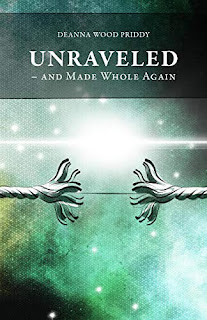
Weekly Reader: Unraveled and Made Whole Again by Deanna Wood Priddy: Short Slim But Intriguing Book About Religion and Faith


Weekly Reader: Unraveled and Made Whole Again by Deanna Wood Priddy: Short Slim But Intriguing Book About Religion and Faith

By Julie Sara Porter

Bookworm Reviews


Spoilers: Deanna Wood Priddy's memoirs Unraveled and Made Whole Again is a very short slim book. However, in its brief length it tells an interesting story about Priddy's religious background and how her faith led her through difficult times.


Priddy spends a lot of time describing her childhood as a preacher's daughter going from revival to revival. Her recall is fascinating as she remembers her father discovering religion after a nightmare and goes from being a drywall worker and painter to a minister.


Some of the highlights in Priddy's book are the various revivals. The Reader can practically hear the religious music, see the excited faces, and feel the sweat of hot days, pre-AC buildings and tents, and large crowds.

While some might disagree with the veracity of Priddy's claims such as seeing people get instantly healed, it's not hard to get swept up in her telling of the stories. When she writes about her father praying for a man to be healed from his cancer, it is an absorbing tale. Even more so, when he is not only declared cancer free but lives to a ripe old age. Regardless of personal belief, it is an interesting story and Priddy's writing grabs the Reader's interest.


Priddy also recalls the various travels that she and her family made. Her book is filled with various anecdotes like when they visited Mexico and received assistance from their interpreter and his wife. Also the times where they traveled by bus from one revival to another, but stopped to fish or listen to Kentucky bluegrass are nice chapters. The travels and various people that they meet such as a boisterous gospel songwriter and a belligerent man with a pipe wrench who wanted to shut down the revival are some of the more interesting passages in the book.


The book is good at showing the difference between religion, the rules and standards that are practiced within a building, sometimes the practice that one is raised in without question, and faith, the personal belief system that one has and chooses that helps get them through difficult troubled times. While Priddy was raised by a religious family and household, her personal beliefs are not discussed at first. Throughout her childhood, she is just moved by her parent's beliefs, never wondering for herself. She saw things that could be described as miraculous but never really considered how it affected her life, until she got married and began a musical career.

She began a career in gospel music sending audition tapes to recording studios and married Craig, a saxophone player. Even though she was rejected by The Grand Ole Opry, she and Craig joined a gospel band until the band leader got too affectionate with her. They settled in Missouri where Priddy worked as a teacher's aide.


Priddy's father's death in 1995 was also a time of problems within Priddy's first marriage. A time of infertility before she gave birth to two daughters, frequent moves and job changes, and differing ideologies particularly when one of the churches that they joined began to transmogrify into a cult took their toll on Priddy's marriage. It got to the point where she became angry at everything and everyone, even at God for putting her in this situation.

Priddy's spiritual anger is a perfectly natural reaction and is handled well. This is the voice of someone who spent her whole life following God, never questioning what she had been taught and wondering what it cost. What was in that faith for her if all it got her was an unhappy marriage and lots of unanswered questions.

Priddy's answers became known in personal signs like hearing a man sing "I'll Fly Away" and then she and her daughter seeing a feather. These spiritual signs allowed her to gain a more personal relationship with her God and not just parrot the way she was raised.


Her renewed faith strengthened as her first husband became verbally abusive and forced her to divorce him. She thanks her girls and her God for the strength to get through the divorce, unemployment, poverty, and a prolonged custody battle. She managed to get through those difficulties and her daughters remained with her, developing talents in art and music. She also began a relationship with Kirk Priddy, a former boyfriend and drummer with his family gospel band. This relationship evolved into a romance and happy second marriage as they formed the band, Unbroken. 

Besides her renewed faith, what also helped Priddy was seeking counseling. This was in contrast to her upbringing which insisted that God could fix anything so psychiatry and counseling were unnecessary. Priddy broke from that upbringing when she realized that "God has counselors too." She found one that encouraged her and helped her relieve much of the anxiety and depression that filled her throughout her life.


 Deanna Wood Priddy's book Unraveled and Made Whole Again is brief but tells a marvelous story about how one can find their own faith and strength to move on in even the toughest situations.