Showing posts with label Racism. Show all posts

Tuesday, July 14, 2026

Borrowed Times by John Glynn; Decent Historical Fiction Has One Glaring Flaw


 Borrowed Times by John Glynn; Decent Historical Fiction Has One Glaring Flaw

By Julie Sara Porter 

Bookworm Reviews 

Spoilers: Borrowed Times by John Glynn has a lot of promise. It's a bildungsroman about a young Englishman trying to find his path in 1940’s and 1950’s Rhodesia but could be so much better. There is a huge glaring flaw that must be addressed.

Melvyn feels rootless and out of place within the rigid expectations drilled into by his harsh boarding school upbringing and his self-involved status seeking mother and stepfather. He takes his interest in antiquities and cartography to Rhodesia to stay with his older brother Tristan. Rhodesia is still under British rule because of colonialism and there are hints of rebellion on the horizon.

There are parts of Borrowed Times that are worth reading. Melvyn’s character is particularly developed through his experiences in school. 

His encounters with a rigid class system born from aristocracy is compelling. He is someone who recognizes the privilege that is installed by others because of their birthright. They were born at the finish line and Melvyn feels insignificant because of them. 

When Melvyn travels to Rhodesia, it's to find a sense of belonging that he is denied from his indifferent family and the society in which he was raised. He gets along with his brother and sister in law rather well. There is an agonizing moment where Melvyn’s true affection for his brother/surrogate father figure is revealed.

Setting also makes the book. While in Rhodesia, Melvyn moves out of his comfort zone by doing rigorous farm work, preparing maps, and exploring the landscape around him. The book is filled with descriptions of the landscape without resorting to assumptions to depict Rhodesia as a savage backwater or an idyllic paradise. Instead it is both realistic and atmospheric. It captures the environmental and political structures which characterized the country during that point in time.

Politics are actually part of the issue. Melvyn befriends many native Rhodesians and begins to understand their concerns about the restrictive white establishment. It's a situation that we can see will create the subsequent years of segregation and racism that still mar the country years later.

However, this is at the expense of a local voice which is the book's glaring flaw. We only receive primarily Melvyn's voice, a white newcomer from an English background not from a local black character. It lacks intimacy and authenticity At the very least, a Black character could have shared narrative duty with Melvyn. 

Otherwise it's similar to a Hollywood movie that uses a white voice to tell what is primarily a story involving the Black experience. It projects the overall impression that Glynn could only tell this story at a distance from someone separated from this experience instead of from the people who actually lived it.


Saturday, August 24, 2024

When Banana Stains Fade: A Jamaican Family Saga of Adversity and Redemption by Frances-Marie Coke


When Banana Stains Fade: A Jamaican Family Saga of Adversity and Redemption by Frances-Marie Coke 

Spoilers: When Banana Stains Fade: A Jamaican Family Saga of Adversity and Redemption by Frances-Marie Coke is the second book in a row dealing with intergenerational conflicts concerning mother and daughters after Red Gifts in The Garden of Stones by P.A. Swanborough. While the latter trod a thin line between the reality of the family in question’s situation and the fantasy of their pagan past, the former has no such detours into the fantastic. It is firmly set in the reality of racism, poverty, classicism, gender inequality, domestic violence, and generational conflicts. All of this is in a setting that is quite familiar with this blog. In fact, it was a setting that was quite common in the books that I read and reviewed last year: Jamaica.

In 2002, Zarah left New York for her childhood home of Jamaica. Her parents, Esther and Bradley and grandmother, Naomi are worried and anxious about their daughter's sorrowful return and her memories of an unhappy abusive marriage left behind in New York. Esther’s concern is also joined by loving but strident remainders that she told Zarah that her marriage wouldn't end well. Her kind anxious demeanor often features acidic attacks on Zarah’s choices and personality. This behavior causes their already volatile relationship to become even more strained and leads to threats of estrangement between mother and daughter. Naomi views the conflict with empathy and understanding. After all she had been through something similar with Esther, just as her mother, Pearlie and Aunt Eudora had been through with her, and their mother, Agatha had been through with them. So the Reader is treated to over 100 years of Jamaican history seen through the eyes of five generations of six fascinating women.

What is particularly fascinating and compelling about this book is that it ignores the touristy side of Jamaica. Oh, some of it’s there: the beautiful landscape, the friendly hospitable locals, the Rastafarian religion and its beliefs. There is even a shout out to author Sir Ian Fleming, who made Jamaica his home as he wrote his James Bond novels. But they are largely left in the background. Instead, we are shown what life was and is like for the locals and all is definitely not paradise for the people who live there. 

The forefront of the book features many of the truths that lie within Jamaica’s sandy beaches and reggae music. It is a history of colonization and racism. It is a present of poverty, economic disparity, and domestic violence. These issues are not treated with bold overlines and dramatic emphasis. Instead they are seen and experienced by the people, specifically the family that encounter them.

We are first told of Zarah’s return and her fractured relationship with her parents. We are then treated to a flashback of an affair that Esther had which ended in her divorce and Zarah’s anger at her mother. The majority of the book consists of flashbacks that begin in 1900 with Agatha, Zarah’s great great grandmother and Esther’s great grandmother. Through this family, we see the conflicts that mark one generation and cause friction with the next. 

Agatha works in a sleepy town and is dominated by her religious family, particularly her father. She is told by women around her to just accept whatever treatment that she gets from men. With only that advice in hand, she enters into a relationship with Mas’ Watson, a well-off farmer. Watson gives Agatha two daughters: Eudora and Pearlie. Agatha works to gather and tag bananas to help support her family but can’t avoid the stares and innuendo that people have about her daughters. 

People gossip about Pearlie’s darker skin compared to Eudora who is much lighter. They marvel at the latter’s perceived beauty and predict that she will go far in life. They shake their heads in dread at Pearlie and believe that she will have a future of hardship. Even Agatha’s attempts to straighten Pearlie’s hair or give her lemon juice to lighten her complexion do not hide her real appearance. 

Many degrade the young girl and Mas’ Watson shows preferential treatment towards Eudora. This shows that even when many people are from the same race, there is unfortunately still division within that race. Sometimes there are stereotypical racist beliefs about the difference between people who are from the same basic skin color but whose shades are darker or lighter and hair is straight or curly.

The scrutiny of Agatha’s daughter’s different skin tones and accusations of whether they had different fathers fill the sisters’ lives up to when they attend school. The outrage becomes so bad that after she is raped, Pearlie runs away. She resides in another village where she gives birth to her daughter, Naomi and enters into a relationship with Bertie, a man whose family helps the single mother get back on her feet. Unfortunately, Pearlie’s happiness is cut short and Naomi finds herself alone and friendless like her mother. 

Naomi ends up living with her cold religious Aunt Eudora. Eudora at first doesn’t even want to take in the girl but she is convinced to do so because of her commitment to Christian duty and how it would look within her community to reject her own flesh and blood. Out of rebellion, Naomi attends the local Catholic church and rejects many of the spiritual teachings from her aunt. 

Naomi falls in love with Miles, a musician who spins fantasies within her about moving to America and starting a new life. That isn’t all that he spins within her. No sooner is she pregnant with her daughter, Esther, than she too is left behind like her mother and grandmother before her.

In the most harrowing section, Naomi enters an unhappy second marriage to Pastor Bloomfield. Bloomfield’s abusive and controlling nature is present as he micromanages her schedule down to prayer times and how long she can meet her friends. He won’t allow her to find a career outside of caring for his home and church. In a very classicist gesture, he forces her to stop using the Jamaican patois and speak the standard British English.

 Because of her limited relationship with her biological family and limited resources, Naomi is trapped in an abusive marriage with someone who she thought was a man of God but turned out to be someone who thought that he was God and had a private church of two worshippers: his wife and stepdaughter. 

A very terrifying encounter breaks Bloomfield’s hold on Naomi and Esther and the two rebuild their lives elsewhere. Naomi reverts to the spiritual beliefs that had always provided her comfort and in an act of defiance against her ex, reverts back to the Jamaican patois that he ridiculed. 

With the generations of Agatha, Pearlie, Eudora, and Naomi we see mothers struggling with problems of racism, poverty, religious dogma, and domestic violence. Each one works and hopes that the younger generation will succeed where they failed. With Esther and Zarah, we see the results of those dashed dreams, the desire to escape, and how that unhappiness and disappointment played into their relationships as mother and daughter and the men in their lives. 

Even though Esther had a comparatively happy marriage to Bradley as compared to her mother’s with Brookfield and great-grandmother’s with Mas’ Watson, even she had troubles. In 1988, Esther reunited with her former boyfriend, Patrick who lived an affluent life in Ft. Lauderdale, Florida. She had been living a meager existence with Bradley scraping for every dollar and was growing tired of the struggle. She dreamed not only of a different wealthy life in Florida but of the dashing man who could have given it to her.

 Thoughts become actions during a hurricane and Esther ends up with a miscarriage, a divorce, and a resentful daughter. What was truly heartbreaking in hindsight was that Bradley is an easygoing, steady, kind hearted man. His laid back nature could have provided a contrast to Esther’s more rigid strident domineering control over Zarah’s life. Zarah could have had an ally when arguing with her mother. Instead she reacted to strictness with rebellion and ran away. Esther only realizes when Zarah returns that Bradley has a peculiar strength in his blundering kindness that she overlooked. 

Zarah is considered the great hope of the family. Her mother puts enormous pressure on her to succeed well in school and have the right friends. She becomes something of an overachiever with dreams of escaping Jamaica. However, she also falls in love with Damien, considering him a reprieve from her mother’s tight control and secrets which caused her family to implode. 

Unlike her antecedents, who only dreamt of a life away from the island, Zarah managed to get away and form a life for herself. But her independence came with a price tag: that of being married to the abusive Damien. 

The freedom that Zarah thought that she would experience being away from Jamaica becomes even more of a trap in New York. She is beaten, insulted, and criticized. Worse, she is isolated in a new country where she is an immigrant and has very few friends. 

However, Zarah continues to work and study, raising money in secret. She befriends a woman who takes a maternal interest into her life and helps steer her into a good direction. Zarah’s drive to get out of the abusive situation shows her to be someone who learned enough from the earlier generation to plan an escape and make a new life for herself even if it means retreating to the homes of Mom and Dad for a while.

Agatha, Pearlie, Eudora, Naomi, Esther, and Zarah all lived very difficult traumatic troubled lives but they found strength in other places. Sometimes it was through close friendships, surrogate family members, their religious faith, future goals, or aspirations. Most importantly they learned from each other. Even when they didn’t always get along and fought endlessly, their inner strength and love for each other is always shown as are their hopes that the daughters will have better lives than the mother’s. 

Sometimes those dreams didn’t always come true and depended on the next generation to make it happen. Most importantly they had each other to find comfort, sanctuary, and guides to see them through the tough times and learn from them.

Sunday, April 7, 2024

Beautiful & Terrible Things by S. M. Stevens; Contemporary Literature Looks At A Beautiful Friendship and Terrible Events


 Beautiful & Terrible Things by S. M. Stevens; Contemporary Literature Looks At A Beautiful Friendship and Terrible Events 

By Julie Sara Porter

Bookworm Reviews 


This review is also on Reedsy Discovery.

Spoilers: S.M. Stevens’ novel, Beautiful & Terrible Things lives up to its name. It's a Contemporary Literature that is about a beautiful friendship among six diverse fascinating individuals but it is also about the terrible things that happen to them as they try to maintain that friendship against their various struggles.


Charley is a bookseller who has various disorders. She has Depression, OCD, Dermatillomania, and Agoraphobia. Her life is structured and rigid from the time she spends preparing her day in her apartment above the bookstore to the amount of time she plays word searches on her phone. One day, she encounters Xander, an eloquent customer who is also a political activist. Charley eventually accompanies Xander on an outing with his friends and is quickly welcomed into their inner circle. They are a truly interesting bunch consisting of: Terrence, Xander’s colleague and fellow activist, Jessica, a financial analyst and Xander’s roommate, Sunny, a nonbinary solar panel installer who is Xander’s friend with benefits, and Buwan, an artist whose vacation home is the center of the first friendly gathering. Through a difficult few months of prejudice, political activism, violence, sexual exploration, romances, lost jobs, and new opportunities this sextet’s friendship is truly tested.

The best thing about this book are the well developed characters. The six protagonists have the type of friendship that makes the Reader think, “I want to live in that city and be a part of that group.” They are from various ethnicities, diverse backgrounds, three genders, and have different outlooks on life yet strive to retain loyal connections with each other.They are almost like the Friends gang, only more diverse and set in the 2020’s. 

The characters go through a lot of development over the course of the book, particularly in terms of relationships. During the novel, two characters tentatively begin a relationship, two more become romantically involved then break up, and one character reveals their amorous feelings towards another. That's not to mention the final pages when some are paired with different people than before, while others take their relationships to the next level. It can get rather confusing to keep track of all of the crushes, romances, and dissolution of relationships. 

Fortunately, the Super Six aren't consumed by romance and the pairings are written realistically without resorting to soap opera tropes like infidelity or love triangles. Some characters click as a couple. Sometimes they have a lot in common or visualize a future together. Sometimes they don't and that's fine as well. As strong as relationships are in their lives, their friendships are stronger. Even after a break up, they still retain those connections and think well of one another. 

As memorable as they are as a team, they also stand out as individuals. The group’s idiosyncrasies develop them and make them come alive. From Xander’s overly flowery language, Terrence’s monochromatic wardrobe, Jessica's insistence on referring to the others by their first initials, Buwan’s dragon tattoos, Sunny’s fascination with marriage and children, to Charley’s superstitious nature, these little quirks and characteristics reveal much about the people who inhabit them in a way that is natural and not cloying. 

Sometimes their quirks are tells of deeper issues especially when we learn that many of the characters have mental and emotional disorders. There's Charley with her various internal struggles. Buwan takes medication for Anxiety attacks. Terrence has an anxious and hyper aware personality stemming from his mother's lessons. Many of the other characters go through periods of loneliness, insecurity, and emotional turmoil as well. 

Once their deeper emotional cores are revealed, much of the earlier behavior that might have been waved off as “just them being them” makes sense and is sometimes seen as sadder and more tragic. These oddities were foreshadowing hints that some things may not always be right with our heroes and they get through their issues by acting out, speaking up, pairing up, hiding, conforming, or fighting against those who threaten them. They are lovable but also troubled.

Besides friendly, romantic, and internal conflicts, the friends struggle with outward controversial issues as well. Charley learns that her bookstore will be closed and she will be evicted. Not only that but one of her friends is involved with the business that wants to purchase that property. She is hurt and betrayed and dangerously isolates herself from everyone else. This economic conflict explores the class structure among the characters and how some in a higher status can unintentionally hurt others by their association.

The characters have various discussions about politics and current events and their beliefs reflect their own backgrounds and experiences. One of those conversations about undocumented immigrants becomes personal for Jessica. In the beginning, she speaks as the child of Colombian immigrants turned American citizens. She distances herself and her affluent family from illegal immigrants insisting that they are different from her. Her self-internalized xenophobia comes back to haunt her when a friend is in danger of being deported. Suddenly, those immigrants that she considered beneath her now have a recognizable face and she is forced to confront her previous views.

Race is a common theme. Terrence recalls many of his mother's advice on how he, as a black man, should go out in public. He has to consider things like his tone of voice and simple gestures like telling a police officer that he is reaching for his wallet before he does. These are things that many of his friends don't have to think about but are central to him so he doesn't get arrested or shot.

Xander encourages his friends to participate in rallies and protests, particularly involving environmentalism, sexuality, gender identity, and race relations. A Black Lives Matter protest becomes climactic when the friends face physical injury and one lands in the hospital. Xander himself displays violent rage filled behavior that he never had before to the point that he frightens Charley who observes him. While they fight for a good cause and have good intentions, the BLM protest takes a physical and emotional toll on the friends that alters their feelings for each other. Things have changed among them forever and may never be fully repaired.

Beautiful & Terrible Things is a book that is a lot like modern life. There are many terrible things, some that can be controlled like a broken romance or a lost job. Some that cannot such as a faltering economy or systemic racism. These things can test us physically, mentally, and emotionally. However, there can be beautiful things as well: a new relationship, time with friends, the pursuit of one's interests or occupation, a pleasant vacation, and a wonderful group that feels like a family and can experience those beautiful things as well.


Sunday, February 11, 2024

Try the Leopard's Mouth by Charles Moberly; Dull Colorless Protagonist Weighs Down African Historical Fiction

Try the Leopard's Mouth by Charles Moberly; Dull Colorless Protagonist Weighs Down African Historical Fiction 

By Julie Sara Porter

Bookworm Reviews 


Spoilers: Charles Moberly’s Try the Leopard's Mouth commits one of the worst literary sins. He tells what could be an interesting history of a traumatic time in a country's history from the point of view of a newcomer who is dull, shallow, and only mildly transforms and evolves despite the stressful time surrounding him. It's a tale of the Armchair Protagonist, a protagonist who only serves as an observer reporting what they see around them while the Readers receive more interesting stories second hand. 


Tom Etheridge decides to leave his drab English life behind for adventure and excitement in Africa. He became a farm manager in Rhodesia (later known as Zimbabwe Rhodesia) in the 1960’s right as the Rhodesian Bush War began. He becomes disenchanted by the farm in which he works and his tyrannical employer. He has dreams of buying a farm of his own. He is attracted to Briony, a local woman with her own ambitious drive, and they end up working together on a farm of their own. They discover a rare drug that Tom eventually grows and Briony markets. The duo then finds their love tested by war, racism, ambition, greed, and a colonial system in which the black natives are exploited and the white government is in control. 


Try the Leopard's Mouth has the potential to be a great novel, but falls hard. The Rhodesian Bush War was a very traumatic time in Zimbabwe Rhodesian history and deserves to be explored in every capacity possible. The history of colonialism in general and British colonialism in particular left a dark mark within many countries that is still being felt around the world. Unfortunately, this book does not convey that. It suggests some things about how colonialism was bad for the country. How black and white people were segregated, How a system in which the ruling elites eventually collapsed in on itself. There are various points where Tom, Briony, and others realize that even with their good intentions they still perpetuate and allow a racist system to thrive.


Unfortunately, these glimpses are used sporadically because of Moberly's decision to tell the book solely from Tom's point of view. It cannot be stressed enough what a flawed point of view it is. Tom is merely a reporter, an observer of all that is going on. He is a privileged white man who arrives in Rhodesia for excitement. In the beginning, he says that he has no opinion either way about the Rhodesian government and their policies and exhibits very little change through the book aside from his status and romantic relationships. Because of his background, Tom only has a limited view of the events that surround him. He looks at the situation in Rhodesia  through this narrow limited lens so when he exhibits some personal change, it seems hollow and unearned.

Despite a plot trajectory that involves war, racism, sexual assault, criminal activity, death and many things that would cause great change in character, it really doesn't transform Tom. In fact, the final pages suggest that he has learned nothing from his experience and in fact regresses. This makes him a very boring character. A potentially exciting plot that covers years of struggles, conflict, and great metamorphosis requires much more dynamic characters to narrate it.


What is particularly egregious is that the book has better options for protagonists, one right in front of Tom: Briony. She would make a much more compelling narrator as she is familiar with the land and the government. She has plenty of ideals and is involved in dangerous and potentially rebellious activities against the government. She could reveal her struggles of being a farmer and businesswoman surrounded by misogyny. Her realization of what she allowed the government to do would be much more traumatic coming from her because she is someone who lived in the country for years, has family there, and felt acceptance around her. Her discovery that the acceptance came at the cost of diminishing and dehumanizing the black population, many of whom were long time friends, would be a legitimate cry of pain.


There are several chapters where Briony tells her life story or another character updates Tom on her status. Her story is one that is colorful, dangerous, exciting, vibrant, and stressful. She had to deal with abuse, sexism, misogyny, assault, abandonment, violence, corruption, and unhappy relationships. She took many risks and was involved in various adventures that required her to use great skill, intellect, attractiveness, and sexuality to survive. She steals every moment and every time that one of these chapters in which her story is summarized to Tom, I think, “Why aren't we reading about this? Why are we hearing about it secondhand?” Tom’s first person narration becomes a barrier to Briony’s much more interesting story.


There is also an elephant in the review that must be discussed. Even more egregious than leaving out the perspective from the far more interesting Briony over her bland and colorless love interest is this, why is a book set in Rhodesia and deals with the racism inflicted on the black population from the white government told from the point of view of a white character? Why isn't it told from the point of view of a native Rhodesian? This is a story that involves that country and its people. The people of Zimbabwe Rhodesia are more than capable of telling it themselves by revealing the impact colonialism and racism had on the country and its residents. 

Alternatively, why is it solely told from Tom's point of view? Another option could be to widen the narrative. Why can't it be third person omniscient or first person told by several characters from different backgrounds, status, races, and experiences showing the Rhodesian Bush Wars from multiple encompassing viewpoints? Ironically, in a book in which white characters discover that they are pawns in a racist government determined to maintain their grip and deprive the people of their own voices, the book does the same. Tom ends up being the spokesperson depriving Rhodesian characters a voice of their own. 


Try the Leopard's Mouth could be so much better with stronger narrators and a more intimate focus on the situations that the book dances around. The Rhodesian Bush Wars was a time that should be explored and dissected but in a better book than this.


Saturday, November 4, 2023

Lit List LitPick Book Reviews


 Lit List: LitPick Book Reviews
By Julie Sara Porter
Bookworm Reviews

It's no secret that I have been incredibly busy this year working on other projects. When I haven't been   reading and reviewing books for the   Bookworm Reviews, I have been editing,   summarizing, and reviewing books for   other sources. I would like to highlight some of those other sources.                                                                                                            


Here is a brief summary and review for the books that I have reviewed for LitPick Book Reviews site. Because of restrictions, I cannot post the full reviews here so I am just posting brief summaries and reviews


The Cuban Gambit by Jay Perin 

The third volume in this series. It involves the powerful, wealthy, and ruthless Shepherd, Barrons, and Kingsley Families who in the wake of their defeat of archenemy, Jared Sanders find themselves embroiled in corporate takeovers, extramarital affairs, kidnapping, scandals and plenty of drama.

This wide encompassing series features a wide variety of multifaceted characters with various goals and motives. There is enough glitz and glamor to put an 80's night time soap opera to shame and enough intergenerational conflict, high stakes, and deep characterization of a Shakespearean Tragedy. It reveals the inner personal struggles of various public figures with all of their conniving schemes and on rare occasions their empathetic warmth.


The Devil's Calling by Michael Kelley

Academic couple Sean McQueen and M Edens are adjusting to a new life together with their children and their recently established all-female college. Unfortunately, a new AI program and some messages from a previous enemy reawakens old fears and grudges as M is about to go on a lecture tour.

This book is awash in both science and spirit to make a technological and metaphysical masterpiece. Sean and M take different views but are able to bridge those views into something that combines the best of both worlds.

They are aided by a brilliantly written circle of friends and family and a deep abiding love for each other. This allows them to overcome every struggle and work together when it comes to a dramatic confrontation against an old enemy


Art Imitating Life by Claire Merchant

After a devastating breakup, Paige Stewart and her friends Liam and Nathaniel (the latter of whom has a crush on Paige) find themselves in a parallel universe. In the fantasy kingdom of Avellithia, the trio must play the parts of Sage the Sorceress, Nathaniel the Rogue, and Liam the Archer to fight an approaching army. Along the way, they discover counterparts of everyone they know and get involved in various romantic engagements.

The parallel universe of Avellithia is very interesting and well written. Unfortunately, it's buried under too much Teen Romance. The love shapes among Paige, Nathaniel, and other characters takes precedence over the potential magic, fantastic elements, and conflicts among kingdoms. The results end up becoming boring and cliche. Because of the focus on Romance over Fantasy, there are some fascinating touches that are introduced but not brought to their fullest fruition.


The Music Within Your Heart by Isaac Samuel Miller 

Songwriter, Sophia looks back on her troubled life. She comes from a dysfunctional background with a mentally ill mother, a father with a secret life, and a brother who was murdered in a hate crime. She is surrounded by racism as she attends college and tries to earn a living as a singer. She also ends up being caught between Sammy, the white son of a racist and Kyle, a charismatic African-American musician.

This is a brilliant character study of Sophia looking back on her hard life to see what went wrong and right. Her journey is both heart wrenching and heartwarming. Many of the more racist elements make for suspenseful and tense moments as Sophia doubts even the seemingly good people around her. She also navigates through her romances with grit and determination as she and Sammy have their ups and downs while Kyle proves to be a charming and engaging presence before he comes to an untimely end.


Tuesday, December 20, 2022

New Book Alert: Wicked Bleu (Simone Doucet Series Book 2) by E. Denise Billups; New Orleans Setting and Haunting Backstory Captivate Supernatural Mystery


New Book Alert: Wicked Bleu (Simone Doucet Series Book 2) by E. Denise Billups; New Orleans Setting and Haunting Backstory Captivate Supernatural Mystery

By Julie Sara Porter

Bookworm Reviews


Spoilers: If you are going to write a supernatural mystery in which a ghost of a murdered woman haunts her descendant and helpa her solve family mysteries, it might as well be set in New Orleans during Mardi Gras.

Yes, it's cliche but it is a setting that lends itself to such magic and mystery by its very nature. It is one of the best locations for this type of genre and is one of my favorite places to read about. In good books, New Orleans becomes a character that thrives on this supernatural energy and respect and reverence for all things macabre.


In this case New Orleans is not the only star of E. Denise Billups' Wicked Bleu, the second volume of Billups' Simone Doucet. The other is the title character, Bleu, the ghost of a woman who lived a life of abuse, racism, and sexual assault and makes her voice heard finally. 

First, Bleu invades psychic and magazine writer Simone Doucet's dreams and gives her visual and audio impressions of her presence. Simone had long communicated with her ancestor and spiritual advisor, Delphine so communicating with ghosts is nothing new to her. But, Bleu's presence is more threatening. 

Simone had visions of violence and drowning. Worst of all, her friend, Stacy, seems to be acting strangely like she's possessed. The answers appear to be found in New Orleans so Simone, Stacy, and their friends Mitchell and Jude go to the Big Easy during Mardi Gras to do some super sleuthing and ghost hunting.

The New Orleans setting is very prominent and is filled with spooky elements. There are many passages where Simone and her friends have to face New Orleans' undead residents.

It's an all too easy location to imagine ghosts around every corner from Jackson Square to the Garden District. 

The book also reveals the less savory aspects of New Orleans' past, particularly the Storyville section, a notorious haven for prostitution. When a location has a depraved history of racism and misogyny, there are bound to be spirits trapped because of a society that profited off another's suffering.

Much of the setting adds to Bleu's character revealing why she is a frightening and sympathetic character at the same time. Many of the chapters where she possesses Stacy add to the overall eeriness. Stacy acts contrary to her usual behavior so Simone and the others are concerned for the changes in her friend. 

 Bleu flirts with total strangers and jeopardizes Stacy's health in her pursuit of the pleasures that she had in life. She also cuts Stacy off from her friends by creating dissension and discomfort among them. In her anger over the injustices that she suffered in life, Bleu makes an effort to put the living, especially the woman whom she possesses in an emotional hostage situation. 

We also spend the last third learning about Bleu's history. Simone reads her diary and recounts an abusive lonely life with an immature prostitute mother and being subjected to abuse and degradation in her youth. 

Bleu's diary is heartbreaking as she is buried with secrets that destroyed not only her life but those of the people close to her. The racism and sexism surrounds her as she strives to make a better life for herself but ends up in a far worse situation than she imagined. This guilt and anger compel to seek revenge from beyond the grave and puts innocent modern lives at risk.

Wicked Bleu is an effective supernatural horror novel because it reminds us that some monsters are born and some are made by society.


Sunday, October 30, 2022

Weekly Reader: Racism is Real by Clive Henry; Personal Story of Encountering Racism and Turning to Activism


Weekly Reader: Racism is Real by Clive Henry; Personal Story of Encountering Racism and Turning to Activism


By Julie Sara Porter

Bookworm Reviews 


Some books that strike against racism take the historical or sociopolitical approach. They look at the whole picture of racism in the historical context describing such events as slavery and segregation and also current issues such as police racial profiling and redlining. It defined what racism is, how it was used throughout history, how it can still be recognized, and what can be done to end its still tremendous hold.

Other books are more personal. They discuss the individual experience with this harmful and ultimately destructive belief. How this person encountered racism and was then motivated to act against it. 

Clive Henry's Racism is Real takes the individual personal approach to prejudice. It is a wonderful powerful book that deals with Henry's experiences with institutional racism and how it affected his personal and professional life.

While racism is an important factor to Henry's book, it is not the only aspect to the book. Before he encounters the bigotry that made his adult life very difficult, Henry describes a happy childhood in Nottingham, England (home of Robin Hood) with loving parents, five siblings, and a love of comedy tv shows, 70's soul music, and movies by Stephen Spielberg and George Lucas. 

That idyllic youth ended with the death of Henry's father in 1983. The shift from childhood innocence to maturity coinciding with the death of a parent is heartfelt and recognizable. Familial roles shift and young people have to prepare themselves for a harder, tougher world that they are uncertain they are prepared for.

As Henry matured, his world became more complex. He eventually worked in retail, collecting data and managing stock levels. He embraced the New Jack Swing style of the mid-90's, partied, and had many romantic relationships. He also faced fatherhood at a young age, maintaining close relationships with his son and the boy's mother, Henry's former girlfriend turned close friend, Vanessa. He subsequently became the father of three other children. He also had to face the illnesses of his mother and sister.

In these chapters, we see not a perfect man but one who faces early adulthood with wild abandon and ultimately maturity and acceptance of adult responsibilities.

There were two major events that brought Henry face to face with racism. The first happened while Henry worked in the UPS Customer Service. After a great presentation, he was promoted to the Sales Department. He was excellent in making queries and practicing sales techniques, so much that he earned praise from his colleagues. He eventually became Inside Sales Executive for the Nottingham branch.

In 2008, ten years after he started working at UPS, he was put on a Performance Improvement Plan to evaluate his productivity and regain lost sales. This occurred when lynx accounts converted to UPS which Henry helped with. The results were 95% effective. Henry managed 30 staff members and collated the information. 

His work was practically flawless. He was given important managerial responsibilities and handled the merger successfully. There was no lost business. In fact, business had increased.

So why was he put under orders for improvement and why did Human Resources not sign off on it?

Those questions are merely rhetorical. There is one obvious reason especially when upon investigation, Henry realized that only he was singled out for this PIP and no one else, none of the white employees were. Henry filed an appeal and was told that "he was making a mountain out of a molehill." 

 During the appeals process, Henry received no support from his employers. He later left his job at UPS and found work as a taxi driver.

Henry's case was taken to court and made public all the way to the European Commission of Human Rights and Court of Appeal. When Henry's case went viral, he received support from many, some who have been in the same position in which he found himself.

Henry's second major encounter with racism occurred after the end of his relationship with Debbie, a woman with whom he had two children but was diagnosed bipolar. She charged Henry with rape. After Henry was out on bail, he collected information about Debbie's unstable behavior including stalking messages that she sent after Henry had been charged.

Once again Henry found himself in another court case that revealed the many cracks in the justice system, especially towards people of color. He revealed that neither Crown Protective Services (CPS) nor his solicitor sent important documentation regarding Debbie's health status in enough time to help with Henry's defense. Another barrister represented him and he was able to achieve a court victory. 

Some Readers may assume that what happened to Henry was an isolated incident of one individual. Unfortunately, there are many that share similar stories of workplace discrimination, harassment, and challenges when trying to oppose them. They happen too often for them to be seen as "just incidents." It is time for many institutions to look hard at themselves and the people who work within and require their goods and services and whether they are truly helping all people equally and fairly.

The institutional racism that Henry faced when his manager singled him out, his solicitor ignored him, and then when UPS and CPS refused to aid him reveals a harsh reality that many people of color face. They can follow all rules, obey the law, work as hard as they want, become an honest citizen and loving spouse and parent, and be considered a model employee. That doesn't always matter.

If an individual manager doesn't like them because of their skin color and that institution protects the racist manager over the employee, then yes that is institutional racism and they should be called out on it. If a person doesn't receive the proper assistance that they are legally allowed to have, then that service needs to be closely examined for their negligent treatment towards people of color.

Individuals, business, programs, and institutions need to be questioned, called out, and challenged. If a person can't treat everyone who walks through their business or governmental doors with the same care and helpfulness no matter what they look like, that person's behavior needs to be examined and they need to be removed.

Policies need to be changed to benefit all and everyone. It's not dismantling a system. It's asking it to be changed and live up to the promises of true equality, justice, fairness, and accountability 

That is true equity and equality.


Monday, September 27, 2021

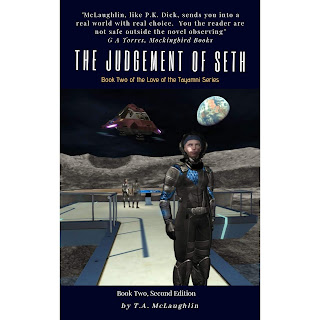
Weekly Reader: The Judgement of Seth (The Love of The Tayamni Book 2) by T.A. McLaughlin; The Struggle Among Tayamni, Tlaloc, and Potacas Gets Wider and More Intergalactic


Weekly Reader: The Judgement of Seth (The Love of The Tayamni Book 2) by T.A. McLaughlin; The Struggle Among Tayamni, Tlaloc, and Potacas Gets Wider and More Intergalactic

By Julie Sara Porter

Bookworm Reviews


Spoilers: The first book of The Love of the Tayamni series took what could be complex themes of Intergalactic space travel, prejudice, fate, and destiny and simplified them into a straight narrative. It was about a woman who was part of an ancient race of aliens sent to Earth and was thrust forward into 1960's Mississippi to protect a child who was destined to become the next Matriarch, head of the community.

It was a good way to draw the Reader into the world created by T.A. McLaughlin and to follow the story and themes. The simplicity of the first volume paves the way for the complexity of the second, The Judgement of Seth.


McLaughlin opens up the universe that she established in the first book. She introduces a larger cast of characters, new worlds and alien species, and expands on the original concepts that were previously introduced in The Love of The Tayamni. In fact, as a sign on how large this book is, most of the main characters from the previous book are reduced to minor roles. 

Batresh, the time traveling protagonist assigned to protect the future Matriarch is initiated into her role as Matriarch after her mother's death (or rather Interim Matriarch until the future one comes of age). Denny, said Future Matriarch, is still a child in 1960's Mississippi, but is beginning to remember their past life and experiencing flash forwards. They are also coming to terms with feeling like an outsider because of a toxic masculine father who insists that Denny should act like a boy. Jerry, Batresh's love interest from the first book, was let in on Batresh's secret identity and mission. He is currently living on Lunar Base and watching over Denny.


While Batresh, Denny, and Jerry are safe and snug in their own subplots (or just barely living in their subplots.),much of the heavy lifting is done by other characters. Now the Tayamni are fighting against rival alien species, the Potacas and Tlalocs. The Tayamni see that this one time private war is threatening other worlds. So many of the characters are dispatched to recruit other planets to join in the struggle.


McLaughlin really gets a chance to explore different types of planets and species. Some are mammalian and human in appearance. Others are cyborgs. Still others resemble other beings. One planet is mostly water and has aquatic beings living in this mostly liquid environment.


 Allowing the core Tayamni characters to interact with new characters shows how large this problem is. In fact, most of the action is set in space or in other worlds. The overall effect is to show that Earth is not the center of the universe (sorry fellow Earthlings). In fact, it's almost like Tatooine in Star Wars. It's far away and remote from the most important decisions made by the higher powers, yet it still ends up in the thick of the action. 


The interactions between old and new characters allows them to open up and build relationships. Kirashi, a Tayamni, develops a romantic relationship with E5, a cyborg. 

She also relates the backstory of the First Ones, the ones who came to Earth and merged their DNA with Earthlings. They were once the Nine but now they are the Eight when Seth broke from the others and killed his brother. (A story that is also known in Egyptian mythology. Remember Set and Osiris?) It is implied that Seth got the Tlalocs and Potacas the power and will to fight the Tayamni. Kirashi's story gives the characters an understanding about why this struggle will eventually affect everyone and why allies are needed.


Batresh's sister, Namazu has a large important character arc. She ascends to the rank of Supreme Commander and takes the lead in fighting against their enemies. She, as many of the characters do, questions the Tayamni Code which encourages love towards everyone, even their enemies. Since Namazu is at the forefront of most of the fighting, she is the most conflicted between the code that she was raised to believe and the current drive to bend and even break it. She also finds and loses love on a personal level as she is mourning the death of colleagues while falling fo someone who is borderline obsessive.


For most series, the second book often feels like filler. The first book introduces us to the world, characters,and conflicts. The third is the final battle where everything gets resolved. Therefore, the second is often filled with personality clashes and side quests that are only meant to fill up pages and not carry any weight in the end. The second book introduces a meeting point for the third book to catch up with in 1977, but everything in the book feels important. Instead of distracting the Reader, The Judgement of Seth, expands on their previous knowledge and helps this universe grow and deepen.


Sunday, September 5, 2021

Weekly Reader: The Love of The Tayamni (The Love of The Tayamni Series Book 1) by T.A. McLaughlin; Complex Science Fiction Series Begins in Outer Space, Ancient Egypt, and 1960's Mississippi


 Weekly Reader: The Love of The Tayamni (The Love of The Tayamni Series Book 1) by T.A. McLaughlin; Complex Science Fiction Series Begins in Outer Space, Ancient Egypt, and 1960's Mississippi

By Julie Sara Porter

Bookworm Reviews


Spoilers: T.A. McLaughlin's The Love of the Tayamni series is complex in theme, narrative structure, and world building but the complexity is what makes it memorable. 


The first book, The Love of the Tayamni, offers an introduction to the overall narrative, story arcs, and characters. Millions of years ago, a species of cyborg humans were forced to leave their home galaxy because of war, disease, and apathy. A group called The Nine or the First Ones brought them to a new world to save their  people. That world is revealed to be Earth and the Nine have names like Osiris, Isis, Nut, Sekhmet, Hathor, and so on. (You might have heard of them.)

The beings that arrived on Earth are called The Tayamni. They  spliced their DNA and taught sacred languages with species that were on the brink of extinction.  Many Earthlings in fact have Tayamni ancestry.

 Many of the Tayamni settled in Kemet AKA Egypt and are human in appearance. They are very spiritual but technologically minded. They believe in reincarnation believing that the body, or ba, dies but the spirit, or ka, will be reborn as is projected for their deceased Matriarch.


Because of their technological advancement, the Tayamni also have far seeing abilities which allows them to see potential destruction in the future and to travel through time into the future to fix the problem. This occurs after the Matriarch dies. Her ka is foreseen to be reborn in the 20th century to a male child who will reconcile both his masculine and feminine sides into a being that exists beyond gender. This future Matriarch will lead the Earth into a new age of peace and spiritual prosperity. 

Unfortunately, the Tayamni also see an alternate timeline in which another alien human hybrid species, the Potacas are going to kill the reincarnated Matriarch as a small child. So the late Matriarch's daughter, Batresh is assigned to go forward to 1960's Tupelo, Mississippi to protect the future Matriarch who goes by the name of Denny Shields. 

Meanwhile, Batresh's husband, Amun, sister, Namazu, and other colleagues are investigating other leads that could bring catastrophic consequences in this timeline that occur on other parts of Earth like Yellowstone National Park, Charleston, South Carolina, and Vietnam. The leads concern another species,The Tlaloc that are also bent on destroying or controlling the planet and are working with or controlling the Potacas to achieve those goals.


The world building that goes into creating The Love of the Tayamni is well crafted with amazing detail. The Tayamni are dissected through their interpersonal relationships, social structure, morality code, and their overall impact with the Earth and their home world. Their species combines ancient spiritual beliefs with futuristic technology. The Tayamni's  connections to Earthlings becomes beneficial for both. The Tayamni are able to preserve their dying race and humans are able to adapt and evolve thanks to the Tayamni influence.

The theory of aliens coming to Earth centuries ago and becoming involved with ancient cultures is almost a joke or a meme now. However, McLaughlin presents a book that not only explores that possibility but does so in a way that becomes believable. 

The Tayamni have a code in which they cannot harm others. However it is not absolute and some like Batresh are told that they can go against the code to achieve the larger picture. This becomes more complicated when the Tayamni reveal themselves as ancient people who still need to learn and that  code is questionable when the enemy wears a human face.


The conflict and themes make the series complicated but McLaughlin wisely limits the first volume to Batresh's experiences. Through her, McLaughlin shows a woman raised as a human with no memories of the home world questioning her existence when her family tells her that they are from another world. She questions her identity and even more so when she is given the task of protecting the future Matriarch (who remember was once her mother but is now a small boy).


While in the 1960's Batresh questions her identity and purpose. She is mated to another Tayamni, Amun, and like all Tayamni is polyamorous. When she meets Jerry, a Mississippian who helps her protect Denny, she has to reconcile her Tayamni lifestyle with her developing human emotions for him. 

Batresh has to struggle with more than the Potacas and Tlaloc who want to do away with the future Matriarch and by extension the future. She has to accomplish her assignment in Mississippi in the grips of segregation during a shameful time of hatred and prejudice in which the Potacas and Tlaloc feed off of. They use that hatred to influence and control humans to do theit vile works for them. Of course in reality, we don't need alien species to commit hateful deeds. On Earth, there are many who are more than capable doing that on their own.


The Love of the Tayamni eases the Reader into the more difficult far reaching complications in the subsequent volumes without insulting the Reader's intelligence and pulls them into the immediate story. It is the first easy step into an increasingly more difficult but 

well written universe.


Thursday, May 20, 2021

Weekly Reader: Little Blue Eyes by Rob Santana; Little Baby Brings Big Trouble and Tough Decisions


Weekly Reader: Little Blue Eyes by Rob Santana; Little Baby Brings Big Trouble and Tough Decisions

By Julie Sara Porter

Bookworm Reviews


Spoilers: Rob Santana has made a career of writing about people making rash and reckless decisions, usually in moments of desperation. His previous work, The Oscar Goes To and his latest work, Little Blue Eyes feature people that do things like appear in adult films, steal and withhold information, deal and buy drugs, and practically kidnap children. These decisions are often abhorrent and create problems for the characters. But Santana writes these characters with a lot of understanding so that the Reader sees that they were made not from intended malice but by other forces like poverty, addiction, revenge, envy, and simple desperation to improve one's life no matter the circumstances. They act and don't stop to consider the consequences. It's later that the consequences come back to haunt them.


That is the situation faced by Elena Mitchell, protagonist of Little Blue Eyes. Elena has been recently let go from her position at a bank even though a lesser qualified woman was promoted in her place. (The Latina/African-American Elena suspects racism since the blond woman not only cannot do the job but can't speak Spanish very well which is a requirement and in which Elena is fluent.) Worse, her sister Terry is moving in with her soon-to-be-fiance and they are having a baby. Terry rubs further salt on the wound of Elena's life that she is unable to bear children, a painful reminder for her.

 While on a fruitless job search, she hears a cry from behind a dumpster. A small Caucasian baby boy with blue eyes stares at her. Elena picks up the little one and falls into confusion and love. 

After some indecision and contacting the wrong people, Elena decides to raise the baby herself and name him Todd. That is slightly complicated when she arouses suspicion as a biracial woman carrying a white baby in an economically disadvantaged neighborhood of mostly black and Latino residents. (She tells them that she is babysitting.) Of course it isn't too long before the police, a dangerous baby broker and his team, and Todd's less-than-stellar birth parents are on the case and Elena finds herself in a world of trouble.


There are conflicts within the book and unfortunately many of them are caused by Elena's actions. The first thing that Elena does is take Todd to a hospital which is good and makes sense. But the second thing that she does is unexplainable. Instead of contacting any authority figures, adoption agency, or family services, she calls a baby broker, Carlos Ruiz. Not only that but she tells him that the baby is white, a prime catch for baby brokers, since they can sell Caucasian infants to wealthy white families and make a profit. True, Elena changes her mind and grows attached to Baby Todd. The book also makes it clear that she is not a cruel heartless person. She is driven by poverty and possibly mistrust of the police or other official services. She sees no reasonable way out. The worst that she can be thought of is reckless and thoughtless. However, her calling Carlos leads to worse complications that could have been easily resolved if she hadn't called him.


To be fair, Elena may make rash and hasty decisions but once she starts actually caring for Todd, she holds his best interests at heart. She protects him as a lioness would protect her cub, often bringing him along on job interviews, or introducing him to friends and family. She properly feeds, cleans up after, and nurtures the little one and protects him from danger. (Granted, danger she put him in herself.) When things get too dangerous, she makes a very tough decision out of love. It becomes clear that contacting Carlos was a mistake, but it doesn't diminish her love for Todd or her role in his life.


By contrast, Todd's birth parents, Sharon and Nick, make plenty of mistakes and are proven to be inferior parents. They are a pair of addicts who are more interested in their next fix than caring for a baby.

The whole reason that Todd is behind a dumpster in the first place is because Nick coerced Sharon into abandoning him at the hospital waiting room and he was left outside by accident. When they finally regret their decision to give Todd up, they harass and stalk people to get answers. (This is not only foolish but unnecessary since it's later revealed that Sharon's uncle is a cop and they could have just asked him. Though they probably didn't want him to know about their addiction or their shameful neglect of Todd.) There is a lot of covert racism as they harass Elena's neighbors and mistrust them on sight.


While they are more self centered than Elena, Nick and Sharon are also seen as driven and desperate people. They are certainly more unlikeable than Elena but they are seen as people who are so bound to their addictions that they put their own lives and that of their child at risk. Even when they search for Todd, it seems to be less out of love and more out of desperation. There is a moment though that the Reader encounters the hurting and suffering would inside and how they regret the path that their addictions led them on as they realize that they could have been a happy family, but were unable to be.


 Little Blue Eyes becomes a clear choice between a baby's addicted seriously messed up birth parents or an unemployed troubled potential adopted mother. While all three have their flaws, only one actually has the baby's best interest in mind and proves to be the real loving parent.


Thursday, March 4, 2021

New Book Alert: Moonlight Becomes You (An Eidola Project Novel Book 2) by Robert Herold; Supernatural Horror Covers Spiritualism and Racism in Post-Civil War USA


 New Book Alert: Moonlight Becomes You (An Eidola Project Novel Book 2) by Robert Herold; Supernatural Horror Covers Spiritualism and Racism in Post-Civil War USA

By Julie Sara Porter

Bookworm Reviews


Spoilers: William James (1842-1910) is a prominent name in the worlds of psychology and parapsychology. The elder brother of author Henry James, William was a well established psychologist and philosopher, even considered the "Father of American Psychology." He was a firm believer in the pragmatic school of thought that the value of truth was dependent on the person who held it. He was also interested in the field of metaphysics and Spiritualism and was a founding member and vice-president of the American Society of Psychical Research. James observed mediums, notably Leonora Piper and evaluated 69 reports of her mediumship. He also contributed studies on mental telepathy. Even though many challenged his research, James' work was a contributing factor that paved the way for parapsychology to be treated as a legitimate science. 

Well with that real life background, William James would be a perfect candidate for a historical mystery horror series and well he is.


William James is one of the ensemble cast of The Eidola Project, Robert Herold's series in which James and his crew investigate supernatural occurrences in the Post-Civil War United States. The other project members consist of: Annabelle Douglas, James' second in command, a hypnotist with a secret addiction to laudanum, Dr. Edgar Gilpin, an African-American physicist and somewhat of a skeptic who is a frequent target of racism, Sarah Bradbury, a former sideshow/vaudeville medium who allows ghosts to speak through her and gets psychic impressions by touching those around her, and Nigel Pickford, a Confederate Civil War veteran and recovering alcoholic who has terrifying precognitive abilities but is cursed to never be believed. This is a group that not only witnesses terrifying things but are equally haunted by their own troubled past, secret vices, and their recent acquaintanceship with each other which still carries a great deal of mistrust and suspicion.


The latest case, Moonlight Becomes You, causes much of that mistrust and suspicion in house to explode while the Eidola members investigate a series of graphic murders. After African-American doctor, Joseph Curtis becomes the latest to be mauled to death by a werewolf in the segregated town of Petersburg, Virginia, Rev. Green calls on the Eidola Project to investigate these odd attacks. 

The James Gang not only has to deal with this monstrous creature who will tear its victims to pieces as soon as look at them, but they also have to deal with racists and the Ku Klux Klan, mistrust within the Petersburg community, and their own infighting before they can function as a team and take on the werewolf.


Moonlight Becomes You is a terrific book that captures both supernatural and real horror. The werewolf attacks are extremely violent and bloody. This is not a corny Hollywood cheese fest. When a person is attacked by the werewolf, they are ripped apart with blood and vital organs exposed. The attacks are not to be read unless the Reader has a strong stomach. The werewolf also lives off of pure animal instinct and will attack someone that they know and love just as easily as someone that they despise, leaving its human form to be tormented by intense guilt with only a slight comprehension of what they have done.

Along with the werewolf attacks, supernatural horror can be found within the Eidola Project members themselves and the people that they encounter. Marie, a vodou priestess is tortured by her fear of the werewolf and is institutionalized. In one of the creepiest passages, she commits self-harm by beating herself in the head while strapped in the asylum. 

Another creepy character is Monique, a witch and former lover of Nigel's. After their union ended in disaster, Monique leaves him with 

a curse as a parting gift. This curse ends up filling his thoughts and dreams so that he not only sees visions of the future but is tortured by hauntings of the people in the past that he couldn't save. Monique gets a sadistic delight out of driving her ex to alcoholism and near insanity.


Speaking of which, Nigel and Sarah's abilities are pretty terrifying as well. Throughout the book, Nigel suffers from PTSD hearing the voices of the men in his regiment accusing him of letting them die. He also has images that he can't always explain of things that will happen and even though sometimes there might be a cast change in those visions, they still happen (for example he dreams that Edgar will be attacked by the werewolf, but Edgar survives only for someone to get attacked in the same way). So Edgar's visions are inevitable and nothing can stop them.

Sarah's abilities also provide some scary moments. When she touches the late Dr. Curtis's sleeve, she sees the full attack with herself as Curtis. Another time she performs a seance and talks in the low baritone voice of an African-American man who reveals a secret known by his bemused and frightened friends. Both Sarah and Nigel are mentally scarred by their abilities that drive them to depression, anxiety, exhaustion, fear, and an inability to connect with anyone else because of what might happen to them.

These books suggest that having these supernatural abilities is not a pleasant experience and if not properly trained and understood could result in exploitation, insanity, and addiction to control them.


Unfortunately, the horror doesn't end with the otherworldly. There is enough fear found in the physical world as well, one that the Eidola Project faces firsthand. Many question the group's interracial and unisex makeup. They are also the frequent targets of the Ku Klux Klan. Edgar is met with hostility and physical and verbal attacks from the Klan. When he falls in love with Saphne, a local woman, the

Klan attacks increase especially, when he learns that she had been frequently raped by her white employer.

One of the chapters that perfectly reveals the racial tension that surrounds the novel is early in the book before Dr. Curtis is killed. Curtis tends to a white woman in labor who unfortunately dies in the process. Even though Curtis did everything that he could, she still died. Curtis knows that her husband, a long standing Klan member, would accuse him of murder even though he tried to help her. He is not surprised when he is surrounded by the white robed Klansmen.

While there technically is no correlation between the werewolf attacks and the Klan's presence, there is a possibility that the disruption of racism and hatred found in the physical world plays just as much damage as the supernatural attacks from the werewolf. That this hatred in the physical world bleeds into the disruption in the metaphysical world.


Along with the human and metaphysical world, the Eidola Project members are conflicted within themselves. James tried to act as a loving and sometimes exasperated father figure to four very dysfunctional and troubled adults.

Annabelle and Nigel both suffer from their addictions to laudanum and alcohol respectively. James is concerned that these addictions could affect their minds and abilities and tries to cut them off. However, subsequent final chapters show both reaching for the bottles in private suggesting that climbing out of their addictions will be long and painful.

Nigel and Edgar both have to deal with racial tension as well. Nigel represents the former white Confederacy, one who spent his life looking at black people as inferior. He simmers with distrust toward Edgar, a black man who represents everything he isn't: educated, eloquent, even tempered to a point. He resents having to treat Edgar like an equal. 

Likewise, Edgar represents the black men and women after the Civil War. Though Edgar was free and acquired an education, he is still looked upon with mistrust and has to jump through twice as many hoops as his white colleagues to receive even a fraction of acceptance from them. Through both men's conflicts with each other, we see the figurative ghosts of the past of slavery and war and how they still leave scars on their present psyche. Though some moments such as when the two save each other from the werewolf and when they refer to each other as a friend during an argument with locals, suggest that friendship and acceptance may be in the near future.


Moonlight Becomes You is part of a very brilliant series that covers how both the physical and metaphysical world can be haunted and healed by our actions.