Showing posts with label Civil War. Show all posts

Tuesday, September 5, 2023

Weekly Reader: Everlasting Spring Beyond Olympus Volume 2 Colton and Blue Star by Francis Audrain; Sequel Mostly Better Than The Original Everlasting Spring Book


 Weekly Reader: Everlasting Spring Beyond Olympus Volume 2 Colton and Blue Star by Francis Audrain; Sequel Mostly Better Than The Original Everlasting Spring Book

By Julie Sara Porter

Bookworm Reviews


Spoilers: Francis Audrain's previous volume in The Everlasting Spring Beyond Olympus series, Benjamin and Boudicca was an incredibly uneven work. It recreated the leadership and independence in Boudicca, Queen of the Iceni, but it came to a screeching halt when Benjamin, a newly converted Christian found himself in Britain and spent most of his time trying to convert the queen to his religion rather than actually helping her fight the Romans. It was clear that Audrain cared more about pushing an agenda rather than telling an engaging historical fiction or even an accurate one (especially since Christianity didn't enter Britain until centuries after Boudicca's death). I suggested that it might have been better if Benjamin encountered a historical character that actually did convert to Christianity or at least a fictional character.

However, Audrain's second volume, Colton and Blue Star, improves on that. While Christianity is a huge part of this book, it is relegated to the background with characters letting their actions and values represent their religious beliefs rather than constantly talking about them. It also presents a fascinating novel with characters living through times of great change and turmoil and how they survived through times of emigration, violence, harsh conditions, war, and racism. Except for a few respects which I will get to later, it is mostly a better volume than Benjamin and Boudicca by far.

The book begins in 1820-40's with Fiona Daley, an Irishwoman who loves to study the history, literature, and legends of her country, particularly the story of Boudicca (who is implied to be her ancestor, tying the two books together). With Protestants taking land and harassing Catholics, Fiona and her parents decide to emigrate to the United States. On the boat, both of Fiona's parents die and she falls in love with Aaron Patrick Cohan, a sailor. They marry and Fiona gives birth to their son, Colton Patrick Cohan.

Fiona and Aaron are pretty interesting characters who unfortunately don't get as much time as they should. It would have been nice for the book to focus on them a bit more or better yet, Audrain made a second book about Fiona and Aaron and made Colton and Blue Star the third book.

Well Colton is a good character as well and this book deals mostly with his adulthood where he moves to the west, gets involved with the Civil War, and falls in love with Blue Star, a beautiful Native American woman.

Colt goes on his own after he kills a man who raped his mother. As many do, in the mid 1800’s, the young man goes west. From a historical perspective, one of the best moments in the book is when Colton is in St. Louis. He sees several steamers and covered wagons all with the same destination as him. It is awe inspiring and at the same time sad at the thought of a country on the verge of expanding and eventually causing the decline of the environment and the people who lived there first. It is possible to feel both hopeful and in despair about the future that we know is coming. 

There are plenty of moments of historical or religious diatribe where the action stops and someone explains something, usually some form of exposition that slows the plot and even some of the characterization, but thankfully it’s not as present or as distracting as it is in Benjamin and Boudicca. Mostly the exposition serves more of a purpose than to give a sermon to the characters and by extension the Reader. Instead, it is used for educational purposes like when Fiona is teaching Colton about his country’s history and why she and her husband immigrated there or as a backstory like when Colton’s friend, Jim Hunter explains about his travels and why he is going west. The exposition can be a bit tedious but does show that Audrain certainly did his homework in writing his novel and inserting his fictional characters in this historical setting. Perhaps, he loved the research so much that he couldn’t bear to part with it so he inserted it into the dialogue as history lessons.

The plot doesn’t get moving again until Colt goes on the Oregon Trail (1980’s kids will surely recall the many bouts of dysentery and cholera, snake bites, and drowning in rivers along the way). There are some interesting details about the costs of horses and wagons, how doctors treated the patients on the trail, and the appearance of a Pony Express rider. There is also a real sense of place and setting as the wagoners travel from Missouri, to Kansas, to Nebraska, and so on. Plains, plateaus, flora, fauna, and weather are present in many paragraphs. The intent of the setting is to recognize the vastness of the lands that surrounds and overwhelms the characters. 

Thankfully, the book does not vilify Native Americans. In fact, it emphasizes how friendly and peaceable most encounters between Natives and European Americans actually are by showing trading exchanges and Natives guiding the white people along their path. In fact the few “Indian attacks” in the book are shown to be isolated incidents, rivalries between tribes, or specifically in self-defense because the European-Americans attacked first. 

Colt is, like I said, an interesting character. In the beginning he is intelligent through his history lessons but also awestruck on the trail. Everything is a new and exciting experience for him, so he learns by example. He also shows tremendous courage when he goes to help Yomba, a Shoshone chief, save his daughter, Blue Star, who was kidnapped by a rival tribe of Paiutes. 

Though cleverly, we are saved from a typical fight because Colt is taken out easily, is resuscitated by a nun, and learns that Blue Star, who is helping to nurse him, escaped on her own accord. Our hero, folks, rides a horse and gets knocked out! Clearly, there are moments to show that Colt, while eager and brave, is still out of his element and is capable of messing up and making plenty of mistakes. He also has a temporary attraction to the gold other riders have found but thankfully it doesn’t drive him to the extreme avarice and addiction of gold fever that many of the miners in California and Alaska would succumb to. Instead he settles in Virginia City, Nevada and agrees to be the partner and bodyguard to Bill Stewart to help keep the peace in Virginia City (an extremely tall order as there are plenty of violent shootouts, Southern sympathizers taking the Civil War to the west, and con men taking advantage of newcomers). 

Unlike Benjamin and Boudica, Colton and Blue Star don't just talk incessantly about Christianity. Colt acts according to his beliefs. Coming from a family that was treated horribly in their home country, Colt has a natural aversion to slavery so sides with the Union and the belief in making the United States free and equal for everyone. He also has to show a lot of honor and integrity by upholding the law against various people who want to take the Civil War to Virginia City. 

While Colt may not be tempted by gold, he is tempted by other interests, showing that though he bestows Christian behavior he is far from saintly, perfect, or self-righteous. He briefly returns to the east, discovers the fate of his parents, and enlists in the Union Army. After being wounded, he enters into an affair with Virginia, a nurse. Colt’s dalliance with Virginia squeaks by because he is under the impression that Blue Star returned to her tribe and married, but he has very little resistance in engaging in an affair with the other woman. In later chapters, it does not go unnoticed and leads to subsequent results.

While Colt is well written, Blue Star does not fare as well. She is written as beautiful, kind, quick-witted in learning to speak English and effectively communicating with Colt and other white people, strong-willed in escaping from the Paiutes on her own, and loyal to Colton who becomes her lover. However, she is treated more as the object rather than the subject. She does not get a point of view chapter and even disappears from the narrative for a time. Most of her thoughts and actions are interpreted by Colton so she is often deprived of her agency. She shows some spunk in later chapters when Colton is assigned to keep an eye on Confederate sympathizers and saboteurs. She learns information by talking to Confederates and provides it to the Union, but she is still often seen as helpless and needing rescue by Colton. It is a sharp contrast to the woman who escaped from the Paiutes and walked her own way from captivity to freedom. 

It could be since Boudicca was such a strong protagonist in the previous book, that anyone after her would falter. But Fiona is an effective lead in the beginning of this book and even gets the POV in the first two chapters. In Virginia City, there are plenty of well written women that are capable of representing themselves such as Julia Bulette, a Madam who helped build the Virginia City community. Fun Fact: Prostitutes often helped build many of the western towns and communities, using their money to build buildings like stores, schools, and churches. They eventually became influential businesswomen and community leaders in their own right. Their contribution was so important that these prostitutes were part of the reason that Wyoming was the first state to grant women’s suffrage. It’s great that Audrain includes this bit of true history in his writing. 

So Blue Star’s uneven characterization and exclusion in telling her own story is even more evident with better women written about in her own book. Audrain should have developed equal time to his heroine as he did in his hero, alternating their perspectives as he did with Benjamin and Boudicca.

Colton and Blue Star deals with much of the hardship and sacrifice of the time period, of living and surviving in an unknown land and fighting to hold the country together. There are plenty of deaths and great sadness, but there is also a strong sense of community, love, family, and friendship that can be found during those times. 


Thursday, November 25, 2021

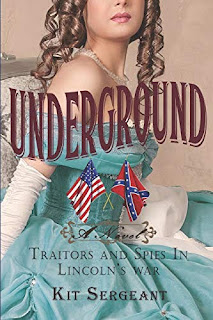
Weekly Reader: Underground by Kit Sergeant; Sergeant's Female Spies Take on The American Civil War


Weekly Reader: Underground by Kit Sergeant; Sergeant's Female Spies Take on The American Civil War

By Julie Sara Porter

Bookworm Reviews


Spoilers: The previous book by Kit Sergeant, 355, told the story of Meg Coughlin, Sally Townsend, and Elizabeth Burgin, three women who spied during the American Revolution, one of which may have been the mysterious enigmatic "355," a woman who wrote missives directly to George Washington himself.

Her next book, Underground: Traitors and Spies in the Civil War, transports us to the War Between the States. She tells of four women who spy for both the Union and the Confederacy in a compelling narrative that gives both sides to a war that still resonates throughout American history and current events.


As with her previous works, Sergeant captures different women from various walks of life that contributed to the Civil War in their own unique ways. Hattie Lewis is the second woman employed by Pinkerton's Detective Agency (the first being Hattie's mentor,Kate Warne). After successfully and secretly hiding and protecting President Elect Abraham Lincoln from an assassination attempt, the boys at Pinkerton's take notice and offer Hattie tougher and more dangerous assignments including spying.

Mary Jane Richards Bower is an African American woman who had been  freed by her employer, Miss Lizzie. Grateful, Mary Jane offers her services by working in various wealthy Confederate homes and passing information to the Union. Her contacts eventually take her to the home of one Jefferson Davis, the President of the Confederacy.

Belle Boyd is a young opinionated Southern Belle who uses her femininity and penchant for firearms to obtain information on behalf of the Confederacy in tempestuous Baltimore, which has mixed residents on both sides of the conflict.

Loretta Janeta Velazquez Williams, a New Orleans widow, takes a more direct approach to the action than the other three lead characters. She dons men's clothes and fights for the Confederacy under the name Lt. Harry T. Buford. 


I have mixed feelings about this installment, as compared to 355 and L'Agent Double which I felt were terrific with no argument. Right or wrong, a lot of my emotions towards Underground have to do with current controversies towards the Confederacy and how it is presented in historical textbooks and popular culture. There are some interesting chapters where Belle uses most men's perception of femininity against them by playing the flirtatious Southern Belle while obtaining and passing information. It's also interesting that Loretta goes the opposite extreme and dons male garb to become a soldier. However, their unapologetic Southern pro slavery views make it hard to be empathetic and root for them.

Many times their racism is made completely clear as they think of black people as subhuman. Loretta is particularly upfront using derogatory terms in her first chapter. The fact that these are women challenging roles that society expects from them and they do not see the correlation towards African Americans doing the same is jarring at best and hypocritical at worst. I know we shouldn't put modern views on the past but there are times when the difference between past and present cannot be ignored and this is one of those times.


Because of that the stories of Hattie and Mary Jane are much more interesting. Hattie tries to break through the all men society of Pinkerton's and eventually earns the respect of her colleagues through her tenacity, courage, and persistence. She spends much of the book on an extended cover assignment where she and a colleague pose as husband and wife. It's a difficult assignment as Hattie must reconcile her personal feelings with her responsibility and duty as an investigator and spy.

Also interesting is Mary Jane's story. Similar to Belle using the masculine views of femininity against her opponents, Mary Jane uses white assumptions about black people against them. She poses as an illiterate kitchen maid but can read very well and is able transcribe missives and documents. She makes her employers believe that she is unintelligent when she is quite brilliant and observant. Also of the four stories, hers is the most suspenseful as Mary Jane ends up working for Jefferson Davis' household right in the belly of the beast of racism and separatism if you will. Her time there is filled with tense moments as she is well aware that any false move, any mistake, and she could be killed by a family who wouldn't bat an eyelid over killing one of their slaves.


Unlike 355 where the stories overlap as the three leads meet and become friends, there isn't much overlap between the four stories. They cover a wide ground of several states so it is not likely that these women would have been able to physically encounter each other very much. There is one awkward early chapter where Belle attempts to seduce "Harry" but Loretta leaves before too much happens, but that's it.


Instead their connections are more thematic then physical. This is particularly prominent when Belle and Hattie are imprisoned at the same time for different charges. The women handle their imprisonment in their own unique styles as Belle flirts with guards and makes powerful allies on the outside that vouch for her. Hattie faces her imprisonment with stoic patience but also quiet terror especially when one of her fellow investigators is executed. 


Underground is yet another achievement in Sergeant's series by giving faces and names to women who otherwise would have gone unknown. It's about time they spoke and acted for themselves.

Thursday, March 4, 2021

New Book Alert: Moonlight Becomes You (An Eidola Project Novel Book 2) by Robert Herold; Supernatural Horror Covers Spiritualism and Racism in Post-Civil War USA


 New Book Alert: Moonlight Becomes You (An Eidola Project Novel Book 2) by Robert Herold; Supernatural Horror Covers Spiritualism and Racism in Post-Civil War USA

By Julie Sara Porter

Bookworm Reviews


Spoilers: William James (1842-1910) is a prominent name in the worlds of psychology and parapsychology. The elder brother of author Henry James, William was a well established psychologist and philosopher, even considered the "Father of American Psychology." He was a firm believer in the pragmatic school of thought that the value of truth was dependent on the person who held it. He was also interested in the field of metaphysics and Spiritualism and was a founding member and vice-president of the American Society of Psychical Research. James observed mediums, notably Leonora Piper and evaluated 69 reports of her mediumship. He also contributed studies on mental telepathy. Even though many challenged his research, James' work was a contributing factor that paved the way for parapsychology to be treated as a legitimate science. 

Well with that real life background, William James would be a perfect candidate for a historical mystery horror series and well he is.


William James is one of the ensemble cast of The Eidola Project, Robert Herold's series in which James and his crew investigate supernatural occurrences in the Post-Civil War United States. The other project members consist of: Annabelle Douglas, James' second in command, a hypnotist with a secret addiction to laudanum, Dr. Edgar Gilpin, an African-American physicist and somewhat of a skeptic who is a frequent target of racism, Sarah Bradbury, a former sideshow/vaudeville medium who allows ghosts to speak through her and gets psychic impressions by touching those around her, and Nigel Pickford, a Confederate Civil War veteran and recovering alcoholic who has terrifying precognitive abilities but is cursed to never be believed. This is a group that not only witnesses terrifying things but are equally haunted by their own troubled past, secret vices, and their recent acquaintanceship with each other which still carries a great deal of mistrust and suspicion.


The latest case, Moonlight Becomes You, causes much of that mistrust and suspicion in house to explode while the Eidola members investigate a series of graphic murders. After African-American doctor, Joseph Curtis becomes the latest to be mauled to death by a werewolf in the segregated town of Petersburg, Virginia, Rev. Green calls on the Eidola Project to investigate these odd attacks. 

The James Gang not only has to deal with this monstrous creature who will tear its victims to pieces as soon as look at them, but they also have to deal with racists and the Ku Klux Klan, mistrust within the Petersburg community, and their own infighting before they can function as a team and take on the werewolf.


Moonlight Becomes You is a terrific book that captures both supernatural and real horror. The werewolf attacks are extremely violent and bloody. This is not a corny Hollywood cheese fest. When a person is attacked by the werewolf, they are ripped apart with blood and vital organs exposed. The attacks are not to be read unless the Reader has a strong stomach. The werewolf also lives off of pure animal instinct and will attack someone that they know and love just as easily as someone that they despise, leaving its human form to be tormented by intense guilt with only a slight comprehension of what they have done.

Along with the werewolf attacks, supernatural horror can be found within the Eidola Project members themselves and the people that they encounter. Marie, a vodou priestess is tortured by her fear of the werewolf and is institutionalized. In one of the creepiest passages, she commits self-harm by beating herself in the head while strapped in the asylum. 

Another creepy character is Monique, a witch and former lover of Nigel's. After their union ended in disaster, Monique leaves him with 

a curse as a parting gift. This curse ends up filling his thoughts and dreams so that he not only sees visions of the future but is tortured by hauntings of the people in the past that he couldn't save. Monique gets a sadistic delight out of driving her ex to alcoholism and near insanity.


Speaking of which, Nigel and Sarah's abilities are pretty terrifying as well. Throughout the book, Nigel suffers from PTSD hearing the voices of the men in his regiment accusing him of letting them die. He also has images that he can't always explain of things that will happen and even though sometimes there might be a cast change in those visions, they still happen (for example he dreams that Edgar will be attacked by the werewolf, but Edgar survives only for someone to get attacked in the same way). So Edgar's visions are inevitable and nothing can stop them.

Sarah's abilities also provide some scary moments. When she touches the late Dr. Curtis's sleeve, she sees the full attack with herself as Curtis. Another time she performs a seance and talks in the low baritone voice of an African-American man who reveals a secret known by his bemused and frightened friends. Both Sarah and Nigel are mentally scarred by their abilities that drive them to depression, anxiety, exhaustion, fear, and an inability to connect with anyone else because of what might happen to them.

These books suggest that having these supernatural abilities is not a pleasant experience and if not properly trained and understood could result in exploitation, insanity, and addiction to control them.


Unfortunately, the horror doesn't end with the otherworldly. There is enough fear found in the physical world as well, one that the Eidola Project faces firsthand. Many question the group's interracial and unisex makeup. They are also the frequent targets of the Ku Klux Klan. Edgar is met with hostility and physical and verbal attacks from the Klan. When he falls in love with Saphne, a local woman, the

Klan attacks increase especially, when he learns that she had been frequently raped by her white employer.

One of the chapters that perfectly reveals the racial tension that surrounds the novel is early in the book before Dr. Curtis is killed. Curtis tends to a white woman in labor who unfortunately dies in the process. Even though Curtis did everything that he could, she still died. Curtis knows that her husband, a long standing Klan member, would accuse him of murder even though he tried to help her. He is not surprised when he is surrounded by the white robed Klansmen.

While there technically is no correlation between the werewolf attacks and the Klan's presence, there is a possibility that the disruption of racism and hatred found in the physical world plays just as much damage as the supernatural attacks from the werewolf. That this hatred in the physical world bleeds into the disruption in the metaphysical world.


Along with the human and metaphysical world, the Eidola Project members are conflicted within themselves. James tried to act as a loving and sometimes exasperated father figure to four very dysfunctional and troubled adults.

Annabelle and Nigel both suffer from their addictions to laudanum and alcohol respectively. James is concerned that these addictions could affect their minds and abilities and tries to cut them off. However, subsequent final chapters show both reaching for the bottles in private suggesting that climbing out of their addictions will be long and painful.

Nigel and Edgar both have to deal with racial tension as well. Nigel represents the former white Confederacy, one who spent his life looking at black people as inferior. He simmers with distrust toward Edgar, a black man who represents everything he isn't: educated, eloquent, even tempered to a point. He resents having to treat Edgar like an equal. 

Likewise, Edgar represents the black men and women after the Civil War. Though Edgar was free and acquired an education, he is still looked upon with mistrust and has to jump through twice as many hoops as his white colleagues to receive even a fraction of acceptance from them. Through both men's conflicts with each other, we see the figurative ghosts of the past of slavery and war and how they still leave scars on their present psyche. Though some moments such as when the two save each other from the werewolf and when they refer to each other as a friend during an argument with locals, suggest that friendship and acceptance may be in the near future.


Moonlight Becomes You is part of a very brilliant series that covers how both the physical and metaphysical world can be haunted and healed by our actions.