Monday, December 28, 2020

New Book Alert: Murder Under A Black Moon (Mona Moon Mysteries) by Abigail Keam; Magnificent Murder Mystery Starring Mona Moon, The Kentucky Derby, and Alice Roosevelt Longworth


New Book Alert: Murder Under A Black Moon (Mona Moon Mysteries) by Abigail Keam; Magnificent Murder Mystery Starring Mona Moon, The Kentucky Derby, and Alice Roosevelt Longworth

By Julie Sara Porter

Bookworm Reviews


Spoilers: Alice Roosevelt Longworth is among the most colorful and interesting of the Presidential children. The daughter of Teddy Roosevelt, she was known for her sense of style and outspoken nature. She was a fashionista of her day, even popularizing the color Alice Blue. Most importantly, she supported various causes like women's suffrage and assisting the poor. She had a particularly wild reputation to the point where her Dad said that he could manage the country or Alice, but not both. 

Even as she grew, she remained involved as a prominent power broker and Washington insider. Her sauciness created many soundbites like "If you can't say anything nice, come sit next to me."

Alice Roosevelt Longworth was such an interesting figure in history that if she appears in historical fiction, she could overshadow other characters. 


Well, Abigail Keam did the smart thing when she inserted her into her Mona Moon Mysteries. She pitted the historical Roosevelt with the fictional, Mona, cartographer, businesswoman, and amateur detective. In Mona, Alice Roosevelt Longworth has met her match. In Keam's Murder Under A Black Moon, the two are intelligent, wry, observant, and live for getting the last word. They are divas of the highest order who command every presence and room they are in. 


Mona and Alice meet each other at the Kentucky Derby. Mona is at the Derby with her friends Willie and Dexter Deatherage, her snobbish aunt Melanie, a pair of new money Texans called Jeannie and Zeke Duff, horse trainer Rusty Thompson, and Mona's fiancee, Lord Robert Farley (who Alice is his special guest.)  A very public and exciting race ends in murder when Rusty Thompson is found dead with a woman's hat pin stuck in his eyes. Unfortunately, it's Willie's hat pin and she is arrested for the murder!


With both Alice and Mona as important characters, Keam is able to provide her leads with some great zingers. When Mona's ruthless aunt Melanie says she is not interested in politics, Ms. Roosevelt Longworth responds " Politics is a bloodsport and you seem to be pretty good at bloodsports." When a detective questions members of Mona's party, Mona remarks that he sounds like a character from a bad Dashiell Hammett novel.

Alice and Mona are independent strong-willed women in the respective worlds of politics and business. So, they are aware that they have to speak up and make themselves heard otherwise the make population in charge would ignore or minimize them.


Their barbs aren't the only things that they have in common. Both are ardently political, though on opposite sides of the spectrum. Alice, like her late father, is a Republican and takes potshots at cousin Franklin. Mona however is a staunch Democrat and supporter of the New Deal. So the two get into political disagreements among their discovery of clues and dead bodies. 

Naturally, their divalicious attitudes get onto each other's skin such as when Alice's bluntness does little to comfort a distraught and intoxicated Willie. Witnessing her best friend emotionally chopped down by the Roosevelt woman, Mona thinks that Alice can't hop on the next train fast enough.


Mona and Alice's mere presence causes much of the rest of the book to take second fiddle even the murder investigation. The scandalous world of horse doping and horse ownership isn't near as interesting as the other worlds that Mona peers into in other books, such as the world of Egyptian archaeology in the previous book Murder Under A Wolf Moon. If you don't follow horse racing, as I do not, you can get lost in the terminology and details.

Also, Mona's romance with Robert isn't near as interesting as it was in the previous volume. Last time, Mona was torn between her independence and accepting his proposal. In this book, now that she has accepted there is very little to do but wait for approval from his father and possibly go to England. So, their romance is simply just stalling, talking, and waiting.


However, the details of the murder itself are compelling enough. In the opposite of a locked room mystery, this murder occurs right out in the open, during one of the most famous races and surrounded by hundreds of spectators. Meaning there are more than enough suspects. One does not envy the job that neither the police nor Mona have in investigating this particular case.

The book also offers some interesting subplots, particularly in the conflict between Mona and her aunt Melanie. In most cozy mysteries, the supporting cast are usually above suspicion. They are the best friends, loving relatives, baffled police officers, and regular townspeople. It is assumed that these regulars remain in the protagonist's life and usually are neither victims nor murderers. Note, I said usually.

Mona and Melanie's relationship in this volume, while not good to begin with, is severely fractured and borders on violent. It is not too much of a stretch to assume in this or a future volume that Melanie herself could be under suspicion of murder (and it may not be a surprise to learn that she did it.)


While Murder Under A Black Moon is not as good as Murder Under A Wolf Moon, the relationship between Mona Moon and Alice Roosevelt Longworth make it shine with wit and cleverness between two fascinating women: one real and one fictional.


Friday, December 25, 2020

New Book Alert: The Haunting of Gallagher Hotel by K.T. Rose; An Engaging Haunted Hotel Journey Through Hell And Back


New Book Alert: The Haunting of Gallagher Hotel by K.T. Rose; An Engaging Haunted Hotel Journey Through Hell And Back

By Julie Sara Porter

Bookworm Reviews 


Spoilers: The second dark fantasy horror book that I am reading to scare up the Holidays is The Haunting of Gallagher Hotel by K.T. Rose. It also continues another trend that has been running through the blog this year: a literal trip through Heaven or Hell. This time, it's the latter. 

The Haunting of Gallagher Hotel is an engaging trip through Hell via a haunted hotel which opens up the guest and staff's guilty secrets forcing them to confront those secrets for all eternity.


Like all haunted buildings, the Gallagher Hotel has an interesting backstory to go with the current ghostly occupants. In 1921, hotelier Trudy Mona Lisa Gallagher is condemned to death for arson, destruction of property, conspiracy to commit murder, and murder. Her business connections and illegal dealings helped put the town of Holloway, Michigan on the map and now the town has hypocritically turned against her. Trudy decides to make her disappointment known in a very public and explosive manner. She burns the hotel down and curses the town before succumbing to the executioner's noose.

Over 90 years later, the Gallagher Hotel is under new management. Brenda Scott, modern businesswoman, wants to rebuild the Gallagher and turn it into a haven for ghost hunters and tourist trap for the morbidly curious. She hires a staff and invites a select group of guinea pigs uh I mean VIP guests to experience the place in all of its hellacious glory.


The guests are the usual peculiar bunch you find in these locked room mysteries/horror stories: the war vet with PTSD, the heiress with a naughty past, the flirtatious doctor with broken hearts behind him, and the staff member who mysteriously knows every nook and cranny of this place, even more so than the owner. Everyone of these characters have something to hide that is forced open in the most gruesome and unforgettable ways.

The two protagonists in the book are two helpless individuals sucked into this nightmare. Of course they carry a lot of emotional baggage that the demons and spirits dwelling in The Gallagher don't mind exploiting for their own needs.

Riley is a young woman hired as a server for this event. She is very spiritual despite or because of a troubled past in which her son died as a result of her negligence. Riley has been unable to fully recover from his death but still hopes her belief in God will pull her through.

Chris is a foil for Riley as well as co-protagonist. He comes from a family of professional thieves who want him to accept the invitation solely to clean the place out of whatever valuables he can find. Like Riley, he too has a tragic death behind him, one that has earned him the ire of his very powerful and very dangerous family. (This robbery is meant to be his last chance). Riley and Chris are already haunted tortured people, so they are like catnip to the ghouls that are looking for a few good mortals to torture and mess with.


There are some pretty graphic passages that reveal the characters' guilty secrets in very violent means. One features a doctor being haunted not only by what remains of a patient that died on his table but an obsessive nurse with plenty of sharp medical instruments.

Another features a veteran whose war ghosts come to life literally.


There are some particularly chilling passages involving Riley, Chris, and Brenda but in the name of plot revelations will be unmentioned. However, they are pretty fascinating and clever twists which causes the Reader to rethink the characters and where they really fall in the good vs. evil spectrum. 


The Haunting of Gallagher Hotel is not the type of setting that one would want to check into in real life, but it is certainly one Hell of a vacation.

Wednesday, December 23, 2020

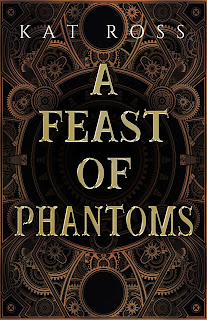
New Book Alert: A Feast of Phantoms: Lingua Magika #1 by Kat Ross; Magical, Terrifying, and Mesmerizing New Steampunk Dark Fantasy


New Book Alert: A Feast of Phantoms: Lingua Magika #1 by Kat Ross; Magical, Terrifying, and Mesmerizing New Steampunk Dark Fantasy

By Julie Sara Porter

Bookworm Reviews 


Spoilers: It's kind of weird to review not one, but two dark fantasy/horror novels for the Holiday season. But when one stops to think about it, it's not that weird at all. Of course there is the simple scheduling that I just happened to be reviewing these books this time of year. But the connection between horror, fantasy, and the holidays is actually deeper than most people are aware.  

When the harvest year died down and winter appeared, many of the ancient Pagan cultures like the Viking and Celts would tell stories of their deceased ancestors as a means to keep their spirits alive and to reassure that they have moved onto better places where they will be remembered. Even when Christianity dominated the European landscape, the idea of telling ghost stories during the Yuletide was not an unheard of concept. Some of the most famous works of European literature like Hamlet and, naturally, A Christmas Carol hearken back to that tradition.

That tradition continues to modern day. The song "The Most Wonderful Time of The Year" refers to "scary ghost stories." Many of our most popular Christmas books and movies like Christmas Carol, It's a Wonderful Life, The Polar Express, and my personal favorite, The Life and Adventures of Santa Claus, deal with that brush of the magical, supernatural, and sometimes fearful spirits and visions that appear just when days get shorter and night is the longest. And who can forget that lovable and cuddly creature from German folklore, Krampus, whose idea of a good time is to punish naughty children by putting them in a sack and beating the ever loving daylights out of them?


In keeping with that tradition of giving the Holidays a supernatural, spiritual, and spooky bent I give my Readers, A Feast of Phantoms by Kat Ross, the first of her Lingua Magika series which combines a Steampunk Western with Dark Fantasy and creates a terrifying out of mesmerizing world that is brilliant to experience and immerse oneself into.

Ross' attention to detail and world building is beyond astounding. It's one of those literary worlds that one falls into and lives in, not just reads. The setting is filled with the Western tropes with out of the way dusty towns, like Lucky Boy, the one horse town that is the residence of protagonist, Deputy Ruth Cortez. There are also references to another town called Three Bars, which was destroyed by a tornado. (Don't you just love these Western small town names?)


By contrast, there is Carnarvon City, a city of industrialization and growth. It is headed by the Carnarvon Family, a mother and her children, who seem to have their fingers in every institution in town. They don't mind stretching those fingers to the rest of the state, maybe the whole country, despite rivalries with the equally wealthy but so far unseen Braga Family.

Where the small towns like Lucky Boy and Three Bars come out of the Western tradition, Carnarvon City is built on Steampunk. There are steam trains and airships, even a few experimental automobiles, the finest in late 19th century early 20th century technology. Of course the aesthetic would not be complete without gears, telescopes, goggles, top hats, and velvet. 


What makes this setting isn't just the Steampunk aesthetic combined with Western theme. It's the fantastic aspects. This is not only a book where magic exists, but it is commonplace. So commonplace that phantoms are alive, well, and very active.

Ross clearly thought a lot about how to write about the phantoms and it shows. She provides little twists that show depths of the creatures such collective nouns (a group of Phantoms are called a feast) and classifications. There are lesser phantoms like Ruth's partner, Doc, who resides inside the deputy's gun and aids her when she requires information or defense. Then there are the larger classification level phantoms who can efficiently destroy a city in a matter of seconds.


Obviously, these phantoms are dangerous and uncontrollable. The hapless humans need help from those who can communicate and control these spirits. There are linguists, humans that can speak a few of the phantom's languages. Then there are savants, humans who can speak several of the phantom's languages. But, savants are not perceived as the sanest or trustworthy of humans as Ruth discovers when she is hired to leave Lucky Boy to guard apprehended savant, Lee Merriweather (not the actress). 


Lee has been captured by Marshall Sebastian Hardin who is acting under orders from Calindra Carnarvon, matriarch of the powerful Steampunk Carnarvon Family. At first, Ruth willingly goes along with Lee's transfer to be tried by the Carnarvons' reps in a potential kangaroo court. However, after Lee escapes, Ruth questions just what exactly the Carnarvons' and Hardin are planning. 


A benefit is that many of the characters are multifaceted and understandable, so that the Readers don't know who to side with. Ruth remains pretty likable and heroic throughout, but the others surrounding her are a curious bunch. Lee alternates between sinister and charismatic. There are also familial ties that he is protective of while others use him for their purposes.


Even Hardin and the Carnarvons who are the main antagonists show fascinating depths in character. Hardin and Ruth share a lot of chemistry implying that if they aren't yet a couple, then they will be. Calindra Carnarvon shows a lot of strength as a business minded woman in the Old West. Her children befriend Ruth possibly for genuine reasons, but just as possibly to keep a potential enemy closer.


Of course, the phantoms are also interesting characters as well. Doc is a deadpan snarker who will help Ruth at the slightest moment but not before getting the last word in. Another demon is terrifying in its powers and ability to hide in plain sight.


A Feast of Phantoms is a great and creepy world to fall into. It's creepiest to read when the nights are at their longest. It is a very commendable movable feast.


Monday, December 21, 2020

New Book Alert: The Adventures of George and Mabel: Based on An Almost...Well You Know by Stefanie Hutcheson; The Darling Duo's Third and Final Installment Ends on a Heartwarming, Touching, and Even Tearful Note


New Book Alert: The Adventures of George and Mabel: Based on An Almost...Well You Know by Stefanie Hutcheson; The Darling Duo's Third and Final Installment Ends on a Heartwarming, Touching, and Even Tearful Note

By Julie Sara Porter

Bookworm Reviews 


Spoilers: George and Mabel Harrison are this year's Maggie Elizabeth Harrington. Similar to the protagonist of D.J. Swykert's novels which I reviewed last year, George and Mabel are a couple of characters that I have gotten to know through various stages and have loved them through these stages. I have enjoyed them so much that I am a little tearful reviewing this, their final installment The Adventures of George and Mabel: Based On An Almost..Well You Know. Once again, their author Stefanie Hutcheson gives us a few stories that are not long on plot but are vast in character and charm. The Reader will sigh in delight, smile in pleasure, and finally shed a tear when the book is closed knowing that the journey of the Darling Duo has finally come to a moving and satisfactory end.


Like any well-written character, just when The Reader thinks that they know everything about the Harrison's, Hutcheson throws another bit of information to add to the depths of their personality. We are aware of the Duo's love of music and penchant for quoting song lyrics and know of their travels such as (in this volume) a spontaneous and crowded Labor Day trip to Myrtle Beach. We now learn that Mabel combined her love of music and traveling to collect music boxes. They include ones from Colorado that play "Rocky Mountain High" and "The Song Remembers When," one of LA that plays "LA International," and one of the Golden Gate Bridge that plays "Come Monday." (not "Dock of the Bay"  or "San Francisco, Be Sure To Wear Flowers In Your Hair"?). For Mabel's 43rd birthday, George surprises his wife with a music box of the Eiffel Tower that plays "Leaving on a Jet Plane" foreshadowing a bigger surprise: tickets for two to Paris. (Altogether now: Awwww!) 


These additions to their character are not meant to be earth shattering. Instead they are stimple nuanced layers that help The Reader understand them. It's almost like getting into a conversation with George and Mabel and The Reader says to George, "I didn't know you used sleight of hand with a gumball machine ring and a real diamond ring to propose to her." They are the couple that you always learn something new about them


As with the previous volumes we also learn about the Harrisons' friends and family and how their influences shaped George and Mabel into the man and woman that they would later become.  A tender WWII-era love story between George's aunt and uncle foreshadows how important finding that soul mate becomes to George and how he knows when he finds her.

Mabel gets a high school-era tale of peer pressure. When she is involved in a drink driving accident, her popular girl clique abandons her. As an adult, Mabel retains loyalty to the true friends who stuck by her even into adulthood.


Because of this being the last volume, there is a sadness present in this one, over the others. One of the darkest and best stories in all three volumes, serves as a wrap around to this volume by carrying over various alternating chapters with the rest of the text. The reason why the Harrison's never had children is revealed in an emotional story. What could be a life of regret and loneliness becomes a heartwarming story of sacrifice and forgiveness, especially when George has to make the decision to not only save the woman that he loves but the one who nearly causes much destruction in their lives. 


This story and an epilogue set in the near future end things on a tearful, but ultimately uplifting note. To borrow the famous quote that has been roaming the Internet, I don't cry because their story is over, I smile because it happened.


Wednesday, December 16, 2020

New Book Alert: The If Way: The Power of 100 Ifs by Imagine Singh; Poetry of Imaginative and Clever Possibilities


New Book Alert: The If Way: The Power of 100 Ifs by Imagine Singh; Poetry of Imaginative and Clever Possibilities 

By Julie Sara Porter

Bookworm Reviews


Imagine Singh is the type of poet who loves to dream up different possibilities and put them into words. That is exactly what he does in his book, The If Way The Power of 100's. This book is a series of poems that imagine different scenarios.


Singh's poems are very pleasant and clever, somewhat reminiscent of Dr. Seuss by way of Lewis Carroll. They start with a an idea such as "If Time Reserved Its Direction." Then the stanzas ruminate on what could happen in that scenario.("The old would be young and/The young would be children./The population of the world now in billions/Would turn into some millions.") Each poem is like that.


Even though the format is the same for each poem, the ideas that Singh writes about keep each poem appear fresh and new as well  as fun engaging. Titles range from "If the Question is Q" to "If We Could Touch Emotions." Topics range from geography ("If All Countries Could Be One"), science ("If All Magnets Suddenly Disappeared Into Thin Air"), biology ("If We Could See With Our Ears and Listen With Our Eyes"), animals ("If Animals Had The Power To Think"), weather ("If We Could Swap Seasons Between Different Regions"), history ("If We Could Witness The Past As Time Flies"), economics ("If We Were All Very Rich and No One Was Poor"), families ("If We Could Become Our Parents For One Day"), and interconnectivity ("If Everybody Listened To Us It Would All Be Very Nice.") among others.


The poems rhyme scheme are simple rhyming couplets that would attract younger Readers. For example, "If We Circled The Earth and Lived On The Moon's" opening lines are "If we circked the Earth and lived on the moon/We might not like to come back to Earth anytime soon." 

There is also some lovely imagery that activates the senses. The poem, "If Colors Could Express Themselves In Words"  is rich with lines like "Red would be the loudest of all/And black would be the proudest of all/Indigo, somewhat depressed, would most of the times be a little bit snappy/Violet, somewhat bright would always be happy." The rhyme scheme and imagery help contribute to making these poems a delightful reading experience.


The possibilities that Singh imagined are filled with interesting scenarios that almost evoke a dream state. The poem, "If We Lived Undersea" describes the wealthy having air pools, and residents fighting with octopuses and racing with fish. Singh clearly had a wonderful time dreaming up these possibilities. It would be an interesting educational experience for teachers to use this book to have students write their own possibilities of things that they would like to see in the world.


While most of the poems evoke a sense of fun, childlike situations, and fantasy, some of Singh's poems strike at the very heart of social commentary. One poem, "If We Could Have A Cure For Human Lust, Greed, and Hate," is blunt but meaningful. "There would be no crimes against humanity/Good sense and love would prevail against insanity/Women would lead a life of dignity and grace/Every man would be humanity's englightened face." Even though, it would be hard to implement such change in reality, nothing can or should stop one from dreaming, imagining, visualizing, or writing about it. 


In The If Way, Singh opens a world of dreams and possibilities and invites the Reader to come along. Sometimes the dream world is better, brighter, and more evocative than the real world. Imagine Singh gives a wonderful tour into his.


Monday, December 14, 2020

Weekly Reader: Winter's Origins: Winter Black Series The Prequel by Mary Stone; Brief But Confusing Tale Especially To Newcomers To The Winter Black Series


 Weekly Reader: Winter's Origins: Winter Black Series The Prequel by Mary Stone; Brief But Confusing Tale Especially To Newcomers To The Winter Black Series

By Julie Sara Porter

Bookworm Reviews


Spoilers: Normally, I don't mind reading a book that is part of a series. I am good at catching up and figuring what happened beforehand. But sometimes, there are books that are hard to follow if you don't know what happened before and since. Mary Stone's short novel, Winter's Origins is that kind of book


It's very well written and has a decent protagonist and genuine moments of suspense, but it clearly calls back and refers to characters and situations that the Reader should know about. It's not Stone's fault, really it's mine. I feel like I dropped in the middle of an A-B conversation, and everyone is looking at me and telling me to C my way out.


What saves this short novel is its lead character. Winter Black is a great protagonist. She is traumatized by the deaths of her family and is determined to become an FBI agent to find closure in their deaths as well as to spare other families from going through the same experiences that she went through.

As true in many of these types of stories, Winter has supernatural abilities to help her on her journey (don't they all?). She is psychic and has images usually before and after a violent crime happens. These visions help provide clues to catching the criminals and prove to help make some pages pretty dark in this story. Unfortunately, her abilities don't always work as shown with her family's death. This fills her with guilt as she pushes herself to succeed in her chosen career path.


There are some really great moments that demonstrate the difficulties of being a woman in the FBI. Winter is constantly questioned by her colleagues and shifted around to various departments. She is purposely made uncomfortable by male colleagues and suspects. 

There are also genuine moments of real suspense throughout, such as when Winter's visions allow them to pursue a particularly nasty character and she has a tense chase pursuing him. The tension is brief but written in a way that captures suspense in the short text. It is a short novel where the action is perfectly spaced within the characterization.


What makes this short novel confusing is the amount of pre-knowledge that the Reader should have before going in. There are moments of exposition that are done in a way to throw names and situations that no doubt the average Reader of The Winter Black Series will get. For example when one character asks another if they are trying to atone for not catching "The Preacher" without any explanation, this Reader thinks "Yes, yes very sad, tragic. Who the heck is The Preacher?"

Since this is supposed to be a prequel, even called Winter's Origins, there shouldn't be that many references. This book should serve as a way to tell Readers what happened before, not confuse them further.


The truth is there is enough that with some editing, Winter's Origins could be a stand alone book and would certainly be better that way. But trying to connect to the other books only creates a blizzard of confusion instead of a nice flurry of excitement.


Thursday, December 10, 2020

New Book Alert: No One Runs Faster Than A Bullet by Andrew Davies; Short But Intriguing Look At Kansas City's Criminal Underworld


New Book Alert: No One Runs Faster Than A Bullet by Andrew Davies; Short But Intriguing Look At Kansas City's Criminal Underworld

By Julie Sara Porter

Bookworm Reviews


Spoilers: I would like to apologise for the long forced break in my blog. I had Covid last month and was sick for two weeks. Afterwards, I had to make adjustments on my glasses because my eyes bothered me. I am better now and have plenty of reviews backed up!


Now on with the first:

 No one may run faster than a bullet, but that doesn't mean an author should write faster than one.


Andrew Davies' short novel, No One Runs Faster Than A Bullet has a very interesting premise in exploring the world of Kansas City's organized crime racket in the late 1920's. It has a potentially interesting roguish bunch of characters that would be fascinating to explore in the environment of deceit, decadence, and depravity. However, because of its short length, a fragment and a sketch of a brilliant idea is all we get. Because of Davies' desire to keep the book short, what is a great idea and concept comes across as shallow and underutilised.


We get some historical information in the opening pages by introducing the  ratification of the 18th Amendment and how it influenced the increase in  organized crime in various American cities such as Chicago, New York City, and Kansas City. 

While Chicago and New York's involvement in organized crime is widely known in pop culture, Kansas City is not as discussed. According to various sources, Kansas City began as a racketeering  center when the DiGiovanni brothers emigrated from Sicily and settled in Kansas City. Their organization rackets were controlled by John Lazia and given a free pass by corrupt politician, Teddy Pendergast. Kansas City was a prime location for illegal activity because of its central presence to various states.


In this milieu several people are featured: stock broker, Albert Carr who is right there when the Dow goes down on October, 1929, Ezra Cohen, a prizefighter who joined law enforcement, Owens, a Pinkerton detective with a bad temper and his violent partner, Anderson, Donovan, a pastor who sees sin everywhere even an attack by a dog, and Ezekiel, the District Attorney, and his wife, Laura who had been kidnapped a year prior. Behind the scenes is Shlomo Weintraub, head of the Weintraub Syndicate and the real strung puller in just about everything going on in Kansas City. 


It's a pretty intriguing roster of characters Davie writes about. The majority of them are amoral and dishonest, even when they claim to be on the right side of the law. They don't mind doing things like getting on the take or using excessive force. There are also some interesting touches with the characters such as Owens and Anderson taking part in a sting operation and Laura still having PTSD from her kidnapping.

There are also many characters who are no doubt based on real people. Weintraub clearly is similar to the real life DiGiovanni brothers and Lazia. Donovan has more than a whiff of the real life Hellfire and Brimstone pastor's of the 1920's and '30's like Billy Sunday.

 Among the most recognizable figures is Laura who is clearly based on Nell Donnelly Read, a Kansas City clothing designer and wife of a prominent politician who was kidnapped. Read's husband contacted Lazia to help him find and search for her. Read was returned, but she later divorced her husband and married his law partner who helped engineer her rescue. Knowing that puts a dismal foreshadowing in Laura and Ezekiel's marriage with the realization that their real life counterpart's marriage didn't last.


No One Runs Faster Than A Bullet could be better. Many of the problems are undone by too many fascinating characters and not enough pages to deal with then and the plot. No sooner are characters introduced than they take part in a shakedown of various criminals, without really concerning ourselves with who they are and what their stakes are in this struggle. Many of the illegal activities are either too quick or discussed after the fact, so we don't have much time to build up the activities. 

Also, this is too large a cast and too many plot lines going on to keep track of in a short novel that is less than 100 pages. If Davie had just involved one of the crimes and had only a few characters it might have worked. Even better, he could have easily expanded the short novel into a longer one putting more emphasis on the characters that we only sort of get to know before Tommy guns are drawn. 


With some extra work and characterization, No One Runs Faster Than A Bullet could make a crime novel that would place Kansas City as a memorable criminal underworld setting. As it is however, it promises to be a great shot but ends up missing the mark.