Tuesday, July 28, 2020
New Book Alert: Light of Hope by S.T. Collins; Inspirational, But At Times Questionable Book About Survival After Domestic Abuse
By Julie Sara Porter
Bookworm Reviews
Spoilers: S.T. Collins's novel, Light of Hope is about people going through a difficult time as survivors of domestic abuse. It also covers the organizations and people that help them get back on their feet and look for new careers, homes, and lives beyond the abuse. Collins succeeds, sometimes.
This book is hopeful and inspirational because it proves that abuse isn't the end of the story. That there are many brave kind people helping survivors get ahead in life, many of whom had been abused themselves. This book captures the brave and kind characters that work in such an institution.
However, the characters make some questionable decisions and do impulsive things that put themselves and others in danger. While their goals and the work they do is admirable, sometimes they behave very foolishly and recklessly. They could use some therapy themselves before they even think about helping others.
The protagonist is Vikki Nelson, a divorcee who suffered from two unhappy previous marriages. Her first marriage ended because her husband had an affair with a friend. Her second marriage, after a long time of psychological and emotional abuse. She is currently staying with her sister, Lily a nurse and single mother who ended a physically abusive marriage. The two sisters depend on each other for strength and support.
Vikki intends to better her life. After receiving a Bachelor's degree in Social Work and working as a waitress, she is interviewed by Robert Cuccio, Director of Light of Hope, a shelter that helps economically disadvantaged women receive public assistance and new jobs. Many of these women heve been abused by husbands and boyfriends. They are afraid and suffer from low self-esteem, so they need someone to help walk them through the process of economic and personal independence. Vikki passes her interview and receives the job as caseworker at Light of Hope.
Vikki does very well at the job. She befriends her colleagues, particularly Rhonda, a saucy case manager who also has relationship troubles. She takes charge of many important projects such as a job fair and bonds with many of her clients like Nikoleta Janovic, a Bosnian immigrant with two children and a stalker ex-boyfriend.
In her personal life, Vikki is able to use what she learned from Light of Hope to help and encourage Lily. We also get peeks into hers and Lily's unhappy marriages and why they led them to the choices they made and the lives that they now lead.
Vikki emerges as a strong character, because of her genuine concern and willingness to help others. As someone who had been in that situation, she wants to be a guide for other women.
The work that the characters at Light of Hope do is beyond admirable. They help these woman move themselves forward from their pain and see possibilities. They are good characters, but unfortunately they make many bad decisions that produce quite a few plot holes and would be questionable in real life situations.
Vikki comes to care about Nikoleta and wants to protect her from her absuive stalker ex so she invites her to stay at Lily's house! First, it wasn't her place to make that decision (though Lily does agree to it.) Second, because of Nikoleta's ex being a stalker, she is putting Nikoleta, her family, Lily, Lily's son, and Vikki herself in danger. Third, why not check her into a battered women's shelter? The option isn't even addressed. They purposely don't reveal their addresses so people can't find them and they have better protection in case they do! Fourth, it doesn't work out anyway because Lily's son and Nikoleta's oldest daughter are two hormonal teenagers and are caught making out by Lily. (That was a factor that should have gone into consideration.) While it shows Vikki's concern, sometimes her thoughtless impulsiveness comes through much clearer. This is one of those times.
Another irritating plot point is Robert and Vikki's romantic relationship. At first, Robert seems like a nice guy, dedicated to helping others, willing to offer advice, and cares about his employees and clients. But then the farther the book goes, the more that there seems like something is..off about him. He has a tendency to be everywhere that Vikki goes. While,Vikki does a good job he promotes her really quickly as if to ensure that they have plenty of alone time. It's not a surprise when he and Vikki have a sexual relationship.
I don't really blame Vikki for this relationship. He is good looking, but there's more than that. Vikki has been through two unhappy marriages. Her emotions are off-kilter. It is easy to look for love and romance with the first man who has ever been nice to her, especially when he recognizes her talent.
The one who is questionable in their behavior is Robert. He is a director of a shelter that helps troubled women. He should be able to recognize the signs of a woman going through a troubled personal life. Also, he is in a position of power and should put the brakes on a workplace relationship.
Besides that even after they get together, he behaves in a way that throws some red flags. When they eat out at restaurants, he orders for both of them (an early sign of controlling behavior.). He makes eyes at a pretty waitress but becomes jealous when Vikki speaks to an old friend. When Vikki want to cool off the relationship,Robert openly promotes one of the other female co-workers to accompany him on a trip instead of Vikki. It's not good when the director of a shelter helping troubled women exhibits abusive controlling behavior himself.
I look at these issues with the plot and I wonder if they were intended to move the plot along. They were there for the sake of a novel rather than making any actual sense. I can't help but wonder if Light of Hope might have fared better as a nonfiction book exploring these type of shelters and what they do to help women. Maybe also offering cases of people who had survived abusive situations. Of course confidentiality is an issue with these stories, but Collins could use pseudonyms.
Light of Hope is an encouraging book that tells the Readers that life after abuse is possible. But, as a novel it dims really quickly.
New Book Alert: Anonymous is a Woman: A Global Chronicle of Gender Inequality by Nina Ansary, PhD; Fascinating Look at Important Women Overlooked By History
New Book Alert: Anonymous is a Woman: A Global Chronicle of Gender Inequality by Nina Ansary, PhD; Fascinating Look At Important Women Overlooked By History
By Julie Sara Porter
Bookworm Reviews
In her landmark essay, A Room of One's Own, Virginia Woolf wondered why she couldn't find any lasting works by women from Shakespeare's day that were as notable as his and his other male contemporaries. In her frustrations, Woolf looked at the many poems and other literary works that were signed "Anonymous." Woolf speculated,"Indeed I would venture to guess that Anon, who wrote so many poems without signing them was a woman."
All over the world and through history, women have been denied opportunities that were given freely to men. Some women like Artemisia Gentileschi, came from artistic noted families and were able to become exceptions and study with male contemporaries. Others like George Eliot, Georges Sand, and The Bronte Sisters published under male pseudonyms. Others like Jane Austen and Anne Bradstreet had to produce their work around the noise and disruption of family life. Then there are those like Rosalind Franklin who received no credit for their discoveries while their male counterparts did or even like Margaret Keane who had their work falsely attributed to male spouses and family members. Then there are others that history still haven't acknowledged.
Not just in history either. The Gender Gap is still wide. According to statistics 104 countries have legislation that prevents women from working in certain jobs. 45 countries do not legally prohibit domestic violence and 72 countries have no determined criminal penalties for domestic violence offenders. 59 countries have no laws preventing sexual harassment. Even certain fields in the United States underrepresent women. In 2017, 2.2 % of venture capital was awarded to businesses founded by women. In 2019, 87% of most of the American museum collections are works by men. Only 17% of people in STEM fields are women.
Many feminist scholars, historians, activists and authors not only try to change the outlook for women of today. They want to acknowledge the forgotten women of the past, recognize their achievements, and give them some long overdue credit. One of those scholars is Nina Ansary.
Ansary's previous book, Jewels of Allah: The Untold Story of Women in Iran highlighted the achievements of many female leaders and advocates throughout Iran's history. This book, Anonymous is a Woman: A Global Chronicle of Gender Inequality, takes her studies on a global scale and acknowledges women all over the world. Ansary describes the achievements of 50 women from En Hedu-Anna (c.2300 BCE), from Akkadia, the world's first known female astronomer who also wrote of her discoveries in poetic form on cuneiform to Alice Ball (1892-1916), an American chemist who created a water soluble solution of chaulmoogra oil to treat leprosy patients.
The women cover a variety of different backgrounds, time periods, ethnicities, nationalities, and occupations. From scientists, to inventors, to activists, to artists, to authors, to doctors, to warriors, to an aviator. These women were admirable in their actions and deeds often becoming the first woman in their fields. For example Sutayta Al-Mahamali (Birthdate unknown-987), from Arabia was the first female mathematician. She was known for her mathematical and legal mind and used advanced algebraic knowledge to solve inheritance disputes.
Another woman who was a first was Bessie Colman (1896-1926). She was the first American woman to receive a pilot's license and the first African-American pilot, period. Since American flight schools were closed to her, Colman moved to France to receive her license. She returned to America and assumed a career as a barnstormer, stunt pilot, until her death in 1926 when her plane went into a nosedive and crashed.
The accounts are brief but that is probably the point. Ansary is only giving the Reader a taste of these women, brief sketches of who they were. The Reader would then be interested to read and learn more about these amazing women. The chapter on Elizabeth Freeman (c.1742-1829) describes how she approached attorney Theodore Sedgwick to sue for her freedom, which she ultimately obtained. Readers may then want to find other works about Freeman and about other African-Americans who worked to obtain freedom before the 13-15th Amendments were ratified.
Readers may read about Marianne North (1830-1890) and learn that the Englishwoman documented and painted over 800 species of flowers and while visiting seventeen countries and six continents. Afterwards, they may want to look at her beautiful detailed paintings and read about her travels.
Readers might know Lilian Gilbreth (1878-1972) because of the book and film, Cheaper by the Dozen. However, the chapter acknowledges her contributions to the field of industrial and managerial engineering and organizational psychology. Her managerial efficiency skills were so well noted that she was a consultant for such businesses as General Electric and Macy's. Readers will learn of her psychological and industrial work and will recognize her as far more than a busy harried mother of twelve.
Many of these women became voices for their communities. Zitkala Sa (1876-1938), a Yankton Sioux woman wrote the libretto for the first opera by a Native American. She also founded the National Council of American Indians which advocated for education and health care for Native Americans.
Another advocate for women's rights in her home country was Zoila Ugarte De Landivar (1864-1969), an Ecuadorian journalist. She founded the first Ecuadorian Feminist magazine, La Mujer, and wrote various articles advocating feminist causes in her country.
Many of these women received abuse and criticism for their contributions. One of those women was Bibi Khanum Astarabadi (1858-1921), an Iranian advocate for women's education. When a book called The Education of Women was published declaring that women should not be educated, Astarabadi wrote her own response, The Vices of Men. She challenged the male dominated society that she lived under and argued for better educational opportunities for Iranian women and girls.
Unfortunately, many of these women's pursuits were overshadowed by men in their fields. One was Marion Mahoney Griffin (1871-1961), an architect who worked alongside Frank Lloyd Wright. Even though Mahoney Griffin was considered the most talented member of Lloyd's team and contributed many details to the projects such as stained glass, murals, and mosaics Lloyd refused to give her any credit clearly wanting to turn his work into a one man show.
In the early days of Hollywood, Lois Weber (1879-1939) was ranked as one of the "three great minds" of the early Hollywood industry, alongside Cecil B. DeMile and D.W. Griffith. The director of more than 130 shorts and feature films, Weber wanted films to discuss serious social issues as well as entertainment. Unfortunately, after her death, she was seen mostly as a star maker and her fame and influence on the industry was eclipsed by her male contemporaries.
One of the more interesting stories of a woman challenging a man for recognition was that of Margaret E. Knight (1838-1914),an American inventor. While working at the Columbia Paper Bag Company, Knight created a machine that made the work productive and allowed for the creation of the square bottomed paper bag. A man named Charles Annan tried to steal and receive a patent for Knight's invention. Knight successfully sued Annan and received the patent when she produced schematics, plans, and journal entries. Knight went on to invent other things like a shoe cutting machine, a numbering machine, and several devices related to rotary engines.
I would be remiss if I did not mention Petra Dufkova's illustrations. Very few of the woman were featured in photographs or portraits, so Dufkova used her imagination to sketch these women. The sketches reveal their strengths, intelligences, and determination to change their circumstances. This illustration shows Dufkova's portrait of Whang Zhenyi (1768-1797), a Chinese astronomer and mathematician who studied lunar and solar eclipses and discovered their mathematical and astronomical progresses.
Through Dufkova's beautiful illustrations and Ansary's insightful words, these women are being recognized for their talents, courageousness, intelligences, and willingness to change the world around them. They are names and faces. They are no longer Anonymous.
Sunday, July 26, 2020
New Book Alert: Life is Big by Kiki Denis; Bizarre, Undefinable, Unforgettable Tale About Life, Death, Interconnectivity, and Achieving Immortality
New Book Alert: Life is Big by Kiki Denis; Bizarre, Undefinable, but Unforgettable Tale About Life, Death, Interconnectivity, and Achieving Immortality
By Julie Sara Porter
Bookworm Reviews
PopSugar Reading Challenge: A book with only words on the cover
Spoilers: Kiki Denis' book Life is Big is not an easy book to categorize. It's a fantasy that focuses on life after death. It's a science fiction because it explores scientific and technological achievements and how researchers quantify our everyday existence, even thought and emotion. It's a satire in which many characters' discoveries and theories are so extreme that they become ridiculous. It's a tragedy that discusses death and how connected we are to each other in strange but meaningful ways. It's bizarre, weird, and sometimes confusing. But most of all, Life is Big is a book that is unforgettable and hard to get out of your mind.
Because Life is Big is such a difficult book to categorize, it is also a difficult book to summarize the plot. It's neither long nor unwieldy, but it takes the point of view of 11 characters all with their own stories, pursuits, beliefs, and agendas. It seems to tell 11 different stories, but the chapters reveal that they are somehow connected to each other in different ways.
The first character that we meet is Alma-Jane, AKA A.J. A.J. is a brilliant 11-year-old girl who is the most genetically happiest person on the planet. (Seriously, she took a test for it.) Unfortunately, because of a genetic mutation, she is dying. A.J., her brother, Ayrtron, and friend, Alejandro have declared war on death. The trio use their mighty brain power (and these kids are geniuses so that brain power is mighty), to find a way to beat death or at least give A.J., a few more years of life. A.J. and Ayrtron have created a website which if successful could help change A.J.'s gene color (which is a contributing factor to her illness.). A.J. also is using the brief time that she has left researching other people who have genetic happiness and consoling a woman whose genetic happiness is zero.
Ayrtron also has another project going on. In cyberspace, he assumes the identity of a 42 year old scientist and gives advice to adult geniuses. (They wouldn't listen to advice from a kid, but maybe from another adult, he reasons.) He calculates heartbeats and thoughts in a person's lifetime. During his studies, he communicates with another scientist, Lazslo, who claims to have part of Einstein's brain in a jar. Ayrtron may be a genius kid, but he is still a kid. He recklessly books a flight to London to visit Laszlo and the brain so he can continue his studies.
Their buddy, Alejandro is also studying the behaviors of an iCub, Qining particularly while it interacts with him and A.J. He wants to study "the little brain people", how the mind works. He asks Qning questions such as whether it is alive and how it feels not to have a father.(Qning was created by a female inventor.)
In their own way and through their private studies, the trio are trying to find some meaning in their lives, and answer questions about the overall key to existence. Maybe through their researches, they are not only hoping to save A.J.'s life, but find something lasting, recognition that will outlive them.
The kids aren't the only ones who are doing bizarre scientific research. Ayrtron's online friend, Laszlo, also has his own studies, creating the Potentiality Puzzle, which measures happiness, delight, and fearlessness in a person. He was inspired by his late girlfriend, Sonia who was the smartest and most fearless person that he knew. Sonia had a mentor, Dr. Maurits Harvey, who created genetically modified mice so he could study their thought patterns and emotions. Sonia was on her way to meet Dr. Harvey when she booked a flight on September 11,2001, so her research remained unfinished. The once self-conscious, Laszlo is determined to continue her work, ironically becoming more fearless in his pursuits.
Another of Harvey's protegees, Lila, is also interested in studying happiness. In fact, she created the Overall Happiness test that determined A.J's score. This book contains a great deal of interconnectivity between characters, mostly through their reasearch. Names are dropped that become prominent later. One person's research proves beneficial to another.
The connection between Lila and A.J. is particularly compelling. Lila was given up for adoption by her birth mother, Raduska. A.J. got the highest score on Lila's happiness study and consoles a woman online whose happiness level is zero. The woman whose happiness level is zero is, ta da, Raduska, Lila's birth mother. A.J.'s research not only gives her recognition and meaning, but it also provides answers to Lila and Raduska.
Oh yes, Dr. Harvey's scientific work has continued beyond his death as well. His chapter is told not from his perspective but from that of one of his mice, Mighty-11. Mighty-11 and the other mice, called the Mighties, have created their own society inside Harvey's lab,where the elder mice educate the younger. Yes, a talking mouse narrates one of the chapters. Did I mention this book was bizarre?
This book is almost satirical in describing the various theories that these geniuses create and study. They demonstrate how scientific minds analyze and quantify everything, even that which cannot be necessarily quantified. How do you measure things like Happiness, Contentment, or Love? What is the process in measuring emotions, intuition, things that by definition resist being measured? What would the results prove, that some people are happier than others? How? Many people in real life do study behaviors and there are lists about the "happiest countries" or "happiest states". But, this book takes those studies to the extreme by giving us characters who live to find a solution to everything, even that which cannot be truly measured.
As if the dying happy little girl, the oddball research, the sentient AI, the talking mice, coincidence of a mother and daughter being linked through the dying happy little girl, and Einstein's brain didn't make this book weird, things get even weirder. We meet Albert Einstein (yes that one) who now lives as one of the Great Immortals with his girlfriend, Sabina, the female protagonist of Milan Kundera's novel, The Unbearable Lightness of Being. Yes, a deceased historical figure and a fictional character have shacked up in the cyberspace equivalent of the Afterlife. It's that kind of book. However, as anyone who studied Einstein's life knows how troubled his real-life marriages to his wives, Mileva and Elsa were, it makes sense that he would not want to spend eternity with either of them. He is attracted to Sabina's "lightness," and ever the scientist, he is fascinated by and studies it.
Einstein is also friends with Alfred Butts, the creator of the board game, Scrabble and Pablo Neruda, the poet who spends his time after death flying kites. These three are considered Great Immortals, people who are missed by many because they left something behind from a scientific theory that changed the world, to Nobel Prize winning poetry, to a board game played by millions.
Then there are people like Socrates, no not the philosopher (I am actually surprised he's not), but A.J. and Ayrtron's grandfather and his wife, Sofia. They are concerned Minor Immortals, because they are only remembered by friends and family, the people that they loved.
Meanwhile, Death and his younger brother, Hypnos AKA Obituary Man or O.M., also get their two cents in. They argue over who to push The Button on, i.e. who is going to die. Death still is ticked off with O.M. for making an unauthorized switch by trading one person's life for another. Death who is pretty cranky also has a conversation with the soon to be late, Grandma Sofia that indicates that he doesn't always like his job but rules are rules. It takes a lot of convincing to persuade Death to bend the rules one more time.
Reading about Denis' version of the Afterlife is similar to the one in Thomas Milhorat's Melia in Foreverland, where famous and average people are strutting around doing their own things, forming friendships, pursuing new interests, even researching new things, and seeing how their achievements affected those left behind. They achieve immortality through their legacies that others follow and remember.
Ultimately, that's what Life is Big is about. How one achieves immortality, not by literally and physically living forever. Immortality is achieved by the things a person leaves behind: their research, their art, their philosophies, their ideals, their actions, and of course by their friends and family. It's not how and when they died. It's who they affected emotionally and what their lives meant to others.
This theme is prominent in a phrase that is carried throughout the book, a phrase that inspired the title of the book: "Life is Big. Immortality exists, although it doesn't apply to humans (yet)."
This book shows that in a way immortality does exist for humans.
Saturday, July 25, 2020
New Book Alert: The Rez: An American Love Story by G. Michael Madison; Bleak, Moving, Realistic, and Uplifting Story About Life on a Pacific Northwest Reservation
Ñew Book Alert: The Rez: An American Love Story by G. Michael Madison; Bleak, Moving, Realistic, and Uplifting Coming of Age Story About Life on a Pacific Northwest Reservation
By Julie Sara Porter
Bookworm Reviews
Spoilers: G. Michael Madison's book, The Rez is one of those type of books in which the Reader must arrive prepared: with a box of tissues and the phone number to their local counseling service on hand. It is a somber realistic book about life on a Pacific Northwest Reservation. It is very honest and bleak about the poverty, illness, and broken families that exist in many of these reservations. However, it is also very moving with plenty of heartwarming and hopeful moments spread throughout.
The Tulalip Indian Reservation, Washington is seen through the eyes of Jonny Esque, the third son and one of ten children total, of Franc and Lois Esque. Jonny is a very shy sensitive boy, mostly silent because of a speech impediment and spends his time tagging along with his cooler more athletic older brother, Caj and being mothered and irritated by his seven sisters. One day while following Caj up the bluffs, Jonny finds himself in the white affluent neighborhood of Mission Heights. He immediately catches the eye of Nikki D. Thomas, a girl who is new to the neighborhood. Despite their different economic positions, family backgrounds, and her mother's disapproval, Jonny and Nikki D. become fast friends. That friendship lasts them through the turbulent times of the 1960's and their own personal problems and developing maturity.
The book is pretty straightforward how it portrays the daily life of the Esque family. Franc tries to be a leader, but receives failure at every turn, so he finds solace in the bottle. His temper makes the Esque home a tense one. The younger children hide from their father rather than risk provoking him.
Lois is a white woman who married Franc for love, but also to escape the sexual abuse within her own family. She appears as a sickly weak willed woman. However, she shows a lot of tremendous inner strength by protecting her children from Franc's wrath and by loving the Tulalip community and becoming a part of it.
The Esque children deal with their unhappy home life in various ways. They act out in school like Caj, take a parental role with the younger children like Claire, or keep to themselves feeling invisible like Jonny. Their oldest brother, Gray, has become a juvenile delinquent and is now residing in prison. It's a hard life and the family knows it.
There are several passages that reveal the hardship and poverty that the family goes through. They are on the brink of starvation a few times. When Lois becomes ill with a nervous breakdown, the children are separated and sent to various Indian boarding schools.
Jonny in particular has a rough time of it. The money that is supposed to be sent for his welfare is late in arriving. He has to suffer from other kids taunting him because he has to wear the same clothes and shoes every day. Madison pulls no punches in describing how hard life is for this family.
Even though, Nikki D.'s family is smaller and wealthier than Jonny's family, it is just as dysfunctional. Her father, Nick, is an alcoholic like Franc, but instead of turning his rages and frustrations outward, he turns inward. He is a meek quiet little man with a domineering wife who lives a life of quiet desperation.
Ginny, Nick's wife and Nikki D.'s mother, is the total opposite. She is scarred from her childhood as the daughter of a Chinese immigrant mother who delighted in verbally abusing her. In adulthood, Ginny focuses all her attention on pushing her daughter to succeed in school and be a part of a high social set. Even though, Ginny comes from an immigrant family herself and had suffered from insults because of her Chinese heritage, she fails to recognize her own racism towards the Esque family and the Tulalips. She refuses to let Nikki D. befriend them to the point of making a scene at Nikki D.'s birthday party when Jonny arrives.
Nikki D. however is determined to be Jonny's friend. The two recognize a kinship with each other because of their mutual dysfunctional backgrounds. Nikki D. Is so determined to be accepted among Jonny's peers that in one horrific passage, she hunts an animal to prove it. She also gets very confused the more mature she gets and the closer she grows to the Esque family. She develops a crush on Caj and has a platonic friendship with Jonny. However, she fails to notice that Jonny's feelings are anything but platonic.
Even though the book is bleak, there are some moments that keep it from being overly depressing. There are some really heartwarming passages. One of them occurs between Lois and Ginny. After Ginny evicts Jonny from Nikki D.'s party, Lois confronts her. The Reader is prepared for a takedown of a total racist bitch. Instead what happens is that both women reveal their insecurities and love for their children and a life long friendship is formed.
While Ginny is still pushy towards Nikki D.'s achievements, she emerges from this conversation as a better person that sees the error of her formerly racist ways. She becomes a true friend to the Esque family and helps provide financial aid to the Tulalip Reservation. Lois' inner strength and love for her children is also revealed in this passage, as she helps make this change happen.
There is also hope provided as the kids grow older and become more active in the world around them. Since the book is set in the '60's, it reveals the youthful energy of that time when young people were excited to get involved and be a part of the world around them. Those A-Changing Times are particularly shown through Nikki D. and Jonny.
Nikki D. is traumatized by the death of John F. Kennedy. This propels her to become involved with politics. She becomes an ardent Feminist and supporter of the Anti-War Movement. Her beliefs are tested when her new boyfriend, Beau enlists to fight in Vietnam. She is a woman of high standards and beliefs, but uncertain about what she wants. Does she want a steady high society boy like Beau, adventure and excitement with a known heartbreaker like Caj, or someone who is a good friend like Jonny? This sexual confusion frustrates her as she takes an active part in the world at large.
Another character who changes because of their involvement is Jonny. In fact, his is the strongest change for the better. He first gains strength at the boarding school when he becomes fed up with the mistreatment. He ties himself to a flagpole to protest the way he and the other Native American students are treated at the school.
As he matures, Jonny becomes an active leader at the Tulalip Reservation, the leader that his father wanted to but failed to become. Caj goes backwards when he returns from Vietnam, falling into the same alcoholic and unhappy marriage pattern that his parents fell in. Their sisters follow their own paths (which will be elaborated upon in the next book, Sisters). However, it is Jonny who emerges as the hero and the strongest character.
Jonny becomes a spokesperson for the tribe and raises funds for a new community center. His best moment occurs after a death in the family. At the funeral, Jonny the once shy kid who tried to be invisible, gives an impassioned eulogy sending love and blessings to his friends and family. Jonny's actions provide hope for the future that he won't make the same mistakes that his parents did and live a life of poverty and despair. Instead, he will lift his community upward.
There are two important symbols throughout the book that symbolize Jonny's trajectory. The main story is surrounded by a wraparound tale told by a storyteller about a mouse traveling amongst other animals to discover his true identity. The second is an eagle that flies overhead a few times and appears as a source of encouragement towards Jonny leading him to the next step in his life. It becomes apparent that Jonny started out as the mouse, nervous and uncertain and having to experience the world before he recognized his part in it. Then he became the eagle, strong, confident, and a leader that can soar above his despair and lead his tribe above that despair as well.
Friday, July 24, 2020
New Book Alert: Solstice Shadows (A VanOps Thriller) by Avanti Centrae; Follow Up To The Lost Power Offers More Adventure, Suspense, Treasure Hunting, and Characterization
New Book Alert: Solstice Shadows(A VanOps Thriller) by Avanti Centrae; Follow Up To The Lost Power Offers More Adventure, Suspense, Treasure Hunting, and Characterization
By Julie Sara Porter
Bookworm Reviews
Spoilers: When last we left the Wonder Twins, Maddy Marshall and Will Argones and their secret agent friend, Bear Thorenson, they found some obelisks that acted as a superconductor and a star chart that points to an ultimate power source. This journey led them to the top of the Great Pyramid of Giza where Maddy used the superconductor to create ball lightning to blast their pursuers sky high. Will accepted the offer to join Van Ops still in mourning for his murdered wife, Maria. Maddy got accepted into a secret organization, the Order of the Invisible Flame, and considered joining Van Ops and adopting A.J., her orphaned student in aikido martial arts, while beginning a romance with Bear.
The second volume in the Van Ops series, Solstice Shadows, is pretty much more of the same. Usually, that's not a good thing but in this case, that is definitely a compliment. Avanti Centrae gives us more adventure, more treasure hunting, more suspense, more exotic locations, and more great characterization. It is not better or worse than the previous one. Instead they are equals in great escapism and high adventure.
The star chart that Will, Maddy, and Bear found is stolen from Maddy's apartment. Now, a dangerous assassin, with a taste for garroting his enemies, is after them. Meanwhile the Indian ambassador to Russia is murdered and his mistress is kidnapped and tortured. It flies right into Will and Maddy's world when they learn that the mistress is their step-grandmother and that they were attacked so their enemies could find the star chart and the location of the power source.
So now the twins, Bear, and a pair of new allies are led on yet another treasure hunt to look for this power source before the winter solstice (where the chart predicts that it can be found). They have to hurry because their enemies knocked out the power in the Philippines where a terrified populace is rioting and A.J. is hiding with an ally.
The novel jumps around from various locations to the Maldives, to the United States, to Brazil, to Russia, to Israel, to Mexico, to Belize, to the Philippines, to Turkey, to Morocco, to Egypt, to Sudan, to Jordan. If Readers want to take an imaginary journey to get their mind off their troubles, this book is the literary equivalent of getting your Imaginary Frequent Flier Miles.
The adventure is pure Indiana Jones meets James Bond. Everywhere the characters go, they run into villains in hot pursuit and have to use their wits to escape. There are many tense passages such as when Will and co-agent, Jags have to travel through the Sahara to avoid assasins.
Another suspenseful moment is when Maddy, Bear, and Will come to the archaeological dig of Anu Kumar, an archaeologist who can provide information on the star chart. She becomes the sole survivor in an attack that almost comes out of a psychological thriller or a horror movie.
The characterization is as sharp as ever mostly because Centrae doesn't forget the human element that lies in the adventure. Maddy goes through some angst and indecision throughout the book. She is reluctant to join VanOps because of how guilty she felt about committing murder in the last book, even though it was in self defense of herself, Will, Bear, and A.J. She is also torn between living a normal life as an adopted mother and getting back together with her ex fiancee or saving the world and taking all these dangerous risks with her new boyfriend, Bear. There is an emotional moment where Maddy has to face the consequences of keeping secrets even from her and Will's older sister, Bella.
One part that doesn't quite fit is her relationship with A.J. While she clearly cares for the boy, the fact that he is in danger in this book, yet again, suggests that he could become a frequent target by their enemies. Maddy debates whether to adopt him, but this book gives several good reasons why she shouldn't.
Will also benefits from the extra care that Centrae provides in writing him. He is no longer grieving for his late wife. In fact, Maria's death and his last adventure has turned him into a dedicated agent who has learned to use his physical skills in knife throwing as well as his mental skills in engineering.
Will also has a potentially romantic relationship with Jags and a lot of cute moments as the two are running from their potential assailants. Jags also provides a sympathetic ear when Will confesses that he feels guilty about being involved with another woman so quickly after Maria's death.
While the antagonists aren't as well written as Ivan, the Hitman with a Heart of Gold from The Lost Power, there is some depth provided within Pyotr Argones, a relative of Will and Maddy's that is after them. While chasing the twins, Pyotr is also worried about his mother who is kidnapped and tortured by a sinister Russian character called the Baron. Oh yeah, and his mother is the aforementioned Indian ambassador's mistress. Pyotr realizes that he is a pawn in a larger game and the players that claim to be on his side could careless about him.
With extra adventure, locations, and great characters on both sides, Solstice Shadows continues the excitement started by The Lost Power. The VanOps Series is a series that could be considered The Great Escape.
New Book Alert: Hot Wheels: Cool Assasins by J.O. Quantaman; Follow Up to Tense Exciting Series About Spies and Assasins is Superior to the Original
New Book Alert: Hot Wheels: Cool Assasins Book Two by J.O. Quantaman; Follow Up in Tense Exciting Series About Spies and Assassins Is Superior to the Original
By Julie Sara Porter
Bookworm Reviews
PopSugar Reading Challenge: A book with a robotic,cyborg, or AI character (Keri)
Spoilers: The first book to the Cool Assasins series, Loose Threads served mostly as exposition. It was written to pull the Reader into the intricate Futuristic world of space colonies, big government corporations that openly control Earth, and a group of misfits recruited as spies and assassins, called the Dog Breakfast Co-op(DB), that aspire to take down these corporate heads, one CEO at a time. The world building was so fascinating as it was introduced largely through the eyes of rookie, Nyssa Persson, that the action plot was slight and confusing. Mostly because it alternated with Nyssa's introduction and was set four years later from the rest of the story.
This volume in the series, Hot Wheels, appears to carry the motto, "Enough with the explaining! Let's get down to the action!" And, oh, does it deliver! Hot Wheels follows a much more straightforward plot set in 2076 than its predecessor and emerges the better for it. J.O. Quantaman gives us a DB attack on an international meeting of the CEO's called Transnats. This attack is told from the point of view of the DBs, the Transnats, and a few innocent bystanders who become more involved with the conflict the further along the plot goes.
The Transnats are certainly a corrupt nasty bunch that barely like each other let alone anyone else. They are spearheaded by W.A. "Double You" Rathbone, an antagonist who does not even appear for the meetings,b doesn't have to for the others to recognize his power. Just him listening into their conversations and his lifelike avatar being present is enough for
the others to recognize his power, even if they don't like him personally. With the hatred and mistrust amongst the Transnats, they almost don't need the DB to bring them down. Chances are, they will end up destroying each other.
They are the kind of people who you expect to find in these type of books who have these far reaching goals and darn it all, if they can't get it done. They have the money and power to control just about everything and everybody. Their plans are almost plausible. For example, a tech genius has the idea of creating an AI operating system called Ultimate Companion, or UC,t not only can be an attractive front for lonely people and extract personal information, but is also designed to shut down in 1,001 days so the consumer is forced to upgrade or buy a new one. In this day of newer faster technology and devices that seem to break down or have problems after a time, is there any doubt that could happen? This book just turns that into a conscious scheme.
The DB plot is excellent and is much better than the one in the previous book partly because it focuses on two of my favorite members of the Dog Breakfast Co-op. The first is Jen "Pix" Marov, a former circus performer who uses her acrobatic skills to climb large structures including the Personas Tower in Kuala Lumpur where the Transnats are meeting. The other character is Joanna AKA Jo and Kemosabe, a martial artist and driver who serves as Jen's getaway.
Jen and Jo are a pair of strong independent women that play off each other really well. Jen's stoic nature and dedication to her skills is tested by Jo's fast driving and intense sexuality. Whether the two are fighting antagonists, escaping to another country, or engaging in sexual byplay with some handsome sailors, they make for a great action comedy duo.
As for Nyssa, the star of the last book, well she is still a presence. She has adapted to life at the Co-op and has settled into becoming one of the gang. She harbors some guilt from her actions from the previous book and is is still hurting from previous abuse from men so her romantic life is still troubling her. However, her experience as a courtesan proves to be valuable as a honey trap. She also has a new assignment in teaching their OS, Keri, to act more human. Through Nyssa's influence, Keri is a brilliant but sarcastic AI with a quick wit and plenty of information.
Meanwhile the novel veers towards a couple of new characters. One is a truck driver, Tomas Redfoot who delivers some mysterious cargo and is confused when he learns that he will be transporting some "dogs" in the near future. Another is Raven Rocksong, a girl from the Haida Gwai band (tribe) from the Pacific Northwest. She plans to leave the band to study medicine, but an unfortunate encounter leaves her broken and paralyzed. There are brief intersections between Tomas and Raven and the others, but a deep secret is revealed that makes the connection stronger. Also, there is some foreshadowing that implies that these two lucky ducks will become closer to the DBs than originally suspected.
Hot Wheels is not only a great follow up to Loose Threads, it is superior. It took the world that was built in Threads and gave it movement, energy, and plenty of action.
Wednesday, July 22, 2020
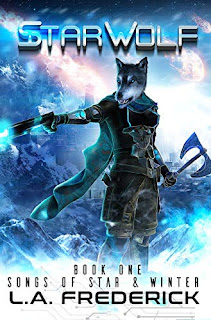
New Book Alert: Star Wolf: A Space Opera (Songs of Star and Winter Book One) by L.A. Frederick; Brilliant Start to Science Fiction Series Starting Anthromorphic Animals
New Book Alert: Star Wolf: A Space Opera (Songs of Star and Winter Book One) by L.A. Frederick; Brilliant Start To Science Fiction Series Starring Anthromorphic Animals
By Julie Sara Porter
Bookworm Reviews
Spoilers: If the Star Fox video game franchise, Brian Jacques' Redwall series, Game of Thrones, and Star Wars had a group orgy and a baby came from that strange union, L.A. Frederick's Star Wolf would be that baby. It is derivative of other science fiction works especially ones with animals in the lead, but somehow it works and is engaging.
Star Wolf is the son of Sun Wolf, the leader of the wolf planet, Lupus. In this universe, anthromorphic animals live on their own planets and are able to walk, talk, wear clothing, think, and reason. They have been able to do this since the Big Bang. Oh they are aware of Earth, but it is a prison planet where animals are sentenced to have their sentience removed and serve as the animals in which we are familiar.
Rather I should say Earth used to exist. In the first few pages, it is destroyed by a colossal weapon operated by Winter Tiger, head of the Tiger race. The Tigers are at peace with the other Worlds since the Apex Wars between them and the Lions ended. However, what the other animal races don't know is that Winter Tiger and his crew have destroyed five planets. In public, they blame it on the Space Kraken. Star Wolf is suspicious, so he and his crew investigate the possibility that the Tigers are lying. This investigation puts them in direct conflict with the Tigers who now have Star Wolf and his team on their hit list.
The world building is rather clever, especially for people who know a lot about animals. Even though the characters are human-like, they still retain their animal environments. (Gazelles live on a planet filled with grassy plains, Lions live on a planet-wide savanna.) They also have their animal like traits. (The Wolves have great hearing. A Blodhound character's sense of smell is useful.) Frederick no doubt studied the behaviors and environments of animals before writing this work and it shows.
There are some cute references to how animals behave on Earth. The leader of Canis, the dog planet, is revealed to be a Jack Russell Terrier. Star Wolf remembers that when they were sent to Earth, Jack Russells ended up "high on energy but void of brain." (Something tells me that Frederick is well acquainted with the breed).
Star Wolf shows the typical leader-like qualities with a strong youthful impetuosity that puts him at odds with his more conservative traditional father. He is clever enough to recognize that Winter Tiger is lying by observing the behaviors of other animals that are clearly on Winter Tiger's payroll, but reckless enough to denounce him during the Council of Worlds meeting. This outburst causes the Wolves' exile from the Council and them to be temporarily devoid of allies.
The greatest thing that Star Wolf does is create a Band of Breeds, a group of different animals united to fight against the Tigers. Everything from a crotchety old Badger, to a loyal Bloodhound, to a cunning Fox that plays both sides, are on the team. Their great qualities merge as they band together to take down Winter Tiger.
The final chapters reveal a new member to the Band of Breeds and some greater Tiger-caused destruction. This makes the second book possibly a great follow up.
Subscribe to:
Posts (Atom)