Showing posts with label Enlightenment. Show all posts

Tuesday, October 12, 2021

New Book Alert: Saratoga (The Illustrated Colonials Book 3) by Tom Durwood; YA Series About Enlightened Young Royals Has A Satisfying Ending


 New Book Alert: Saratoga (The Illustrated Colonials Book 3) by Tom Durwood; YA Series About Enlightened Young Royals Ends On A High Note

By Julie Sara Porter

Bookworm Reviews

Spoilers: So this is it.

We come to the last final volume in Tom Durwood's The Illustrated Colonials series. We reach the final adventures of Jaiyi Mei Ying, Prince Mahmoud, Sheyndil, Leo, Will O., And Gilbert du Motier and it ends on a high note. While the first book, The Pact is my personal favorite, Saratoga brings the characters forward allowing them to adapt and accept their roles in a new world. The teens are now ready to leave their youth, ascend into adulthood, and become the leaders that they were trained to become. 

The plot mostly focuses on Prince Mahmoud who apparently ties with Mei Ying as Durwood's favorite characters in the ensemble (since they receive the lion's share of attention in both this and Home Fronts). 

Mahmoud travels to the future United States to deliver documents of alliance and finance to Gilbert who is busy filling the role history and popular culture (such as a famous Tony Award winning Broadway hip hop musical) have bestowed upon him as "America's favorite fighting Frenchman," the Marquis De Lafayette.

 After enduring a very uncomfortable sea voyage Mahmoud encounters loyalist spy, Gentleman Johnny Burgoyne, a meeting that ends with him being kidnapped. Mahmoud manages to make his escape and is caught in the middle of the Battles of Beckman's Mill and Saratoga.

Meanwhile, Leo's military strategy and Will's business contacts end up becoming quite fruitful for them as people come directly to Will to work for him. Unfortunately, on his way to travel to Boston Harbor to join his buddies, Leo is threatened with a duel and subsequently betrayed. Sheyndil and Mei Ying take their lessons to the home front to battle local opposing forces with the same drive and dedication that their male counterparts possess.

It would be nice to see the Enlightenment Six reunite perhaps on American soil. One of the gifts that the first volume had was the ensemble cast. These were kids from different countries with diverse backgrounds, ethnicities, economic status, goals, and roles in society. Each one grew and adapted, becoming a close group of friends and better individuals. It would have been a nice payoff to see them reunite physically, perhaps in the United States during the American Revolution or back in Alsace-Lorraine after the war ended. Instead, they spend the book apart and only a few see each other again.

However, it also makes sense that Durwood would do this approach. It gives a chance for the characters to make individual contributions, using their various talents and contributions in their own way. Many of those contributions are made within their own countries but lead to the ultimate goal of uniting each other. They also are able to evolve into leaders on their own merits.

The one who benefited the most from this approach was certainly Mahmoud. I was not kidding when I speculated that he is probably Durwood's favorite character. He certainly has shown the most development in the three volumes.

In the first book, The Pact, he was a spoiled arrogant Prince certain of his own place as a royal and put everyone around him into little boxes of nobles, slaves, etc. Through his education, he learned different philosophies and looked at a larger world around him.

The second book , Home Fronts, featured Mahmoud verbally sparring with his family in Ottoman Turkey when he realizes that he has changed but they have not. His philosophies are spoken and theoretical. They are not yet practiced.

Saratoga is the completion of Mahmoud's journey. He is finally able to physically put what he learned into practice and become an accomplished freedom fighter. Throughout this book, he is able to use his strength and intelligence to outfight and outwit his enemies. He proves to be clever at escaping from captivity and active as he fights in battle. He has clearly changed a lot and it is wonderful watching him grow so much into a hero.

The other reason that it makes sense for the characters to have their stories come to an end on their own is to emphasize the international concerns of The Illustrated Colonials series as a whole. While part of the series is set in North America and the covers show an emphasis on the American Revolution, the series expands on that by taking on international concerns in France, China, Russia, The Netherlands, Germany, and Turkey later expanding into The United States and Africa. This is very important as it shows oppression and tyranny wears many faces and that there are many people who suffered under it. There were also people who fought against it and shared the same values of equality and loyalty. This isn't just an American struggle, it's a global struggle.

Of course, as with many final volumes, there is great loss. Some characters don't make it, leaving many tears from friends, family, and a few from the Reader. Some ascend and become well known in their own right. Years later, one character acknowledges the other's roles in the world that they helped to create. It is a very satisfactying ending as the character is addressing a college of young people, thereby recognizing the leadership that their friends took and passing the mantle to the next generation. 

Saratoga is a terrific ending to a wonderful YA series. Hopefully, young people will discover and read it, love the characters and setting, and maybe just learn a thing or two about friendship and equality along the way. 


Saturday, August 28, 2021

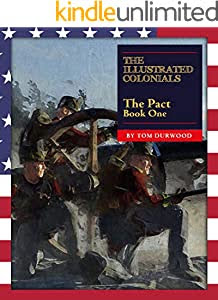
Weekly Reader: The Illustrated Colonials: The Pact Book One by Tom Durwood; Beautifully Illustrated Strong Character Driven Start Of Series About 18th Century International Teens Getting Involved in America's Revolution


 Weekly Reader: The Illustrated Colonials: The Pact Book One by Tom Durwood; Beautifully Illustrated Strong Character Driven Start Of Series About 18th Century International Teens Getting Involved in America's Revolution

By Julie Sara Porter

Bookworm Reviews


Spoilers: Tom Durwood's book, Kid Lit: An Introduction to Children's Literature,  dissects children's literature and explores the deeper meaning in many of our pop culture touchstones such as Harry Potter, His Dark Materials, Superhero comics, Pixar and Disney animated films, Afrofuturistic novels, early adventure novels and comics like Tarzan and Tintin, and the Star Wars franchise. 

My personal theory is in putting the book together and researching various works and essays, Durwood thought "I could do that. I could write my own children's book series with a plucky group of young adventurers. Stronger themes that could be hidden inside the plot and the readers will appreciate the characters and adventures and afterwards may understand something." 

Well I for one am glad that Durwood accepted the challenge. 


Durwood's wrote The Illustrated Colonials, an alternate history in which six young people from different countries in 1775 are selected to attend The School for Young Monarchs in Alsace Lorraine. Inspired by the Enlightenment theories of liberty, freedom, and equality, the students learn to fight against tyranny and see each other as equals. They are to take those lessons and fight for them when they return to their home countries.

The first book, The Pact, is a beautifully illustrated strong character driven novel that introduces us to the six protagonists, the school, and the conflicts that result between the students and others. The themes of liberty, equality, community, and cooperative partnership are also revealed in The Pact.


The group of six are a diverse bunch, from different countries and backgrounds, all with different reasons for registering at the school. They are: 

Jiayi Mei Ying, from China-The daughter of a prominent family that manages the waters, lands, and operations on the Yunhe Canal territories. She arrogantly lords over the family's subordinates. Her high handedness causes her grandfather to disinherit her. The local teacher in Zhengzhou begins teaching phrases like "common sense" and "no taxation without representation." Mei Ying is uncertain but figures that she couldn't do worse than attend the School For Young Monarchs and maybe become a better leader.

Gilbert Marie John Paul Joseph Roche Yves Gilbert du Motier, Chevalier of the Noailles Dragoons  from France-Gilbert's name will be recognizable to Revolutionary War buffs. He is from a noble aristocratic family and is  a dragoon fighting in battle. Despite his wealth and privilege, he is not blind to the troubles faced by the poor. He is also inspired by the revolutionary ideals and his own sense of adventure to attend the School For Young Monarchs.

Sheyndil Czerzinsky AKA Shay from Russia-A former peasant, Shay is interested in new technologies and planting seeds for agricultural production. Her interests in technology and agriculture are shared in higher places particularly by Catherine the Great, Empress of Russia. Catherine decides to patronage the young woman so she can represent Russia at the school.

Leo Krummensee-Grabmaler from Brandenburg-Leo is the son of the Heir of Hohenzollem, Lesser Magistrate of the Margraviate of Brandenburg. The arrogant noble and soldier is informed that a petition is being circulated where he and his sister could lose their titles and estates. Leo's sister plans on marrying while Leo decides to lay low in Alsace Lorraine and attend the School.

Prince Mahmoud Mustafahn Hasan Husameddin Cezayrili, third son of the sixth wife of Sultan Abdulhamid Caliph of all Muslims, Secular Ruler from the Ottoman Empire, Turkey- Mahmoud is the spoiled overweight son of the Sultan. His mother is tired of the boy having everything handed to him. She wants him to study at the School to prepare for his eventual role as Sultan.

Will Oldenbarnevelt from the Netherlands-Will is the youngest son of a prosperous merchant. Since his father declared that Will's older brother, Casper, will inherit the family business, Will gets nothing. Will is well read, shy, and a strategic chess master, his mother points out. She suggests that Will at least get a smaller trade route in the Bosporus. Before that though he has to attend a certain school.


By their powers combined, the six set out to become heroes in their day, sort of an 18th century version of the Planeteers Minus Captain Planet. (Maybe more like Captain Liberty?)  At the school, the students learn about the Enlightenment philosophies and start practicing them in their daily lives. They begin to work together and use their talents in fighting, engineering, agriculture, scholarly research, finance, and leadership to aid each other. 

There are a few times when they are challenged by opposing forces such as former enemies from their countries and soldiers who represent forces who  are opposed to this idea of togetherness. The Super Six learn to fight alongside each other as a team putting those values that they have been taught to practical use.


Of course fighting as a team doesn't mean that they will always get along. Personality conflicts abound almost as soon as they meet. It begins right away when Mei Ying defends Will from a bit of physical joshing by Gilbert. She gives the Frenchman a serious kick earning respect from Will, Leo, Sheyndil, and oddly enough Gilbert.

The students get into plenty of arguments such as when Sheyndil, Leo, and Gilbert fight about what it actually means to be a royal and who in their group deserves that moniker. 

Mahmoud and Gilbert get into a particularly fierce disagreement about whether servants do or should respect their employers and what rights that they have. These conflicts show how the characters were raised and how their upbringing shaped them so far. However, the fact that they are at that school and able to listen to each other shows that they can reject some of those limiting beliefs from their childhoods and evolve and grow as people.

It is genuinely heartwarming when this group accepts each other's friendship to the point that they make a pact to always aid when one is in trouble. They would send for the others and they would come running.


I would be remiss if I did not mention the beautiful illustrations. Various art forms including portraits, photographs, and prints went into this work. The names of the illustrators themselves including Timothee Mathon, Sahab Sewarty, Jessica Taylor, and Mai Nguyen et al fit two pages. Many authors stick with one illustrator, but Durwood uses several. This fits into the overall narrative of the book. 

While the story is set in an alternate historical continuity, it is also treated like a real event. One of the students actually was a real person. So like any famous people from another time, there may be several pictorial depictions of them. After all, how many times has George Washington or Benjamin Franklin been captured in art?

The various pictures show the six characters and their world as one that could have happened.


Through the students' relationship in The Pact, we learn how history could have been different. Maybe from that, the alternate present could be one of equality, cooperation, and understanding. This book perhaps could be a guide on turning that alternate possibility into a reality in this timeline.

Saturday, May 25, 2019

New Book Alert: Golden Keys To Open Doors: About Spiritual Cotton Candy by Harry Meier; Unique Book of Spiritual Advice is Direct, Upfront, and Highly Inspirational


New Book Alert: Golden Keys To Open Doors: About Spiritual Cotton Candy by Harry Meier; Unique Book of Spiritual Advice is Direct, Upfront, and Highly Inspirational


By Julie Sara Porter


Bookworm Reviews

Sometimes guide books want to help you by using uplifting phrases, visualizations of a perfect life, and taking all of your problems to a Higher Power. They try to be cheerful and build you up with sweet thoughts and positive words. Others just want to slap you in the face with cold reality, shake you out of your complacency, and be as direct as possible.


Harry Meier's Golden Keys to Open Doors is an example of the direct kind of book. Meier's book forgoes the feel good spiritual advice of others and goes right for the plain honest truth. It can be a difficult book to read. Sometimes you want the pleasant words, but sometimes you want the plain ones too. Meier delivers just that.


It is similar to The Subtle Art of Not Giving a F&$k in that it uses advice that is solid and upfront that runs contrary to other books of its kind. However sometimes we need that author to say “Okay this way didn't work out for you, tough luck. Try it like this.”

You have to hand it to anyone who begins their book with “Read it or not/Understand it or not/Enjoy it or not/I don't care.” You can't be more honest than that. Meier uses a metaphoric mountain and suggests the Reader bought the book to climb that mountain. This book, Meier says is not the book to help you climb it. (Thanks if I'm ever on Everest, I will be sure to note what book I am not bringing.)


The introduction introduces the concept of spiritual cotton candy. That term appears to refer to metaphors that gurus use that make their followers feel good but have no real meaning. This book is definitely free of that.

Many of the chapters contain bits of advice that hearken to Benjamin Franklin by way of Mark Manson (author of Subtle Art of Not Giving a F#$k). These sentences like “You do not need to be wise. Simply look for what men search for. That should be enough” are common sense, practical, and somewhat forceful in their approach.

In a chapter about achieving enlightenment, Meier scoffs at the dramatic search for enlightenment of other gurus. He preferred more concrete means like “There is nothing to do. Let's do it” and “You read too quickly and only understand particles.”
The meditation chapter provides interesting thought provoking words like “What does it mean when you see a blue stone during meditation? That you are meditating and you see a blue stone.” Not exactly a puzzler.

Golden Keys to Open Doors is a book that makes the Reader pay attention to every word even to the point where the text draws them in by saying they are reading too quickly. Sometimes the text says “Again, you are reading too quickly. Have you really read what (Meier) has written?”. Like a parent who lectures their kid and, when the kid has zoned out, asks “what did I say?” It makes the Reader sit up and take notice which is what this book is meant to do.

Golden Keys to Open Doors is the kind of book that makes you pay attention by slapping you a bit with reality. That's what makes it ideal for self-help, because it asks for the Reader to help themselves.