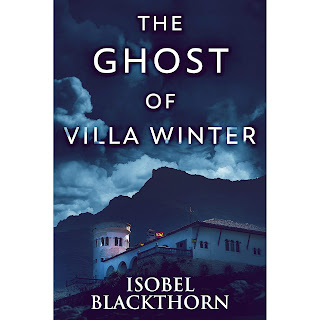
New Book Alert: The Ghost of Villa Winter (Canary Islands Mysteries Book 4) by Isobel Blackthorn; Engaging Murder Mystery Set On A Beautiful Island
By Julie Sara Porter
Bookworm Reviews
When last we left the lovely but intriguing Canary Islands in Isobel Blackthorn's A Prison in the Sun, ghostwriter Trevor Moore found a backpack of stolen money, a manuscript about a gay man imprisoned during Franco's Spain, and a dead body. In short order, he kept the money for himself, translated and edited the manuscript and kept the credit, and was left the target of sinister figures who were probably responsible for the dead body.
In Blackthorn's latest caper, The Ghost of Villa Winter, Trevor is in prison and his only remaining friend, Clarissa, is fighting a so far fruitless endeavor to get him released. Clarissa knows Trevor well and knows that he is innocent of the murder. Okay, sure he's a literary thief for passing off the manuscript as his own. Sure he was foolish and greedy for not reporting the money. And sure, he's well….kind of a bumbling idiot, but a murderer? Never!
Clarissa is staying with her niece, Claire and Claire's husband, Paco while she waits to visit Trevor in prison and reopen his case. Claire and Paco want her to forget about Trevor for a while and just enjoy herself. So, she takes their advice and notices a flier for a guided tour of Villa Winter. She decides to take the tour and gets to know a group of eccentric tourists and their tour guide, Francois. It is on the trip to this historical building with a sinister past, in which it was the farmhouse of Gustav Winter, a member of the Nazi Party, where things take a dangerous turn. She and novelist, Richard Parry, get separated from the group and discover the corpse of a murdered woman inside the Villa. Even more terrifying is that the apparent time of death had to be within the last few minutes, so the woman's murderer had to be a part of the tour, but who?
The Ghost of Villa Winter is just as effective a murder mystery as its predecessor. Blackthorn once again provides a real strong sense of place throughout the book. Unlike Prison in the Sun which took advantage of the gorgeous beaches and outdoor views, most of the action is set in and around Villa Winter and the village of Cofete. However, the setting never feels claustrophobic or contained as there is always something new to explore.
Villa Winter is itself described as an imposing building. Blackthorn writes, "Villa Winter presented its visitors with a very high and imposing stone wall that appeared to serve as the dwelling's foundations. The two corners of the wall were finished off with square turrets, each sporting a small casement window set about two-thirds of the way up the front wall-too high for anyone outside to peer in-and topped with a stone parapet. The house itself sat above a stone wall and sported a somewhat austere veranda contained within a series of stone arches. A low pitched roof of terracotta tiles completed the look. Attached to the front of the house on the far side was a large round tower. The whole edifice was more imposing close up than (Clarissa)'d imagined viewing photos on the Internet."
Between the stone wall, tower, the strange bunkers on the lower floor, and a kitchen that looks more like an autopsy room, Villa Winter leaves a general impression that no one comes in and no one comes out.
The setting isn't the only thing that leaves a memorable eerie impression on the Reader. The tour group are an odd crew that would be at home in an Agatha Christie locked room mystery. From the mean looking tour guide, Francois, to the know it all married couple, Fred and Margaret, to the oddly quiet, Helen, to the thrill seeking backpackers, Dave and Steve, to the gossipy Vera, to the no nonsense, Carol, to the mysterious, Simon who seems unsure even of his name at times. These characters give off a bizarre vibe particularly when they enter Villa Winter and seem to engage in a verbal competition over who knows the most about Gustav Winter, WWII trivia, and conspiracy theories. These are people who constantly bicker and don't mind showing off their knowledge to anyone who asks, and to anyone that doesn't. Anyone of them could be a murderer and their odd behaviors suggest that no one could be ruled out.
The only character that Clarissa finds completely trustworthy is Richard and that's because he is too much of a sniveling wimp to be a murderer and he hasn't left Clarissa's side since they entered Villa Winter. (He had no time to steal away and murder the young woman the way the others would have).
There are some genuinely suspenseful moments that evoke a Hitchcockian film. Clarissa and Richard are abandoned by the tour group and trapped in the tower where they hear footsteps and the sounds of someone turning on the crematorium down below.
They also plan a daring escape from Villa Winter that requires a long climb downhill as the sun threatens to set. Then, they find that the road out of Cofete is closed so they are trapped in a small village with no electricity and no phone, with their tour group, one of whom is a murderer. The chapters are designed to keep the Reader clenched in suspense throughout this tour.
Even though there is a dark undercurrent, particularly with the murder and the history of Villa Winter, the protagonists keep things light-hearted veering this book towards a cozy mystery more than its darker predecessor. In particular, Clarissa is a great lead character. She has some unique traits such as her interest in astrology. (Really she should have known there would be trouble with the arrangement of Saturn, Pluto, and Mars and a Scorpio Moon present). She has a gift of being a good of judge of character, such as her initial observations of the tour group, that is seldom proven wrong. This gift seems to border on intuition, a sixth sense, love of mysteries, and good common sense that comes with age. That's how come she knows that Trevor is innocent. She knows him well.
Clarissa is also a brave and physically fit woman. She is like Miss Marple or Jessica Fletcher juiced up. When she and Richard have to escape Villa Winter, she proves her mettle by pushing herself and her cowardly companion outside of the Villa and harm's way. Most of that mettle is proven by carrying Richard's useless weight around as he spends most of the time, sniveling, whining, and contributing very little to their survival or solving the mystery around them.
Clarissa shows a protective streak towards Richard and Trevor, showing more competency than either of them. She isn't romantically attached to either one (Richard because of his personality and Trevor because of reasons that are revealed in A Prison in the Sun.) She has a sisterly protectiveness that wants to care and look after these guys. This leads to a heartfelt and sweet reunion between Clarissa and Trevor that strengthens their friendship.
The Ghost of Villa Winter is an engaging follow up to A Prison in the Sun that shows in scenic locations all may not be Paradise. Not with terrifying histories, dead bodies, and curious odd tourists and locals lurking around every beach and villa.

