Wednesday, September 30, 2020

New Book Alert: The Plot Against Heaven by Mark Kirkbride; Intriguing Premise and World Building Undone by Short Length


New Book Alert: The Plot Against Heaven by Mark Kirkbride; Intriguing Premise and World Building Undone by Short Length

By Julie Sara Porter

Bookworm Reviews


Spoilers: Some novellas benefit from a short length. The story is best told in a short manner to the point so that the characters encounter the monster or solve the mystery without any unnecessary subplots or padding. Then there are ones that falter because of their short length.


Mark Kirkbride's The Plot Against Heaven is one that is way too short and would greatly benefit from expansion. It offers an intriguing premise of a widower caught between the battle of Heaven and Hell so he can be reunited with his deceased wife. It also has a brilliant sense of world building on how Heaven and Hell are written, in fact almost too good. The problem is because of the 68 page length, the premise and world building aren't as incredible as they could be.


The story is similar to the myth of Orpheus and Eurydice, in which a musician goes to the Underworld to get his deceased wife only to lose her when he disobeys Hades's command not to look back at her until they get out. It's sort of a variation of the myth with modern twists.

Paul Desuthe, a jingle writer/poet is in Heaven to plead his case before God that his wife, Kate, was taken too early and wants to have her back. When he finds the Big Guy isn't there and appears to have not been there for some time, he becomes irate and denounces God. Well anyone who has ever read or seen Faust, The Devil and Daniel Webster, the legend of the Flying Dutchman, Oh God You Devil, or another encounter between Heaven, Hell, and mortals know that when someone denounces God, someone else is listening. Down Paul goes to Hell and encounters Satan. Satan appears friendlier than God's staff and says he will bring Kate back to life if he does one tiny favor for him. See Satan and God will soon be engaging in the Big War, Armageddon, and Satan needs a good writer like Paul to be his pitch person and advertise Hell in a way that is contradictory to the traditional view.


The Plot Against Heaven does some really unique things with how Heaven and Hell are written. Heaven is a composite of a sterilized urban metropolis and a police state. The buildings are all skyscrapers with God's being the biggest of all. God himself gets driven around in a limo, and the only glimpse that Paul catches of Him is a large brain. 

There are fighter planes constantly flying up and down Heaven's skies and there are plenty of soldiers and suited business types asking their newcomers any questions. There are also billboards and signs warning people to follow all rules and that they never know who might be listening. This version of Heaven is ready for war at anytime and has none of the joy and Paradise in which it is usually associated.


By contrast Hell looks more like Las Vegas or any type of party town with casinos, games, loud music, and plenty of good looking men and women just for the asking. It is bright and colorful and without the rigidity of Heaven's existence.  While Hell is enticing, there is a superficiality that suggests that the good times are all surface and a means of entrapment. Similar to the Rolling Stones' song "Sympathy for the Devil," Satan is definitely "a man of wealth and taste." He watches over his kingdom with a smug sophistication, satisfied that by giving his people what they want, then they are completely in his power.


Heaven and Hell are so brilliantly written that it is such a shame that we are given so little time inside them. Heaven only apears in two chapters before Paul takes his downward plunge. Hell is covered pretty decently but more could be added. 

While the war happens between the sides, we see very little interaction between Paul and the other denizens. We aren't given enough of a build up before War is declared nor are we given much of a chance to get to know characters before there are casualties.

The thought of Heaven as a police state and Hell as a casino are so intriguing that there should be more chances to explore these settings in great detail. There are plenty of ripe moments for satire in the presentation that don't get too land because of the brief length.


The climax also needs to be better explored. There are various twists on top of the other. Some are pretty clever but they contradict each other and one revelation only makes sense if the other plot twist didn't happen. It produces an ending that is more puzzling than satisfactory.


The Plot Against Heaven is a great idea, but without more depth invested in the work an idea a sketch is all it is. Kirkbride could and definitely should explore this milieu in a longer work. This idea certainly deserves it.


Wednesday, September 23, 2020

New Book Alert: The Black Veldt by Michael Reyes; Short, but Graphic and Terrifying Horror About The Haunting Darkness


New Book Alert: The Black Veldt by Michael Reyes; Short, but Graphic and Terrifying Horror About The Haunting Darkness

By Julie Sara Porter

Bookworm Reviews


Spoilers: One thing for sure in Michael Reyes's graphic and terrifying horror novella, The Black Veldt is that its protagonist, Jose Carvel is one seriously haunted SOB.


Even as a child, Carvel has not had an easy life. He was abandoned and unnamed as an infant. He hitchhiked from a children's home in Tulsa with a man who didn't molest him "like other truckers" so he took his first name, Jose. As for his surname, Carvel it came from a guy in Kansas who didn't make much use of the name. Carvel doesn't remember much about his past and what he does remember comes in fragments of freaky nightmares, frequent travel, physical and sexual abuse, and some dark sinister creatures that appear in and out of the shadows. He had spent most of his life running from the shadows, the shadows that he tries to forget but compelled him to commit violence.


In 1970's New York, Carvel sells cocaine, which he uses, and heroin,which he doesn't, hangs out at a local bookstore, mocks the Studio 54 crowd ("Hell will be ABBA playing 'Dancing Queen'", he predicts.), scans the streets for notorious serial killer, Son of Sam, and engages with the eccentric drugged up night life crowd. 


There is a strong presence of the setting of New York's nightlife in the '70's. Many nights, Carvel wanders around in a hopeless daze through a decaying city infested with crime, drug dealers, street kids, prostitutes, and of course Son of Sam lurking about. While not mentioned in The Black Veldt, history tells us that New York City was suffering such a financial crisis at the time that they were declaring bankruptcy and requested assistance. This time of hopelessness and poverty also serves as a backdrop to the general haunted mood of the novella of a city that is being swallowed hole by despair, decay, and darkness. It becomes a perfect world for someone with a haunted past like Carvel to live and thrive. If he is surrounded by darkness, might as well enjoy it with the other hedonists, enjoy it to a potentially early grave.


Carvel's nights become even stranger and his hauntings take a more supernatural bent. He runs into people who recognize him and address him by other names even though he doesn't remember them. He follows Javonka, a mysterious woman with green hair and polychromatic eyes who also recognizes him and carries clippings of missing people all around the U.S. He also receives information from a friend about the leucrota, dark mythical creatures that despise humanity. These experiences reawaken the "shadows" inside and the urges that Carvel originally repressed to do violence.


It's hard for a book with such a bleak haunting dark setting and tone to get even darker, but that is what Reyes does. The book actually sets us up for the supernatural experience by featuring Carvel trapped in a place called The Black Veldt surrounded by demonic creatures and a sinister cult from which he struggles to escape. Once the setting hits New York, we are led to believe that maybe this strange introduction could be a nightmare, fever dream, or a drug trip.

Only when the memories start to return and Carvel starts to feel the violent urges and sees the demons everywhere, even in one very frightening passage while making love to Javonka, that we know the demons are real and they have claim over Carvel.


With such natural and supernatural darkness that haunts the novella, any type of positive resolution would be out of character for Carvel and the world around him. In fact without giving too much away, it seems that Carvel is forever caught in an endless cycle of encountering both a real and figurative hell. He gets the Hell of demons and retreats to the hell of his real life only to reencounter the demonic hell once more. The Hell and the haunting darkness will be with him forever.


Many novellas are too short, but this one's length is perfect. Any longer would overdo the sinister dark aspects: too many nights of Carvel taking drugs and sleeping around before we encounter the demons from which he can never really run. Too many passages with the demonic creatures tormenting Carvel when the small tastes that we are given are just fine. At its brief length, The Black Veldt is haunting and terrifying enough without going overboard with padding and filler.


The Black Veldt opens up the possibility that we can be haunted not only by the supernatural, the unknown, but by the known world around us. Reyes expertly mixes both worlds as ones that can scare us almost to death.


New Book Alert: An Interactive Family Guide: The ADHD Sibling Challenge: How To Thrive When Your Brother or Sister Has ADHD by Barton S. Herskovitz, M.D.; Helpful and Interactive Guide For Siblings


New Book Alert: An Interactive Family Guide: The ADHD Sibling Challenge: How To Thrive When Your Brother or Sister Has ADHD by Barton S. Herskovitz, M.D.; Helpful and Interactive Guide For Siblings 

By Julie Sara Porter

Bookworm Reviews


Attention Deficit Hyperactivity Disorder (ADHD) can be a stressful condition for both those who have it and the people around them. Child psychologist, Barton S. Herskovitz, MD, understand this. That's why he wrote The ADHD Sibling Challenge: How to Thrive When Your Brother or Sister Has ADHD. 

Herskovitz says that he spends a great deal of time counseling both children with ADHD and their parents. "The child may need therapy or perhaps medication," Herskovitz said in his introduction. "The parents usually need help with parenting strategies."


Unfortunately, this attention often leaves out some specific family members: siblings of those with ADHD. Many boys and girls feel confused by their siblings' ever-changing behavior. They may be confused about why the sibling can't sit still or constantly talk when they are told to be quiet. The sibling may feel angry when their brother or sister borrows things without asking only to carelessly break them or goes inside rooms where they are not allowed. They may feel jealous when their parents' attention and conversations always revolve around the sibling with ADHD. They may be furious that they have to follow rules that the other sibling is unable to without medication or assistance. The sibling may overcompensate by acting like the perfect rule abiding child or go the opposite extreme and rebel and bully their brother or sister.


The book, The ADHD Sibling Challenge, is a helpful and interactive guide for young people with siblings who have ADHD. The book is very easy for parents and children to skim through. It discusses an overview of the disorder and how family dynamics are affected. It also discusses honestly about the different feelings such siblings have like feeling invisible or confused. It also offered some tips on how parents could talk to the sibling about their discomfort and confusion. Tips such as Active Listening help validate the child's feelings and allows them to talk openly about their problems with their sibling.


The majority of the book consists of activities and scenarios in which the siblings of the ADHD child can write about their own experiences. For example the child is encouraged to write about good times with their sibling and circle the adjectives that describe them such as "funny," "creative", or" fun to play with." They are also encouraged to write about the hard times by adding on a scale how they feel when they are with their sibling from patient to annoyed, caring to mean, calm to upset/yelling. These activities show how fluid emotions are that people, children especially, can go from one extreme to another and those emotions are valid when dealing with the complexities of such disorders.


The various scenarios of siblings are another important aspect of this book. They describe various situations of children interacting with their ADHD siblings. One situation describes Johnny, a young boy having trouble getting moving in the morning while his sister, Sarah keeps having to prompt him to move as though she were another mother. Another involves Emma who after her sister, Callie, loses or breaks her things is conflicted with her wish that Callie would be sent to a boarding school and her guilt for feeling that way. Each scenario comes complete with questions which ask the young Readers about how they get along with their sibling. Each scenario is different showing that while symptoms are similar, each person's experience with ADHD (or any other disorder) is different and sometimes what one does not recognize as filling all the checklists of such disorders does not necessarily mean that they don't have it.


While the emphasis is on siblings of children with ADHD, the advice is useful for any child with a sibling with other emotional, psychological, or physical disorders. Such exercises as talking about one's feelings, practicing active listening, understanding one's role in the family dynamic, and recognizing both positive and negative emotions and experiences are useful advice for any young person going through similar difficulties.


The ADHD Sibling Challenge is a useful tool that reminds children who have siblings with ADHD that they are important too and are not left out.


Monday, September 14, 2020

Weekly Reader: Girl At Sea: A Coming of Age Tale by David Burton; An Intriguing and Moving Rime of Two Modern Mariners


Weekly Reader: Girl At Sea: A Coming of Age Tale by David Burton; An Intriguing and Moving Rime of Two Modern Mariners

By Julie Sara Porter

Bookworm Reviews


Spoilers: The Samuel Taylor Coleridge poem, "Rime of the Ancient Mariner" is about a sailor who shoots an albatross, a symbol of spirituality. The sailors tie the albatross around his neck as he and the crew take a nightmarish journey by ocean. While the sailors die, the Mariner suffers a fate worse than death. He lives an immortal existence telling the story of his voyage. The albatross fell from his neck, but the memory and story remain.

In his fascinating fantasy novel, Girl at Sea: A Coming of Age Tale by David Burton modernizes the story to make it about a teenage girl and her adopted sailor father who are also stalked by a bird. The only difference is that this bird is one that represents death.


Beth Portman is a young girl whose parents are killed in a house fire while she went sailing with a family friend, Silas Tuffs. Beth is grief stricken and desperate to hold onto family. She could live with Silas with whom she feels a genuine bond, but she ends up living at her best friend Judy's house. Judy's home isn't exactly happy with a verbally and sexually abusive monster for a father. When he turns his attention towards Beth, Judy begs her to run away so she does, back to Silas and his boat, The Montegar.


Silas is a good man and a genuinely loving father figure for Beth. They have a marvelous time sailing across the Pacific Ocean and visiting the scenic port cities. Why, they even obtain love interests. Unfortunately, their happy life ends when Silas's girlfriend is viciously murdered. After the attack, a strange black bird hovers over the ship looking for a new dead body and it becomes hungry for more.

Superstitious mariners spread tales that The Montegar brings death. The two soon find that no port can be home until they face this spirit of death and enemies that have been left behind.


Girl At Sea has a great plot and brilliant characterization, particularly in Beth and Silas. They are a touching father and daughter duo that fill a void in each other's lives. Beth lost her parents and Silas lost his wife and child. They are the family that one another needs. It is also refreshing that the book shows a single older man adopting a young child without any fears of something sordid. (In fact the sordid behavior comes from her friend's married father who acts like the traditional family man only to hide his sadistic pleasures behind that guise.) Silas and Beth are simply family to each other, a family that they need.


Burton offers some lovely description of sea travel with pristine oceans and colorful characters residing on the ports.Many characters from Marguerite, a sweet restauranteur who catches Silas's interest to Tom, an Australian teen who becomes a friend to Beth provide a safe harbor.


The descriptive paragraphs activate the senses such as: "Calm seas. A few wisps of white cloud in a clear blue sky. A warm ten knot breeze pushed Montegar with an easy motion through deep blue water. The sails were trimmed to a broad reach, genoa and main sails let out over the port side.... Uncoiled lines, askew seat cushions, ripped canvas, a bent lifeline stanchion testified to the storm receding on the northwestern horizon. Montegar sailed on, though no one was on deck. Down below, books, cushions, wet clothes littered the floor. Cans with tattered labels, smashed fruit, soggy cereal, broken glass, filled the galley sinks."

Burton fills the book with nautical terminology and know how on sailing. He clearly knows the environment in which he is writing. It's a rich and beautiful world that Burton writes about and that makes the violence that surrounds it somehow worse.


Beth, Silas, and their friends encounter some violent characters like pirates, abusive exes, criminals, and pedophiles. It's a dangerous world around the oceans and it's one that the death bird seems to feed. It predicts the cruelty and violence that they are exposed to. Similar to the Ancient Mariner, Beth and Silas are exposed to the dark side of human nature, one that hurts out of greed, revenge, or lust. Only unlike the Ancient Mariner who faces this world alone because of his actions, Beth and Silas face the darkness of others together. This togetherness helps them as they face their worst enemy.


Girl At Sea is a beautiful, dark, but ultimately triumphant book about recognizing evil that exists within some people, but also accepting the goodness that can be found through genuine friendship, lovers, and family. Only then can the albatross fall from our necks and we can truly be free.


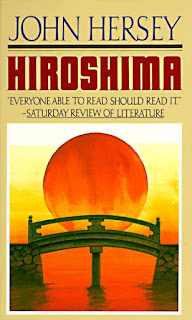
Classics Corner: Hiroshima by John Hersey; Terrifying and Heart Wrenching Account of Life During and After The Nuclear Bomb


Classics Corner: Hiroshima by John Hersey; Terrifying and Heart Wrenching Account of Life During and After The Nuclear Bomb

By Julie Sara Porter

Bookworm Reviews


PopSugar Reading Challenge: A book set in Japan (host of the 2021 Summer Olympics)


Spoilers: On August 6,1945 a bomb was dropped onto Hiroshima, Japan and the world as we know was changed. It was a nuclear bomb. WWII ended and the Atomic Age began, not with a whimper but a bang. 

Over 100,000 people were killed by the blast and many more succumbed to the long term effects of radiation sickness. To this day, the village is surrounded by shadows of the people who had been vaporized. 

In what was considered one of the biggest news stories of the 20th century, the nuclear attacks on Hiroshima and Nagasaki still are controversial. Should the Americans have dropped it? Were the Japanese going to surrender without it? Would it have saved a ground combat? What can't be denied is that it was a truly monstrous act that resulted in far more casualties, far more civilian casualties, than any other battle in the war. 


In 1946, reporter John Hersey was commissioned to write a series of articles for The New Yorker on the impact of the nuclear attack. The articles proved to be so powerful that instead of splitting them,the editors of the New Yorker devoted their entire August 31, 1946 issue to Hersey's coverage. Ignoring the usual talk of the town, theater listings, short stories, and biting popular culture reviews, The New Yorker had one letter to their Readers: " TO OUR READERS. The New Yorker this week devotes its entire editorial space to an article on the almost complete obliteration of a city by one atomic bomb, and what happened to the people of that city. It does so in the conviction that few of us have yet comprehended the all but incredible destructive power of this weapon, and that everyone might well take time to consider the terrible implications of its use. The Editors." 


Hiroshima was later published in book form by Alfred A. Knopf. Hersey's article was designed to get people talking and talk they did. His descriptions of the attack are nightmare inducing because unlike many nightmares, it happened. Hersey reported what was seen and somehow that makes the actions so monstrous that people have the power to create and use such weapons of mass destruction on real live human beings.


Hersey's descriptions of the events are incomparable, mostly because he did not resort to emotion. He told the events like they were, figuring the story was enough to move the Readers. Here is the moment of the blast from one of the eyewitnesses, Dr. Terufumi Sasaki: "(Dr. Sasaki) was one step beyong an open window when the light of the bomb was reflected, like a gigantic photographic flash, in the corridor. He ducked down on one knee and said to himself as only a Japanese would, 'Sasaki gambare! Be brave!' Just then (the building was 1,650 yards from center), the blast ripped from the hospital. The glasses he was wearing flew off his face; the bottle of blood crashed against one wall, his Japanese slippers zipped out from unde his feet-,but otherwise thanks to where he stood,he was untouched."


As any good writer does when covering a real-life event, Jersey personalized the Hiroshima attack, giving the atrocious events human faces to go with such a tragedy. He told of the attack from six civilians recounting their lives before, during, and after the attacks. Each of the six attributed his or her survival to chance. Hersey wrote, "Each of them counts many small items of chance or volition-a step taken in time, a decision to go indoors, catching one streetcar instead of the next-that spared him. And now each knows that in the act of survival he lived a dozen lives and saw more death than he ever thought he would see. At the time, none of them knew anything."


The six are:

Rev. Kiyoshi Tanimoto-A pastor of the Hiroshima Methodist Church, he was in the process of moving religious items via handcart. He was concerned about bombings in the area as well as raids. He and a colleague stopped at a rich man's house in Koi when the blast hit. Tanimoto cowered behind some large rocks in the garden and missed the impact. 


Mrs. Hatsuyo Nakamura-A Tailor's widow and single mother of three, Nakamura and her children were exhausted from the various air raids in which they ran for shelter. Nakamura let her children sleep in rather than prep them for another one. At the moment of the explosion, Nakamura looked out the window to see her neighbor tearing down his house because it was in the way of an air-raid-defense fire lane. She took a step away from the window just as the flash filled the sky and her daughter called to her.


Dr. Masakazu Fuji-A prosperous doctor, Fuji saw a friend off the night before. His large home was often visited by patients and their family members. On August 6, Fuji only had two staying with him. He sat cross legged, reading the newspaper, when he saw the flash. As he rose, he saw the hospital which he lived near topple and sink into the river below.


Father Wilhelm Kleinsgore-a German priest of the Society of Jesus, Kleinsgore was in frail condition. He had been ill and the war time rations did very little to restore him to good health. He began his daily service when a siren ended it prematurely.  He breakfasted with the other Fathers and then retreated to his bedroom to read. He lost his mind after the blast and could only remember wandering around the mission vegetable garden in his underwear.


Dr. Terufumi Sasaki-A young Red Cross surgeon affected by a nightmare and a sleepless night, considered calling in. He decided to take an earlier streetcar than originally scheduled. He drew blood from a patient and took it to the lab just as he saw the flash. As Dr. Sasaki wandered the halls, he realized that the patient that he tended had died as did a colleague with whom he had just spoke. In fact, Dr. Sasaki was the only doctor unhurt by the explosion.


Toshiko Sasaki-No relation to Dr. Sasaki, Miss Sasaki was a clerk in the personnel department East Asian Tin Works. She attended a memorial service for a former employee, a local Navy man who committed suicide. Miss Sasaki returned to her office and turned away from the windows just as the bomb hit. Miss Sasaki was near a large bookcase when the ceiling and floor above her collapsed. The bookcase next to Miss Sasaki toppled over, pinning her to the ground and breaking her leg.


The book is filled with various moments of intense fear and terror, mostly because of a populace that was unaware of the true impact of what had attacked them. They were used to traditional air strikes and bombs, but this was different. This had the power to destroy in less than a few seconds and no one was prepared. No one was warned that they would be attacked by a new weapon or what the impact could be. The true cruelty was revealed that one side had a massive weapon that they willingly used on another side that had no concept of what had hit them.


After the bomb hit, the book tells of the devastation which faced the six people. These paragraphs are heart wrenching as they wander through a once bustling city now filled with fallen and burning buildings, dead and injured bodies, and a miasma that filled the sky above them. There are moments that are meant to break the Reader's heart in reading the devestation such as when Tanimoto is given a child by an injured mother and carries the child to a makeshift hospital which is already filled with fifty or sixty wounded people. He later helped rescue 20 other people on a sandpit. 


What parent wouldn't feel the anguish as Nakamura tries to wade through the debris to rescue her entombed children? Hearing their voices and unable to reach them is every parent's worst nightmare. 

There is also salvation even in the midst of confusion. Even though Kleinsgore was still in a confused daze amid all the destruction, he managed to act. He saved the lives of a woman and her daughter who were trapped inside the catechist's fallen house. He too helped tend to the fallen with Tanimoto and helped the Nakamura Family leave.


Dr. Sasaki also exhibited a lot of courage as one of the few uninjured doctors on duty at his hospital. He took fresh bandages and tended to those who were nearby. He had no system. He just worked on as many as he could from those who had minor injuries to those at the point of death. Hersey compared his actions to those of an automaton working on as many people as he could without eating, sleeping, or stopping to rest.

There is sheer terror as Hiroshima's residents were caught in situations where every move could have killed them. Fuji and others were trapped on a bridge with fire approaching from every side. Rather than burn to death, they sought refuge in the water below. Fuji eventually returned to his home badly injured and in deep pain.

Miss Sasaki was also caught in an awful situation. Laying underneath the book case, she waited in intense pain for rescue as her leg became festered with pain and gangrene. She eventually was rescued by friends who assumed that she had died.


Because of the scant news and the immediate destruction that surrounded them, it was several days before the residents of Hiroshima learned that another nuclear bomb dropped on Nagasaki. During that time and Japan's surrender the people just waited to recover, unable to get the destruction out of their minds. Tanimoto remained at a nearby park tending to wounded and trying to locate other's families. Nakamua lay in a shelter with her frightened ill children. Fuji received assistance for his injuries that he tried to treat himself at home. Kleinsgore continued to help the wounded, including Fuji and the Nakamura. 

Dr. Sasaki took a much deserved rest and began the process of identifying friends and family. He also began to recognize the symptoms of what would be identified as radiation sickness. Miss Sasaki languished in a hospital bed in pain knowing that she was soon going to lose her now useless leg.


Despite the enormous loss of life, the six people featured in Hersey's book were among the survivors. They suffered from immediate hardships in the days following the bomb. Hersey told us: "Miss Sasaki was a cripple. Mrs. Nakamura was destitute. Father Kleinsgore was in the hospital. Dr. Sasaki was not capable of the work he once could do. Dr. Fuji had lost the thirty-rook hospital it took him many years to acquire and had no prospects of rebuilding it. Mr. Tanimoto's church had been ruined and he no longer had his exceptional vitality. The lives of these six people who were among the luckiest in Hiroshima would never be the same."


Even though they survived, the six suffered from severe physical and psychological illnesses afterwards. They became the hibakusha- "explosion affected persons." Destitute, Nakamura continued to work as a seamstress to support her children despite having constant fatigue and abdominal pain. A severe bout of illness forced her into hospitalization and to sell her sewing machine to pay the cost. Nakamura carried a sense of passivity and acceptance to her fate. She managed to deliver bread and various other jobs before working in Suyana Chemical factory. Nakamura worked at Suyama for thirteen years, retired at 55, and lived with her children. In 1975, she fell ill during the flower festival.


Dr. Sasaki continued to be haunted by the bombing and the wounded. He continued to work at the hospital while working on his doctoral dissertation on appendiceal tuberculosis. He married during the stressful time after the bombing to a woman described as more sensible than he. At the hospital, he removed keloid scars from patients which returned. Sasaki and his colleagues had no literature about atomic survivors so they had little to go on. 

In 1951, Sasaki quit the hospital and set up a private clinic. In 1963, Dr. Sasaki needed surgery on his lungs. The attending surgeons found cancer on his left lung and one of the blood vessels into the lung cavity gave way. He suffered severe hemorrhaging which almost killed him. Due to his near fatal illness and his wife's death in 1972, Dr. Sasaki decided to help the elderly and built a new clinic for that person.


Kleinsgore suffered from fever, diarrhea, and wounds, and exhaustion. His body was weakened but he continued to have a seflless spirit. In 1948, he was named priest of a larger church. He was so devoted to his adopted country that he became a Japanese citizen and legally changed his name to Father Makoto Takakura. He continued to have health problems including a low white blood cells, severe joint pain, and A-bomb cataracts. Finally in 1961, he retired from the church citing ill health. In 1976, Takakura slipped on an lcy patch and was hospitalized. He fractured his eleventh and twelfth vertebrae and became bedridden. He read the only two works that he said never lied-The Bible and timetables. Despite being nursed by his fellow priests, Takakura died.


Miss Sasaki adjusted to her injury, but was forever mentally scarred from  the ordeal. She became the guardian of her orphaned brother and sister. She ended an arranged engagement in which her parents set before the war. Kleinsgore was a frequent visitor and tried to convert her to Catholicism. In 1947, Miss Sasaki placed her younger brother and sister into an orphanage and began working as an attendant. She ultimately transferred to another orphanage where she worked for six years, finding her calling.

Eventually she underwent three operations to restore her leg. They eventually became equal in length even though she felt pain for the rest of her life. In 1957, she converted to Catholicism, took her vows, and became Sister Dominique Sasaki. Sister Sasaki became director of a home for seventy older people and remained in charge of the home for twenty years. One of her gifts was to help people die in peace, probably because she experienced so much death during the attacks. In 1980, she was honored for twenty five years as a nun.


In 1948, Fuji built a new clinic on the site of the old one.  He performed operations on keloids, appendectomies, and and treated sounds and took on venereal cases. He suffered no physical illnesses from radiation, but psychologically he was greatly affected. He tried to live for his pleasure principle. He took on hobbies like dancing, photography, golf, and  billiards and drank to excess. He acquired a reputation as a playboy. In 1963, Fuji attempted suicide. On January 25, he fell into a coma and remained in a vegetative state until his death 11 years later.


Tanimoto had difficulties restoring his church without fundings. He visited the Methodist Board of Missions in the United States to solicit funds. By the end of 1949, Tanimoto raised ten thousand dollars for his church. He also established the Hiroshima Peace Center Foundation in New York to receive American funds for the city. Years later, those plans came to fruition with the Peace Memorial Museum and Peace Memorial Hall. After a second trip to the United States, Tanimoto created a Bible class for young girls affected by the blast and asked the city governments for funds to give them plastic surgery. He became something of a celebrity appearing on talk shows and You Bet Your Life (where he shook hands with one of the Ebola Gay pilots.) Later in life, Tanimoto was devoted to peace and disarmament. He lived long enough to see the Cold War and the United States and Soviet Union stockpile nuclear weapons, many of them worse than the ones that hit his home town.


Hiroshima gives an unflinching look at the consequences of war. It gives human faces to the people that some may think of as the enemy. Most of all, it reminds Readers that the enemy can sometimes be ourselves when we fail to account for the sufferings of others.





Sunday, September 13, 2020

Classics Corner: Love in the Time of Cholera by Gabriel Garcia Marquez; Romantic Marquez Novel About Romance, Passion, and Young Love


 Classics Corner: Love in the Time of Cholera by Gabriel Garcia Marquez; Romantic Marquez Novel About Romance, Passion, and Young Love

By Julie Sara Porter

Bookworm Reviews


PopSugar Reading Challenge: A book with a bird on the cover


Spoilers: I will admit that One Hundred Years of Solitude is not the best book to start with if you are interested in reading Gabriel Garcia Marquez's fine works. I learned this the hard way.

 It is a grand wondrous novel that combines Colombian history with magical realism. However, it is also large with an at-times unwieldy plot and multigenerational characters that share the same name and personality traits. It can leave the first-time Marquez Reader feeling enchanted and at the same time discombobulated. 

For the Marquez Virgin, a better book to break in your experience would be the shorter but still compelling Love in the Time of Cholera. It's not as well written as One Hundred Years, but it has a tighter focus and a more straightforward plot and characterization. In fact it is mostly limited to three characters.


The first character that we meet is Dr. Juvenal Urbino as he goes through his daily routine. He teaches a class in general clinical medicine, visits patients especially playing chess with his favorite patient, Jeremiah de Saint-Amour, reads from his vast book collection, visits his favorite cafe, and has frosty conversations with his wife, Fermina Daza. Juvenal's life is so routine that Marquez tells us that if Fermina ever needs him for anything, she knows exactly where to reach him and who he is with.

Juvenal and Fermina have been married for a number of years. They are pillars of the community and are settled into a marriage that is pleasant but complacent. Most would even describe their marriage as idyllic, even perfect, and that they are the greatest loves of each other's life. That is until after Juvenal's death. 

At Juvenal's funeral, the weeping widow encounters a familiar face, Florentino Ariza. The elderly man confesses that he has loved Fermina all along and has never stopped loving her. Fermina brushes him off citing her grief, and you know time and place, but later when she is alone and weeping, she realizes that she is not weeping for Juvenal but Florentino


We then peer into the early lives of Fermina and Florentino and learn that they were once lovers. Florentino was an illegitimate son and worked as a telegraph operator. While delivering a message, he catches sight of a beautiful young girl reading to her aunt and falls in love at first sight. The two engage in a romantic affair in which her father does not approve, even to the point of sending Fermina away to live with her deceased mother's family. However, the two are so heated for each other that they are willing to risk anything to marry. They continue their relationship via telegraph and get engaged

 Unfortunately, just as heated as their relationship begins, it ends just as abruptly when they physically see each other again. Fermina says that their relationship was based on "nothing more than illusion." Fernina breaks things off and settles into marriage with Dr. Juvenal Urbino and Florentino bounces from one love affair to another, never settling into one relationship for very long. 


The magical realism touches that were so prevelant in One Hundred Years are sporadic in Love in the Time of Cholera, replacing one story that was so memorably fantastic with another that is almost disappointingly normal and ordinary. 

However, there are some clever touches. One of them is Juvenal and Fermina's pet parrot. Fermina got it after an argument with Juvenal in which he insisted that she could not get a pet and the only thing that can live in the house is anything that speaks. Clever Fermina took those exact words to heart and brought home the parrot. Juvenal admired his wife's subterfuge and even bonded with the bird himself. Unfortunately, the parrot inadvertently leads to its master's death as when it escapes, Juvenal climbs a ladder to retrieve it only to fall off the ladder and break his neck.

These incidents share One Hundred Years's penchant for making ordinary things extraordinary and finding magic and bizarreness in even the most mundane everyday things.


The love story between Fermina and Florentino seems similar to those found in fairy tales and legends of star crossed lovers. We have the innocent pair who fall in love at first sight. We have the disapproving parental figure who wants to split them up. We even have the Fairy Godmother who tries to help bring them together, in Fermina's Aunt Escolastica, who becomes exiled for her efforts. What we don't get is the happy ever after between the young lovers.


As much as Love in the Time of Cholera is invested in magical realism, it also is set in the real world. A real world that recognizes and acknowledges passion, but knows that passion is not always the best way to live. In fact the book brings new meaning to the term "love sick."

During their courtship, Fermina and Florentino, particularly Florentine, are so besotted with each other that they become physically ill. The illness is even comparable to the symptoms of cholera which Juvenal tries to eradicate. It is almost as though the lovers are romance incarnate, filled with heedless passion, the kind that makes a person feel physical pain when the loved one is far away and that healing when they are nearby. 

Because of the passion of their romance, it makes sense in a strange sad way that their romance would fizzle out just as quickly. No real reason is given, just Fermina says some harsh words that are never taken back and they go onto their separate lives. Passion cannot exist very long and people fall out of love as quickly as they fall in.


It is also no coincidence that Fermima settles into a correct stable marriage with Juvenal. He is a man of routine, devoid of passion. His goal is to eradicate cholera, as if to eradicate passion from his life. Once, he and Fermina marry, there is very little keeping them together beyond their status. He is not an unkind man, just not a very loving one. Everything for him must be measured, correct, and by the book. However, he too succumbs to passion when he admits that he had an affair during his and Fermina's marriage. Fermina also falls into that passionless life and cares for her home, possessions, and the standings of herself and her children.


While Fermina settles into full responsibility, Florentino continues to live on the outsides of society. He never marries, only fulfilling his sexual needs with various women. With each woman, he tries to fill the void left by Fermina but never succeeds. He disregards and treats many of them horribly such as a young woman, who after Florentino rejects her, commits suicide. Fermina became a creature of rationality only to be satisfied with creature comforts and status. Florentino becomes a figure of unbridled romance only to be satisfied with fulfilling his sexual desires. The two need each other to fill those aspects of their lives that are solely missing.


Eventually, the long divergent roads that the two take become intertwined after Juvenal's death. Youthful passion is long gone, but maturity and age set in. They are able to resume their romance and make plans to marry. 

The ending of the book offers the lovers a second chance at a life together as though they weren't ready the first time. They needed to grow up, experience loss, find unhappiness in unfulfilled relationships, and gain a few gray hairs before they are permitted to be together. The lovers were right for each other, but the timing was off.

Once they realize this, they are able to realize that their relationship was one that was not built solely on sexual fulfillment and emotion. It was built on real love, compassion, and tenderness. 


Friday, September 11, 2020

Weekly Reader: The Adventures of George and Mabel: Based On An Almost (Kind of? Sort of? Could be?) True Story by Stefanie Hutcheson; Sweet and Funny Slice of Life About A Loving Middle Aged Couple


 Weekly Reader: The Adventures of George and Mabel: Based On An Almost (Kind of? Sort of? Could be?) True Story by Stefanie Hutcheson; Sweet and Funny Slice of Life About A Loving Middle Aged Couple

By Julie Sara Porter

Bookworm Reviews


Spoilers: It is apparent a book called The Adventures of George and Mabel: Based on an Almost (Kind of? Sort of? Could be?) True Story is not going to be a hard hitting drama about some particular social issue or a heavy psychological thriller about the dark side of human nature.

Instead, Stefanie Hutcheson's novel is what it is. A sweet humorous character study of a married couple. 


The book isn't long on plot and it doesn't have to be. Instead it is almost an anthology or a series of character sketches which explore the titular duo and their interests, families, friendships and most importantly their love for each other.


From the opening lines when the two of them go into the famous 

Pinky and The Brain "What are we going to do tonight/The same thing we do every night" dialogue, George and Mabel Harrison are instantly likeable. They are a quirky duo that take long road trips to visit extended family and  quote favorite song lyrics back and forth to each other when the situation calls for it. (When Mabel mentions a friend named Geraldine or Gerry, George sings the Four Seasons song, "Sherry Baby.") They are the type of couple that constantly have nicknames for each other like George's "Red" for Mabel and "Lula Mom" for Mabel's mother and share private jokes. These facets to their personality are explored in exquisite details.


A few chapters are  devoted to their background, such as Mabel's relationship with her religious minded sister and the couple's child free life, but close bond with their 9 nieces and nephews. Their colorful road trips to visit extended family are explored. We learn about their first meeting during the Summer of '78 when the two pre-teens kissed each other out of curiosity and separated, only to reunite and begin dating years later. This initial meeting and their relationship years later (as well as George's childhood crush on the "Little Red Haired Girl" from the Peanuts comics and cartoon specials and his ultimately fulfilled desire to be with his own version of her) suggest that the couple's lives are fated. 


A humorous chapter early on the book also provides a bit of fatalism. The duo takes a road trip and observe that a crate falls from an unmarked truck bed. Mabel's constant nagging suspicions about whether the truck contained drugs or humans being trafficked, actually proves useful when it turns out the truck actually did have kidnapped immigrant children, who were being sold to human traffickers. Unbeknownst to George and Mabel, the traffickers are arrested thanks to the Harrison's phone call. According to the introduction, this incident sprang from a real (though less dramatic)  situation in which Hutcheson observed a crate falling from a truck. 


This chapter is a slight stab at social commentary that doesn't quite fit the quirky humorous tone of the rest of the book. However, it fits the religious connotations that appear from Hutcheson's own Christian background that are elaborated upon in her introduction. It offers a little story of people doing good works and saving others, even if they are unaware of those actions. It also parallels how George and Mabel's lives are fated or directed by a beneficial and loving Higher Power.

Unlike many inspirational books, this one doesn't force a religious point. In fact, it is mostly understated. What governs are the goofy cute characters that surround the religious undertones.


In one of the worst years on record, The Adventures of George and Mabel cannot be reommended highly enough. They aren't deep or serious. George and Mabel are a genuinely sweet and loving couple in which it is nice to spend some time with.