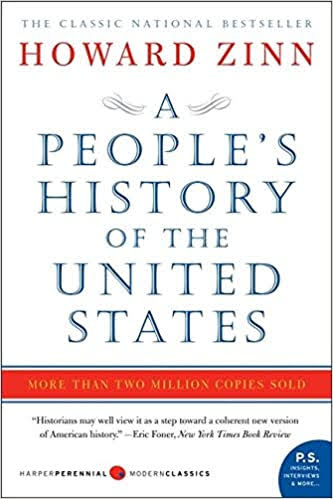
Classics Corner: A People’s History of the United States: 1492-Present by Howard Zinn (1980 5th ed. 2003); Definitive Account of American History
By Julie Sara Porter
Bookworm Revies
A People’s History of the United States could be considered the older sibling of Lies My Teacher Told Me. While James W. Loewen wants high school students, teachers, and text book authors to look at history differently, Howard Zinn wanted everyone to look at American History differently.
In this eye-opening thought-provoking and sometimes controversial treatment of history, Zinn told the story from the point of view of Native Americans, African-Americans, Latin-Americans, women, immigrants, lower class workers, and just about anyone and everyone who has ever been slighted by previous accounts of American history’s parade of dead rich white men.
Native Americans
Zinn used various primary and secondary sources to capture these various voices and he captured them well. When the Puritans declared war on the Pequot tribe bragging about their kill of 600 tribes members in the 1630's, one account reads that the Pequots learned three things: “That the Englishman’s most solemn pledge would be broken whenever obligation conflicted with advantage, that the English way of war had no limit of scruple or mercy; and that weapons of Indian making were almost useless against weapons of European manufacture. These lessons the Indians took to heart.”
Those lessons that the Native Americans took to heart lead to many centuries of displacement and near extinction of the Native tribes.
Many chapters report on mutual distrust between the Native Americans and their conquerors who originated from Europe.
The animosity continued after the United States was formed. When many Presidents sent representatives to the tribes describing them as “Children” to the President as “Father,” the tribes were less than responsive. When William Henry Harrison faced Tecumseh, his translator told the chief “Your father requests that you take a chair.” Tecumseh replied “My father! The sun is my father and the earth is my mother; I will repose upon her bosom.”
Another told President James Monroe after he argued for the tribe’s removal: “I’m sorry I cannot abide with the request of my father…We wish to remain here, where we have grown up as the herbs of the woods; and do not wish to be transplanted into another soil.”
Indian Removal was a way for the white population to regain more land that originally belonged to Natives. Zinn wrote "The cost of human life cannot be accurately measured, in suffering not even roughly measured. Most of the history books given to children pass quickly over it." In 1820,120,000 Indians lived east of the Mississippi. By 1840, fewer than 30,000 were left.
During the Revolutionary War, most of the important tribes fought on the side of the British. After the war ended the British went home, but the Indians were stuck with the new victorious white Americans. Many fought to protect their land that was threatening to be seized. Even Washington's Secretary of War, Henry Knox said "The Indians being the prior occupants, possess the right of the soil."
By the time Jefferson became President, there were 700,000 white settlers west of the mountains. Jefferson approved of policies that would allow for the future removal of the Creek and Cherokee.
When Jefferson made the Louisiana Purchase, he proposed that the Indians be encouraged to settle in smaller areas and to trade with whites, by paying off debts with tracts of land.
Indian Removal
Andrew Jackson has been known in history as an enemy towards Native Americans and with good reason. He became a hero in the War of 1812 which was mostly a war for expansion of a new nation, into Florida, Canada, and Indian territory.
Tecumseh tried to bring the Native tribes together to fight their white enemy: "The way….to check and stop this evil, is for all...to unite in claiming a common and equal right in the land as it was at first and should be yet; for it was never divided, but belongs to all for the use of each. That no part has a right to sell, even to each other, much less to stranger-those who want all and will not do with less."
Some of the Creeks were willing to work with the whites, even adopting their ways to foster friendship. Others called Red Sticks fought against them. In 1813, Red Sticks massacred 250 people while Jackson troops burned down a Creek village.
Jackson became a war hero when he fought the Battle of Horseshoe Bend against 1,000 Creeks killing 800 of them. He had the assistance of the Cherokees, who believed promises of governmental friendship, if they aided him. They swam the river and made a surprise attack on the Creeks, winning the war for Jackson. He dictated a treaty which took away half the Creek's lands. This treaty granted Indian individual ownership of the land and breaking up communal landholding. "(The treaty) introduced the competition and conniving that marked the spirit of Western capitalism," Zinn wrote. "It fitted well into the old Jeffersonian of how to handle the Indians, by bringing them into 'civilization.'"
Seminoles tried a different tactic. Escaped black slaves made their way to the villages. Some Seminoles captured and bought slaves, but their form of slavery was more akin to that in Africa. Slaves had their own villages, could obtain freedom after a number of years, children were considered free, and there were mixed marriages.
Jackson's attacks on Seminole villages led to the Seminole War of 1818.
The Indian Removal policies became central to Jackson's Administrative Policies. 70,000 Indian east of the Mississippi were forced westward. The Sac and Fox Indians were removed after the Black Hawk War. Chief Black Hawk ended his surrender speech by saying "The white man do not scalp the head, but they do worse-they poison the heart."
In 1829, gold was discovered in the land of Jackson's old war companions, The Cherokee. Thousands of whites invaded and destroyed property to stake their claim. They seized land and stock, beat Indians who protested, sold them alcohol to weaken resistance, and killed game which was used for food. Treaties broke up Creek, Choctaw, and Chickasaw tribes.
The Cherokee decided to adapt to the white man's world. Sequoyah created a written language for Cherokees to follow. The Legislative Council voted money for a printing press and they began to publish a newspaper, The Cherokee Phoenix. For the first time, a Native tribe had a formal council as compared to the loose leadership in the past.
Jackson's 1829 message to Congress made it clear that he was not interested in cooperation or assimilation. He wanted the Native Americans gone. He "advised them to migrate beyond the Mississippi or submit to the laws of the states." In 1831 after betrayal when fifty of their delegates were bribed with money and land, 13,000 Choctaws took the long journey west to a different land and climate. They got to the Mississippi River when the trek became disorganized. Food was scarce and many Native Americans succumbed to pneumonia and cholera. Choctaws died by the hundreds. The ones that survived settled in Mississippi where their descendants remained.
As for the Cherokees, assimilation proved unsuccessful. Land was confiscated and councils were forbidden from meeting. In 1830, the Cherokee nation tried to make a public plea for justice. They said that they were an independent people and had maintained friendships with the whites. They said that they only wished "to remain on the lands of (their) fathers." They tried to appeal to basic human nature telling their accusers that their ancestors were forcibly removed as well. "Let them remember in what way they were received by the savage of America, when power was in his hand and his ferocity could not be restrained by any human arm….Let them bring to rememberance all these facts, and they cannot and we are sure, they will not fail to remember, and sympathize with us in these our trials and sufferrings."
Jackson pointed out that the Choctaws and Chickasaws agreed to removal. White supporters were forbidden from staying in Cherokee territory without taking an oath to the state of Georgia. Various raids resulted in the arrest of missionaries and the white printer of the Cherokee Phoenix. Many were found guilty and some only found release after declaring the oath. The Cherokees fought with nonviolence. The Choctaw and Chickasaw agreed.
The Creeks had to be forced. The Creeks were invaded by whites. Some retreated into the swamps and forests. The Creeks were forced out in a haphazard way similar to what happened to the Choctaws. They were put in a concentration camp in Mobile Bay where hundreds died.
The Seminole War and Trail of Tears
The Seminoles decided to fight with violence. They were forced to move from Northern Florida to the swamps in Central Florida were food could not be grown and wild game could not survive. Protests against migration erupted between Seminoles and whites.
Chief Osceola led the resistance. When they ordered to assemble for migration on December 1835, no one came. Instead they organized guerilla attacks.
The war between the Seminoles and whites lasted eight years. The Seminoles overwhelmed by the size of their enemies tried to ask for a truce. In 1837, Osceola was seized and put in irons where he died in prison. The war just ended from exhaustion.
The Cherokees tried nonviolent resistance, but the U.S. government pitted tribes against each other. They put pressure on the community by suppressing the newspaper, dissolving their council, putting missionaries in jail, and parceling land through a lottery.
In 1834, 700 Cherokees moved west with 81 dying en route of cholera. Those who arrived to cross the Mississippi did so during a Cholera epidemic. Half of them succumbed.
The Cherokees were summoned to sign a removal treaty but less than 500 people of the 17,000 Cherokees arrived. The removal treaty was signed anyway. In 1838, Martin Van Buren ordered General Winfield Scott to use whatever military force to force the Cherokee off their land.
On October 1,1838, the Cherokee began the infamous Trail of Tears. As they walked, they began to die of sickness, drought, heat, exposure. Survivors recalled arriving in Mississippi in the middle of winter with the river filled with ice "hundreds of sick dying penned up in wagons or stretched upon the ground."
Mexican-American War
Conquest was how U.S. territory was expanded at the expense of the people who lived there. The Native Americans saw this and so did the people of Mexico in the 1840's when the U.S. tried to seize that territory as well. Mexico won it's independence from Spain in 1821 which included most of Texas, and what is now New Mexico, Utah, Nevada, Arizona, California, and part of Colorado. After aid from the U.S., Texas originally became the Lone Star republic in 1836 only to become a state in 1845.
James Polk had designs to expand the U.S. territory to California. His order to General Taylor to move troops to the Rio Grande was an intentional provocation towards Mexico. Taylor marched his troops, constructed a fort, implanted his canons prepared for battle. Mexican occupants had fled to Matamaros.
The Washington Union stated that the march to California could have been peaceful but instead "a corps of properly organized volunteers would invade, overrun, and occupy Mexico. They would enable (the soldiers) to not only to take California, but to keep it."
John O'Sullivan, editor of the Democratic Review wrote a famous phrase that would haunt the United States for centuries. "Our manifest destiny to overspread the continent allotted by Providence for the freely development of our yearly multiplying millions."
Polk had the war fever and troops. Now all he needed was an incident to provoke the public. He got one when General Taylor's quartermaster, Col. Cross disappeared and his body was found eleven days later with his skull smashed in. He was believed to have been killed by Mexican guerillas. The next day one of Taylor's patrol troops were attacked by the Mexican soldiers leaving sixteen dead and others wounded or captured. Polk found his incident.
While the Mexicans fired the first shot, many even soldiers knew that they responded the way the Americans expected. Col. Hitchcock wrote in his diary, "I have said from the first that the United States are the aggressors….We have not one particle of right to be here….It looks as if the government sent a small force on purpose to bring on a war so as to have a pretext for taking California."
Slavery- Pre-Civil War
Zinn also wrote of the treatment of black people and when they arrived in America. They already had a disadvantage being removed from their country and forced into slavery leading to centuries of racism, oppression, anger, and mistrust between blacks and whites.
“The Indians were on their own land,” Zinn wrote. “The whites were in their own European culture. The blacks had been torn from their land and culture, forced into a situation where the heritage of language, dress, custom, family relations was all but obliterated except for the remnants that blacks could hold onto by sher, extraordinary persistence.”
The Africans also used their sheer extraordinary persistence to challenge their enslavement even while still in the African countries where one trader reported that some of the captives leapt out of canoes, boats, and ships and drowned rather than submit to being caught.
While resistance was controlled and slavery remained from the 17th century to 1865, African-Americans rebelled by running away, organizing slowdowns, and fighting back. In 1742, seven slaves were put to death for murdering their masters.
While slavery had ended in the North after the Revolution, it continued in the South. Benjamin Banneker, a black man who was appointed by Thomas Jefferson to plan the new city of Washington appealed to the President to “embrace every opportunity to eradicate that train of absurd and false ideas and opinions which so generally prevails with respect to us.”
Zinn wrote of several slave rebellions preceding the Civil War such as Nat Turner's and John Brown's, and The Underground Railroad, as well as many abolitionists like Frederick Douglass and William Lloyd Garrison who wrote and spoke in favor of abolition. Abraham Lincoln himself had different feelings about the issue. Many quote his "If I could save the Union without freeing any slave I would do it" but ignore the entirety of the quote "I do because it helps to save this Union, and what I forebear, I forebear because I do not believe that it would help to save the Union…I have here stated my purpose according to my view of official duty, and I intend no modification of my oft-expressed personal wish that all men, everywhere could be free." While Lincoln's main goal was to keep the Union intact, he did not see how it could be possible if some of the population were in chains.
Civil War-Reconstruction
It would take until 1863 when Lincoln issued the Emancipation Proclamation for this to become a reality. The Emancipation Proclamation saw an increase in recruitment towards black soldiers. People like W.E.B. DuBois wrote glowingly of these soldiers who enlisted. Sojourner Truth took part in recruitment drives to increase enlistment of black soldiers. Harriet Tubman raided plantations leading black and white troops. In one expedition, they freed 750 slaves.
Many of the southern plantation owners resisted. They were under the false impression that their slaves were happy ignorant children and liked their lives on the plantation. One woman wrote "The people are all idle on the plantation, most of them seeking their own pleasure. Many servants have proven faithful, others false and rebellious against all authority and restraint…..Their condition is one of perfect anarchy and rebellion. They have placed themselves in perfect antagonism to their owners and to all government and control..Nearly all the house servants have left their home, and from most of the plantation they have gone in a body." In believing that black people were ignorant and the slaves liked their captivity, the white slave owners proved their own ignorance and racism by denying the humanity and desire to be free within their former slaves.
As with other wars, Zinn makes it clear that freeing slaves or preserving the union was not the main goal. "The American had set out to fight the slave states in 1861, not to end slavery, but to retain the enormous national territory and market and resources."
The black Union soldiers saw that first hand. Off duty soldiers were attacked. In 1863, when various immigrants organized riots in New York City to resist being drafted in place of rich men who didn't want to serve, many immigrants attacked black people off the street, blaming them for the war. They also weren't sure of their status after the war would change, whether they could own property or would serve in a semislave status under other people.
After the war, former slaves were determined to make their freedom count. They promoted racial equality. Black men were elected to state legislature and performed admirably. Public education was free and encouraged students of different races to study together. White and black people worked together to obtain the equality that was guaranteed by the 13th-15th Amendments in writing and put it to practice.
Unfortunately, many were against equal rights policies. Then President Andrew Johnson vetoed many laws that guaranteed rights and helped create "black codes" which caused many black people to live serf like existences. There were also many groups of white southerners who resented the gains African-Americans received leading to hate groups and eventually segregation.
Women Suffragists-Seneca Falls Convention
Zinn’s book takes a comprehensive look at other groups as well. Women were looked upon as inferior-only good for their biological role as childbearers. White women were often coddled by their parents and later husbands.
Black and Native women were often used for sexual gratification or to breed more slaves. Linda Brent (later known as Harriet Jacobs) said that “My master began to whisper foul words in my ear. Young as I was, I could not remain ignorant of their import.” Women were deprived of any possessions, even propery. The husband was entitled to her wages, and joint labor of the husband and wife belonged solely to the husband.
The status of women was pretty dismal as Catherine Beecher wrote of the difficulties that mill girls in Lowell, Masssachusetts had to live through working 12 to 16 hours in front of dangerous machines and Frances Trollope wrote of the ennui of the upperclass Philadelphia women.
However, some women led early feminist acts such as Elizabeth Blackwell, who attended medical school despite derision and became a doctor, Lucy Stone, who upon her marriage kept her maiden name, and Amelia Bloomer, who made famous the long pantaloons that would bear her name.
The crowning moment of the early Feminist movement was the 1848
Seneca Falls Women’s Convention in which Elizabeth Cady Stanton and Lucretia Mott rewrote the Declaration of Independence by saying “We hold these truths to be self-evident that all men and women are created equal.”
Among the most famous speeches of the “First Wave of Feminism” is from escaped slave Sojourner Truth who said that no one ever helped her into carriages, that she had ploughed, and planted, bore 13 children, worked as much as a man always asking “A’n I a woman?”
Labor Union Struggles
Zinn also wrote of the problems of workers many of which like the Lowell Mill Girls in 1847, shoemakers of 1844, and the Mechanics Association in 1860 went on strike to speak out against their ill treatment, dangerous conditions, and low wages. In what he refers to as “The Other Civil War,” Zinn told how the strikes continued through the early 1860’s by America’s poor who began to feel slighted and unheard.
The Fincher’s Trades’ Review wrote in November 21, 1863 a list of activities from various unions including “The City Railroad employees struck for higher wages, and made the whole population for a few days, ride on ‘Shank’s mare’” and “The lithographic printers are making efforts to secure better pay for their labor.”
In 1877, during a series of railroad strikes particularly in St. Louis and New York among other places resulted in several riots and over 100 people dead, 1,000 in jail but 100,000 workers had gone on strike and roused other workers. This resulted in concessions from the railroads, but strengthened their “Coal and Iron Police” against the strikers and led to Congressional railroad regulation and the advents of the Robber Barons and Tycoons. Zinn wrote that by 1877 people paid attention to the workers, "but the working people “learned they were not united enough, not powerful enough, to defeat the combination of private capital and government power.”
European Immigration
Much of the anti labor union rhetoric also culminated in anti-immigrant rhetoric as well.
By the late 19th century, immigrants that arrived consisted mostly of Italians, Russians, Jews, Greeks, and people from Eastern and Southern Europe. Immigrants who arrived earlier, such as Irish and Germans who had been assimilated into American society, were used to discriminate against the newcomers.
Irish Immigrants were treated horribly in the 1840's with signs that said "No Irish Need Apply" and discrimination policies. By the 1880's, they embraced the political machines particularly in Boston and New York's Tammany Hall and were used to discriminate against other immigrants. In 1902, a mass funeral for a rabbi was broken up by Irish immigrants who were enticed to start a riot.
Many immigrants vied for economic reasons. In California, Chinese immigrants who were recruited to work on the railroad numbered 75,000. They became the targets of frequent violence. In Rock Springs, Wyoming in 1885, 500 Chinese immigrants were attacked by whites with 28 murdered in cold blood.
Immigrants were often tricked into doing backbreaking labor for minimum wage. One Italian immigrant reported that he arrived to work in the railroads in Connecticut, but instead he was kidnapped to work in the sulfate mines in the South. They were captured at gun point and ordered to work or die. When they resisted, they were manacled and dismissed after five months. The Italian said that he had to walk to New York, utterly exhausted.
Human trafficking against immigrants was too common especially among children. Some desperate impoverished parents agreed. Sometimes the children were forced to labor under ruthless "padrones" and others as begger musicians. Female immigrants often worked as servants, prostitutes, housewives, and factory workers.
By the 1880's, there were 5 ½ million immigrants. This created a labor surplus that kept wages down. They were also often confused and felt helpless, stuck in a new country where they barely knew the language or the customs. The adults and children often worked long hours. In 1880 there were 1,118,000 children under sixteen at work in the United States.
Many immigrants rebelled such as Leonora Barry. She arrived from Ireland to New York and worked in a hosiery mill after her husband's death. She joined the Knights of Labor, which had 50,000 women members eventually becoming general investigator. She reported that her fellow female workers acquired "a sort of second nature, the habit of submission and acceptance without question of any term offered them, with the pessimistic view of life in which they see no hope."
Haymarket Attack
The struggles between management and unions culminated in the Haymarket Attack in Chicago. In 1886, 3,000 people assembled during a mass meeting. The meeting was without incident until a detachment of 180 police officers ordered them to disperse. A bomb exploded wounding 66 police officers, 7 of whom later died. The police then shot several people and wounded 200. With no evidence on who threw the bomb, the police arrested eight anarchists. None were even at Haymarket that day, but they were accused of inviting the murder. Four were hung, one committed suicide, and three remained in prison.
They Haymarket Tragedy became a rallying cry for union workers and anarchists against police brutality. It had long history. In 1968 when a group of young radicakd in Chicago blew up a monument that paid tribute to the police officers who died. The trial of the eight antiwar leaders dubbed the "Chicago Eight" recalled the Haymarket Eight that were tried and convicted.
World War I
The 20th century provides interesting accounts of anti-war movements, revolution from minorities, and protests against the rise in America's military power. While the people who protested the Vietnam War are well documented, not many Readers may know about those who protested the World Wars.
In the summer of 1917, Socialist Party members called America’s declaration of being involved in WWI “a crime against the people of the United States.” When Woodrow Wilson passed the Espionage Act, Charles Schenck was arrested for printing and distributing leaflets that denounced the draft and the war. Zinn writes that about 900 people were arrested under the Espionage Act, bu statistic was buried under the rug of “militawary bands, flag waving, the mass buying of war bonds, the majority’s acquiescence’s to the draft and the war.”
The Not-So-Roaring Twenties
After WWI, union activities increased and with good reason. With such tragedies as the Triangle Shirtwaist Factory Fire led people to realize that the workplaces were unsafe, and immigrants, lower class workers deserved better treatment. In 1919, a walkout of 100,000 people brought the city of Seatte, Washington to a halt. The mayor swore in 2,400 and several Marines and sailors were brought in by the federal government. The General Strike ended after five days. Even though the strike was peaceful, there were raids and arrests.
The steel mill workers in Pennsylvania also had a similar strike in 1919 in which 100,000 union members and 250,000 others went on strike.
The strikes made big business nervous and they used various methods to halt them. Sherman Services Inc. instructed their strike breakers to "stir up as much bad feeling as (they) can between Serbians and Italians. Spread data among the Serbs that the Italians are going back to work...Urge them to go back to work or the Italians will take their jobs." More than 30,000 black workers, excluded from the AFL Unions because of race, were put on as strikebreakers creating more racism and dissension.
By the 1920's the Ku Klux Klan was revived and spread to the North. (partly because of D.W. Griffith's film Birth of a Nation which portrayed the Klan as noble heroes. Woodrow Wilson even had a private screening at the White House.) By 1924, there were 4 ½ million members, many joined because of hatred over blacks as well as Socialists. The NAACP felt helpless against mob violence and racial hatred.
A nationalist movement led by Marcus Garvey spoke of black pride, racial separation, and a return to Africa. Unfortunately, it could not make headway against the powerful white supremacy that existed.
Rich Vs. Poor
While the Popular Culture image of the Roaring Twenties was true in some respect, Zinn's book revealed that it was mostly true for those on top, not so much those on the bottom. From 1922 to 1929 wages went 1.4 percent and stock holders gained 16.4 percent a year.
Six million families made less than $1,000 a year. Every year throughout the 1920's, about 25,000 were killed and 100,000 permanently disabled. Two million New Yorkers lived in tenement slums which were nothing more than firetraps. The well off people were notable enough that they pushed the poor into the background.
Writers tried to make notice of the suffering that the poor went through. Sinclair Lewis's Babbitt revealed the shallow attitudes that existed within the middle class in which many were interested in obtaining the latest gadgets.
F. Scott Fitzgerald, considered one of the spokespeople of the 1920's, revealed that there was a dark side to this era underneath the glitz and glamor. He saw unhappiness, drunkeness, and violence: "A class mate killed his wife and himself on Long Island, another tumbled 'accidentally' tumbled from a skyscraper in Philadelphia, another purposely from a skyscraper in New York. One was killed in a speakeasy in Chicago; another was beaten to in a speakeasy in New York and crawled home to the Princeton Club to die. Still another had his skull crushed by a maniac's axe in an insane asylum where he was confined." This from the man who gave us Jay Gatsby (which The Great Gatsby in and of itself is highly critical of the shallowness in the age of which it was written).
Once women finally got the right to vote, political views hadn't changed. Eleanor Flexner said "Women have shown the same tendency to divide along orthodox party lines as male voters."
Very few political figures spoke out for the poor. One was Fiorello LaGuardia, future mayor of New York City. He questioned the high price of meat. When he appealed to the Secretary of Agriculture, William Jardine, Jardine sent a pamphlet on how to save on meat.
La Guardia was not impressed:
"I asked for help and (Jardine) sent me a bulletin. The people of New York City cannot feed their children on Department bulletins..Your bulletins….are of no use to the tenement dwellers of this great city. The housewives of New York have been trained by hard experience on the economical use of meat. What we want is the help of your department on the meat profiteers who are keeping the hard working people of this city from obtaining proper nourishment."
The Stock Market Crash
The stock market crash of 1929 came from wild speculation which collapsed and brought the economy down with it. But behind that speculation was the fact that the economy was completely unsteady. John Galbraith, who wrote The Great Crash, said that the United States was filled with unhealthy corporate and banking structures, an unsound foreign trade, economic misinformation, and "bad distribution of income" was to blame. A Socialist critic went so far as to say the whole Capitalist system was by nature unsound, since it is driven by profit and therefore unpredictable and unstable by nature.
The irony was that not everybody reaped the benefits of the Roaring Twenties, but nearly everyone suffered from the Great Depression in one way or another. Immediately, after the crash over 5,000 banks closed and so did many businesses. Industrial production fell by 50 percent. By 1933, perhaps 15 million were out of work. Ford Motor Company was down from 128,000 workers to 37,000 by August, 1931. By the end of 1930, almost half of New England's 280,000 textile workers were unemployed.
Many in charge were ignorant of what was happening or how to resolve it. Herbert Hoover, then President said "We in America are in final triumph over poverty than ever before in the history of any land."
Henry Ford said in 1931 is the fault of workers: "The average man won't really do a day's work unless he is caught and can't get out of it. There is plenty of work to do if people would do it." A week later, he laid off 75,000 workers.
Basic goods could not be obtained since food could not be transported and clothes were too expensive to buy. People couldn't afford to rent or keep their homes and many were forced out into the streets or in makeshift Hoovervilles. The newspapers reported many personal stories of suffering such as that of Brooklyn native, Peter J. Cornell, an unemployed roofing contractor who died in his wife's arms.
The New York Times said "A doctor gave the cause of (Cornell's) death was heart disease and the police said it had partly been caused by the bitter disappointment of a long Day's fruitless attempt to prevent himself and his family being put out in the streets."
In 1932, Max Chichon refused to leave his home near Elkhorn, Wisconsin. His home was auctioned off but he refused to leave. He held off intruders with a shotgun. When Chichon refused to surrender, the sheriff ordered deputies to fire their machine guns. Chichon waa arrested and his wife and children were in the county hospital. A dispatch from Wisconsin to the Nation paper said, "Chichon is not a troublemaker….That a man of his standing and disposition should go to such lengths in defying the authorities is a clear warning that we expect further trouble in the agricultural districts unless the farmers are soon helped."
Riots and Marching Against the Great Depression
The spirit of rebellion, that John Steinbeck wrote about in The Grapes of Wrath, grew. 500 farmers marched into the business section of England, Arkansas demanding food. In Detroit, 500 unemplyed men rioted when they were turned out of a city lodging house. In Indiana Harbor, Indiana, 15,000 jobless men stormed the Fruit Growers Express Company demanding to receive jobs. In Chicago 500 schoolchildren in ragged and tattered clothes, marched to the Board of Education demanding to be fed. In Boston, 25 children raided a buffet lunch for Spanish War veterans only to be called away by two carloads of police officers.
Veterans of the First World War led a Bonus March demanding that Congress pay off those bonds immediately. The bill was passed in the House, but was defeated by the Senate. Many left, bit some stayed encamped by government buildings near the Capitol. Hoover orders the army to evict them. Four troops of cavalry, infantry, a machine gun squadron, and six tanks were assembled led by Douglas MacArthur and his aide, Dwight Eisenhower led. George S. Patton was one of the officers. They used tear gas on the veterans and set the buildings on fire. When it was over, two veterans were shot to death, an eight year old was left blind, two police had fractured skulls, and over one thousand veterans were injured by the tear gas.
Yip Harburg revealed the rage and despair with his haunting song, "Brother, Can You Spare A Dime?" (Which became the unofficial anthem of the Depression). Harburg said, "In the song the man is saying, 'I made anD investment in this country. Where the Hell are my dividends?' It's more than just a bit of pathos. It doesn't reduce him to a beggar. It makes him a dignified human, asking questions and a bit outraged too as he should be."
The New Deal
In 1933, President Franklin Delano Roosevelt (elected in a landslide against Hoover) began his reform legislation called The New Deal. In contrast to the Bonus March, when another veteran's march occurred. Roosevelt greeted them, offered coffee, allowed them to meet with his aides, before they went home.
The Roosevelt reforms were designed to meet two needs: reorganizing capitalism and stabilize the system, and head off the alarming growth of rebellion in the early years of the Roosevelt Administration. The first action, The National Recovery Act (NRA), created a series of codes agreed on by labor, management, and government, fixing prices and wages,,limiting competition. Big business dominated the NRA. Roosevelt tried to make more concessions to working people, but he was unprepared to withstand the pressure of industrial spokespeople to control the NRA codes. Roosevelt surrendered a share of the NRA power to the industries.
In 1935, Agricultural Adjustment Administration, tried to stabilize agriculture but favored larger farmers rather than smaller ones. The Tennessee Valley Authority was a government owned network of dams and hydroelectrics to control floods. It gave jobs to the unemployed and lowered electric rates. Some called many of the programs like TVA, Socialistic. However, Zinn wrote ",The New Deal's organization of the economy was aimed mainly at stabilizing the economy, and secondly at giving enough help to the lower classes to keep them from turning a rebellion into a real revolution."
Rebellion was very real. Molly Jackson, a woman who was active in labor struggles in the Appalachian Mountains, threatened to shoot a shopkeeper if he didn't allow her to take a 24 pound sack of flour to feed her children. He agreed and she fed only the flour to her children, since they didn't have anything else.
In many major cities people organized to protest evictions and unemployed councils were formed all over the country. Various people organized assistance with each other. In Seattle, a fisherman's union caught fish and exchanged with people who cut fruits and vegetables, and wood cutters. They had a commissary where food and firewood was exchanged for goods and services. In Pennsylvania, coal miners dug small mines and sold coal at below the commercial rate. By the end of 1932, there were 330 self-help organizations in 37 states with other 300,000 members.By early 1933, they collapsed because the economy was too broken to fix by individual deeds.
In 1934, a million and a half workers from different industries went on strike crying for reform by the New Deal to help workers, one of the biggest was that of 325,000 textile workers in the South. In rural South black and white sharecroppers began to organize. In early 1936, rubber factory workers in Akron, Ohio strikes by stopping work and sitting down. Sit ins became a means of protest, the longest took place at the Fisher Body Plant #1 in Flint, Michigan. The sit in began in December 1936 and lasted until February, 1937. The 2,000 strikers became a community. "It was like war," one said. "The guys with me became my buddies." The sit downs were dangerous to the system because they were not controlled by regular union leadership.
The Wagner Act of 1935 set up a National Labor Relations Board. It gave Unions legal status, and listened and settled grievances. The Board moderated labor rebellion by channeling energy into elections. Richard Cloward and Frances Piven, author of the Poor People's Movements, said "Factory workers had their greatest influence, and were able to exact their most substantial concessions from government during the Great Depression, in the years before they were organized into unions. Their power during the Depression was not rooted in organization, but in disruption."
World War II
The coming of World War II weakened labor militancy because the war created new jobs at higher wages. The New Deal decreased unemployment from 13 million to 9 million, while the war almost put everyone to work and called for excess patriotism including an end to labor strikes. The AFL and CIO pledged to call for no strikes.
Popular Culture during WWII focuses on the support for it. Many call it “The Good War” or considered it one of against the evil of Hitler and his Nazis. No American could have possibly been against it could they? Zinn writes “The atmosphere was too dense with war fervor to prevent them to be aired.”
Zinn suggests that many of the protesters had a lot to protest about particularly America’s early relationship with Germany and Italy. While the Americans would later be at war with Germany, their previous policies allowed the Germans to gain ground in the countries that the American government would later criticize them for.
In the ‘30’s, the U.S. had joined England and France in appeasing Hitler. Roosevelt and his Secretary of State, Cordell Hull was reluctant to openly cDriticize Hitler’s Anti-Semitic policies. The U.S. allowed American businesses to send oil to Italy in huge quantities which allowed SMussolini’s soldiers to continue to take the lead in their war. Even after America’s involvement in the war after Pearl Harbor, Roosevelt did not see freeing Jews as a high priority “He left it to the State Department and in the State Department, Anti-Semitism and a cold bureaucracy became obstacles in action,” Zinn said.
There were 43,000 refusers who did not show up after the draft and Zinn cites the anti-war literature such as Joseph Heller’s Catch-22, and James Jones’ From Here to Eternity, and Norman Mailer’s The Naked and the Dead which captured many people’s, especially former soldiers’ true feelings about the so-called “Good War.” One character even says “There isn’t a good officer in the world.”
Racial Discrimination during the War
Of course, America’s hands weren’t clean regarding segregation and racism. The Jim Crow Laws had been in effect for about 50 years prior, armed forces troops were segregated by race, so much that even black soldiers in the navy were placed in the depths of the ships near the engine room far from the fresh air on deck. The Red Cross had separated black and white blood, even though a black physician Charles Drew, developed the blood bank system. Blacks were still discriminated against for jobs. Many African-Americans were openly indifferent and hostile to fighting in the War. One said, “The war doesn’t mean a thing to me. If we win I lose, so what?”
Asian-Americans were also discriminated against during the war. Japanese-Americans on the West Coast were placed into internment camps. One Congressman said: “I’m for catching every Japanese in America, Alaska and Hawaii now and putting them in concentration camps…Damn them, let’s get rid of them!” Of course the bombings of Hiroshima and Nagasaki led to much debate, one military analyst Hanson Baldwin wrote that the Japanese army was already in a hopeless position before the bombs dropped: “Need we have done it? No one can of course be positive, but the answer is most certainly negative.”
Pre-Civil Rights Movement
Black rebellion was predicted by much of the art, music, and literature preceding it. Langston Hughes famous poem asked "what happens to a dream deferred?" and whether it exploded. Jazz and blues hinted at rebellion and anger. Paul Laurence Dunbar wrote "We wear the mask" hiding rage behind a smiling facade.
Many novelists like Richard Wright spoke how white society pitted black people against each other and educated them to remain silent.
Many black people like Wright joined the Communist Party, which paid attention to racial equality. While some accused the Party of exploiting the African-American struggle for their own benefit, many of the Black Communists earned admiration by organizing work against obstacles. Members including, Hoses Hudson and Angelo Herndon became organizers in their community.
Herndon organized a demonstration. In 1932, he was arrested. At his trial, he declared, " The state of Georgia displayed the literature that had been taken from my room. They questioned me in great detail. Did I believe that the bosses and government ought to pay insurance to unemployed workers? That Negros should have complete equality with white people? Did I believe in the demand for the self-determination of the Black Belt-that the Negro people should be allowed to rule the Black Belt territory, kicking out the white landlords and government officials? Did I feel that the working class could run the mills and mines and government? That it wasn't necessary to have bosses at all? I told them that I believe all of that and more." Herndon was sentenced to five years and represented a growing militancy against the white Establishment. Others like W.E.B DuBois, Paul Robeson, and Benjamin Davis did not hide their support for the Communist Party.
"Seperate, But Equal"
President Harry Truman concerned about the spread of Communism appointed a Committee on Civil Rights, which recommended the civil rights section of the Department of Justice be expanded. He was concerned about the economic over the moral reason-discrimination was costly to his country and wasteful of its talent.
The Committee encouraged various actions. Truman issued an executive order to desegregate the Armed Forces and initiate racial equality as quickly as possible.
In 1954, the Supreme Court struck down "seperate, but equal." Brown vs. Board of Education revealed that the separation of schoolchildren "generates a feeling of inferiority….that may affect their hearts and minds in a unlikely to be undone. In the field of public education, seperate but equal has no place." Unfortunately, even though they were told to integrate with great speed, even ten years later in 1965, schools were still largely separated in the South.
In the late '50's-mid '60's, black people rose in rebellion in the South and held insurrections in the North. Zinn wrote "It was all a deep surprise to those without a deep memory of slavery, that everyday presence of humiliation, registered in the poetry, the music the occasionak outbursts of anger, the more frequent sullen silences. Part of that memory was of words uttered, laws passed, decisions made, which turned out to be meaningless.
For such a people with such a memory, and such daily recapitulation of history, revolt was only minutes away, in a timing mechanism which no one had set, but which might go off with some unpredictable set of events. The events came at the end of 1955 in the capital city of Alabama-Montgomery."
Bus Boycott and Sit Ins
The bus boycott led by Rosa Park's refusal to move to the back was that event. Car pools were organized and many black people preferred to walk rather than ride. White supremacists retaliated. Bombs destroyed four churches. A shotgun blast was fired in Rev. Dr. Martin Luther King Jr.'s home and later his home was bombed. King began to make a name for himself as a leader in the busboycotting. In 1956, the Supreme Court declared segregation on bus lines as unconstitutional.
Zinn felt that the bus boycott was an emblematic of the subsequent Civil Rights protest. "It forecast the style and mood of the vast protest movement that would sweep the South in the next ten years: emotional church meetings, Christian hymns adapted to current battles, references to lost American ideals, the commitment to nonviolence, and the willingness to struggle and survive."
While King stressed nonviolence and built a sympathetic following among blacks and whites, he was not willing to back down. He led demonstrations and acts of civil disobedience. He encouraged love, but also action.
Many, especially black people, thought his approach was ineffective and even naive. Two years after the bus boycott, an ex marine and President of the local NAACP, Robert Williams encouraged black people to fight against violence, using guns if provoked. When Klansmen attacked the home of a NAACP member, Williams and others fired back. Surprised, the Klan left.
Four freshmen at a historically black college in Greensboro, North Carolina sat at a Woolworth's lunch counter, where only whites are. When they refused to leave, the counter closed for the day. The next day, they returned and others followed.
The Greensboro Sit In led to other sit ins. They spread to fifteen cities in five Southern states. A 17 year old, Ruby Doris Smith reported that she was one of 200 students were selected among others to lead a demonstration in Atlanta. Bob Moses, an African-American math teacher from New York saw the angry defiant looks of the protestors, where before he thought of them as on the defensive. "This time, they were taking the initiative," Moses said. "They were kids my age and I knew this had something to do with my life."
Freedom Rides
A Northern based group Congress for Racial Equality (CORE) led the Freedom Rides, a group of black and white people, traveled together on buses going South, to break segregation patterns. The president John F. Kennedy, but was cautious about civil rights, more concerned about the southern white leaders of the then Democratic Party.
Two buses heading for New Orleans never got there. In South Carolina, riders were beaten and attacked, and a bus was set fire. The southern police and federal government did nothing to stop the violence. FBI agents watched, but did nothing.
Another Freedom Ride organized by the integrated Student Nonviolent Coordinating Committee (SNCC) led to the Riders getting arrested in Birmingham, Alabama. Then, they were attacked in Montgomery. Undaunted, they resumed their trip to Jackson, Mississippi.
The Freedom Riders received international attention. Then Attorney General, Robert Kennedy agreed not to interfere with the Rider's arrests in return for Mississippi police protection. The Riders protested, sang, and demanded their rights.
Increased Violence and Rioting
Protests increased. In 1961, and in 1962, 22,000 black people organized mass demonstrations and were arrested. The SNCC took many to the county courthouse to vote. A black teenager, James Crawford, challenged a registrar. The registrar asked what if he were shot, Crawford replied "I got to die anyhow."
In Birmingham 1963, thousands of blacks marched into the streets faxing police clubs, tear gas, dogs, and fire hoses. The Department of Justice recorded 1412 demonstrations in three months in 1963.
In 1964, three civil rights workers, James Cheney,Andrew Goodman, and Michael Shwerner, were seized, beaten with chains, and shot to death.
Civil Rights laws were passed in 1957, 1960, and 1964 promising voting and employment equality, but were barely enforced. In 1965, Johnson passed a stronger voting law. Zinn wrote that the federal government wanted to channel the anger into cooling down into voting.
In Birmingham, 1963 (18 days after Martin Luther King's famous "I Have A Dream" speech), a bomb exploded in a church killing four girls. Malcolm X spoke out not only against the racially motivated violence, but what he perceived as the selling out of his people.
He cited the March on Washington as African-American people agteeding to become part of the system: " As they took it over, it lost its militancy. It ceased to be angry, it ceased to be hot, it ceased to be uncompromising. Why it even ceased to be a march. It became a picnic, a circus. Nothing, but a circus with clowns and all.
No, it was a sellout, a takeover. They controlled it so tight, they told these N$#@os what time to hit town, where to stop, what signs to carry, what song to sing, what speech thru could make, and what speech they couldn't make, and then told them to get out of town by sundown."
COINTELPRO, Black Capitalism, and Busing
When Civil Rights laws were at their peak in 1964 and '65, there was violence against black people in every part of the country. A bomb threat occurred in Cleveland set off by the killing of a white minister protesting discrimination. Riots were set off in New York City after the death of a fifteen year old.
In August 1965, the Watts neighborhood of Los Angeles was the scene of rioting. A black driver was arrested, a bystander was clubbed to death, and a woman suffered a seizure and was accused of spitting on a police officer. A fed up African-American populace rioted in the streets, looted, and fire bombed stores. National Guard was called in. 34 people were killed, most of them black, hundreds injured, and thousands were arrested.
The rage was felt as many African-Americans resorted to violence and rioting. King's nonviolent approach was set aside in favor of those by Malcolm X and Huey Long of the Black Panthers. Malcolm X said, "You'll get your freedom by letting your enemy know that you'll do anything to get your freedom; then you'll get it."
In 1968, stronger Civil Rights Laws were enacted to protect black people from violence, but it did not apply to police officers or federal employees (who were doing or allowing most of the violence). It also established caveats against people planning or organizing riots, which took the teeth out of some of the protests.
During the time, Malcolm X was assassinated in 1965 and the FBI investigated Martin Luther King for alleged ties to Communism. They tapped his phone conversation, sent fake letters and tapes to his wife claiming that he was having an affair, and in an anonymous letter suggested that he should commit suicide. He established a Poor People's Campaign and fought against systemic poverty.
In 1968, his death brought new urban uprisings in which 39 people were killed, 34 were black.
A Counterintelligence Program (COINTELPRO) was established and took action against 295 black groups. In 1969, a raid on a Black Panthers hideout killing two of their members. Subsequent documentation revealed that the FBI had an insider who gave them a sketch of where they lived and where Fred Hampton, the leader, slept.COINTELPRO was used to create disinformation and dissension within the groups.
The government tried to lure some groups with economic incentives such as encouraging "black capitalism." Many former militants were invited to the White House and one, James Farmer, was given a job in the Nixon Administration. The Rockefeller family tried to help encourage black-owned businesses. However, in the summer of 1977 unemployment among black youths was at 34.8 percent.
The busing of black and white children to integrated schools set off a wave of white neighborhood violence. Zinn wrote," The use of busing to integrate schools-sponsored by the government and the courts in response to the black movement-was an ingenious concession to protest. It had the effect of pushing poor whites and poor blacks into competition for the miserable inadequate schools which the system provided for all the poor."
Vietnam War
It is impossible to understate how much of a failure the Vietnam War was. Zinn wrote "From 1964 to 1972, the wealthiest and most powerful nation in the history of the world made a maximum military effort, with everything short of atomic bombs, to defeat a nationalist revolutionary movement in a tiny peasant country-and failed. When the United States fought in Vietnam, it was organized modern technology versus organized human beings and human beings won."
The irony was that Ho Chi Minh was inspired by his future enemies to declare independence from the French. He cited the Declaration of Rights of Man from the French Revolution and the American Declaration of Independence to challenge the French government, citing grievances against French rule.
Why did the U.S. attack the Vietnamese? The most popular reason was the domino theory-that if one country fell to Communism, others will follow. However a secret memo said "Communist control of all Southeast Asia would render the U.S. position in the Pacific, offshore island chain precarious and would seriously jeopardize fundamental U.S. security interests in the Far East….Southeast Asia, especially Malaya and Indonesia is the principal source of natural rubber and tin, and a producer of petroleum and other strategically important commodities." Representatives during the Eisenhower and Kennedy Administration parlayed with the Vietnamese leaders, while encouraging potential war for resources and to halt the spectral threat of Communism.
In early 1964, Lyndon B. Johnson used an attack at the Gulf of Tonkin as an excuse to declare war against the Vietnam War. It turned out officials lied to the American people to justify war. In 1965 over 200,000 soldiers were sent to South Vietnam. By 1968, that number increased to 500,00. As many as 500 Vietnamese were killed during the first air strikes. Villages were attacked, under "search and destroy" orders because they were believed to hide Viet Cong terrorists. A program called "Operation Phoenix" secretly without trial executed 20,000 civilians. In 1968, in the village of My Lai between 450-500 civilans including women, children, and old men were killed. Only one lieutenant, William Calley, was found guilty in the My Lai Massacre and he served only three years under house arrest, and later was paroled. Nearby Laos and Cambodia were also attacked or invaded by the early '70's.
Many Americans were drawn to the Anti-War Movement. Many Civil Rights workers already distrustful of the American government spoke out against being forced to fight. Martin Luther King Jr. Gave an impassioned speech defending "the suffering poor in Vietnam." Muhammad Ali gained negative publicity and renounced his championship titles when he refused to fight in "a white man's war."
Young men refused to serve, burning their draft cards in protest. By mid '65, 380 persecutions were made against men refusing to be inducted. By 1969 2,400 young men refused to show up for induction. Two people Norman Morrison and Alice Herz set themselves on fire.
By the late '60's, even so-called Establishment members spoke out against the War, such as Daniel Ellsberg. An economist did secret research for the government, Ellsberg became horrified by what the U.S. was doing in Vietnam. He and his friend Anthony Russo, duplicating a 7,000 page document about the history of the war. They released the document, called The Pentagon Papers, to the public.
Priests and nuns as well as former veterans became active against the war. Students largely organized by the Students for a Democratic Society spoke out. By 1969, 215,000 participated in the protests.
The unpopularity of the war at home was one of the direct causes for its end in 1975.
The 1970's
The 1970's were marked by protests from disenfranchised groups. Women began to lead the Second Wave of American Feminism by fighting for job equality and reproductive rights including the landmark Roe Vs. Wade case which allowed abortion to be legalized. Prisoners spoke out against the brutality in the penal system and erupted into violent riots, particularly in Attica in 1971. Native American groups like the American Indian Movement, organized demonstrations such as occupying Alcatraz Island and Wounded Knee, South Dakota. An arrest of homosexuals at Stonewall Inn resulted in a riot and a cry for LGBT rights. Zinn wrote about the various demonstrations, "Never in American history had more movements for change had been concentrated in so short a span of years. But the system in the course of two centuries has learned a good deal about the control of the people. In the mid-seventies, it went to work."
Many Americans had lost faith in the system and even establishment figures were beginning to questions. Radicals such as Angela Davis received light sentences or were acquitted by judges and juries. Watergate, the infamous break in in which five burglars broke into the Democratic office at the Watergate Hotel, created more dissatisfaction with the system. When it was revealed that they had ties to President Richard Nixon, he resigned rather than face impeachment.
President Gerald Ford declared "the long national nightmare is over" and then pardoned Nixon of all charges.
Unfortunately, some believed that the nightmare that allowed Nixon to flourish continued. Claude Julien, editor of La Monde Diplomatique said "The elimination of Mr. Richard Nixon leaves intact all the mechanisms and all the false values which permitted the Watergate scandal." Julien believed that many of the foreign policies that Nixon and his Secretary of State, Henry Kissinger, permitted such as supporting dictators like General Pinochet in Chile, General Geisel in Brazil, and General Stroesser in Paraguay. The House Committee solely focused on Nixon's actions during Watergate, not the bombing of Cambodia, deals with powerful corporations. The point was get rid Nixon but keep the system. It worked. Nixon's foreign policies and corporate connections remained.
Corporate influence on foreign policy was prevelant throughout history. International Telephone and Telegram gave money to both parties. In 1960, they made illegal contributions to Bobby Baker who worked with Democratic senators. In 1970, they promised to donate $1 million to the U.S. government to help overthrow the Allende government in Chile.
The next year, ITT planned to take over Hartford Fire Insurance Company. Even though, they were originally charged with violating anti-trust laws, the settlement was made out of court and ITT got its corporate takeover.
A Senate subcommittee investigating multinational corporations revealed a document in which oil company economists discussed holding back productions of oil to keep prices up.
In 1975, Congress issued and investigation into the CIA and FBI. They found various secret operations for gathering Inteligent. One of those was the infamous MKULTRA in which unsuspecting Americans were given LSD to test their effects. One scientist given a dosage, leapt to his death from a hotel window.
The CIA was also revealed to be involved in various assassination attempts against Fidel Castro including sending him an exploding cigar and purposely introducing swine fever virus to Cuban shores. They also revealed that they had worked to destabilize certain governments like that of Salvadore Allende in Chile with assistance from ITT.
The FBI was also under fire such as their involvement in disrupting and destroying radical and left wing groups. They sent forged letters, engaged in burglaries, opened mail illegally, and in the case of Fred Hampton, leader of the Black Panthers conspired to commit murder.
While the investigations revealed much, they still operated with the departments in question so much was denied and declared confidential.
As if that wasn't enough the economy tanked. Inflation and unemployment were on a rise. The number of Americans feeling alienated and disconnected climbed to 50 percent in 1973 from 29 percent in 1966. After Ford succeeded Nixon, the alienation statistic climbed to 55 percent.
Pessimism was especially prescient among those who earned less than $700 annually. The numbers of the poor had risen to 25.9 million people.
The Trilateral Commission formed by the United States, Western Europe, and Japan created a tighter control of capitalism and to grow international economies into a new multinational economy.
Carter and Iran
Jimmy Carter's election was an attempt to recapture a disillusioned citizenry. He was seen as populist-appeared to various members of American society. Carter talked about helping the poor and black people, but also kept in league with corporate powers and maintaining military control, allying the U.S. with right wing tyrannies abroad.
One of those tyrannies was Iran. The resentment of the U.S. backed Shah of Iran resulted in mass demonstrations. Inn 1978, hundreds of demonstrators were massacres by the Shah's troops. The Shah fled. In 1979, the U.S. embassy in Tehran was taken over by student militants, demanding the Shah face trial. 52 embassy employees were held hostage. Iranians and Iranian-Americans faced discrimination and were attacked. Iranian students who lacked proper visas were sent home. An Iranian-American girl was denied the opportunity to give a commencement address at her graduation.
When the 52 hostages were released physically unharmed, some compared it to American attacks of the past. Alan Richman, of the Boston Globe said "It wasn't like 15,000 innocent people permanently disappearing in Argentina..They (the American hostages) spoke our language. There were 3,000 people summarily shot in Guatemala last year who did not."
Reagan Economics and Foreign Policies
The victories of Ronald Reagan and George H.W. Bush transformed the liberal Carter years to a time of conservatism. They weakened Roe v.Wade, restored the death penalty, and said that poor people could be forced to pay for public education.
Corporate America thrived because of the Administrations. Environmental and OSHA regulations favored by the Nixon-Ford-Carter Administrations. Reagen however ignored or minimized those requirements. He appointed a businessman who was critical of OSHA as head of OSHA and let businesses decide for themselves. While Bush encouraged the Clean Air Act it was weakened by manufacturers release 245 tons of hazardous waste into the air two years later.
Poverty and unemployment grew during the Reagan years. In 1982, 30 million people were all employed all or part of the year. Over 16 million lost health insurance. New requirements eliminated free school lunches for more than one million poor children, who depended for their daily nutrition. A quarter of the nation's children were living in poverty. Welfare for the poor was cut leaving many living below the poverty line. Black families were four times as likely to be on welfare. Of course those who benefited from Reagan's policies were the superrich. By 1989, the before tax increase of the 1 percenters rose by 77 percent.
A woman wrote to her local newspaper that she was a college graduate, highly intelligent and was now, she and her children were on welfare that was in danger of being cut. She tried to look for work, sending her resume out but works part time at a library. "It appears we have employment offices that can't employ, governments that can't govern and an economic system that can't produce jobs for people to work...So this is the great American dream my parents came to this country for. Work hard, get a good education, follow the rules, and you will be rich. I don't want to be rich! I just want to be able to feed my children and live with some semblance of dignity."
Besides the great divide between rich and poor, the other legacy from the Reagan-Bush Administration was increased military power in other countries. In 1984, the CIA, admitted that it had exagerrated Society expenditures from the actual 2 percent and insisted it was 4 to 5 percent to inflate military expenditures.
One move the Star Wars program was set to create a shield in space to stop nuclear missles in mid-air. The first three tests failed. By the fifth time and failure, the Secretary of Defense suggested faking the results to show success.
Reagan approved of various secret missions to fight other countries: provided weapons to the Nicraguan contra and put mines in the harbors of Nicaragua to blow up ships. 200 Marines were killed in an unauthorized attack in Lebanon. In 1983, U.S. forces were deployed to Grenada to show that the United States "was a very powerful nation." The U.S. didn't mind supporting military junta's governing in Latin America like in Guatemala, Chile, and El Savador, that supported the U.S. But they cane down hard on ones that weren't like Moammar Khadafi in Libya.
Iran-Contra Affair
Reagan's foreign policy came back to bite in 1986 when a newspaper article revealed that weapons had been sold by the United States to Iran if Iran would release hostages held by extreme Moslems. During a press conference, Reagan told four lies: the shipments to Iran consisted only of a few antitank missiles, that the United States didn't condone shipments by third parties, that weapons had not been trades for hostages, and that the purpose of the mission was to promote dialogue with Iranian moderates.
Then a transport plane carrying weapons to the contra was downed and the American pilot who flew the plane was revealed to be a CIA agent.
The Iran-Contra Affair followed the policies "was to deny the truth, to investigate but not too much, and the press will publicize but not get to the heart of the matter," Zinn said.
In fact even though the Iran-Contra Affair was public with a televised hearing, no charges were filed. Reagan and Bush were never indicted, and we're kept out of questioning. Reagan retired and Bush became the next President. Col. Oliver North was found guilty for lying to Congress, but never sentenced (He is currently President of the National Rifle Association.)
Bush End of the Soviet Union
Bush became President just as the Soviet Union was coming to an end. East and West Germany united and the Berlin Wall came down. There were mass demonstrations in the countries that made the Soviet Union and Eastern Europe. The United States claimed victory, but the change began after the death of Stalin as open discussion were initiated. According to former Soviet Union ambassador, George Kennnan "the general effect of Cold War extremism was to delay rather than hasten the great change that overtook the Soviet Union by the end of the 1980's."
Without the spectre of Communism, the U.S. defenses were large, but unable to hold their grasp. Instead they concentrated on individual nationalism.
Revolutions in Latin America were threats to United Fruit, so they sought to remove Panama dictator, Manuel Noriega. In the past, he cooperated with the CIA such as offering Panama as a base and met with Oliver North to discuss sabotage. By 1987, Noriega's usefulness was over and his involvement in the drug trade was open. The U.S. invaded Panama in 1988, using the excuse that Noriega was a drug trafficker and they needed to protect their citizens. Noriega was quickly captured and hundreds, perhaps thousands of civilians were killed and 1,400 were homeless.
In 1990, Saddam Hussein had taken over it's oil rich neighbor, Kuwait. Bush doubled military forces to Iraq 500,000 forces. To control the oil rich resources for the Middle East as an incentive In 1991,when Saddam Hussein refused to pull his soldiers out of Iraq, the United States attacked in Operation Desert Storm. A report, that was highly questioned, was that babies were ripped from incubators in their mother's haste to escape. There is no veracity to this article, but it existed to make the Iraqis appear less than human. The operation ended after three months and Hussein was still alive. (Later implications during the War on Terror would haunt this decision.)
The 1980's and '90's produced protests against these policies. Many held demonstrations at nuclear power plants against nuclear weapons. Groups as diverse as women, priests, and doctors protested nuclear power. In 1982, the largest demonstration ever occurred in New York City with over a million people to protest against the arms race.
In 1991, many demonstrations occurred against the Gulf War and the new sophisticated weaponry like the smart bombs. Many wrote to Bush revealing their concerns and objections to the War.
One of the letters reveals the cyclical nature of history, one that demonstrates the theme of this book, that there will always be people in charge but always people to fight against them:
"Dear President Bush, Please send your assistance in freeing our small nation from occupation. This foreign force occupied our lands to steal out rich resources. They used biological warfare and deceit, killing thousands of elders, children, and women in the process. As they overwhelmed our land, they deposed our leaders and people of our own government, and in its place, they installed their own government systems that yet today control our daily lives in many ways. As in your own words, the occupation and overthrow of one small nation…is one too many.
Sincerely,
An American Indian"
Subsequent editions thoroughly cover the Clinton and George W. Bush Administrations.Unfortunately, Zinn died in 2010 so we didn't get to read his thoughts towards the Obama and Trump Administrations. Like before, he probably would have had a lot to say and not all of it good.
A People’s History of the United States is a grim book. It can be hard to read about all of these conquests and rebellions. However, it forces its Readers to look at American History in a new light. They see it not as a clear place where what we were once taught was always good and right. That history is a lot murkier than we thought. We can learn that history isn’t always made by the winners. We need to hear all voices to truly understand where we came from and where we are going.