Showing posts with label Royalty. Show all posts

Sunday, December 8, 2024

Innocents, Immortals, and Amoral Gods (The Emergent Designs Book 1) by Harry Dehrian; Wide Reaching Immersive Science Fiction Novel Excels in Character and World Building


Innocents, Immortals, and Amoral Gods (The Emergent Designs Book 1) by Harry Dehrian; Wide Reaching Immersive Science Fiction Novel Excels in Character and World Building 

By Julie Sara Porter 

Bookworm Reviews 

Spoilers: Among my favorite Science Fiction and Fantasy novels are the ones that don't involve Earth or characters from our world. I enjoy them because the authors have to work twice as hard to create them. They have to be aware of this new world, the names, the topography, the political landscape, the society, and the species and people that inhabit it. That imagination increases tenfold when writing Science Fiction, because often the author doesn't settle on creating one world, they have to create several as characters hop from planet to planet introducing Readers to these brave new worlds. That's where Innocents, Immortals, and Amoral Gods, the first book in Harry Dehrian’s Emergent Designs comes in.

Innocents, Immortals, and Amoral Gods is an epic Science Fiction novel that created a wide-ranging immersive world. 

Trouble is afoot in the Amestra Nuvo planetary system in the Styx Galaxy. The mutilated body of a member of the Elite has been found, possibly eaten by a leviathan. The opportunistic megalomaniacal Governor Jaas has designs on expanding his control beyond his planet of Mosaar. Meanwhile visions of an entity plague the various mortal inhabitants of the Amestra Nuvo System. It becomes clear that a great cycle is about to end and a new one is waiting to reset.

This is a Science Fiction novel that carries many plots and characters to draw the Reader into this world. The subplots are numerous as various characters are affected by the changes in their system. 

The Styx Galaxy is rich in character and detail. We are shown technology like Qu-ducts which allow faster than light travel. There are skinsuits, body suits that hold to the skin and appear as a full body. The technology is worked on by mekanoots, automatic mechanics. There is a lot of specfific terminology and even a glossary to describe these terms. 

The planets have unusual characteristics like one where the sun rises and sets in the same direction. Then there is a planet of mostly water which is inhabited by blood thirsty leviathans who would probably hang out with Cthulhu. 

By far the strangest beings are the Daune Reesh. They are the Most Elite of the Elites, wealthy, powerful and are often at the ear of politicians and royalty. They are able to manipulate and move situations into their favor. They are also immortal and are rumored to have certain powers. They bring overwhelming awe and hostile suspicion towards others because of their immense power but dubious motives.

Because of this vastness in setting and character, more than one character is given a point of view. The narrative is divided by six main characters. They are:

Vierdaat AKA X Dev-He is a cynical recently promoted Giest, law enforcement officer with questionable ethics but dogged perseverance. Dev’s assignment is to investigate a series of graphic murders which he hopes will lead him to a dangerous psychopathic criminal. 

Razia-She is an idealistic adventurous member of the Liberation Crusade, a military organization that protects various planets and species from captivity. As she becomes involved in violent struggles and corrupt politics, she finds her previously firmly held values threatened. 

Lord Baelin-He is an elite and trusted advisor to Queen Meiral. He is on a diplomatic mission between sympathetic worlds as well as looking after the Queen’s children. His endurance and confidence in his place in the universe end up in jeopardy as he challenges the motives of those around him.

Princess Disa Ecrit M’Rota-She is Queen Meirel’s bookish and studious daughter. The young princess is assigned to do a series of taxing physical and academic challenges that test her skills and abilities. She discovers an inner strength and wisdom she never previously knew.

Princess Nora Ecrit M’Rota-She is Disa’s arrogant feisty sister and Meirel's older daughter. She is aware of her future as queen. Like Disa, she too participates in the series of tests and has to learn some things about real leadership and personal responsibility.

Prince Vikaron Ecrit M'Rota-He is Queen Meirel's brilliant ambitious son and Nora and Disa's brother. He longs to prove himself as a future king to his mother. He investigates a mass genocide that puts him directly in the path of Governor Jaas and places targets on his and his family's backs.

The main characters provide a rich tapestry of the Amestra Nuvo System and Styx Galaxy with their interactions with the various settings and other characters.The Reader becomes invested in each character’s personal journey and their involvement within the larger picture around them.

Dev has a strange symbiotic relationship with his false-bod, a mechanical vehicle which he dubs the “little beast.” It grows from owner and machine to surrogate parent and child. He also has to weigh his own actions, interactions with others, and violent tendencies with his new role as an officer upholding laws as he hunts his prey.

Dev also develops a surprisingly touching bromance with Vikaron as their paths to investigation overlap. They compare notes about their goals and their places in the universe. Vikaron himself has been catapulted out of his comfort zone and has to rely on his wits, strength, and the assistance of others to survive this universe.

Nora and Disa spend a lot of time together and have to rely on one another's strengths and weaknesses. They encounter a fighting group, whose leader challenges their status and leadership and could be a potential love interest for one or both girls.

Meanwhile, Baelin acts as a father figure towards the royal youngsters becoming more personally involved in their lives than their mother. His affection for the children is present as he questions his allegiance to the Queen and the system that he represents.

By far one of the darkest chapters involves Razia and a situation that is all too common on Earth as it is in Styx Galaxy. She and her crew help a charismatic politician seek power that plays on their commitment towards justice and loyalty. Once he is elected, he gives a speech that conveys the exact opposite of what he previously claimed to represent. Razia’s stunned revelation that she and her team willingly allowed an authoritarian dictator through the front door is heart wrenching as it retains a lot of relevance these days in real life.

 On the surface this book seems to be a pure Space Opera with clearly drawn heroes and villains where good triumphs over evil. However, there is a dark undercurrent that hints that something Apocalyptic is on the horizon. There is the constant talk about cycles ending and beginning. It seems that all of these random violent corrupt events with natural disasters, military coups, and manipulative power groups might not be so random. It suggests that this cycle might be coming to an end in the most violent way possible and everyone is out for themselves to take all that they can with them.

There are also various statements that describe Styx Galaxy in negative terms. It's cold, lonely, and filled with a vast nothingness. This suggests a Nihilistic or Cosmic Pessimism where the characters are alone in the universe and have to rely solely on themselves and the trusted few that will ride the storms alongside them.

Another clue to the book's theme is in the title. The Innocents are clearly the main characters that are being maneuvered and placed into situations beyond their control. The Immortals has a double meaning. It refers to the literal immortals like the Daune Reesh who use their long life span to bend others to their will. It also refers to politicians and royals, Elites who want their names to be immortal. They can go down in history and they don't care who they step on to achieve it.

The last part of the title Amoral Gods is initially confusing. There are no shown deities in the book. None of the characters pray to them or speak about them and that's the point. The only being that they refer to in any reverence is The Styx Galaxy and as previously mentioned not in the most glowing terms. This suggests that they are alone in the universe. If there are deities or a higher power, they are at best apathetic to the concerns of mortals and at worst play with them for their own amusement. 

That the book ends in cliffhangers where the characters are in various forms of danger suggests that the cold universe isn't through playing with them. Things are about to get darker and a whole lot worse before they ever get better. If they ever do get better.




Friday, November 10, 2023

Weekly Reader: My Queen My Love: A Novel of Henrietta Maria (The Henrietta of France Trilogy Book One) by Elena Maria Vidal; Queenly Elegant Historical Fiction About The Rocky Marriage of Queen Henrietta Maria of France and King Charles I of England


Weekly Reader: My Queen My Love: A Novel of Henrietta Maria (The Henrietta of France Trilogy Book One) by Elena Maria Vidal; Queenly Elegant Historical Fiction About The Rocky Marriage of Queen Henrietta Maria of France and King Charles I of England

By Julie Sara Porter

Bookworm Reviews


Spoilers: If Royal couples don't have enough stress, being Royals in a time of great change can be the worst. Take for example King Charles I and Queen Henrietta Maria. Because of religious turmoil and many who challenged Charles's belief in the Divine Right of Kings, England was embroiled in a civil war which ended in the abdication and beheading of Charles and the creation of the Commonwealth of England led by Oliver Cromwell.

As with many conflicts, the English Civil War was one of a long string of conflicts that carried throughout history. In this case, much of it carried over from the religious schism of whether England would be Protestant or Catholic. The marriage between Charles and his French wife, Henrietta Maria only added to the conflict because many were suspicious of the ardently Catholic Queen.


Elena Maria Vidal's novel, My Queen My Love: A Novel of Henrietta Maria, the first book in the Henrietta of Trilogy tells of this tumultuous history through the perspective of Queen Henrietta Maria. This book covers her early years as a young princess being molded by her powerful mother, Marie de Medici on how to use her own power even if she has to marry into it. Her marriage to Charles is arranged but grows into a love match. Unfortunately one person is standing in Henrietta Maria's way, George Villiers, Duke of Buckingham, Charles's advisor and also the advisor and best friend (and possible lover) of Charles's father, King James I. Villiers is a conniving social climber and will be a sworn match against the strong willed Queen.


It becomes apparent that this book is a chess match between Henrietta Maria and the Duke of Buckingham. We don't even get to the English Civil War yet (Considering this series is supposed to be a trilogy, that is literally a Future Charles and Henrietta Maria problem).

These are two characters with differing religions, ideologies, and views but both have the love and ear of the King in common.


Henrietta Maria is strengthened by two very important assets: The legacy of her maternal family the Medicis and her Catholic religion. With her mother's name practically being a byword for power, influence, and playing the game of leadership, Henrietta Maria is well trained in the art of court intrigue. She had already been warned about Buckingham’s influence so she is on the lookout for corruption and deceit. Being a Medici, she is able to grant that influence for herself as well. When Buckingham tries to convince Charles to get rid of her French allies, Henrietta Maria is able to play the loving wife card and keep them. It helps that their marriage is a loving one  and Charles relies on his wife for support and advice. Her French courtiers are extremely loyal to her and are able to spy and report on the ever changing tide of English loyalty towards their new queen. 


Henrietta Maria's faith  becomes a bond of contention in her adopted country through no technical fault of her own. It's clear that even after a century has passed since Henry VIII’s reign, England still hasn't recovered from the religious split that occurred within the lifetimes of Henry, Mary, Elizabeth, and James. When faiths change based on the whims and loyalties of a country's leader, instability is bound to occur when some are desperate to cling to the Catholic Church, others to the Protestant, and others to the newer sects of Anglicanism and Puritanism. (It doesn't help that while the Anglican church was meant to be created as a compromise between the Catholic and Protestant churches, there were still plenty of questions regarding doctrine, practices, how much of each religion is permitted, and whether conversion is necessary.)


For the Catholic believers, Henrietta Maria presents them with a voice that they haven't had for some time and representation that had been lost. For the Protestants and other sects, Henrietta Maria is a dangerous interloper and a compelling reason that the Crown is out of touch and has lost its way. 

Henrietta Maria herself is devout and her religion eases her during a period of stress and adjustment. While being Queen, she seeks solace from her faith and its rituals and iconography. If it makes her an enemy in other’s eyes, then so be it. 


Meanwhile on the other side of this conflict is Buckingham. Once the confidant of Charles's father, James, Buckingham acts as a surrogate brother and best friend to the king by guiding him through insecurities and anxieties about his role. Unlike Henrietta Maria’s familial and religious connections, Buckingham is motivated by ambition and his own placement within the court. He is someone who isn't above throwing a former ally or Charles's wife under the carriage to get his way. He is an upwardly mobile schemer who will claw and connive to hold onto what power he has and to obtain more.


Buckingham shows a loyal and protective side towards Charles even engaging in masquerades and adventures with Charles while he was still a prince. It's clear that his love for James transformed into love for Charles and he sees himself as a guide to the young king whom he still thinks of as a kid. However, his influence in court has grown complacent between the two generations. What he had with James cannot be duplicated with his son and in some ways, he knows it too. That's why he's so desperate to hold onto what he has and sees Henrietta Maria as a threat. His security and placement with Charles's father is now taken by Charles's wife and he does not like that.Buckingham really underestimates who he is dealing with and unfortunately finds out too late.


My Queen My Love is a very regal look at palace intrigue and the love and loyalties of the monarchs and those around them. It begins with a chess match between two individuals and eventually escalates into a dangerous war for the entire country.

Wednesday, March 3, 2021

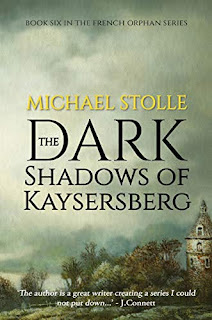
New Book Alert: The Dark Shadows of Kayserberg by Michael Stolle (Book Six of the French Orphans Series); Brilliant Adventure Romance Covers Scandal, Murder, and Conspiracy in 18th Century France


New Book Alert: The Dark Shadows of Kayserberg by Michael Stolle (Book Six of the French Orphans Series); Brilliant Adventure Romance Covers Scandal, Murder, and Conspiracy in 18th Century France

By Julie Sara Porter

Bookworm Reviews


Spoilers: Michael Stolle's The Dark Shadows of Kayserberg is the sixth novel in the French Orphan series in which Pierre, a young impoverished orphan ascends to the title of the Marquis de Beauvoir and makes an advantageous marriage and very powerful dangerous enemies set against the backdrop of 18th century France in the years of corrupt nobility before the Revolution. The books are tied together to Pierre's life and struggles, so it's hard to separate them. However, the sixth book, The Dark Shadows of Kayserberg changes tactics by presenting a different lead protagonist and making Pierre a supporting player.

 That is all for the better if you, like me, haven't read the other novels in the series. Recurring characters show up but do so in a way that explains their previous connections to the other novels or make you think that you met them for the first time. Plot points are summarized clearly as though these were characters who spent their lives having adventures that you might not have known the full story but would not feel lost if you didn't follow it in the first place.


Rather than Pierre, the main character is his best friend Armand St. Paul, son of the Marquis de St. Paul. The St. Paul Family has made a lot of powerful enemies, most particularly Cardinal Mazarin, a corrupt man of the cloth who studied under the Cardinal de Richelieu (The Three Musketeers'  best fiend). Mazarin may have been responsible for the death of Armand's oldest brother. Since his middle brother has become a priest, Armand is left to inherit not only the title, money, and estate, but the target on his back that Mazarin wants to fire upon. 

When another nobleman taunts Armand into having a duel and the hot headed and not quite bright Armand reciprocates, it's time for some damage control and life saving (not to mention a few clunks on Armand's head for being an idiot to walk into such an obvious trap and nearly either getting himself killed or wanted for murder). Pierre, Armand's father, and Pierre and Armand's friend, Francois arrange for Armand to go incognito to Kayserberg, where an old friend of Armand's father resides. Armand can hide out there while Mazarin's men chase a look-alike of Armand's elsewhere.

Unfortunately, Armand learns that corruption, scandal, and murder can be found anywhere. When he resides at the home of Guillaume, Count of Kayserberg, he finds himself falling in love with Elisabeth, Guillaume's ward and getting caught in a power struggle between the count, his scheming younger wife, Catherine, and his abusive brutal brother, Otto. Armand's stay in Kayserberg is not bound to be a long one.


The Dark Shadows of Kayserberg has all of the adventure of an Alexander Dumas novel with the scandal and gossip of Laclos' Dangerous Liaisons. It's hard to tell which is more numerous in the book: thrilling one on one fights and daring escapes from traps or bickering nobles playing musical beds and plotting to do away with each other. The characters are an adventure seeking roguish bunch who will either fight with you or bed you, some would do both within an hour.

The opening gives us an idea of the world that we are in and the type of characters that we meet. Armand is waking up in the boudoir of the beautiful and very married Countess Eloise de Verneuil. Neither Armand nor Eloise harbor any illusions about true love. For Armand, he gets to bed a beautiful woman and maintain his status as a rogue. Eloise gets to be in control as the elder party and gets pregnant since her impotent husband cannot provide a child. As for her husband, he just wants an heir. This open relationship is emphasized when after Armand is exiled, Eloise tells his parents and expresses concern the way one would about an old acquaintance that they barely know who's in trouble. Eloise wishes him well, but moves on. He did his part by giving her a child that will be raised by her and her husband. Armand's work is done.


This book is full of characters like that who have hidden agendas and are concealing whatever schemes that they are doing. Mazarin plays a loyal man of the Church and an upstanding individual but he is carrying on an affair with the queen and orders the assassinations of rivals as assuredly as a mob boss.

 Catherine acts like a loving wife to Guillaume and adopted mother to Elisabeth, content to be stuck in a small kingdom when in reality she tries to seduce her hot young houseguest, abuses her husband's ward, and plots Guillaume's death with his brother. 

Even characters like Armand and Elisabeth have dark agendas. Armand is a womanizer and has a violent temper against people that he doesn't like while Elisabeth, longing for freedom from her isolated castle, doesn't mind resorting to um explosive means to engineer hers and Armand's escape. 


This is a world where if this is the usual behavior of the average royal, noble, and church member then it's easy to see the French Revolution knocking on the door a few years later. Tellingly, we don't see many poorer characters except servants, mercenaries, innkeepers and others whose job it is to serve the nobility. The servants like Elizabeth's maid, Amelie and Armand's valet, Mathieu are very helpful to the plot and good characters in their own right. (Amelie and Mathieu even develop a romance the same time Armand and Elisabeth have theirs). But the actual suffering of the poor is far away from these characters, exploring the wide socioeconomic gulf that this time provided which allowed no real interaction between rich and poor. The wealthy nobles of the time resort to decadent distractions and devious plots to keep their hold on a way of life that is in the process of dying around them.


There are also plenty of daring suspenseful moments that hearken to the French adventure novels like The Scarlet Pimpernel or The Three Musketeers. From the beginning where Pierre, Francois, and Armand's father use subterfuge to hide Armand from Mazarin and his associates, the book is an exciting ride of suspense, disguises, duels, and characters who outfight and outthink each other. When Elisabeth and Armand leave Kayserberg through the mountains, Pierre helps them sneak away with assistance from hired mercenaries and helpful villagers while Mazarin gets his own spy into the works. Pierre, Francois, and Armand are a clever trio who tease each other with witty repartee but will use muscle and or brain to defend each other.

Elisabeth also proves to be a valuable asset to their team. When Armand is accused of a death in Kayserberg, Elizabeth sets fire to a wing, a fire which gets out of hand, to help him escape. She also manages to get out on her own when Catherine and Otto resort to kidnapping her. She instantly fits in with Armand, Pierre, and their friends when true to his teasing nature, Pierre says that anyone who sets fire to a building is perfect for Armand.


The Dark Shadows of Kayserberg is a brilliant novel that captures not only the adventurous romance of 18th century France but it's decadent scheming and conspiracies as well.