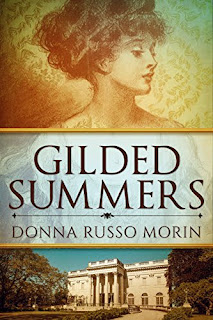
Weekly Reader: Gilded Summers (Newport's Gilded Age Book 1) by Donna Russo Morin; Moving Novel About Friendship Reveals Gilded Age Gender, Immigration, and Economic Conflicts
By Julie Sara Porter
Bookworm Reviews
Spoilers: There are many comparisons between now and The Gilded Age. Among them are the strong economic divides between rich and poor, the prejudice between Americans and immigrants, and the questions towards gender roles and how much progress women have actually made over the years.
Those struggles are remembered and paralleled into real modern life within the novel, Gilded Summers by Donna Russo Morinn, the first book in Morin's Newport's Gilded Age series. The series involves two women from different backgrounds who become best friends and have to deal with many of the issues of the day such as the division between the haves and have nots, the struggles that immigrants face when settling in the United States, and the fight for women's rights.
In 1895, 15 year old Pearl Worthington lives an upper class privileged life in Newport, Rhode Island. (Fun fact: Gilded Age Newport is also an important setting in the book Mistress Suffragette by Diana Forbes.). Pearl seems to have a life that most would envy: a large mansion, summers spent in the country, the current fashions. and her family's friends have famous last names like Astor, Oelrichs Fish, and Vanderbilt. She appears to have an enviable life but nothing can be further from the truth.
Pearl has a talent for drawing and illustration but cannot pursue it in any meaningful way except as an ornament for a potential marriage. She would love to study at the Rhode Island School of Design. Maybe pursue her art to a professional career like acquaintances from similar wealthy homes, Mary Cassatt and Edith Jones (later Wharton).
Pearl is weary of the small mindedness, malicious gossip, and verbal cruelty of the social set. She longs for the freedom granted to men like her brother, Clarence, in which they can step out of line and misbehave and no one would think anything of it (in fact many encourage that behavior in men) but a woman is marked for life.
Pearl is supported by her father, Orin, who is very busy but encouraging to her pursuits. However, Orin is dominated by his wife, Milicent. Milicent is emotionally abusive towards Pearl and expects her to fulfill her expected role to marry wealth, have rich children, and live the life of a society matron no questions asked and no arguments made.
Meanwhile, the Worthingtons take on new servants, widower Felice Costa, and his daughter, 15 year old Ginevra both who recently emigrated from Italy. Felice is hired to teach a very reluctant Clarence to play the violin. (Felice is a gifted violinist and luthier.) Ginevra is hired as a house maid to mostly sew clothes. Eventually, Ginevra moves up to becoming Pearl's lady's maid.
Like Pearl, Ginevra also feels limited by her role in society. Most of the Newport elite treat their servants like robots. They don't talk to them. They just expect them to serve their food, clean their houses, take care of their children, and so on in their own world only to come out of it to collect their payment. To the wealthy, people like Felice and Ginevra are nobodies and treated like nobodies. Ginevra watches Pearl and her friends and family, as well as the handsome men paraded in front of Pearl and feels like she lives in a separate existence from others. They are depersonalized and made to feel less than human.
That depersonalization exists among the servants as well. Many like Mrs. Briggs, the housekeeper, look down on the Costas for being new arrivals and on the lower levels of the service pecking order. Even kitchen maid, Greta, who is among the lowest in the servants' hierarchy, mocks Ginevra's accent and thinks of her as stupid.
The Costas are also judged as immigrants. Many German and Irish immigrants, especially ones who arrived years ago look down on the new Italian arrivals. People mock their accents and some want them to return to their own country.
Like Pearl, Ginevra dreams of a different life. Her talent for sewing leads to an interest in fashion. She begins to make Pearl's clothes creating embellishments and adding a personal style. She has dreams of being a fashion designer or opening a clothing boutique but like Pearl feels limited by her gender, economic status, and ethnicity.
Despite their differences, Pearl and Ginevra develop a genuine friendship that looks past their statuses and sees the real women inside. The friendship between Pearl and Ginevra is beautiful because it helps them get past their previous limitations. Together, they share their talents as Ginevra observes Pearl's sketchbook with awe and Pearl admires the beautiful gowns that Ginevra makes. They also talk about deeper issues like how they feel stifled by the people around them. Their friendship allows them to open up and see the world through different eyes.
Pearl and Ginevra are not only able to see their limited roles but those of the people around them. Pearl sees the "Swell Set" for what it really is and finds out what goes on inside the palatial Newport homes. She sees dissension and infidelity in marriages that are happy only in appearance. She and Ginevra see cheating spouses and the other half of the marriage that would rather look the other way than lose everything. They also see these same people look down and judge anyone else by the standards that even they can't live up to, such as when three society women including "The" Mrs. Astor, critique Milicent (the same set that she aspires to join). This is a few years before these women are also revealed to fall short of their own expectations and one files for divorce.
The two friends, particularly Ginevra, also experience first hand the sexism of the day when men feel like women are their property to do as they wish. This comes to a head when an intended fiance of Pearl's also wants Ginevra. He wouldn't mind marrying one and having the other as a mistress. His intentions eventually become violent but Pearl and Ginevra are there for each other in every way possible. Their friendship is strengthened by this incident and finally propel themselves to go after the freedom that they longed for.
Gilded Summers is a beautiful novel about how friendship can help see people beyond their race, ethnicity, sex, and income. Far from gilded, this book is pure gold.

