Showing posts with label Climate Change. Show all posts

Wednesday, August 4, 2021

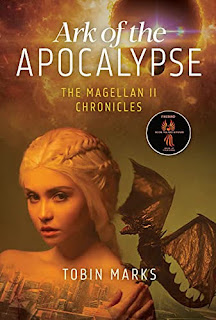
New Book Alert: Ark of the Apocalypse (The Magellan II Chronicles) by Tobin Marks; The Dark Somber Final Word on Earth's Destruction By Human Cruelty, Arrogance, Apathy, and Ignorance


New Book Alert: Ark of the Apocalypse (The Magellan II Chronicles) by Tobin Marks; The Dark Somber Final Word on Earth's Destruction By Human Cruelty, Arrogance, Apathy, and Ignorance

By Julie Sara Porter

Bookworm Reviews


Spoilers:There are science fiction books that are so dark that you fall into a black hole of personal depression. Then there are those that cause you to just throw up your hands and go "No hope! We're doomed!"

 If Court of The Grandchildren is a final warning for humanity to prevent climate change and to mind what we are doing before it's too late, then Ark of the Apocalypse The Magellan II Chronicles by Tobin Marks is the final message. It's the suicide note that Gaia will write as if saying "The Earth is dying because you weren't good to it. Now you are dying too."

Last year, I reviewed The Girl Who Found The Sun right when Missouri was in the process of shutting down because of the Covid pandemic. A Science Fiction novel in which the characters live in an underground world kept from the outside suddenly seemed more real when compared to a real life situation in which people were kept inside their homes because of the ravages of a pandemic and the arrogance of many people and a then Presidential Administration that chose not to follow simple common sense advice and allowed the virus to spread.

Once again a Science Fiction novel has become too real. With the Delta Strand variant of Covid creating another wave and many people around the world being unable to or choosing not to be vaccinated, with wildfires the size of New York City, Chicago, and Los Angeles spreading throughout the United States, and above all billionaires like Richard Branson and Jeff Bezos engaging in a "measuring contest" to see who can spend less than 15 minutes in space in a private spaceship instead of using that wealth to pay taxes or to help the people on this planet. The Magic 8 Ball prediction for Ark of the Apocalypse switches from "Maybe possible" to "Absolutely certain."

Once the future hits in 2035, it really hits and it's written in a way that is extremely believable. Temperatures in Mexico have reached 120 on normal days (the last time it hit under 115 was in 2027). Rising global sea levels have made most coastal cities flooded and uninhabitable and many once thriving water regions, like the Sea of Cortez, have become dead zones. Also hurricanes no longer operate through seasons and form supercells on a regular basis. Snow no longer appears on mountain ranges like the Rockies and the Alps.The rivers in India and China have dried up and the Great Lakes are becoming smaller because the waters dumped into them have dried up.

Earth is no longer able to produce enough food to maintain its increasing population. With the scarcity of water, only 20% of the Earth's population of 12 billion can be adequately fed.

 Countries, most notably Russia and the United States, are going to war over diminished resources. The U.S. President Abigail Moore is particularly eager to fire off her country's space orbital weapons system The Theater High Orbital Rover or THOR. (Typical USA in financial, environmental, and sociopolitical ruin but of course the government has the money to install and use a high tech brand new weapon for defense. I told you this book was spookily accurate.) 

The war ends in less than four minutes but one of the Iranian missiles explodes over Russia causing more tension between nations. Of course nuclear blasts unleash disease, famine, and a depressed and angry populace (at least the ones that survive.) Moore and Russian President Yuri Volkov exchange accusations and blame until they come to an uneasy agreement.

This is the kind of world where at the International Convention on Climate Control, climatologist Dr. Randall Burt's speeches could be summarized as "We tried to warn you. Everyone is guilty including myself. So long, Suckers!" Before he goes home to attempt suicide. His only suggestion is to eliminate 90% of the population or watch as we all drop dead. The only chance for humanity's survival is for a small group to travel into the stars and live on another planet. 

Two families are important to this mission. Their plan was centuries in the making. In the 1930's The Yanbeyevs, a Tatar family is ordered to be deported to Siberia. However, they have a secret up their sleeves which will help them get through the future struggles: A strange gift of prophecy shared by the seventh child of the family. This prophetic gift is passed through Anatoly's descendant Olga and her granddaughter, Nadya. Olga is determined that Nadya is to be one of the people on that space mission and she isn't above doing secretive underhanded things to ensure that future comes to pass and Nadya is able to survive to fill that destiny.

Another important family is that of Hikaru Mizushima's from Japan. After the bombing of Nagasaki, they have been holding onto a secret project contained within a metal box, a secret which will enable humanity to travel to the stars. Hikaru is able to use his ancestor's research to create spacecraft without rocket propulsion. 

This possibility of interstellar travel saving humankind is on the surface optimistic but that optimism is tempered by many realities.

 1) That only a select few people get to go so the majority of the population is left on Earth to die. In fact the cold attitude of many of the characters like The Yanbeyevs, Mizushimas, Moore, and Volkov is that "Everyone else can go f#$@ t&$#@(+-@_s," which is not the best way to make the Reader want to actually like these people and root for their mission to succeed.

2) Since the majority of the book is set on Earth, the focus isn't on space exploration or what this new planet is like. We do have some chapters where the characters encounter dragon-like beings and Nadya's dreams in the hyperspace sleep travel prove useful to the survival of the expatriate Earthlings. However, most of the book deals with the slow death march that Earth is on. 

We are given pages and pages of war and environmental catastrophe which is slowly strangling the remaining population. While you can't blame characters like Burt for reminding people that this could have been avoided, the callous tunnel vision that many characters have for the interstellar mission is is like ripping open a bandaid on a gaping wound. The wound is still there.

Especially since they are also willing to leave their families behind including small children. Unless they are planning subsequent space missions, they leave knowing that they are essentially consigning loved ones to their deaths by allowing them to remain on Earth. Also the chapters where they are on that planet suggest that they haven't lost their warlike nature or the desire of control and domination.

3) Of course the realism in how Marks writes this future cannot be avoided nor can the comparisons to the world that surrounds this fictional universe. It gets to the point that it's no surprise that the final two leaders of Russia and the United States: Viktor Petrov (replacing Volkov who was assassinated after 66 years as Russian President) and Crissy Caryn (an attractive former media celebrity) still engage in threats of war even as the world is dying around them suggesting that with some people power, any power, is more important than protection and survival. Nor is it any surprise that when Burt delivers the bad news, the people blame him for it instead of accepting their own share of the guilt.

This scenario is all too real and in real life may only be a few short years away (if not already here). The impending destruction and the callousness of the people living within it is something that we all have experienced and may continue to experience.

Ark of the Apocalypse The Magellan II Chronicles is one of those types of Science Fiction novels where even the hopeful moments convey a sense of despair because of what is left behind. It's a nightmare that is all too true and while we can close this book and forget about its contents, we can't close the real world around it. The only thing that we can do is turn things around, before this nightmare fictional scenario becomes the complete inescapable truth.


Tuesday, May 25, 2021

New Book Alert: Court of the Grandchildren by Michael Muntisiov and Greg Finlayson; Somber Warning About The Future World The Next Generations Will Inherit


New Book Alert: Court of the Grandchildren by Michael Muntisiov and Greg Finlayson; Somber Warning About The Future World The Next Generations Will Inherit

By Julie Sara Porter

Bookworm Reviews


Spoilers: While reading Michael Muntisiov and Gregory Finlayson's Science Fiction novel, Court of the Grandchildren, I was reminded of the proverb, originally attributed to environmental activist, Wendell Berry, "We do not inherit the Earth from our ancestors, we only borrow it for our children." I am also reminded of Greta Thunberg, the young climate activist and Nobel Peace Prize Nominee, addressing the world leaders at the UN Climate Action Summit with the passion of her youth but the wisdom of someone twice her age with: "How dare you? You have stolen my dreams and my childhood with your empty words! And yet I am one of the lucky ones! People are suffering! People are dying! Entire ecosystems are collapsing! We are in the beginning of a mass extinction, and all you can talk about is money and fairy tales of eternal economic growth! How dare you?"

As older generations, we have to take into account the world that we have destroyed either on purpose for corporate gain or accidentally through apathy and inaction, the world that future generations will inherit. According to NASA's Global Climate Change Website, the global temperature has increased by 2.12 degrees with most of the increase occurring in the last 40 years. This causes rising sea levels, decreased snow cover and shorter winters, shrinking ice sheets and glacial retreat, declining Arctic seas, ocean acidification, and extreme weather patterns like hurricanes, tornados, floods, drought, blizzards, and famine. This is the world future generations will be given and may worsen.


This is also the world envisioned by Muntisiov and Finlayson in their novel. It is only set in a few short decades in 2059. This is a world where a massive flood caused by increased sea levels and inadequate protection occurred. The results were that many of the coastal states were destroyed or declared uninhabitable.

 New states are formed in the absence of old ones. Because people haven't learned anything about welcoming asylum seekers, the constitution limits entry of out of state residents into one of the states, Concord. Of course, these former residents are taunted and threatened by locals that complain about sharing resources and employment with out of staters. 

The environment is on the precipice of destruction and extinction of the human race is happening. To make up for the lack of human workers, artificial intelligence is on the rise. Some anti technology zealots have joined a group called Humans First. Younger generations have turned violent against the elders because of the state of the world that they have been left with by calling them "burners" and attacking them. (Forget, "Okay boomer." The term "burner" carries much deadlier connotations.) Death and loss are so common that the Euthenasia Law is enacted so people can acquire the right to commit suicide.

In this world, 96 year old David Moreland is at a loss. He is ordered to appear before the Climate Court because he is charged for being one of the people who caused the massive floods that destroyed the bicoastal states. He is guilty about the devastation but has also appealed to the court and reunited with his great niece, Lily for one reason: he wants to acquire the right to die.


This book is extremely dour and dark with a bleak future projected. However, there is a sense of detachment and world weariness within the writing. It alternates between David and Lily's points of view with transcripts from David's trial and memoranda provided by the Climate Court, police, and Presidential candidates. The overall effect is that the Reader is experiencing David's trial as though it were a real event. 

We are only getting parts of the information without providing an emotional investment. This is one of those books where the authors don't have to resort to melodrama or cheap gimmicks to appeal to emotion. The situation is sad enough to imagine the destruction of various beaches, coastlines, and once vastly populated cities, and the deaths of millions of people. It doesn't need theatrics, it just needs to report the events.


David and his great niece Lily reflect the generation gap that is inflicted in this book. David is grouchy, witty, and argumentative. He fights not only with Lilly but Sarah, his AI housekeeper, and everyone else unfortunate enough to be caught near him. However, he is a man who is using his snark and foul temper to hide the hurt that is inside. He knows that he is responsible for much of the blame and suffering that has  incurred including personal losses of his own. 

Lily on the other hand represents the younger generation, the one that has to live and work in the environment that her forebears created. She does not have the luxury of wanting to die so she has to push herself forward. Even though she just met David, she feels responsible for him since they both lost various family members. She realizes that granting permission for his death is a difficult request and has to weigh the consequences on allowing someone to die because by all intents and purposes, he is guilty for the deaths of many or letting him live because he is about the only family that he has.

One of the more heartbreaking moments occurs when David finally reveals what happened at the disaster that killed his family and was instrumental in the mass flooding. It becomes sadder when it is revealed that it was caused not by a slow natural progression from climate change but by human means, corporate greed, and human desire for cheap and easy rather than safe and energy efficient.  

We see this loss that has surrounded David and understand why he feels that he can't live with these ghosts any longer. 


Court of the Grandchildren is a dark book that makes us look at the consequences of our actions of the past and present. We can look at what we have caused and declare us, all of us, guilty. 


Thursday, June 27, 2019

New Book Alert: Wanted in Paradise By Kate Ashenden; Romance Has Charming Couple And Beautiful Island Setting


New Book Alert: Wanted in Paradise By Kate Ashenden; Romance Has Charming Couple And Beautiful Island Setting


By Julie Sara Porter

Bookworm Reviews

Spoilers: One thing that many Romance novels have are unforgettable locations. Settings that are beautiful and make the Readers want to pay them a visit at least in the pages of a book.

Kate Ashenden's novel Wanted in Paradise has one. This Romance novel is set mostly at the Maldives. Ashenden captures the beauty and splendor of these Indian Ocean islands and gives us a sweet charming couple to experience it.

Jasmine Hartwell, a publicist receives the plum job offer to help promote pop sensation, Romeo Moretti’s Power to Change concert. Besides a great business opportunity, there is another reason. Romeo and Jasmine were once in love. Jasmine had previously been in a relationship with Romeo's temperamental brother, Diego and when her relationship with Diego went south, Romeo provided more than a shoulder. Diego found out and Romeo and Jasmine separated. Jasmine, no sooner goes to the island than she and Romeo realize that they still have feelings for each other.

Wanted in Paradise has all the tropes found in Romance novels but Romeo and Jasmine are a good pair of protagonists and the Maldives setting is so beautiful that this Reader is willing to overlook the formulaic content and the occasional lapse in credibility to experience a whole that is greater than some parts.

The Maldives setting is what makes this book. Ashenden describes the scented flora and white sandy beaches with the blue waves so well that this Reader actually felt sand beneath her toes. There are many pages where Romeo and Jasmine walk hand in hand in the scenic beaches or that Jasmine and other characters partake in sailing, snorkeling, and other activities. Reading books like this always makes me wonder whether the location makes an upswing in real-life tourism or the setting itself benefited from the author's recent vacation. Either way, Maldives is a beautiful and unique setting for such a novel and is not one a lot of writers choose making it fresh in the Reader's eyes.

While Maldives could be a paradise on Earth, Ashenden’s writing shows awareness of the country's problems, many of which are the direct result of climate change. In the book, many of the beaches are losing their splendor and natives are being driven from their homes because of environmental disasters. Corrupt business executives destroy the waters and skies with industrialization and create a sprawl by building hotels where land used to be. Hence, the Power to Change concert which highlights the concerns towards the Maldives’s rapidly declining environment.

Besides the setting, Ashenden’s lead couple are well written. It would be tempting to make Romeo, a conceited womanizing shallow star who is a bad boy but redeemed by the love of a good girl. Ashenden thankfully does not do this. Despite the fame and screaming fawning female fans, Romeo is actually a nice guy who is genuinely concerned about climate change. Even though, the concert is televised he wants to make it as low key and green powered as possible.

Romeo also reveals his love and commitment towards family and those around him. He originally ends his earlier romance with Jasmine out of loyalty to his brother and when Diego disappears, he is worried about him and how it will affect his mother. Even when Jasmine gets involved with Romeo, they resist at first until they are completely sure whether they love each other.

When Jasmine is temporarily seduced by a wealthy sheik, Romeo is jealous but is also concerned about whether the man will hurt Jasmine and interfere with the concert because of his ties to the aforementioned corrupt businesses.
Jasmine is also a well developed character. She suffers from PTSD from surviving a typhoon that killed many including her cousin. While she is understandably still shaken and comforted by her well meaning parents, she wants to pursue her career in public relations and is as committed to bringing awareness to climate change as Romeo is.

Jasmine's time working under Romeo's direction is filled with all the experiences a recent employee has working in a new position. Many opportunistic employees resent her presence and she is nervous about pitching her ideas. However, she shows how good a publicist she is by offering suggestions to make the concert more personable so the people at home can relate to the Maldivian struggles.

Jasmine also shows some naivete and Romanticism. She is naturally swept up in this new exciting world and when she is offered gifts such as an expensive purse and tube dress from an admirer, she can't help but be impressed despite how untrustworthy the source turns out to be.

However, her passages with Romeo are very sweet as they bring out the best in each other. When Jasmine realizes she's wrong, she admits it and works to improve her situation.

There are some parts in Wanted in Paradise that are a bit contrived. Characters, long gone, suddenly make a reappearance. There is some manufactured suspense as the concert is sabotaged but the saboteur is easy to guess. This is the type of book that is easy to figure out but is earnest in its play on tropes.
With a well-written loving couple and a beautiful evocative setting, Wanted in Paradise makes for perfect summer reading by the pool or the beach.